
On this page
Start here
Quick answer
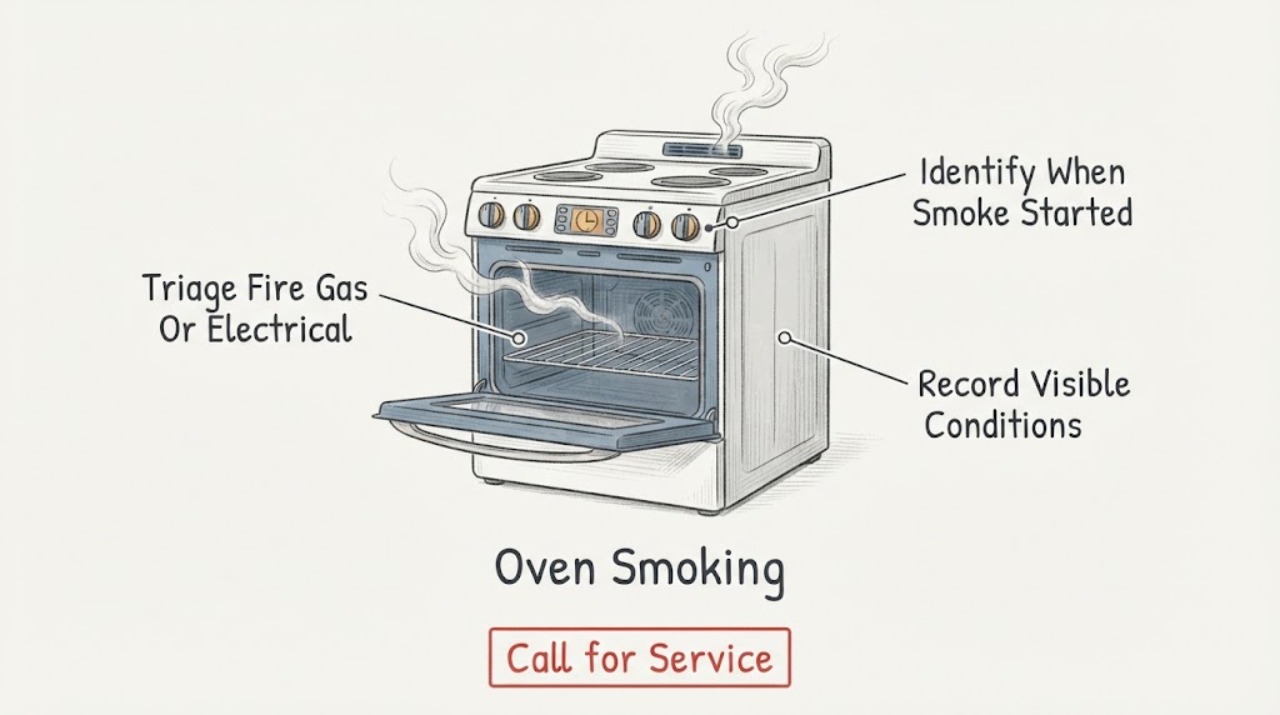
Treat Kenmore oven smoke as a symptom to classify, not as proof of a failed part. If there are flames, heavy smoke escaping the oven, sparks, smoke from the controls or wiring, or a gas smell, stop using the oven and follow the fire or gas emergency path; do not reopen or restart it. If the smoke occurred during a self-clean cycle or after a visible food spill, let the oven cool, record the exact model, and use the matching Kenmore manual before cleaning or running another cycle. Kenmore says to remove loose food residue before self-cleaning, ventilate the room, and wipe spills only after the oven cools. Persistent smoke, smoke without food or self-cleaning, or any electrical or gas warning needs qualified service rather than a guessed element, board or valve replacement.
Work through in order
Diagnostic checks
Use only checks that match the exact appliance or system and its official guide.
-
Check 1
Stop operating the Kenmore oven immediately if you see flames, heavy smoke escaping the cavity, sparks, smoke from the controls or wiring, or smell gas. For an oven fire, turn the oven off and keep the door closed; if flames escape, leave the home. For a suspected gas leak, leave without using switches, a match or a phone inside.
Expected result: The symptom includes an active flame, smoke escaping beyond the oven, electrical arcing/smoke, or a gas odor; or it is limited to light smoke inside during cooking or self-cleaning.
Next step: Use the emergency path for fire, escaping smoke or gas odor. Do not reopen, reset, relight or restart the oven until the hazard has been assessed. Continue only after the oven is off, cool and free of an emergency sign.
Why this matters
Why: The first group is an immediate fire, electrical or gas safety condition. Light smoke confined to a documented cleaning or residue situation is a different branch, but it is not a guarantee that the oven is safe to keep running.
-
Check 2
Write down whether smoke began during normal bake/broil, during self-clean, immediately after a spill, or with no food or cleaning cycle. Note where it appeared: inside the cavity, at the vent, around the door, or at the controls.
Expected result: Smoke has a clear connection to a spill or self-clean cycle, or it recurs during ordinary operation without a visible food source.
Next step: For a residue or self-clean pattern, wait for a complete cool-down and use the matching manual. For unexplained recurrence or smoke near controls, keep the oven off and arrange qualified service.
Why this matters
Why: Kenmore's cleaning guidance supports a residue/cleaning branch, while recurrent smoke without a visible source cannot be assigned to a particular element, sensor, board or gas part from the symptom alone.
-
Check 3
Read the model number from the oven or range label and enter it in Kenmore's official manual center before selecting a cleaning procedure or interpreting the smoke pattern.
Expected result: A matching manual is available and identifies the oven as gas or electric, with a self-clean or manual-clean procedure; or the model cannot be confirmed.
Next step: Follow only the matching manual's cleaning and safety instructions. If the model remains unknown, do not borrow a self-clean, burner, vent or reset procedure from another Kenmore family.
Why this matters
Why: Kenmore states that its manuals cover ovens and ranges and are retrieved by model number. Without the model, the page can give only conservative symptom and safety guidance, not a universal control sequence or part diagnosis.
-
Check 4
After the oven is fully cool and switched off, inspect only visible, accessible cavity surfaces for burned food, grease or a spill. Remove loose residue and wipe a cooled spill only with the method allowed by the exact Kenmore manual; do not touch heating elements, wiring or the door gasket.
Expected result: There is visible residue that matches the smoke location, or the cavity is clean and the smoke source is not visible.
Next step: If residue was found, complete the model-approved cool-down and cleaning path before any future use. If no residue is found or smoke returns, keep the oven off and use service rather than escalating to internal repair.
Why this matters
Why: Kenmore says loose food particles and spills can contribute to smoke and odors when heated. A clean cavity does not prove that an internal component is defective, but it removes the most obvious user-visible source.
-
Check 5
If smoke occurred during self-cleaning, do not assume every Kenmore model uses the same duration or control sequence. Once the oven is cool, remove loose food particles as Kenmore recommends, ventilate the room, and consult the exact Care & Use Guide before another cycle.
Expected result: The smoke was limited to self-cleaning and stopped after cool-down, or it was excessive, involved flame, or returned after residue was removed.
Next step: Use the model manual for any further cleaning decision. Do not run another cycle to test the oven if smoke was excessive, a flame occurred, or the source remains unexplained; arrange qualified service.
Why this matters
Why: Kenmore describes self-cleaning as a very high-heat process and says loose particles can increase smoke and odors; excessive smoke, fire or recurrence is outside a simple cleaning explanation.
-
Check 6
Keep the oven out of use and arrange qualified appliance service when smoke persists after visible residue is addressed, occurs during ordinary operation without a food source, comes from the controls or wiring, follows a gas odor, or is accompanied by sparks, repeated tripping or damaged parts.
Expected result: The smoke is unexplained or recurring, or any fire, gas or electrical warning remains after the appliance is off and cool.
Next step: Provide the model number, fuel type, smoke location, operating mode, visible residue, photos taken only when safe, and the emergency symptoms to the qualified service provider. Do not open panels, move a gas range, bypass a safety device or repeatedly test it.
Why this matters
Why: These findings need model-specific inspection and may involve hazards that cannot be identified safely from an external symptom; they do not justify choosing an element, board, igniter, valve or fuse from the smoke alone.
Use your observations
Decision map
Find the observation that best matches what you see, then follow the next safe action.
-
PATH 01Next step
What you see
Flames escape the oven, smoke is rapidly filling the room, or the oven is visibly burning.
Do this next
Turn the oven off if it can be done without approaching danger, keep the door closed, leave the home if flames escape, and call 911 from a safe location. Do not reopen or use the oven afterward until it is assessed.
Why this path and its safety boundary
Why it matters: This is an oven-fire emergency rather than a cleaning or part-identification problem.
-
PATH 02Next step
What you see
A gas odor is present, especially with a gas Kenmore range or oven, even if no flame is visible.
Do this next
Leave immediately and call the gas supplier or 911 from outside or a neighbor's location. Do not use a phone, light, match or electrical switch inside, and do not move the appliance to inspect its connector.
Why this path and its safety boundary
Why it matters: Treat the odor as a suspected gas leak; the cause cannot be safely distinguished by relighting or switching controls.
-
PATH 03Next step
What you see
Smoke appears only during self-cleaning or after a visible food spill, stops after the oven cools, and there are no flames, sparks or gas odor.
Do this next
Use the exact model manual, remove loose residue and ventilate as directed. If smoke is excessive or returns, stop and request service instead of repeating the cycle.
Why this path and its safety boundary
Why it matters: The observation is consistent with heated food soil or residue, which Kenmore says can create smoke and odor during high-heat cleaning; it does not prove the oven is defect-free.
-
PATH 04Next step
What you see
Smoke occurs during ordinary baking or broiling with no visible spill, or comes from the control area, wiring or outside the intended vent path.
Do this next
Switch the oven off, keep it out of use, and arrange qualified appliance service. Do not open the control area or run another cycle to reproduce the smoke.
Why this path and its safety boundary
Why it matters: The source is not supported by Kenmore's general cleaning guidance and cannot be assigned to a specific internal component from the symptom.
Helpful context
Understand the symptom
Smoke can have different meanings
A small amount of smoke during a self-clean cycle can come from food soil being heated, while smoke during ordinary baking or broiling may come from a spill or food residue. Those observations do not establish that a heating element, control board or gas component has failed. The first decision is whether this is an active fire, a gas warning, a visible residue problem, or a recurring unexplained symptom.
Use the exact Kenmore manual
Kenmore's manual center covers ovens, ranges and stovetops and asks for the appliance model number. Kenmore has different gas and electric product families, so use the manual for the model on the appliance before choosing a cleaning cycle, cleaner, rack position or control sequence. A manual for a similar-looking range is not a substitute.
Keep the service boundary conservative
Do not open the control area, touch wiring, adjust a burner, move a gas range to inspect its connector, or repeatedly run the oven to reproduce smoke. A persistent or unexplained smoke source needs qualified appliance service; a gas smell or escaping flame is an emergency response, not a troubleshooting experiment.
When checks do not resolve it
Need a professional?
Request qualified Kenmore appliance service for recurring or unexplained smoke, smoke near controls or wiring, smoke with sparks or repeated breaker trips, any gas-related symptom, or any oven fire. Give the provider the exact model, fuel type, operating mode and safe observations; do not select an element, igniter, valve, board or fuse from the smoke symptom alone.
Common questions
FAQ
Is smoke during a Kenmore self-clean cycle always a failed part?
No. Kenmore says self-cleaning uses very high heat and recommends removing loose food particles first because residue can create smoke and odor. Excessive smoke, flame, recurrence or smoke outside the expected path still requires stopping the cycle and using the exact manual or qualified service.
What should I do if the Kenmore oven smells like gas?
Leave immediately and call the gas supplier or 911 from a safe location. CPSC says not to use a phone, light, match or electrical switch inside and not to move the appliance to inspect its connector.
Can I keep baking if the smoke stops after a spill?
Wait until the oven is completely cool, identify the model, and follow the matching Kenmore cleaning instructions. If the smoke returns, has no visible food source, or comes from controls or wiring, keep the oven off and arrange service rather than testing it again.
Why is the Kenmore model number important?
Kenmore's manual center uses the model number to provide the applicable oven or range manual. Gas/electric design, cleaning features and control steps vary, so a similar-looking Kenmore manual should not be used as a substitute.
Read the exact guide
Official sources
- Strategies to Reduce Home Cooking FiresUnited States Fire Administration · Official USFA cooking-fire safety document; used only for the general oven-fire response boundary.
- Find Your Manual | Kenmore Appliance Manuals & GuidesKenmore / Transform SR Brands LLC · Official Kenmore manual center; used to require a model-matched guide before model-specific cleaning or control instructions.
- Certain Older Gas Connectors May Be DangerousU.S. Consumer Product Safety Commission · Official CPSC gas-appliance safety notice; used for the gas-smell emergency boundary and no-moving/no-DIY connector warning, not for Kenmore model diagnosis.
- Pictograph: Oven Fire SafetyUnited States Fire Administration · Official U.S. Fire Administration fire-safety guidance for an oven fire; it supplies emergency boundaries, not a Kenmore component diagnosis.
- Hot Oven Cleaning Tips and TricksKenmore Livemore · Official Kenmore brand cleaning guidance for general oven-care decisions; exact model Care & Use Guide controls when procedures differ.
Community feedback
Share a repair observation
Share a plain-text repair observation. Accepted observations are published automatically; this page may take a moment to update.