
On this page
Start here
Quick answer
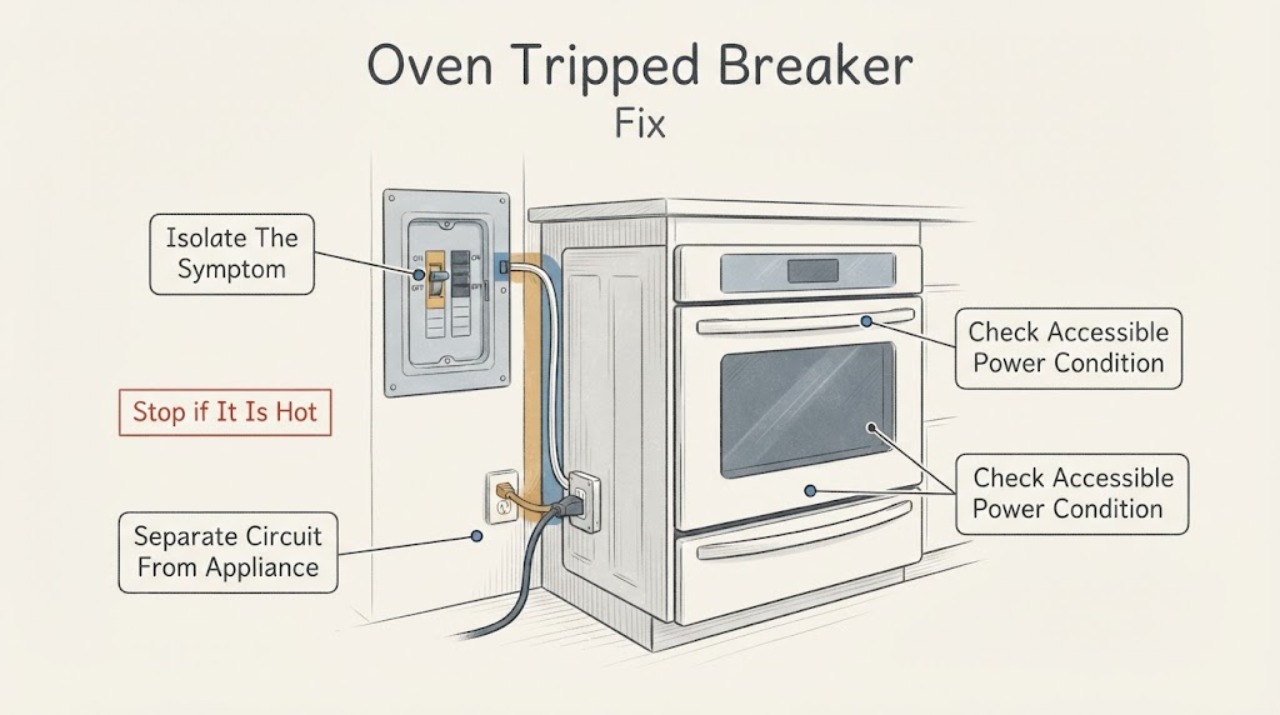
Treat a tripped breaker as a power and safety symptom, not proof of a failed oven part. If the breaker trips again when the Kenmore oven is used, stop using the oven and arrange qualified appliance service; the CPSC says an appliance that repeatedly trips a breaker should be unplugged and repaired or replaced. If the outlet, switch or branch circuit is the part that trips, or there is a hot outlet, smoke, burning odor, sparking, shock or damaged insulation, keep clear and use a qualified electrician or emergency response as appropriate. Do not use a higher-rated breaker, repeatedly reset the circuit, open the oven or order a control or heating part without the exact model and a diagnosis.
Work through in order
Diagnostic checks
Use only checks that match the exact appliance or system and its official guide.
-
Check 1
Stop using the oven and, from a safe position, record which breaker or protective device operated, whether the oven was heating or idle, and whether there is smoke, burning odor, heat, sparking, shock or visible damage.
Expected result: There are no hazard signs and the event was isolated, or a hazard sign is present or the device trips again.
Next step: For smoke, odor, heat, sparking, shock or damaged insulation, keep clear and use the appropriate emergency or qualified electrical response. Otherwise continue only with external identification and do not repeatedly operate the oven.
Why this matters
Why: A repeat trip or an electrical warning is not a normal control-setting issue and cannot identify a safe replacement part from the symptom alone.
-
Check 2
Without opening the oven or moving a hardwired appliance, note whether the same breaker trips only when this oven is used or also trips with the outlet, switch or other loads on the circuit.
Expected result: The trip follows the oven, or the outlet, switch or branch circuit trips independently of the oven.
Next step: Keep the oven off and arrange qualified appliance service for an oven-linked repeat trip; arrange a qualified electrician for an outlet, switch or circuit-linked trip.
Why this matters
Why: The first pattern points to an appliance-service boundary; the second points to a household wiring or circuit boundary. Neither pattern proves a particular internal part.
-
Check 3
Only when the area is dry and there are no hazard signs, look at the accessible plug, cord and receptacle for looseness, scorching, heat or damaged insulation; do not remove covers, probe wiring or reach behind a hardwired range.
Expected result: The accessible connection is cool and intact, or it is hot, loose, scorched, wet or damaged.
Next step: Do not use a damaged connection. Have a qualified electrician assess the receptacle or wiring; if the oven itself repeatedly trips a sound circuit, use appliance service instead.
Why this matters
Why: A damaged or overheated connection is a wiring and fire-safety concern, not evidence that the oven needs a particular control or heating part.
-
Check 4
Read the complete Kenmore model number from the rating label and enter it in Kenmore's official manual lookup, confirming that the returned document matches the oven or range and its control type.
Expected result: A matching manual is found, or the model is incomplete, unavailable or returns a different appliance.
Next step: Use only the matching manual's external instructions. If no match is available, give the model details to Kenmore support and do not improvise a reset or internal repair.
Why this matters
Why: Kenmore's lookup is model-number based; an unmatched manual cannot establish the correct breaker, reset, installation or user-check instructions.
-
Check 5
After documenting the model and circuit behavior, report whether the breaker trips immediately, during preheat or only after a period of heating, and provide that record to the correct qualified service route; do not keep resetting the breaker to collect more tests.
Expected result: The breaker remains stable with the oven isolated, or it trips again when the oven is used.
Next step: Keep the oven out of service and arrange qualified appliance repair for a repeat oven-linked trip. Use electrical service when the circuit or connection is the part that trips.
Why this matters
Why: A repeat oven-linked trip is a service condition even if the oven appears to work briefly; timing alone does not diagnose an element, sensor, board or wiring part.
Use your observations
Decision map
Find the observation that best matches what you see, then follow the next safe action.
-
PATH 01Next step
What you see
The breaker tripped once during a broader power event, there are no heat, odor, smoke, spark or damage signs, and it does not trip again with the oven isolated.
Do this next
Keep the model and event record, use the matching Kenmore manual for any permitted user check, and stop if the breaker operates again.
Why this path and its safety boundary
Why it matters: The available evidence does not identify an oven component or prove that the oven is safe to resume; the event may involve the circuit or installation context.
-
PATH 02Next step
What you see
The same breaker trips again when the Kenmore oven is operated.
Do this next
Keep the oven unplugged or isolated when safe and arrange qualified appliance service. Do not use a higher-rated breaker or open the oven.
Why this path and its safety boundary
Why it matters: This is a repeated appliance electrical symptom; it is not a basis for repeatedly resetting the breaker or naming a failed part.
-
PATH 03Next step
What you see
The outlet, switch or branch circuit trips independently of the oven, or the receptacle is hot, scorched, loose or damaged.
Do this next
Do not use that connection and arrange a qualified electrician. Do not increase the breaker rating or continue testing the oven on it.
Why this path and its safety boundary
Why it matters: The immediate concern is household wiring or the connection point rather than a confirmed oven part.
-
PATH 04Next step
What you see
Smoke, burning odor, sparking, shock, damaged insulation or unexpected heating is present.
Do this next
Leave the area if needed, avoid touching the appliance or damaged wiring, and use emergency or qualified electrical service as appropriate. Do not restore power for a test.
Why this path and its safety boundary
Why it matters: This is an immediate electrical or fire-safety boundary, and the no-model task cannot support a user repair.
-
PATH 05Next step
What you see
The model cannot be confirmed or the official manual does not match the appliance.
Do this next
Contact Kenmore support with the rating-label information or obtain the correct manual before attempting any model-specific control or power procedure.
Why this path and its safety boundary
Why it matters: The Kenmore oven identity is retained, but model-specific reset, circuit and installation instructions remain unresolved.
Helpful context
Understand the symptom
Stop and identify what actually tripped
Do not keep testing the oven while a breaker is open. From a safe position, note whether the device that operated is the oven's circuit breaker, a receptacle protection device, or a larger household breaker, and whether the oven was running, preheating or idle. A single power event and a repeat trip on every oven use are different situations. If there is smoke, a burning smell, a hot outlet or visible damage, leave the appliance off and do not touch damaged wiring or insulation.
Do not diagnose a Kenmore part from the breaker alone
A trip can involve the appliance, the circuit, the receptacle or the installation, and the symptom does not identify a heating element, control board, wiring fault or other part. The task does not include an exact model or electrical type, so do not order a part or open the oven to test it. A gas model also needs its own model-specific instructions; this page does not provide gas-valve or ignition work.
Use the exact Kenmore manual before any user reset
Record the complete model number from the rating label and use Kenmore's official manual lookup for the matching oven or range. Kenmore states that its manuals and resources are retrieved by model number. Follow only a manual-authorized user step that matches the appliance and symptom. If the manual cannot be matched, do not copy a reset or breaker procedure from a similar-looking Kenmore control panel.
Separate appliance service from electrical service
If the same Kenmore oven causes the breaker to trip again, keep it out of service and arrange qualified appliance repair. If the breaker trips with a particular outlet, switch or branch circuit, or the outlet is hot or damaged, use a qualified electrician. Do not install a larger breaker or bypass a protective device. Kenmore's support and repair resources can help route a model-specific appliance question, but they do not make a generic no-model symptom safe to repair internally.
When checks do not resolve it
Need a professional?
Arrange qualified Kenmore appliance service when the oven-linked breaker trip repeats, the oven heats without a normal command, the display or controls become abnormal after the power event, or the exact manual does not resolve the problem. Arrange a qualified electrician when an outlet, switch or branch circuit trips, is hot or shows damage. Do not choose an oven part from the breaker symptom alone.
Common questions
FAQ
Can I keep resetting the breaker if the Kenmore oven works afterward?
No. If the breaker trips again when the oven is used, stop using the oven and arrange qualified repair. A repeat trip is not proof of a single replaceable part, and repeated resets can leave an electrical fault energized.
Should I replace the breaker with a larger one?
No. The CPSC wiring guide warns against using a higher-rated breaker or fuse. Have the circuit and appliance assessed by the qualified professional appropriate to what is tripping.
What Kenmore information should I collect before requesting help?
Record the complete model number, which protective device operated, whether the oven was idle or heating, when the trip occurred, and any odor, heat, smoke, spark, shock or visible damage. Kenmore's official manual and support pages use model information to direct manuals and repair help.
Read the exact guide
Official sources
- Warranty Information | Kenmore AppliancesKenmore / Transform SR Brands LLC · Official Kenmore warranty information; supports using correct installation and authorized service, and does not diagnose a no-model breaker trip.
- Contact Us | Kenmore Customer SupportKenmore / Transform SR Brands LLC · Official Kenmore contact page; supports routing product questions and appliance repair after the model and symptom are documented.
- CPSC Guide to Home Wiring HazardsU.S. Consumer Product Safety Commission · Official CPSC wiring-safety guide; supports distinguishing appliance-linked from circuit-linked trips, not using higher-rated breakers and referring repeat faults to qualified service.
- CPSC and NESF Urge Consumers to "Plug Into Electrical Safety"U.S. Consumer Product Safety Commission · Official CPSC safety guidance; supports stopping use and seeking repair when an appliance repeatedly trips a breaker, and avoiding hot or damaged outlets and cords.
- Find Your Manual | Kenmore Appliance Manuals & GuidesKenmore / Transform SR Brands LLC · Official Kenmore manual portal; supports model-number matching and confirms that oven and range manuals are available, but does not establish a universal breaker or reset procedure.
- Customer Care & Support | Kenmore AppliancesKenmore / Transform SR Brands LLC · Official Kenmore customer-care page; supports product questions, manuals, safety information and repair or service routing.
Community feedback
Share a repair observation
Share a plain-text repair observation. Accepted observations are published automatically; this page may take a moment to update.