
On this page
Start here
Quick answer
First determine whether the compressor, a fan, or only the interior light is running, and record the exact model. Some of Kenmore's newest refrigerators use inverter compressors designed to run constantly and quietly, so continuous compressor sound is not by itself proof of a failure; the exact model manual decides whether that design applies. Measure the cabinet temperature with an appliance thermometer and compare it with Kenmore's guidance of 37–40°F for the refrigerator and 0°F for the freezer. With the appliance safely accessible, clean dirt from the door gasket and clean accessible condenser coils as the manual allows. If the refrigerator is above its target temperature, food is spoiling, unusual noise is present, or the problem continues after these checks, stop trying to diagnose sealed or electrical components and arrange service. Keep food at or below 40°F and discard food that has been held at unsafe temperatures according to food-safety guidance.
Before you begin
Safety first
- Owner checks stop at safe observation, thermometer reading, model-manual settings, gasket cleaning, and accessible coil cleaning as permitted by the exact manual. Internal electrical, compressor, fan, control, refrigerant, and sealed-system work requires qualified service.
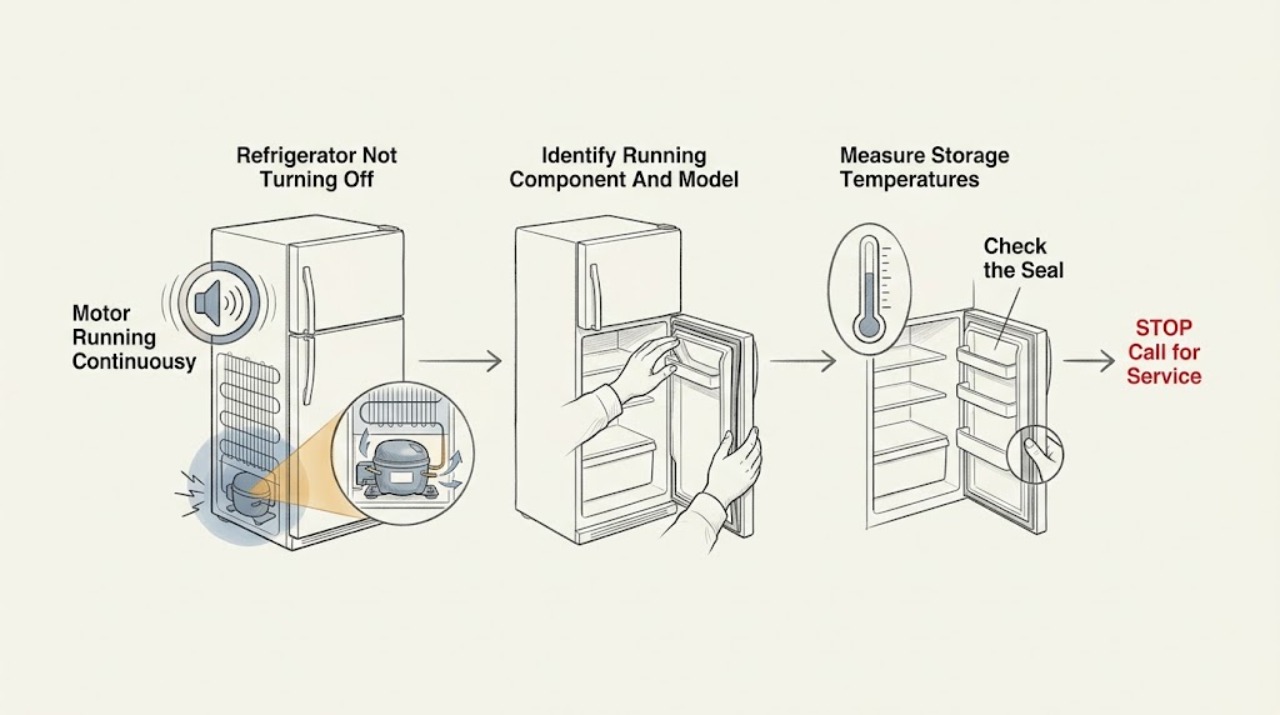
Work through in order
Diagnostic checks
Use only checks that match the exact appliance or system and its official guide.
-
Check 1
From a safe position, note whether the sound comes from the compressor area, an internal fan, or only the light; record whether the sound is steady, cycling, or unusually loud. Photograph or record the complete Kenmore model number and note the refrigerator form factor.
Expected result: The compressor seems continuously active, only a fan or light is active, the sound cycles normally, the sound is unusual, or the model and architecture are unknown.
Next step: Use the exact manual and the temperature check below; do not remove panels or enter service diagnostics to identify a component.
Stop if: Stop for smoke, burning odor, sparking, a hot or damaged cord, refrigerant or chemical odor, water near electrical parts, or a cabinet that is unsafe to access.
Why this matters
Why: The phrase not turning off does not identify the running component. Kenmore describes constant inverter-compressor operation only for its newest models, so the model is needed before treating continuous sound as abnormal.
-
Check 2
Place or read an appliance thermometer in the refrigerator and freezer compartments without blocking vents. Record the temperature after the appliance has had time to stabilize, and compare it with Kenmore's 37–40°F refrigerator and 0°F freezer guidance.
Expected result: The refrigerator is within 37–40°F, above 40°F, or fluctuates; the freezer is near 0°F, warmer than expected, or the temperature cannot be measured reliably.
Next step: If temperature is above target or food is warming, protect food and arrange service if it does not recover; do not select a compressor or thermostat part from the symptom alone.
Stop if: Stop using questionable food and follow food-safety guidance if the refrigerator has been above 40°F or food safety cannot be established.
Why this matters
Why: A continuous sound with stable target temperature may be an operating-pattern question, while continuous operation with warming food indicates an unresolved performance problem. FDA treats 40°F or below as the refrigerator safety limit.
-
Check 3
Inspect the visible rubber door gasket all the way around for dirt, folds, gaps, or a door that does not close evenly. Wipe the gasket with mild detergent and warm water as Kenmore recommends, then close the door normally; do not pry the gasket out or adjust hinges.
Expected result: The gasket is dirty, visibly damaged or gapped, the door closes evenly, or the door will not close without force.
Next step: After cleaning, recheck closure and temperature. If the gasket is torn, the door remains misaligned, or temperature stays high, provide the model and observation to service rather than ordering a generic seal.
Stop if: Stop if the door, hinge, cabinet, or seal requires disassembly or cannot close safely.
Why this matters
Why: Kenmore says dirt can make a gasket less effective and allow cold-air leaks. A clean, evenly closing gasket does not prove that an internal cooling component is good or bad.
-
Check 4
If the exact manual permits it and the refrigerator can be moved safely, disconnect power as directed, access only the documented condenser-coil area, and remove dust with a soft brush or vacuum. Restore the appliance only after all tools and panels specified by the manual are in place.
Expected result: Coils are visibly dusty, accessible coils are clean, coil location is unknown, the refrigerator is built in or unsafe to move, or temperature remains high after cleaning.
Next step: Allow the refrigerator to return to operating temperature and remeasure it. If the unit remains warm or continuously runs with warning signs, arrange model-specific service.
Stop if: Do not remove rear or electrical covers, touch wiring, access refrigerant tubing, or move a built-in appliance without qualified help.
Why this matters
Why: Kenmore recommends cleaning condenser coils at least a couple of times each year and directs owners to the manual for coil location. A clean coil does not identify a compressor, fan, control, or sealed-system fault.
-
Check 5
Use the complete model number in the official Kenmore manual or product documentation and check whether the refrigerator is one of the newer inverter-compressor models described by Kenmore. Compare the observed steady, quiet operation with that model's operating information; do not assume the newest-model description applies to every Kenmore refrigerator.
Expected result: The exact documentation identifies inverter operation, does not identify it, cannot be found, or the unit is not one of the newest models described in the guide.
Next step: If applicable documentation describes constant inverter operation and measured temperatures are safe, monitor for changes. Otherwise use the service branch for persistent operation or abnormal temperatures.
Stop if: Do not open the compressor compartment, change controls beyond the manual, or perform electrical or sealed-system tests.
Why this matters
Why: Kenmore's constant-operation statement is limited to the newest refrigerators in its buying guide. Without model-specific confirmation, continuous operation remains an unresolved symptom rather than a confirmed normal condition.
-
Check 6
After the safe identification, temperature, gasket, coil, and model-documentation checks, record whether the refrigerator remains continuously active, whether temperature is above target, whether food is spoiling, and whether odd noise, leak, odor, smoke, or electrical damage is present.
Expected result: Temperature is stable and the model supports constant operation; temperature is high; food is spoiling; unusual noise is present; or a safety hazard is present.
Next step: Arrange qualified Kenmore appliance service with the model, temperature readings, sound description, and checks already completed. Protect food and follow FDA temperature guidance while waiting.
Stop if: Stop use immediately for smoke, sparking, burning odor, damaged cord, water near electrical parts, or any other electrical, chemical, or physical hazard; do not open panels or sealed refrigeration components.
Why this matters
Why: Kenmore treats constant running with odd noise or faster spoilage as a warning to have the refrigerator checked. The observed symptom cannot safely distinguish compressor, fan, control, gasket, airflow, or sealed-system causes.
Use your observations
Decision map
Find the observation that best matches what you see, then follow the next safe action.
-
PATH 01Safety boundary
What you see
The exact model documentation confirms the newer inverter design described by Kenmore, the sound is quiet and steady, and measured temperatures remain within target.
Do this next
Monitor temperature, noise, and food condition and follow the exact manual; arrange service if any of those conditions change.
Why this path and its safety boundary
Why it matters: Constant compressor operation may be an intended operating pattern for that applicable model, rather than proof of a failed compressor.
Safety stop: Do not generalize this branch to an older or unidentified Kenmore model.
-
PATH 02Safety boundary
What you see
The gasket is dirty or not closing evenly, or accessible condenser coils are dusty, and cabinet temperature is not yet at target.
Do this next
Clean the documented accessible areas safely, allow the appliance to stabilize, and remeasure. Escalate if temperature remains high or the door cannot seal.
Why this path and its safety boundary
Why it matters: Kenmore identifies gasket effectiveness and coil cleanliness as maintenance factors that can increase cooling workload, but these observations do not prove a specific failed part.
Safety stop: Do not disassemble the door, remove electrical covers, or select a replacement gasket or coil-related part without model-specific confirmation.
-
PATH 03Safety boundary
What you see
The refrigerator runs continuously while the measured refrigerator temperature is above 40°F, food is warming, or food is spoiling faster than before.
Do this next
Protect or discard food according to FDA guidance and arrange qualified service with the model and temperature readings; do not diagnose sealed-system parts from the sound alone.
Why this path and its safety boundary
Why it matters: This is not a reassuring constant-operation pattern. Kenmore lists constant running and faster spoilage as warning signs, and FDA identifies 40°F or below as the refrigerator safety limit.
Safety stop: Do not continue storing perishable food in a refrigerator that cannot hold a safe temperature.
-
PATH 04Safety boundary
What you see
The model is not confirmed as a newer inverter design, or continuous operation persists after safe maintenance checks, especially with an unusual noise.
Do this next
Arrange model-specific appliance service and provide the exact model, sound description, temperature measurements, and maintenance observations.
Why this path and its safety boundary
Why it matters: The public Kenmore guidance does not identify whether the cause is a compressor, fan, control, gasket, airflow, or sealed refrigeration issue; internal diagnosis is required.
Safety stop: Do not remove panels, live-test electrical parts, open a refrigerant circuit, or order a compressor or control by symptom.
-
PATH 05Safety boundary
What you see
Smoke, sparking, burning odor, a hot or damaged cord, water near electrical parts, chemical odor, or other immediate physical hazard is present.
Do this next
If it can be done without touching a hazard, isolate power from a safe position and keep people away; arrange qualified appliance or electrical service.
Why this path and its safety boundary
Why it matters: The symptom is now a safety event rather than a troubleshooting decision. The refrigerator should not be operated while the hazard remains.
Safety stop: Do not restore power, open the cabinet, touch wet electrical areas, or continue temperature testing during a hazard.
Helpful context
Understand the symptom
Continuous sound is not the same as a confirmed failure
Start by identifying what you hear. A compressor, a circulation fan, and an interior light produce different observations, and a newer Kenmore model may use an inverter compressor that runs continuously and quietly. That description applies to the newest models in Kenmore's guide, not automatically to an older or different model. Use the model number and owner's manual before deciding that a normal operating pattern is a defect.
Use temperature and food condition as the first decision point
Measure the refrigerator and freezer rather than judging by sound alone. Kenmore recommends 37–40°F for the refrigerator and 0°F for the freezer. A refrigerator that runs often but holds the target temperature is a different situation from one that runs constantly while warming or spoiling food. FDA guidance sets 40°F or below as the refrigerator limit and advises using a thermometer and discarding food that has not been kept safely cold.
Check the gasket and accessible condenser area
Kenmore says dirt on rubber door seals can reduce their effectiveness and allow cold-air leaks, and recommends cleaning condenser coils at least a couple of times each year. Inspect and clean only areas that are safely accessible and covered by the exact manual. Do not remove electrical covers, open a sealed refrigeration circuit, or infer that a compressor, control, refrigerant charge, or door gasket must be replaced from the running symptom alone.
Escalate when performance is abnormal or the cause is internal
Kenmore specifically calls out constant running together with odd noises or faster food spoilage as a reason to have the refrigerator checked. If temperature remains above target, the unit is making an unusual sound, or safe external checks do not change the symptom, record the model, measured temperatures, sound pattern, and recent changes for service. The Kenmore customer-care page provides repair and warranty routing; it does not replace model-specific diagnosis.
Safety boundary
Stop conditions
- Stop use for smoke, sparking, burning odor, a hot or damaged cord, water near electrical parts, chemical odor, or another immediate physical hazard.
- Do not remove electrical or rear covers, live-test wiring, open the sealed refrigeration system, or attempt compressor, refrigerant, fan, or control diagnosis from sound alone.
- Do not assume that a newer Kenmore inverter-compressor description applies to an older or unidentified model; use the exact manual.
- Do not keep perishable food in a refrigerator that cannot maintain 40°F or below; follow FDA food-safety guidance.
When checks do not resolve it
Need a professional?
Arrange qualified Kenmore appliance service when the refrigerator remains above its target temperature, food is spoiling, unusual noise accompanies continuous running, safe gasket and coil checks do not resolve the symptom, the exact model does not document constant inverter operation, or internal electrical or sealed-system access would be required. Use the Kenmore manual and customer-care resources to route the model-specific repair.
Safety scope: Owner checks stop at safe observation, thermometer reading, model-manual settings, gasket cleaning, and accessible coil cleaning as permitted by the exact manual. Internal electrical, compressor, fan, control, refrigerant, and sealed-system work requires qualified service.
Common questions
FAQ
Should a Kenmore refrigerator run all the time?
It depends on the model and its temperature performance. Kenmore describes constant, quiet inverter-compressor operation for its newest refrigerator models, but constant running with odd noises, warming, or faster food spoilage should be checked.
What temperature should a Kenmore refrigerator reach?
Kenmore's general maintenance guidance recommends 37–40°F for the refrigerator and 0°F for the freezer. FDA says the refrigerator should be at or below 40°F for food safety; measure with an appliance thermometer.
Can dirty coils or a door seal make a refrigerator run longer?
Kenmore identifies condenser-coil cleaning and effective door gaskets as maintenance factors. Clean only the areas and in the manner allowed by the exact model manual; a symptom alone does not establish that a seal or another part needs replacement.
When should I call for Kenmore refrigerator service?
Arrange service when the refrigerator stays above target temperature, food spoils, odd noise accompanies continuous running, or safe external checks do not resolve the symptom. Use the exact model number and recorded temperatures when contacting Kenmore customer care.
Read the exact guide
Official sources
- Are You Storing Food Safely?U.S. Food and Drug Administration · General FDA food-safety guidance for refrigerated food; it does not diagnose a Kenmore refrigerator.
- Appliance Maintenance Tips to Help Maximize EfficiencyKenmore Livemore · Kenmore's general refrigerator maintenance guidance; exact coil location and model operation vary.
- Kenmore ManualsKenmore · Kenmore appliance documentation; model number is required and instructions vary by refrigerator.
- Fridge Buying Guide: NEW French Door and Side-By-SideKenmore Livemore · The newest French-door and side-by-side models described by Kenmore; not a universal statement about all Kenmore refrigerators.
- Customer Care & SupportKenmore · Kenmore support and service routing; repair path depends on product and model.
Community feedback
Share a repair observation
Share a plain-text repair observation. Accepted observations are published automatically; this page may take a moment to update.