
On this page
Start here
Quick answer
A GE refrigerator that seems not to turn off is often running within its design range: GE says modern compressors may run 80% to 90% of the time and can approach 100% in hot, humid conditions. First check whether the cabinet is actually holding temperature and whether the display shows TurboCool; on applicable models TurboCool runs the compressor and high-speed fans for up to 8 hours. If the refrigerator is warm, check the temperature setting, recent warm loading or frequent door openings, door closure and gasket seal, blocked vents, room clearance, and whether the model has cleanable condenser coils. A door that does not seal, an interior light that stays on, restricted airflow, or a dirty accessible condenser can make the compressor run longer. Do not remove panels or perform electrical, fan, compressor, defrost, refrigerant, or sealed-system tests. Arrange qualified service if the refrigerator stays warm after model-specific stabilization, continues to run with the temperature rising, has abnormal noise or repeated cycling, or needs an internal component diagnosis. Stop immediately for smoke, burning or electrical odor, sparks, a hot or damaged cord or outlet, water near electrical parts, severe vibration, or cabinet damage.
Before you begin
Safety first
- The owner may inspect the display, documented controls, door closure, gasket, load, light behavior, room clearance, visible vents, and a model-approved accessible condenser after power is safely isolated. Qualified personnel must handle internal wiring, switches, controls, fans, defrost components, compressor, refrigerant, sealed-system work, live testing, and hazard conditions.
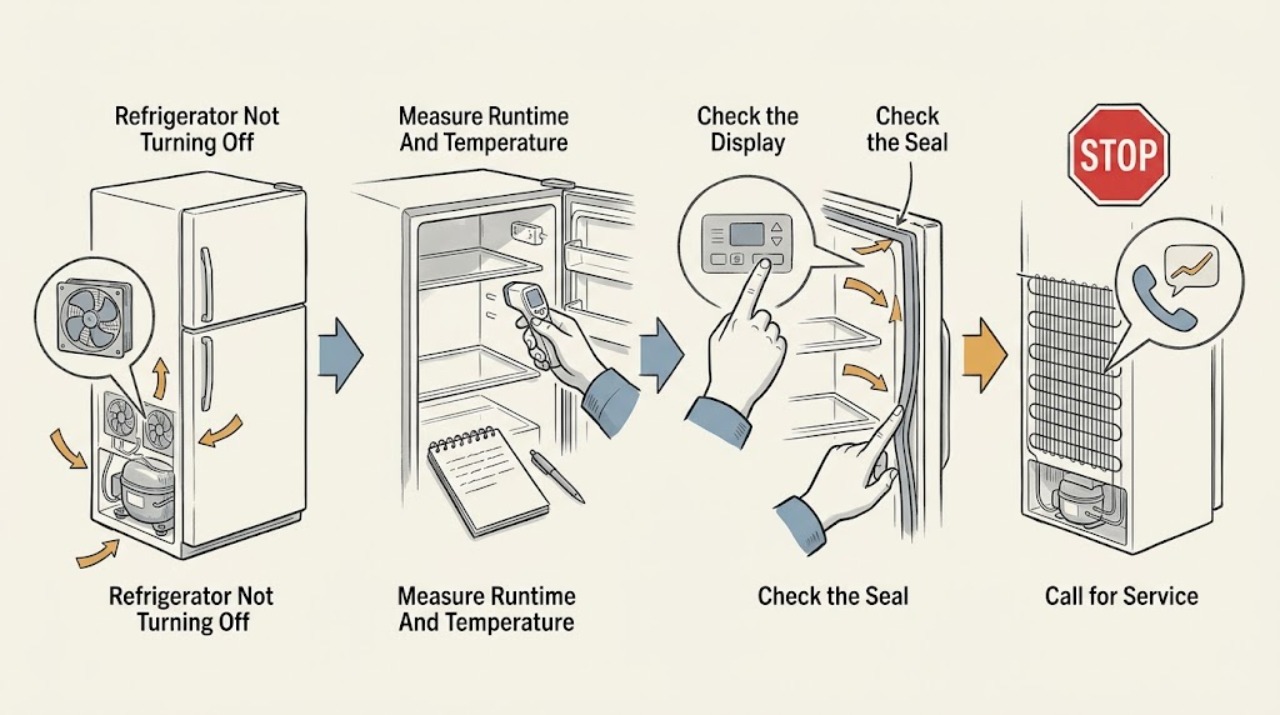
Work through in order
Diagnostic checks
Use only checks that match the exact appliance or system and its official guide.
-
Check 1
Record the full GE model, cabinet style, room conditions, and when the long run began. Check the refrigerator and freezer temperatures using the appliance display or a suitable thermometer, and note whether the compressor sound is steady, whether fans can be heard, and whether either compartment is warming. Avoid opening the doors repeatedly while observing.
Expected result: Both compartments hold their normal temperatures; the unit is newly installed or was loaded with warm food; the room is unusually hot or humid; or the temperature is rising despite continuous operation.
Next step: If temperature is stable, continue to the mode and heat-load checks. If it is rising or food is not staying cold, protect perishable food and continue only with the external checks below; arrange service if the model-specific recovery period has passed.
Stop if: Stop use for smoke, burning or electrical odor, sparks, a hot or damaged cord or outlet, water near electrical parts, severe vibration, or cabinet damage.
Why this matters
Why: Stable temperature with a long, steady run is consistent with GE's normal 80%–90% duty-cycle guidance and may approach continuous operation in hot conditions. Rising temperature or no recovery shifts the problem toward heat entering the cabinet, airflow, condenser efficiency, or an internal cooling fault.
-
Check 2
With the doors closed, read the display for TurboCool or a model-specific cooling-mode indicator and compare the temperature setting with the exact Owner's Manual. If TurboCool is visibly active, use only the model's documented control to turn it off once; do not guess at a key combination or repeatedly change the set point.
Expected result: The display shows tC or another documented TurboCool indicator; the setting is colder than intended; the control responds normally with no special mode; or the display is unresponsive or shows an unfamiliar code.
Next step: Exit the documented mode or restore the intended setting, then allow the exact model's stabilization time. Photograph an unfamiliar code and arrange model-specific service if the control will not respond or the mode returns.
Stop if: Do not enter hidden diagnostics, remove the control panel, bypass a control or sensor, or continue if the display or appliance shows smoke, arcing, abnormal heat, or electrical odor.
Why this matters
Why: On applicable GE models, TurboCool intentionally activates the compressor and high-speed fans and can last up to 8 hours. A wrong setting can also create a long run, while an unresponsive display or unfamiliar code is a control-specific symptom rather than proof of a stuck compressor.
-
Check 3
Inspect the visible door and drawer edges, bins, shelves, and magnetic gaskets. Remove only items that visibly prevent closure, confirm the door closes fully without holding it, and slowly close it while watching whether the interior light goes out. Look for a torn, dirty, folded, or visibly separated gasket; clean an accessible gasket with the model-approved mild method and dry it.
Expected result: A tray, bin, ice, or package keeps the door ajar; the door does not close on its own; the gasket has a cut, tear, wrinkle, or gap; or the light remains on when the door is nearly closed.
Next step: Rearrange the load and clean the seal without using bleach, ammonia, petroleum-distillate, or abrasive products. Use the exact manual for leveling or gasket adjustment; if the seal is torn, the hinge is damaged, or the light switch does not behave normally, arrange service.
Stop if: Do not heat, stretch, glue, or replace a gasket unless the exact manual supports the procedure; do not remove door wiring or switch covers.
Why this matters
Why: A door leak continually admits warm air and can keep the compressor running. GE also says a light that stays on can add heat, and that leveling, alignment, or a damaged gasket can prevent a proper seal. A door that seals and a light that goes out make this branch less likely.
-
Check 4
From inside the cabinet, look for tall containers or packages pressed against freezer or refrigerator air vents and move them forward without blocking the passages. Outside the unit, check that its sides, top, and back have the clearance stated in the exact manual and that the installation area is not an extreme-temperature location.
Expected result: An air vent is covered, the cabinet is packed tightly against the wall, or the refrigerator is in an unusually hot, cold, or enclosed location; or airflow and clearance match the manual.
Next step: Restore the model-required airflow and clearance, then allow the refrigerator to stabilize before judging runtime. If the cabinet cannot be safely moved or the problem persists with correct clearance, stop at external checks and arrange service.
Stop if: Do not pull a built-in refrigerator, crush tubing or the power cord, remove covers, or reach into a fan or condenser compartment.
Why this matters
Why: Blocked internal airflow can leave one area warm while the compressor keeps running. GE gives a general one-inch clearance guideline but says the required space varies by model; GE also notes that installation areas below 60°F or above 110°F may impair cooling.
-
Check 5
Consult the exact GE manual to determine whether this refrigerator has a cleanable condenser. If it does and the coils are visibly accessible, isolate power from a dry, safe position before brushing or vacuuming only the accessible dust and pet hair as the GE instructions describe; replace any grille before restoring power. Skip this check on NeverClean or inaccessible models.
Expected result: The manual identifies a cleanable condenser with visible dust or pet hair; the manual identifies a NeverClean or inaccessible condenser; or cleaning cannot be performed without moving the unit or opening a compartment.
Next step: Clean only when the manual and access path support it, then allow the unit to stabilize. If the condenser is clean or inaccessible and the refrigerator remains warm or never cycles, arrange qualified diagnosis rather than assuming the compressor or refrigerant is at fault.
Stop if: Unplug before owner-approved cleaning; do not reach behind sharp fins, touch the compressor or fan, open a rear panel, or restore power with a grille or cover removed.
Why this matters
Why: GE says dirty condenser coils can reduce cooling efficiency, but most refrigerators manufactured since 2001 have a NeverClean condenser that does not require owner cleaning. A restricted or hazardous access path is not a permission to improvise.
-
Check 6
After the documented mode, load, door, airflow, clearance, and applicable cleaning checks, leave the refrigerator closed and observe whether temperature recovers and whether the compressor eventually cycles. Keep a written timeline of set point, actual temperature, display messages, unusual sound, frost pattern visible without panel removal, and any outage or recent service.
Expected result: Temperature returns to normal and runtime reduces; the refrigerator is cold but never audibly cycles; temperature remains high; the compressor repeatedly starts and stops; or frost, fan, water, or fault symptoms appear.
Next step: Use the timeline and exact model for qualified appliance service. Keep the refrigerator powered only when there is no hazard and the service provider wants the symptom preserved; protect food if temperatures are unsafe.
Stop if: Do not remove freezer or rear panels, make live voltage or continuity tests, bypass a thermostat, switch, overload, or sensor, or add refrigerant.
Why this matters
Why: Recovery supports a temporary heat-load, mode, door, airflow, or normal-cycle explanation. Persistent warmth, repeated abnormal cycling, or a symptom involving a hidden fan, defrost system, control, compressor, or sealed system cannot be isolated safely from outside.
Use your observations
Decision map
Find the observation that best matches what you see, then follow the next safe action.
-
PATH 01Next step
What you see
The refrigerator and freezer are holding their intended temperatures, the doors seal, and the room is hot or the unit recently handled warm food or many door openings.
Do this next
Keep doors closed, allow the load to stabilize, and monitor temperature rather than trying to force a shutoff. Service is not indicated solely by a long run when cooling is stable.
Why this path and its safety boundary
Why it matters: A long steady run is more consistent with GE's designed duty cycle and heat load than with a failed off control. The compressor may run 80% to 90% of the time and approach 100% in hot, humid conditions.
-
PATH 02Next step
What you see
A documented TurboCool indicator such as tC is displayed, and the model's controls otherwise respond.
Do this next
End the mode with the exact model's documented control and wait for stabilization. If the indicator cannot be cleared or the temperature does not recover, arrange model-specific service.
Why this path and its safety boundary
Why it matters: The refrigerator is deliberately calling for maximum fresh-food cooling; GE says TurboCool runs the compressor and high-speed fans and lasts up to 8 hours unless turned off sooner.
-
PATH 03Next step
What you see
A package blocks closure, the gasket is visibly damaged or gapped, the door is misaligned, or the interior light remains on with the door nearly closed, and the cabinet is running warm.
Do this next
Correct only the visible load or clean the gasket using the approved method; use the model manual for leveling or gasket work. Service is appropriate for a torn gasket, hinge/alignment fault, or abnormal light-switch behavior.
Why this path and its safety boundary
Why it matters: Warm air or light heat is entering continuously, making longer compressor operation expected. GE specifically lists damaged or dirty gaskets and a light that fails to turn off as runtime factors.
-
PATH 04Next step
What you see
The temperature is high, internal vents are blocked, clearance is below the model requirement, or a model-approved accessible condenser is visibly dirty.
Do this next
Restore airflow and model-required clearance; clean only an owner-accessible condenser after safely isolating power and following the manual. If warmth persists, arrange service without opening the machine compartment.
Why this path and its safety boundary
Why it matters: The cooling system is losing efficiency or distributing cold air poorly, so the compressor may stay on while the cabinet struggles to reach set point. On many newer GE models the condenser is NeverClean or inaccessible, so do not assume cleaning is applicable.
-
PATH 05Next step
What you see
The cabinet remains warm after documented stabilization and external checks, the compressor repeatedly starts and stops abnormally, a hidden fan or frost symptom is suspected, or the display/control is unresponsive.
Do this next
Arrange qualified GE appliance service and provide the model, temperature timeline, display text, mode state, outage history, and observed sound. Do not keep cycling power to chase a change in the symptom.
Why this path and its safety boundary
Why it matters: An internal control, fan, defrost, compressor, or sealed-system problem is more likely than a simple normal long run, but the symptom does not identify a replaceable part by itself.
Helpful context
Understand the symptom
Running most of the time can be normal
The meaningful question is not whether you can hear the refrigerator, but whether it is maintaining safe temperatures and eventually cycling. GE says modern compressors are designed for long duty cycles, with 80% to 90% operation considered normal and nearly continuous operation possible in hot, humid conditions. A recently installed unit, one loaded with warm food, or one recovering from repeated door openings can run for a long period while it pulls the temperature back down.
Check for a deliberate cooling mode before calling it stuck
Some GE models have TurboCool. GE describes it as a mode that activates the compressor and high-speed fans after frequent or extended door openings or warm loading; the fresh-food compartment stays at its coldest setting for up to 8 hours. A display such as tC, or a model-specific equivalent, points to an active setting rather than a failed thermostat. Turn it off only with the exact model's documented control, and do not copy a button sequence from another GE refrigerator.
Warm food or rising temperature changes the diagnosis
If temperatures are stable, runtime may be normal. If temperatures are rising while the compressor runs, look at heat entering the cabinet: an obstructed door, damaged gasket, blocked vent, interior light that stays on, poor clearance, or a dirty accessible condenser. GE says clearance and condenser access vary by style and model. A clean exterior check cannot establish a refrigerant, compressor, fan, control, or defrost fault, so persistent poor cooling belongs with qualified service.
Keep the machine compartment closed
Limit owner checks to the display, temperature controls, door closure, gasket, visible food placement, interior light behavior, room clearance, and model-approved cleaning. If the manual says the condenser is owner-accessible, disconnect power from a dry, safe position before cleaning; do not move a built-in unit or reach past sharp fins. Do not remove rear or freezer panels, probe wiring, defeat a door switch, touch the compressor or fan, add refrigerant, or open the sealed system. Stop for smoke, burning or electrical odor, sparks, abnormal heat, a hot or damaged cord or outlet, water near electrical parts, severe vibration, or cabinet damage.
Safety boundary
Stop conditions
- Stop using the refrigerator for smoke, burning or electrical odor, sparks, a hot or damaged cord or outlet, water near electrical parts, severe vibration, cabinet damage, or a repeated breaker event.
- Do not remove rear, top, or freezer panels, make live voltage or continuity tests, bypass a door switch, thermostat, sensor, overload, or thermal protector, or touch a moving fan or compressor.
- Do not puncture refrigerant tubing, add refrigerant, or open the sealed system. Internal electrical, control, defrost, fan, compressor, and sealed-system diagnosis belongs to qualified service.
- Use the exact GE Owner's Manual for TurboCool, temperature controls, clearance, condenser access, cleaning, and stabilization timing. Do not copy a button sequence or maintenance procedure from another model.
Only after diagnosis
Potential parts
- door gasket
Consider only if a qualified or model-specific inspection confirms a torn, permanently deformed, or non-sealing gasket after visible obstructions and cleaning are addressed.
Gasket shape and fit vary by GE model and door configuration; confirm the complete model before ordering. - temperature control or electronic control
Consider only after qualified diagnosis confirms that the refrigerator remains warm or runs abnormally with correct settings, door seal, airflow, clearance, and applicable condenser checks.
Control components are model-specific and a long run alone does not identify a failed control. - condenser or evaporator fan assembly
Consider only after qualified diagnosis confirms a fan fault; do not infer a failed fan from a sound or from continuous compressor operation alone.
Fan assemblies and access differ by model; confirm fitment and have internal work performed by qualified service.
When checks do not resolve it
Need a professional?
Arrange qualified GE appliance service when the refrigerator remains warm after the exact model's stabilization period and external checks, runs continuously while temperatures rise, repeatedly starts and stops, has an unresponsive control or persistent display message, or needs diagnosis of a fan, defrost system, thermostat, control, compressor, or sealed system. Use qualified electrical service for a hot or damaged outlet, cord, smoke, arcing, or a protective-device problem. Keep the unit powered only when there is no hazard and the service provider wants the symptom preserved.
Safety scope: The owner may inspect the display, documented controls, door closure, gasket, load, light behavior, room clearance, visible vents, and a model-approved accessible condenser after power is safely isolated. Qualified personnel must handle internal wiring, switches, controls, fans, defrost components, compressor, refrigerant, sealed-system work, live testing, and hazard conditions.
Common questions
FAQ
Is it normal for a GE refrigerator to run all day?
It can be. GE says modern compressors are designed to run 80% to 90% of the time and may approach 100% in hot, humid conditions. Stable temperatures are reassuring; rising temperatures or no recovery after the model-specific stabilization period require service evaluation.
Why is my GE refrigerator running constantly after I added groceries?
Warm food and frequent or extended door openings add heat. GE also says TurboCool, when equipped and selected, activates the compressor and high-speed fans for up to 8 hours. Keep the doors closed, check the display for the documented mode indicator, and allow the unit to stabilize.
Can a bad door seal make a GE refrigerator run nonstop?
Yes. A torn, dirty, folded, or obstructed gasket can let warm air enter continuously. Check that packages and bins do not hold the door open, clean the gasket with the approved mild method, and use the exact manual for adjustment or replacement.
Should I clean the condenser coils on my GE refrigerator?
Only if the exact model manual identifies an owner-accessible cleanable condenser. GE says many refrigerators made since 2001 have a NeverClean condenser and do not require this cleaning. Disconnect power safely before any approved maintenance and do not open a compartment to reach hidden coils.
What does tC mean on a GE refrigerator?
On applicable GE models, tC is the TurboCool indicator, not necessarily an error. GE says TurboCool activates the compressor and high-speed fans and runs the fresh-food compartment at its coldest setting for up to 8 hours. Use the exact model's instructions to turn it off.
When should I stop troubleshooting a GE refrigerator that will not turn off?
Stop at user-level checks when the cabinet remains warm, temperature rises, cycling is abnormal, a control or display is unresponsive, or the issue requires a fan, defrost, compressor, electrical, or sealed-system diagnosis. Stop immediately for smoke, burning or electrical odor, sparks, abnormal heat, a hot or damaged cord or outlet, water near electrical parts, severe vibration, or cabinet damage.
Read the exact guide
Official sources
- Refrigerator - TurboCool SettingGE Appliances · Only GE refrigerator models equipped with TurboCool; indicator and controls vary by model.
- Refrigerator - Cleaning Condenser CoilsGE Appliances · Only models whose exact manual identifies owner-accessible cleanable condenser coils; many newer models use NeverClean condensers.
- Refrigerator - Normal Cycle TimesGE Appliances · General GE refrigerator runtime guidance; exact model controls any model-specific mode or timing.
- Refrigerator, Freezer and Standalone Ice Maker - Care and Cleaning of Interior and GasketGE Appliances · General GE refrigeration gasket-care guidance; exact model manual controls any adjustment or replacement procedure.
- Refrigerator or Freezer - Normal Run TimeGE Appliances · General GE refrigerator and freezer runtime guidance; use the exact manual for controls and maintenance access.
- Refrigerator - Not Cooling EnoughGE Appliances · General GE guidance for a refrigerator that runs but is not cold enough; exact model manual controls settings, clearance, and access.
- Refrigerator - Door Will Not CloseGE Appliances · General GE refrigerator door-closure checks; cabinet and leveling details vary by model.
Community feedback
Share a repair observation
Share a plain-text repair observation. Accepted observations are published automatically; this page may take a moment to update.