
On this page
Start here
Quick answer
A Bosch refrigerator that seems not to turn off is not automatically failing: efficient compressors and fans can run longer after installation, a warm room, a large warm load, frequent or prolonged door opening, or a colder setting. Bosch manuals also describe Super Freezing or Super Cooling as functions that increase cooling activity and noise until the model-specific function ends or is cancelled. First check whether the appliance is actually maintaining temperature, whether a Super indicator is on, whether the doors and seals close fully, and whether vents are blocked. If it runs continuously while temperatures rise, an error appears, the door will not seal, or the cord, casing, or controls are damaged, stop using it as appropriate and arrange Bosch service. Do not open the cabinet or test the compressor, refrigerant circuit, fan wiring, sensors, or control board yourself.
Before you begin
Safety first
- The user may read the display, identify a documented Super mode, check doors and reachable gaskets, remove visible obstructions, and check external airflow. Temperature-control, fan, compressor, refrigerant, wiring, sensor, control-board, sealed-system, and internal electrical work is for trained or qualified service personnel.
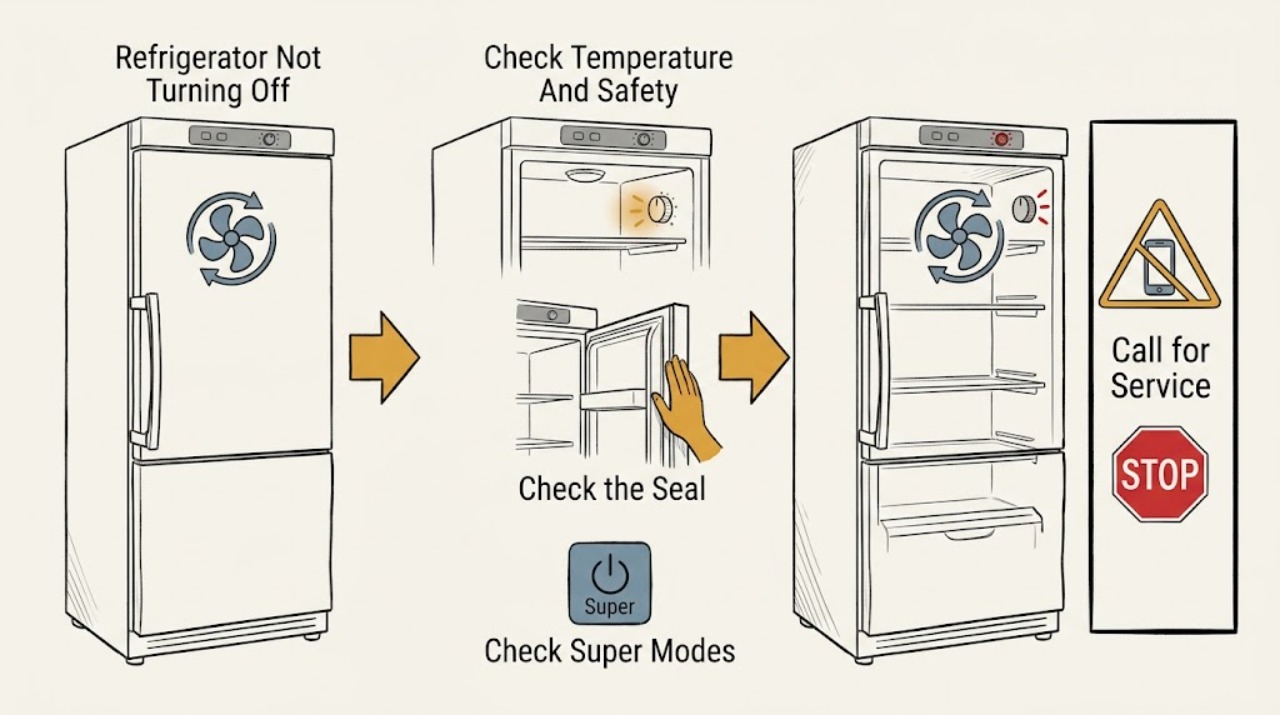
Work through in order
Diagnostic checks
Use only checks that match the exact appliance or system and its official guide.
-
Check 1
Check the refrigerator and freezer displays or a model-approved temperature indication without opening the cabinet or removing panels. At the same time look for smoke, a burning smell, a hot or damaged cord/casing, water near the outlet or controls, repeated breaker trips, or an error indication.
Expected result: Temperatures are holding near the set values with no hazard, temperatures are rising or an alarm/error is present, or the appliance has an electrical, water, heat, or cabinet-damage symptom.
Next step: For smoke, burning odor, damaged electrical parts, water near electricity, or repeated protection trips, stop using the appliance and isolate power only from a safe location before service. For rising temperature or an error without an immediate hazard, record it and continue only with the external checks below.
Stop if: Do not touch wet energized parts, continue running a damaged refrigerator, or open a panel to locate a hot, noisy, or energized component.
Why this matters
Why: Stable temperatures with a long cycle can be normal recovery or a selected cooling mode. Rising temperatures, an error, or a hazard changes the problem from a noise/cycle question to a cooling or safety fault.
-
Check 2
Read the exact model manual and inspect the display for Super Freezing, Super Cooling, fast-freeze, or similar cooling-mode indicators. If one is active, use only the model's documented cancel control or allow its documented automatic return to normal operation; do not use random key combinations.
Expected result: A Super function is visibly active and the manual says it increases cooling activity or noise, or no such function is active or the appliance remains continuously on after the documented mode ends.
Next step: Cancel the active mode as documented, close the doors, and observe whether the appliance returns to its ordinary cycle while temperature remains stable. If the mode will not cancel or the refrigerator still runs continuously with poor cooling, arrange service.
Stop if: Do not change hidden service settings, disconnect a mode switch, or apply a different model's timing or control sequence.
Why this matters
Why: An active Super mode can intentionally make the refrigeration unit or fans run longer and may increase noise. Continued operation after the mode is cancelled or its documented end makes a normal selected mode less likely.
-
Check 3
Inspect the closed refrigerator and freezer doors from the front. Move a package, bin, or shelf only if it is visibly preventing closure; check that the gasket is clean, intact, and touching the frame, and that the door is not being held open. Wipe a reachable gasket with mild soapy water and dry it as Bosch directs.
Expected result: A door closes fully with a clean, undamaged seal, a package or bin holds it open, or the door remains misaligned, the gasket is damaged, or a gap remains.
Next step: Remove only the visible obstruction and close the door normally. If the door still will not seal or the gasket is damaged, arrange Bosch service and do not treat continuous operation as a compressor diagnosis.
Stop if: Do not pry, cut, glue, heat, or remove the gasket, hinges, or door trim; do not force a door that is misaligned.
Why this matters
Why: Warm air entering through an open or poorly sealed door can make the refrigerator work longer. A clear, intact seal makes that explanation less likely; a damaged seal or closure problem needs model-specific repair rather than repeated temperature changes.
-
Check 4
Recall whether the refrigerator was newly installed, switched off for a long period, loaded with a large amount of warm food, or opened frequently. Leave food in place, minimize door openings, and allow the exact model's normal recovery period; do not turn the control to its coldest setting just to force a faster cool-down.
Expected result: The long run began after installation, a warm load, frequent door opening, or a warm room and the temperatures gradually recover, or the same continuous run persists without those conditions and temperatures do not recover.
Next step: Keep doors closed as much as practical and reassess the temperature using the model's instructions. If temperatures remain high or the motor never changes behavior after the workload has cleared, contact Bosch service.
Stop if: Do not keep food in an unsafe temperature condition, repeatedly adjust controls without checking the model manual, or open the cooling system to improve recovery.
Why this matters
Why: Bosch manuals list installation, warm loads, high ambient temperature, and frequent or prolonged door opening as reasons the motor may run longer. Recovery toward the set temperature supports a normal workload; no recovery makes a cooling fault more likely.
-
Check 5
From outside the appliance, confirm that the ventilation openings are not covered by boxes, dust, cabinetry, or stored items, and that the refrigerator has the model-required clearance. Do not pull a built-in appliance forward or remove a rear cover to inspect the condenser or fan.
Expected result: An external vent is blocked or clearance is obviously restricted, or the openings are clear and the installation appears consistent with the manual.
Next step: Remove only loose items blocking an accessible external opening and allow the appliance to operate normally. If the unit is built in too tightly, hot, noisy, or still runs continuously, arrange service or a qualified installation assessment.
Stop if: Do not place hands near a moving fan, remove grilles, use steam or high-pressure cleaning, or alter cabinet clearances without the installation instructions.
Why this matters
Why: Blocked airflow can make the refrigeration unit run more often or longer. Clear external obstructions only; clear vents with persistent poor cooling point away from a simple airflow correction and toward service diagnosis.
-
Check 6
Record the exact Bosch model, the displayed temperatures, whether Super functions are active, when the long run began, whether the doors seal, whether vents are clear, and any error or unusual sound. If the refrigerator still runs continuously while temperatures rise or the symptoms persist after the external checks, leave it out of service as appropriate and request professional diagnosis.
Expected result: The appliance returns to cycling and holds temperature after a documented correction, or it continues to run with poor cooling, frost, an error, abnormal electrical symptoms, or a hidden source of heat/noise.
Next step: Contact Bosch or a qualified appliance service provider with the model and symptom record. Protect perishable food if the refrigerator is not maintaining a safe temperature, and keep a damaged or electrically unsafe appliance disconnected.
Stop if: Do not remove covers, test live wiring, handle refrigerant, bypass sensors or controls, or replace an internal refrigeration part based only on continuous running.
Why this matters
Why: A return to normal cycling supports a workload, mode, door, or airflow explanation. Persistent operation with poor cooling cannot safely distinguish a sensor, fan, control, compressor, refrigerant, or other internal fault.
Use your observations
Decision map
Find the observation that best matches what you see, then follow the next safe action.
-
PATH 01Safety boundary
What you see
The appliance runs for a long period after installation, a warm load, frequent door opening, or a warm room, but the displayed temperature is recovering and no hazard is present.
Do this next
Minimize door openings, keep the doors sealed, keep external vents clear, and reassess using the model's temperature guidance. Arrange service if it never reaches temperature or the long run persists after recovery.
Why this path and its safety boundary
Why it matters: A normal cooling workload is more likely than a failed off control; Bosch documents longer operation under these conditions and with efficient compressors and fans.
Safety stop: Do not force the coldest setting or open the appliance to make the compressor cycle.
-
PATH 02Safety boundary
What you see
A Super Freezing or Super Cooling indicator is on and the model manual says the function increases cooling activity/noise or runs for a defined period.
Do this next
Cancel it only with the exact model's documented control or allow its automatic return to normal operation, then confirm the temperature remains stable.
Why this path and its safety boundary
Why it matters: The selected cooling mode is more likely than a failed control to explain the long run.
Safety stop: Do not use undocumented service controls or assume another model's timer applies.
-
PATH 03Safety boundary
What you see
A door is held open, the gasket does not seal, warm food was recently added, or an external ventilation opening is blocked.
Do this next
Remove visible obstructions, clean a reachable gasket as directed, keep doors closed, and allow recovery. Call service if the seal is damaged or cooling does not recover.
Why this path and its safety boundary
Why it matters: Heat entering the cabinet or restricted airflow is more likely than a primary internal part failure.
Safety stop: Do not remove a gasket, grille, cabinet panel, or fan cover yourself.
-
PATH 04Safety boundary
What you see
The refrigerator runs continuously after modes are cleared and doors/vents are normal, while the displayed temperature rises, frost builds, or cooling is inadequate.
Do this next
Protect perishable food, stop using the appliance as appropriate, and arrange Bosch or qualified service with the model and temperature history.
Why this path and its safety boundary
Why it matters: An internal cooling, sensor, fan, control, compressor, or sealed-system fault is more likely; the observation cannot identify the part safely.
Safety stop: Do not open the refrigeration circuit, test live components, bypass a sensor, or replace a control or compressor without professional diagnosis.
-
PATH 05Safety boundary
What you see
Smoke, burning odor, a hot or damaged cord/cabinet, water near electricity, or repeated breaker trips accompany the continuous operation.
Do this next
Stop the appliance, isolate power only from a safe location, keep it out of service, and request qualified service.
Why this path and its safety boundary
Why it matters: An immediate electrical, fire, or moisture hazard outweighs any attempt to determine whether the motor should cycle.
Safety stop: Do not touch wet energized parts, re-energize it for another test, or open an electrical cover.
Helpful context
Understand the symptom
Decide whether it is really continuous operation
A hum or fan sound can continue intermittently even when the compressor cycles, and a refrigerator may run for a long period while it pulls down a new installation or a warm load. Note the sound, the displayed temperature, and whether the sound ever changes or stops. The useful distinction is normal recovery with stable temperatures versus continuous operation with poor cooling or an alarm.
Check modes and airflow before suspecting a part
Bosch manuals describe Super Cooling and Super Freezing as additional functions that make the relevant compartment colder and may increase noise; some models return to normal operation automatically, while others provide a documented cancel control. The exact display and timing vary by model. Keep external ventilation openings clear and do not apply another Bosch model's button sequence.
When long running becomes a service problem
A refrigerator that runs longer but reaches its set temperature can be behaving normally. Persistent running together with rising temperature, heavy frost, a door that cannot close, a recurring error, unusual electrical behavior, or a damaged cord or cabinet needs service. Internal refrigeration and electrical diagnosis belongs to trained or qualified personnel.
Safety boundary
Stop conditions
- Stop using a refrigerator with smoke, burning odor, a hot or damaged cord/cabinet, water near the outlet or controls, or repeated breaker trips; isolate power only from a safe location and arrange professional service.
- Do not remove electrical, fan, evaporator, compressor, or rear cabinet covers; test live wiring; handle refrigerant; or open the sealed refrigeration circuit.
- Do not bypass temperature sensors, door switches, controls, or safety devices, and do not replace an internal part based only on a continuous-running symptom.
- Do not pull a built-in appliance forward through water or place hands near a moving fan; use only accessible external checks.
- If temperatures are rising, protect perishable food and arrange service rather than repeatedly changing settings or waiting indefinitely.
When checks do not resolve it
Need a professional?
Arrange Bosch or qualified appliance service when the refrigerator continues running with rising temperatures after Super functions, door closure, load, and external airflow checks; when an error persists; or when a seal, cord, cabinet, fan, control, or cooling symptom is unsafe or inaccessible. A long cycle with stable temperature after installation or a warm load may be normal, but persistent poor cooling requires diagnosis.
Safety scope: The user may read the display, identify a documented Super mode, check doors and reachable gaskets, remove visible obstructions, and check external airflow. Temperature-control, fan, compressor, refrigerant, wiring, sensor, control-board, sealed-system, and internal electrical work is for trained or qualified service personnel.
Common questions
FAQ
Is it normal for a Bosch refrigerator to run continuously?
It can be normal for a long period after installation, a warm load, frequent door opening, a warm room, or a colder setting. Bosch also notes that efficient compressors and fans may run longer. If the temperature does not recover, rises, or an error appears, arrange service.
Can Super Freezing make my Bosch refrigerator stay on?
Yes. Bosch documents Super Freezing as a mode that cools the freezer as cold as possible; covered manuals describe increased noise and model-specific automatic or manual cancellation. Use only the exact model's documented control.
Why does my Bosch refrigerator run more when the door seal is dirty?
A door that does not close or seal properly lets warm air enter, so Bosch says the refrigerator may work harder. Remove a visible obstruction and clean a reachable gasket with mild soapy water. A damaged seal needs Bosch service assessment.
What if my Bosch refrigerator runs constantly but is not cold?
Check the displayed temperature, Super modes, door closure, and accessible ventilation openings. If cooling does not recover after those checks, protect perishable food and arrange professional diagnosis. Do not open the cabinet or test the compressor, fan wiring, sensor, or refrigerant circuit.
Should I unplug a Bosch refrigerator that will not turn off?
Do not unplug it while standing in water or touching a wet plug. For smoke, burning odor, damaged electrical parts, water near the outlet or controls, or repeated breaker trips, isolate power only from a safe location and arrange service. For a nonhazardous long cycle, first check temperature, modes, doors, and airflow using the model manual.
Read the exact guide
Official sources
- Use and Care Manual KIF86H..Bosch Home Appliances · Bosch KIF86H model family; included functions and automatic durations are not universal across Bosch refrigerators.
- Refrigeration | Error CodesBosch Home Appliances · Bosch US refrigeration error-code support; exact code meaning is model-specific.
- Bosch home appliances: digitalusermanualBosch Home Appliances · Bosch refrigerator documentation; exact safety labels and model details must be confirmed on the user's appliance.
- Instructions for UseBosch Home Appliances · Bosch refrigerator documentation; installation clearances and electrical details vary by model.
- Refrigerator Not Cooling Properly | TroubleshootingBosch Home Appliances · Bosch US refrigerator support; exact model controls and service routes vary.
- What to do if your refrigerator thermostat isn't workingBosch Home Appliances · Bosch US refrigerator support; thermostat behavior and controls are model-specific.
- W10577849A.fmBosch Home Appliances · Bosch refrigerator model family in the cited manual; exact controls and installation clearances vary by model.
- Refrigerator Door Won’t Shut | TroubleshootingBosch Home Appliances · Bosch US refrigerator support; seal design and replacement procedure depend on model.
- Fridge-freezerBosch Home Appliances · Bosch fridge-freezer model family; temperature controls and mode behavior are model-specific.
- Fridge repairsBosch Home Appliances · Bosch US refrigerator repair support; service availability depends on location and model.
- Super freezingBosch Home Appliances · Bosch refrigerator models using the cited Super Freezing documentation; controls and duration differ by model.
Community feedback
Share a repair observation
Share a plain-text repair observation. Accepted observations are published automatically; this page may take a moment to update.