
On this page
Start here
Quick answer
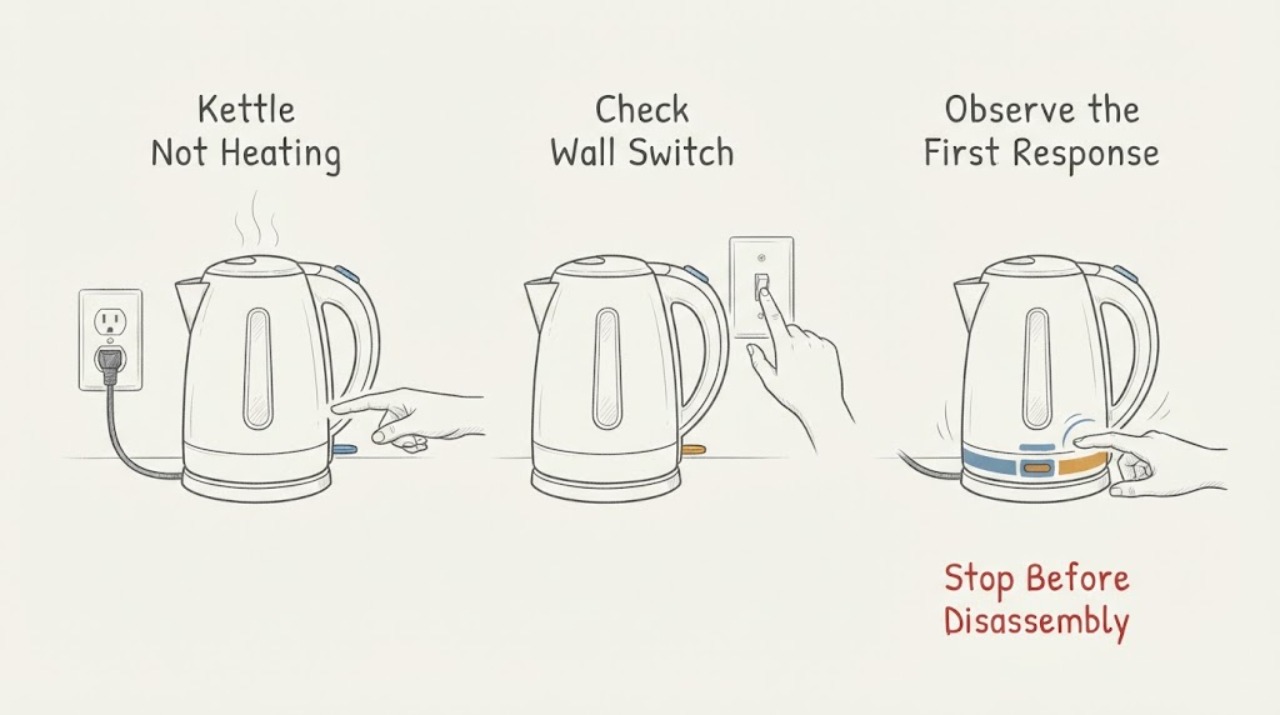
For a kettle that does not heat, first reseat the kettle on its supplied base, confirm the switch is on, and test the outlet with another appliance. If it was boiled dry, switch it off, unplug it, let it cool, and refill it before trying again. A kettle that still does not heat, has a damaged cord, or smells electrical should remain unplugged for service.
Work through in order
Diagnostic checks
Use only checks that match the exact appliance or system and its official guide.
-
Check 1
With the kettle cool and empty of hot water, place it firmly on its supplied power base and confirm the switch is in the on position. Check that the cord and plug are not visibly damaged and that the outlet powers another small appliance.
Expected result: The outlet is dead, the kettle is not seated, the switch is off, or the power path is normal.
Next step: Correct only the outlet or seating issue; keep the kettle unplugged if the cord, plug, or base is damaged.
Why this matters
Why: A dead outlet, poor base contact, or off switch can explain no heat. A normal outlet and firm seating move attention to boil-dry protection or an internal fault.
-
Check 2
Think back to whether the kettle was switched on with too little or no water. If so, leave it off and unplugged until it is cool, then add water between the model’s minimum and maximum marks and retry once.
Expected result: It resumes heating after cooling and refilling, or it remains cold.
Next step: Stop repeated attempts and arrange service when the kettle remains cold.
Why this matters
Why: Recovery after a dry-boil pause supports the thermal safety device operating as designed. No heat after a cool refill suggests a control, contact, or element fault.
-
Check 3
If the kettle heats slowly rather than staying cold, inspect the accessible interior for heavy mineral scale and follow the model manual’s approved descaling procedure. Do not use abrasive tools or non-approved liquids.
Expected result: Scale is visible, or the interior is reasonably clean but heating remains slow or absent.
Next step: Use only the documented descaling method, then stop using the kettle if the symptom persists.
Why this matters
Why: Scale can lengthen heating time; a clean kettle with persistent poor heating points toward a component fault.
Use your observations
Decision map
Find the observation that best matches what you see, then follow the next safe action.
-
PATH 01Next step
What you see
The base or outlet was not supplying power
Do this next
Restore a safe outlet or base connection before use.
Why this path and its safety boundary
Why it matters: The kettle itself may be serviceable and the power path was the immediate cause.
-
PATH 02Next step
What you see
The kettle was dry-boiled and works after cooling and refilling
Do this next
Always fill to the model’s marked range before switching on.
Why this path and its safety boundary
Why it matters: The boil-dry protection interrupted heating as intended.
-
PATH 03Next step
What you see
The kettle remains cold with a sound power path
Do this next
Keep it unplugged and arrange qualified small-appliance service or replacement.
Why this path and its safety boundary
Why it matters: An internal thermal, switch, contact, or element fault is more likely.
Helpful context
Understand the symptom
An electric kettle needs a complete contact path through the base and a sufficient water load. A boil-dry protector can stop heating until the unit cools, while scale can make a working element heat slowly rather than remain completely cold.
Keep the check external. The base, cord, switch, and water level are user checks; the heating element and thermal controls are not safe to diagnose by opening the kettle.
When checks do not resolve it
Need a professional?
If the safe external checks do not restore normal operation, arrange qualified appliance service using the complete model information.
Common questions
FAQ
Can I use any base or extension cord to test the kettle?
Use only the supplied base and a sound outlet. Follow the model manual for any extension-cord limitations; do not improvise a base.
Does discoloration on the heating floor prove the kettle is broken?
No. The cited Hamilton Beach manual says normal stainless element discoloration does not by itself affect performance. Slow or absent heating is the symptom to investigate.
Read the exact guide
Official sources
- Electric KettleHamilton Beach · electric kettle not heating
Community feedback
Share a repair observation
Share a plain-text repair observation. Accepted observations are published automatically; this page may take a moment to update.