
On this page
Start here
Quick answer
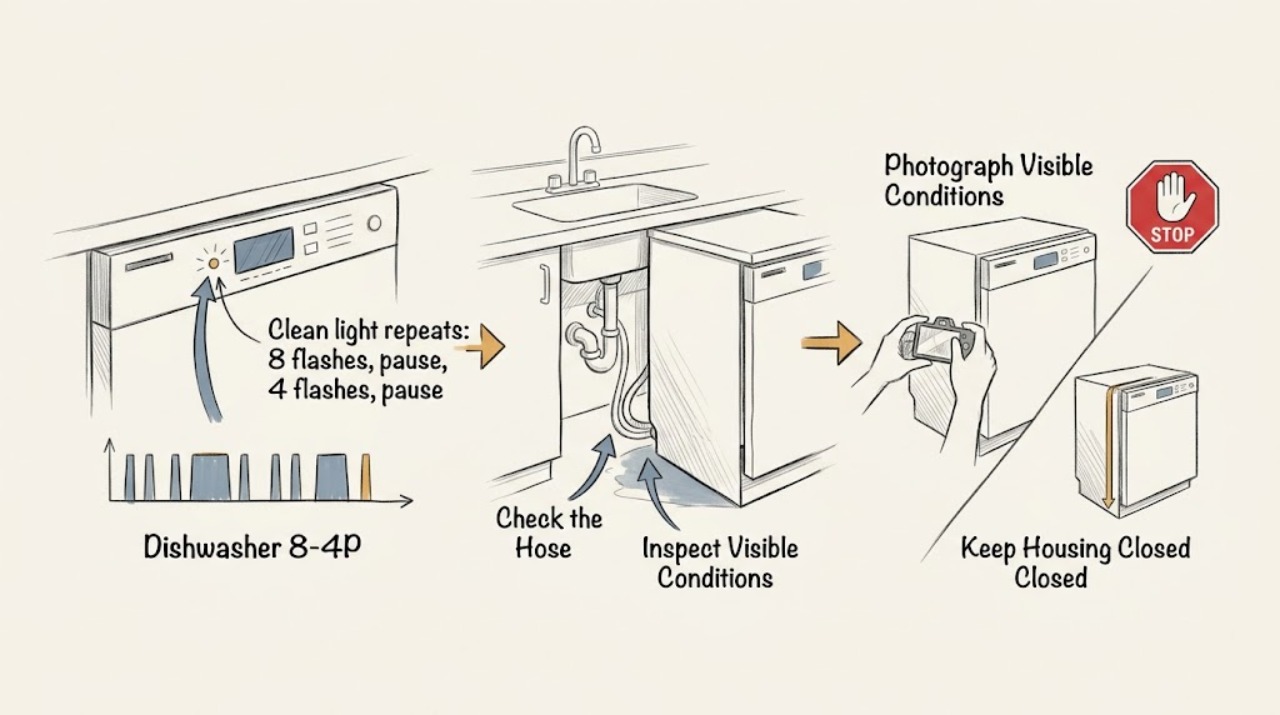
KitchenAid's official Product Help page labels this pattern “8 Pause 4 Pause,” not a separate alphanumeric 8-4P code. On the applicable KitchenAid dishwasher platform, it corresponds to F8E4: water detected in the drip tray/overfill protection, and operation may be prevented. First photograph the exact pattern and rating label, then look only for visible water, an obvious supply-connection leak, or excessive suds with the dishwasher stopped. If water is active, turn off the dishwasher water supply from a safe, dry position; if water is near electrical parts, isolate power only when safe. Do not remove panels, disconnect the float wiring, tilt the dishwasher, or keep resetting it. Because the model and market are missing, confirm the exact manual before treating 8-4P as F8E4; a different sequence needs its own guide.
Before you begin
Safety first
- Do not remove the dishwasher base or control panel, disconnect or bridge the float switch, tilt the machine, test energized wiring, reach into a hidden pump, or keep running it to create a leak. Isolate water or power only from a safe, dry position when there is a leak or electrical hazard.
Work through in order
Diagnostic checks
Use only checks that match the exact appliance or system and its official guide.
-
Check 1
Stop the dishwasher and photograph the complete display or clean-light sequence. Count eight flashes, the short pause, four flashes, and the longer repeat pause; record which light is flashing, whether a digital display also shows F8E4, and the complete model and market from the rating label.
Expected result: The sequence repeats as eight-pause-four-pause and the model is identifiable, or the display is a different F#E# code, a different flash count, or the model is unreadable.
Next step: Use the exact model manual and regional KitchenAid support page. If the model or pattern remains uncertain, stop code-specific troubleshooting and arrange service rather than guessing an overfill part.
Stop if: Do not enter undocumented diagnostic mode, remove the control panel, or bridge terminals to reveal a code.
Why this matters
Why: KitchenAid's current guide describes a two-part function/error sequence, while the dedicated support page maps 8 Pause 4 Pause to F8E4 on its applicable platform. A partial or different pattern cannot safely be converted to F8E4.
-
Check 2
With the dishwasher stopped and the floor dry, inspect only the visible floor area, the underside of the sink, and accessible water-supply connection points for fresh water, a loose-looking connection, or a kinked visible hose. Do not pull the dishwasher out or loosen a fitting.
Expected result: Water is actively leaking, the floor or cabinet base is wet, a visible connection is wet, or no water is visible externally.
Next step: If water is active, turn off the dishwasher's water supply from a safe dry position and stop use. If the area is wet near electrical parts, isolate power only if safe; otherwise keep clear and call qualified service. Do not tighten, disconnect, or repair hidden connections.
Stop if: Do not touch wet electrical parts, reach under the energized dishwasher, or continue a cycle to locate the leak.
Why this matters
Why: KitchenAid places water-supply connection checks ahead of an internal diagnosis for the 8 Pause 4 Pause/F8E4 path. Visible water establishes a leak-safety branch; no external water does not rule out water in the drip tray or an internal cause.
-
Check 3
Open the door only after the dishwasher is stopped and safe, and look for standing water in the tub and visible bubbles or hand-dish-soap foam. Do not put hands into the sump, remove the drip tray, or probe the float area.
Expected result: There is heavy sudsing, standing water in the tub, no visible tub water, or water is suspected under the unit.
Next step: For heavy suds, turn the dishwasher off and let them dissipate; do not add another chemical or restart repeatedly. For standing water, suspected under-unit water, or a recurring code, keep the unit off and arrange service.
Stop if: Do not remove the drip tray or float connector, tilt the dishwasher, or reach for a hidden pump or float switch.
Why this matters
Why: KitchenAid says excessive suds can push water out and contribute to leaking, while F8E4's drip-tray path can prevent operation. A clear tub does not prove that the tray, float wiring, or leak source is clear.
-
Check 4
If the exact model manual supports clearing this condition and there is no leak, wet electrical area, smoke, burning odor, or other hazard, use the documented Cancel action once. KitchenAid's current error guide describes a 30-second power cycle generally, but do not apply a reset to an unidentified model as a substitute for the exact F8E4 instructions.
Expected result: The warning clears and the dishwasher remains dry, the 8 Pause 4 Pause/F8E4 pattern returns, or the unit will not drain, latch, or power normally.
Next step: Record the exact sequence, water/suds observations, and reset result. If the pattern returns or operation remains blocked, leave the dishwasher off and arrange qualified KitchenAid service; do not keep cycling power.
Stop if: Do not reset repeatedly, defeat a float or door latch, or restore power while water is near electrical parts.
Why this matters
Why: A clear after one model-supported reset does not prove the drip-tray or overfill cause is gone. KitchenAid directs service when the code returns, and the generic guide warns that codes vary by model.
-
Check 5
If service is needed, provide the rating-label model and market, a photo of the display or flash sequence, whether water was visible on the floor or in the tub, whether suds were present, and whether the pattern appeared during fill, wash, drain, or immediately at startup.
Expected result: The technician receives a confirmed 8 Pause 4 Pause/F8E4 pattern with a dry or wet timeline, or the sequence/model remains unresolved.
Next step: Ask qualified service to match the exact model and code, inspect the water-containment and protection path, and identify any repair only after safe diagnosis. Do not order a float, valve, pump, or control board solely from 8-4P.
Stop if: Do not remove panels, disconnect float wiring, test live circuits, or tilt the dishwasher to empty a hidden tray.
Why this matters
Why: The support page's F8E4 guidance is platform-specific, and the current guide says exact codes vary by model. The timeline lets service distinguish a visible installation/leak clue from a persistent overfill-protection or control condition without a consumer opening the machine.
Use your observations
Decision map
Find the observation that best matches what you see, then follow the next safe action.
-
PATH 01Next step
What you see
The complete pattern is eight flashes, pause, four flashes, pause; the model is a KitchenAid dishwasher covered by the applicable support page; and water or suds are present.
Do this next
Stop the dishwasher, control the water supply from a safe position if needed, allow suds to dissipate without adding chemicals, and arrange service if water remains or the code returns.
Why this path and its safety boundary
Why it matters: This is the strongest match to KitchenAid's 8 Pause 4 Pause/F8E4 overfill or drip-tray path, but the observation does not identify a failed valve, float, pump, or control.
-
PATH 02Next step
What you see
The same 8 Pause 4 Pause/F8E4 pattern appears with no visible external leak and no excessive suds, or it returns after one exact-model-supported clear/reset.
Do this next
Keep the dishwasher off and arrange qualified KitchenAid service with the model, pattern, timing, and observations. Do not tilt the unit or open the base to inspect it.
Why this path and its safety boundary
Why it matters: The user-level external checks did not resolve the water-protection warning. Hidden tray water, float/protection, installation, or other model-specific causes remain possible, and the code is not a parts diagnosis.
-
PATH 03Next step
What you see
The sequence is not eight-pause-four-pause, the model or market cannot be confirmed, or the display is a different code such as F8E5, F9E1, or F6E1.
Do this next
Photograph the complete pattern and use the exact model's guide or qualified service. Do not use 8-4P/F8E4 instructions for a different code.
Why this path and its safety boundary
Why it matters: KitchenAid's current guide says exact codes vary by model, and similarly shaped codes have different concerns. Treating a different pattern as F8E4 could send troubleshooting down the wrong water or drain path.
-
PATH 04Next step
What you see
Water reaches electrical areas, the floor is wet, the breaker trips, there is smoke or a burning odor, or the dishwasher behaves erratically.
Do this next
Stop use, keep clear of wet electrical areas, and isolate water or power only from a safe dry position when possible. Arrange qualified service; use emergency assistance for active fire or immediate electrical danger.
Why this path and its safety boundary
Why it matters: This is a water, electrical, or fire-safety stop condition that overrides code interpretation and routine clearing.
Helpful context
Understand the symptom
8-4P is usually a description of the light sequence
The official KitchenAid page is titled “8 Pause 4 Pause - pause, repeat,” and its solution text refers to F8E4. That means a report written as 8-4P may be shorthand for eight flashes, a pause, four flashes, and a pause—not proof that the dishwasher has a literal standalone 8-4P alphanumeric code. KitchenAid's error-reading guide says flashing-light models communicate a two-part function/error code and that exact codes vary by model.
What F8E4 points toward
For the KitchenAid platform covered by the opened support page, F8E4 is associated with water detected in the drip tray/overfill protection. The page distinguishes self-installed and professionally installed situations and names water-supply connections, the float switch, the drip tray, and excessive suds as checks. Those checks do not prove a failed float, valve, pump, or control, especially when the complete model and market are unknown.
When checks do not resolve it
Need a professional?
Arrange qualified KitchenAid service when 8 Pause 4 Pause/F8E4 returns after the exact-model-supported clear, when water is found under the unit or in an inaccessible tray, when the model or pattern cannot be confirmed, or when diagnosis would require a float, pump, valve, wiring, panel, or live test. Stop immediately for water near electrical parts, a tripped breaker, smoke, burning odor, or other hazard.
Safety scope: Do not remove the dishwasher base or control panel, disconnect or bridge the float switch, tilt the machine, test energized wiring, reach into a hidden pump, or keep running it to create a leak. Isolate water or power only from a safe, dry position when there is a leak or electrical hazard.
Common questions
FAQ
Is KitchenAid 8-4P a separate error code?
The opened KitchenAid support page calls it “8 Pause 4 Pause” and refers to the resulting F8E4 error. It is usually a shorthand description of the flashing sequence, not proof of a separate 8-4P alphanumeric code. Confirm the model, display format, and full repeat pattern before using the F8E4 path.
Does 8 Pause 4 Pause prove the float switch or inlet valve is bad?
No. KitchenAid's F8E4 guidance points to water detected in the drip tray/overfill protection and names several possible checks, including supply connections, the float switch, the drip tray, and suds. It does not authorize a consumer to replace a float, valve, pump, or control from the pattern alone.
Can I keep resetting the dishwasher if 8 Pause 4 Pause clears?
No. Use only the reset or Cancel procedure documented for the exact model, at most once when there is no leak or electrical hazard. If the pattern returns, water remains, or operation is blocked, stop using the dishwasher and arrange service instead of repeated power cycling.
Read the exact guide
Official sources
- 8 Pause 4 Pause - pause, repeat - Error Code - DishwasherKitchenAid Product Help · Official KitchenAid support page addressing the 8-4P shorthand as the 8 Pause 4 Pause sequence in the regional support environment represented by the page; confirm the exact model and market before applying it.
- Dishwasher Error Codes - ReadingKitchenAid Product Help · Official KitchenAid general guide; it explicitly says exact codes vary by model, so use it for sequence reading and the exact manual for model-specific action.
Community feedback
Share a repair observation
Share a plain-text repair observation. Accepted observations are published automatically; this page may take a moment to update.