
On this page
Start here
Quick answer
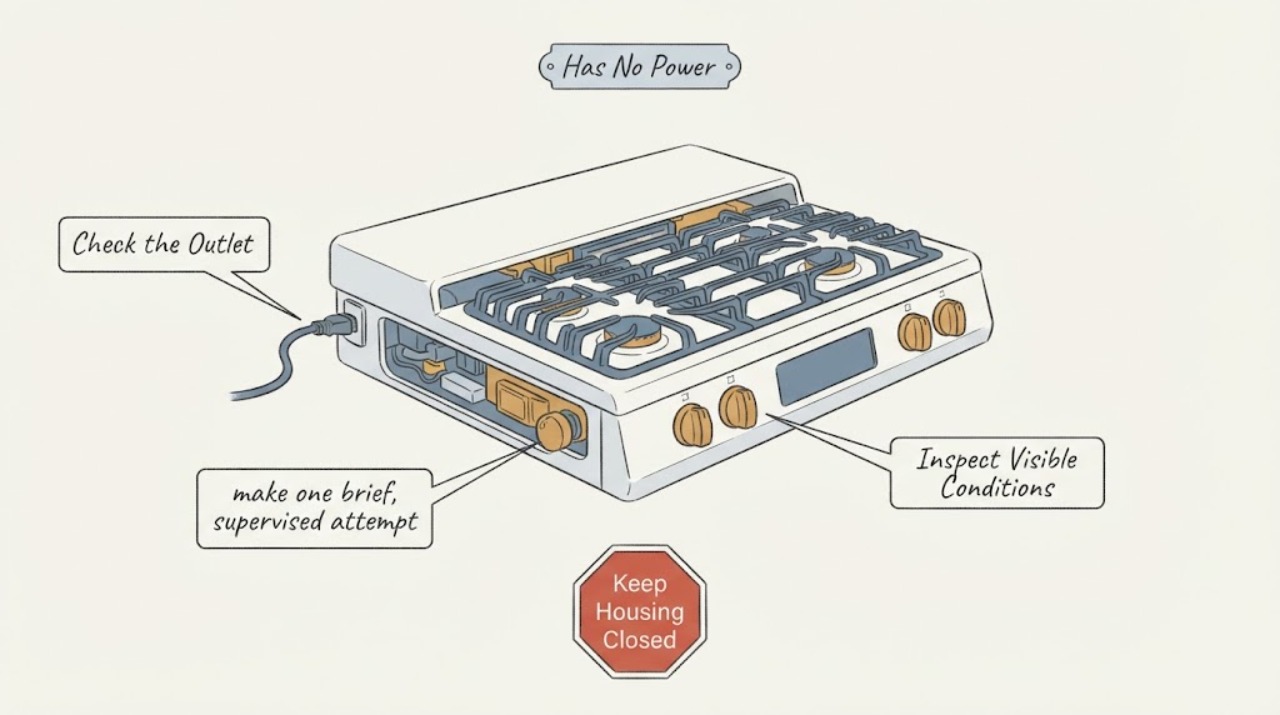
The KitchenAid KCGS356ESS is a gas cooktop with electronic ignition, so a loss of electrical power can explain why no burner clicks even though the appliance uses gas for cooking. KitchenAid's model specification rates it at 120 V and 15 A. First turn every knob to Off, check the dedicated grounded supply and the household breaker or fuse, and check the control state without opening the cooktop. If power returns but the burners still do not click or light, the issue moves to the ignition or gas-service branch. Do not use a match or lighter as a test, repeatedly reset a breaker, adjust the gas connection, or open the appliance. Stop immediately for gas odor, unlit gas flow, smoke, sparking, an uncontrolled flame, a hot or damaged cord, or liquid near electrical parts.
Work through in order
Diagnostic checks
Use only checks that match the exact appliance or system and its official guide.
-
Check 1
Turn all five burner knobs to Off and check from a safe, dry position whether the KCGS356ESS power cord is fully seated in its intended grounded outlet and whether the cooktop's labeled household breaker or fuse is open. Confirm that the supply is the model's stated 120 V, 15 A arrangement without opening the appliance.
Expected result: The breaker or fuse is open, the outlet or cord is abnormal, the cooktop regains ignition after one permitted reset, or there is still no electrical response.
Next step: Reset an accessible breaker only once if household instructions permit and the circuit is clearly identified. If the breaker opens again, the outlet or cord is damaged, or power remains absent, leave the cooktop off and call a qualified electrician or appliance technician.
Stop if: Do not keep resetting protection, use a damaged cord, remove an outlet or junction cover, probe energized wiring, or continue if there is smoke, burning odor, sparking, heat, liquid near electrical parts, or gas odor.
Why this matters
Why: KitchenAid's specification identifies electronic ignition and a 120 V, 15 A electrical supply. A whole-cooktop no-click symptom with an open protection device or absent supply is an electrical path issue before it is a burner or gas diagnosis.
-
Check 2
If electrical power is confirmed and there is no gas odor, look for a lock indicator or other control state described by the model manual. With the cooktop cool and all knobs Off, inspect only the visible cap, spreader, electrode, and port area for moisture, a loose cap, or accessible spill residue; do not remove fixed panels or change gas settings.
Expected result: A lock or control state clears, one or more burners click, the cap or igniter area is wet or misaligned, or all burners remain silent despite power.
Next step: Use only the exact manual's unlock and cool-cleaning instructions, let accessible components dry fully, and make one controlled test. If no burner clicks or the lock will not clear, stop and arrange qualified KitchenAid service.
Stop if: Do not force a knob, enlarge a burner port, move an electrode, remove the ignition module, enter undocumented diagnostics, or use a flame to test gas or ignition.
Why this matters
Why: A control state or moisture/misalignment can prevent normal ignition, while a silent response from every burner after power is restored points toward a shared ignition or control path. A single different burner is more consistent with a local burner-area issue, but does not identify the part.
-
Check 3
With power and controls normal, make one brief, supervised attempt on one burner using the documented knob position, then return the knob to Off if it does not ignite. Note whether there is no click, a click without flame, or one burner behaves differently; do not repeat attempts to purge or test the gas line.
Expected result: No burner clicks, all burners click but do not light, one burner clicks or lights differently, or gas continues without ignition.
Next step: For no click or a persistent all-burner failure, leave the controls Off and arrange qualified appliance service. For a click without flame or uncertain gas supply, stop releasing gas and contact qualified gas-appliance service.
Stop if: Do not use a match or lighter, repeatedly release gas, adjust the regulator or shutoff connection, bypass ignition, or continue around a gas odor, uncontrolled flame, smoke, sparking, or abnormal heat.
Why this matters
Why: No click after confirmed power is an ignition/control branch; clicking without flame moves attention to gas supply, moisture, cap, or port conditions; one different burner localizes the observation without proving a component. Unlit gas flow is a safety condition.
Use your observations
Decision map
Find the observation that best matches what you see, then follow the next safe action.
-
PATH 01Next step
What you see
All five KCGS356ESS burners are silent, the display or other electrical response is absent, and the household breaker or fuse is open or the 120 V supply cannot be confirmed.
Do this next
Keep all knobs Off and have the circuit, outlet, cord, and cooktop connection checked by a qualified electrician or appliance technician. Do not reconnect or open the cooktop to trace the circuit.
Why this path and its safety boundary
Why it matters: The shared electrical supply or ignition power path is more likely than five independent burner faults. KitchenAid identifies electronic ignition and a 120 V, 15 A electrical supply for this model.
-
PATH 02Next step
What you see
Electrical power is confirmed, the controls are not locked, and one burner remains silent while other KCGS356ESS burners click or light.
Do this next
After the cooktop is cool, perform only the manual's permitted cap alignment and drying check once. If the burner remains silent, schedule qualified KitchenAid service.
Why this path and its safety boundary
Why it matters: The symptom is localized to one burner or its ignition path; a cap, igniter area, port, or internal control issue is possible, but the observation does not identify a replaceable part.
-
PATH 03Next step
What you see
Power and controls are normal, burners click without lighting, the main gas valve is uncertain, or the cooktop was recently installed, reconnected, or converted.
Do this next
Return all knobs to Off, stop attempts, and arrange qualified gas-appliance service to inspect the supply and ignition system. Provide the model and installation history.
Why this path and its safety boundary
Why it matters: The remaining branch concerns gas supply, installation, moisture, cap/port condition, or ignition timing. Releasing more gas or changing the connection is not a safe user test.
-
PATH 04Safety boundary
What you see
Gas odor, unlit gas flow, smoke, sparking, an uncontrolled flame, a hot or damaged cord, liquid near electrical parts, or a breaker that trips again is present.
Do this next
Leave the area when safe, avoid switches and flames, isolate power only from a safe position when appropriate, and contact the appropriate emergency, gas, electrical, or appliance service from a safe location.
Why this path and its safety boundary
Why it matters: The symptom has crossed a gas, fire, shock, or electrical-protection boundary and should not be treated as a normal no-power check.
Safety stop: Do not reproduce the symptom, reset protection repeatedly, relight a burner, operate switches near gas odor, or open the appliance.
Helpful context
Understand the symptom
No click points to the power path first
KCGS356ESS uses electronic ignition rather than a standing pilot. If every burner is silent and there is no ignition response, check the electrical supply before treating the symptom as a gas-flow problem. The model specification lists 120 V and 15 A, so the supply and protection device must match the installed appliance. A working gas shutoff cannot make the electronic igniters click when the cooktop has no electrical power.
Separate whole-cooktop loss from one-burner ignition
If the supply is restored but no burner clicks, the ignition or control path needs qualified diagnosis. If only one burner differs while the others click, the problem is more localized to that burner assembly, cap, igniter area, or port condition. The manual permits cool, external cleaning and correct burner-cap alignment, but it does not make a no-click symptom a reason to adjust gas fittings or replace an internal part without service.
Common questions
FAQ
Does the KitchenAid KCGS356ESS need electricity if it uses gas?
Yes. The model uses electronic ignition, and KitchenAid's specification lists a 120 V, 15 A electrical supply. If every burner is silent, check the electrical path before assuming that the gas supply is the only issue.
Why does my KCGS356ESS have no power or clicking?
Turn every knob to Off, then check the grounded supply and the labeled household breaker or fuse. Reset accessible protection only once if safe and permitted. If power is absent, the breaker trips again, or no burner clicks after power returns, leave the cooktop off and arrange qualified electrical or appliance service.
What if the burners click but do not light?
Return the knob to Off and stop repeated attempts. A click without flame can involve gas supply, moisture, a cap or port condition, or ignition timing. Do not adjust the gas connection or use a flame to test it; arrange qualified gas-appliance service if the problem persists.
Can I replace the KCGS356ESS igniter or ignition module myself?
Do not open the cooktop or choose an internal part from a no-click symptom. KitchenAid's manual requires qualified service for work beyond specifically recommended user actions. Provide the model, supply result, and burner-click observations to a qualified technician.
Read the exact guide
Official sources
- KCGS350ESS and KCGS356ESS Owner's ManualKitchenAid · Official KitchenAid owner's manual covering KCGS356ESS and related KCGS models; it documents the KCGS356ESS burner arrangement, ignition and burner-care instructions, and service boundaries.
- KCGS356ESS Specification SheetKitchenAid · Official specification sheet for KCGS356ESS; it identifies a gas cooktop with electronic ignition and lists 120 volts and 15 amps.
- Not Powering On - Electric CooktopKitchenAid Product Help · Official KitchenAid power-troubleshooting guidance used only for the shared electrical checks and service boundary; the KCGS356ESS gas model's ignition and gas instructions remain controlled by its own manual.
Community feedback
Share a repair observation
Share a plain-text repair observation. Accepted observations are published automatically; this page may take a moment to update.