
On this page
Start here
Quick answer
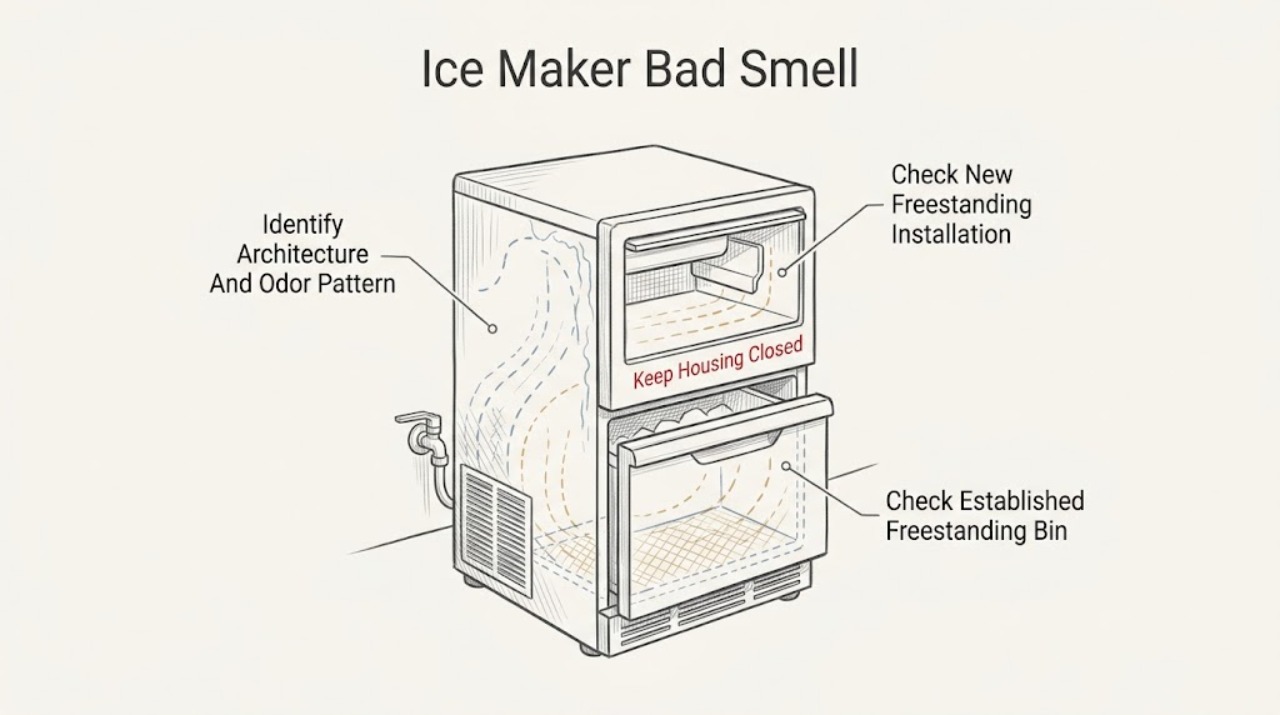
First identify whether your KitchenAid unit is a freestanding ice maker or an ice maker built into a refrigerator, and record the model number. For a newly installed freestanding unit, KitchenAid points to an unwashed storage bin, remaining packaging, the water-supply line, and mineral scale as possible odor sources. For an established freestanding unit, its guidance adds food stored in the bin, model-fitted filter condition, and the need for the approved cleaning cycle. For a refrigerator-built-in ice maker, KitchenAid says odors can transfer from improperly stored food through circulating refrigerator air, and a new plumbing connection or overdue filter can affect ice and water. Discard affected ice, clean only the removable or model-documented areas, and follow the exact owner's manual. Stop and arrange qualified service for a burning or electrical smell, leaks near electrical parts, persistent odor after the correct cleaning, or any need to open panels or work on internal water, wiring, or refrigeration parts.
Before you begin
Safety first
- Do not remove the cabinet or refrigerator panels, open water or refrigeration circuits, bypass an ice-maker switch, disconnect internal wiring, handle refrigerant, or perform live electrical tests. For smoke, burning or electrical odor, sparking, a hot or damaged cord, or water near an outlet or controls, stop using the appliance and isolate power only if safe before obtaining qualified service.
Work through in order
Diagnostic checks
Use only checks that match the exact appliance or system and its official guide.
-
Check 1
With the ice maker stopped and safe to approach, record the complete model number and identify whether it is a freestanding ice maker or part of a refrigerator. Note whether the smell is in the ice only, the storage bin, the refrigerator air, or the dispensed water as well.
Expected result: The appliance is freestanding, refrigerator-built-in, or cannot be identified safely; the odor affects ice only or also affects water and the cabinet air.
Next step: Use the matching branch below and locate the exact owner's manual before removing a bin, changing a filter, or starting a clean cycle.
Stop if: Do not move an unstable appliance, remove a cabinet panel, or touch a wet or damaged cord to read the label.
Why this matters
Why: KitchenAid publishes different checks for freestanding and refrigerator ice makers. Ice-only odor points toward the bin, ice-maker surfaces, water path, or scale; odor also present in refrigerator air makes food or interior odor transfer more likely.
-
Check 2
If the unit is a newly installed freestanding KitchenAid ice maker, inspect only the accessible storage bin and installation area for leftover packaging, and confirm from the model instructions that the documented cold-water supply line is being used.
Expected result: The bin was not washed, packaging remains, the supply line does not match the model instructions, or none of those conditions is present.
Next step: Discard affected ice, wash the accessible bin as the manual directs, remove only clearly identified packaging, and correct the supply installation only through the documented procedure. Recheck a fresh batch after the manual's required flush or discard period.
Stop if: Do not pull on water tubing, open fittings, or remove panels to reach packaging or internal plumbing.
Why this matters
Why: KitchenAid identifies an unwashed bin, packaging transfer, and an unsuitable water-supply line as possible causes of off odor or taste on its newly installed freestanding models. Their absence makes mineral scale, water quality, or a persistent internal fault more relevant, but does not prove one.
-
Check 3
For an established freestanding unit, remove all ice, check that no food or other item is stored in the bin, and look for visible mineral scale or a cleaning-needed/clean-cycle indication. Start the approved clean cycle only if that exact model documents it.
Expected result: Food or residue is in the bin, scale or a cleaning indicator is visible, ice production has decreased, or the bin and indicator look normal.
Next step: Clean the bin and the applicable freestanding system with the approved cleaner and exact manual procedure; let the system complete its documented rinse, then discard affected ice and reassess.
Stop if: Do not remove hoses, reach into an energized cutter-grid area, or improvise bleach, vinegar, or other chemicals in the water system.
Why this matters
Why: Food can transfer odor, while KitchenAid says mineral deposits and a cleaning indicator or reduced production are signs that the freestanding system needs its documented cleaning. A normal-looking bin does not rule out an internal water-path problem.
-
Check 4
For a refrigerator-built-in KitchenAid ice maker, inspect wrapped food, spills, and the refrigerator/freezer air for a matching odor. If the exact model has a water filter, compare its indicator or installation date with the owner's manual, and remove only the documented bin or other removable parts for hand cleaning.
Expected result: The cabinet air or food has the same odor, the filter is due or incorrectly seated, removable parts have residue, or the odor is isolated to ice with no visible source.
Next step: Correct the food-storage or removable-part issue, replace the filter only when the model calls for it, and follow the cleaning article/manual. Run the maker and discard the first 2 to 3 batches before judging the result.
Stop if: Do not force an in-door bin, wash a part in a dishwasher when the manual forbids it, or remove the refrigerator's panels or water tubing.
Why this matters
Why: KitchenAid says circulating air can transfer strong food odors to ice and water, and that a clogged or improperly installed filter can reduce water flow; residue in a removable bin can directly affect stored ice. An isolated persistent odor after these checks needs model-specific evaluation.
-
Check 5
After the correct architecture-specific cleaning and discard period, reassess the smell and check externally for leaks, unusual heat, an unresponsive control, or an odor that resembles burning plastic, solvent, or electrical insulation.
Expected result: The smell is gone, it returns in new batches, a leak or abnormal heat is present, or the odor is clearly hazardous.
Next step: Return to normal use only when the ice is odor-free and the model instructions are satisfied. Otherwise document the model, architecture, timing, cleaning performed, filter or plumbing changes, and observations for qualified service.
Stop if: For burning or electrical odor, smoke, sparking, water near controls or an outlet, or a hot/damaged cord, stop using the appliance and isolate power only if safe. Never perform a live electrical test or open the sealed system.
Why this matters
Why: A resolved odor supports a removable contamination or water-quality path. Recurrence after correct cleaning, an internal-looking leak, abnormal heat, or a hazardous odor is not evidence that another cleaner will fix the appliance and may involve internal water, electrical, or refrigeration components.
Use your observations
Decision map
Find the observation that best matches what you see, then follow the next safe action.
-
PATH 01Next step
What you see
The model is a freestanding KitchenAid ice maker and the smell began immediately after installation or during the first batches.
Do this next
Discard the affected ice, complete only the model-documented bin and installation correction, and reassess fresh ice. Escalate if the odor persists without an accessible cause.
Why this path and its safety boundary
Why it matters: The first pattern is consistent with the installation and first-use causes KitchenAid lists for newly installed freestanding units; clear checks shift attention to water quality, scale, or the exact model's manual.
-
PATH 02Next step
What you see
The model is a freestanding KitchenAid ice maker that previously made acceptable ice and now has odor, visible scale, reduced production, a cleaning indicator, or an item other than ice in the bin.
Do this next
Use the exact freestanding clean-cycle and approved-cleaner procedure, then discard affected ice. Arrange service if odor returns after a correct cleaning or if the procedure cannot complete.
Why this path and its safety boundary
Why it matters: The first pattern favors removable contamination or mineral buildup described in KitchenAid's freestanding guidance. Clean visible surfaces and no indicator make an internal water-path or water-quality issue more relevant, not confirmed.
-
PATH 03Next step
What you see
The ice maker is built into a KitchenAid refrigerator and the odor is also present in the refrigerator/freezer air, follows a strong-smelling food, appeared after plumbing work, or coincides with a due or poorly seated filter.
Do this next
Correct food storage and clean documented removable parts, replace the model-approved filter if due, and discard 2 to 3 fresh batches after cleaning. Escalate persistent isolated odor.
Why this path and its safety boundary
Why it matters: Matching cabinet odor or a recent plumbing/filter change fits KitchenAid's refrigerator-specific odor paths. Ice-only recurrence after those external checks is not proof of a bad filter and needs the model's manual or service path.
-
PATH 04Safety boundary
What you see
The odor is burning, electrical, solvent-like, or accompanied by smoke, sparking, water near electrical parts, unusual heat, a leak, or recurrence after architecture-specific cleaning.
Do this next
Stop using the appliance, isolate power only if safe, preserve the model and symptom notes, and arrange qualified appliance service.
Why this path and its safety boundary
Why it matters: This pattern is outside a safe surface-cleaning diagnosis and may involve internal electrical, water, pump, or refrigeration components. Repeated cleaning, resets, or part substitution could increase the risk.
Safety stop: Do not open panels, bypass controls, handle refrigerant, disconnect internal wiring, or perform live tests.
Helpful context
Understand the symptom
Start by identifying the ice-maker architecture
Do not begin with a generic filter or drain instruction. A freestanding KitchenAid ice maker has its own storage bin, water pan, clean-cycle control, and air-cooled condenser in the applicable help pages. A refrigerator-built-in ice maker may be in an in-door, pull-out, or top-freezer arrangement with a removable bin whose removal method varies by model. Record the full model number, where the smell is strongest, whether the water also smells, and whether the odor began after installation, a plumbing change, food storage, or a long period without cleaning.
New freestanding units have a different first-use path
KitchenAid's newly installed freestanding guidance says to check whether the storage bin was washed before first use, whether all packaging was removed, and whether the recommended cold-water supply line is installed. It also explains that minerals removed during freezing can form a hard, scaly deposit. Discard the affected ice, wash the bin if the model permits, and inspect only visible installation items. Do not substitute this freestanding checklist for a refrigerator ice maker or assume that an unidentified model has the same water connection.
Established freestanding units need a scale and bin check
On an established freestanding KitchenAid ice maker, check that the bin contains ice only, note any visible scale or a cleaning-needed indicator, and use the model's documented cleaning procedure. KitchenAid's cleaning page specifies an approved ice-maker cleaner and a clean cycle for the applicable freestanding architecture; it also warns that hard water can require more frequent cleaning. Follow the exact manual and cleaner label, and never remove hoses or improvise a chemical mixture. If the odor remains after a correctly completed cleaning and fresh ice cycle, stop treating it as a surface-cleaning issue.
Refrigerator-built-in ice can pick up food or plumbing odors
For a KitchenAid refrigerator ice maker, inspect the refrigerator and freezer for uncovered, spoiled, or strongly scented food and for spills, because KitchenAid says air circulates between the sections and odors can transfer to ice and water. If the model has a water filter, use its indicator and owner's manual for replacement timing; do not install a filter by appearance alone. After cleaning, replace the documented removable parts, run the maker, and discard the first 2 to 3 batches. A new plumbing connection or supply line should be handled according to the installation instructions rather than by guessing at a flush or fitting.
Know when odor is a service problem
A burning-plastic, electrical, solvent-like, or refrigerant-related smell is not a cleaning diagnosis. Turn the appliance off; if a plug, outlet, controls, or nearby floor is wet, isolate power only if it can be done safely without touching damaged parts, and keep the unit out of service. Do not remove the cabinet, probe wiring, bypass an ice-maker switch, open a water valve or sealed refrigeration circuit, or perform live tests. Persistent odor after the correct model-specific cleaning, an internal-looking leak, abnormal heat, or a failed clean cycle needs qualified appliance service with the model number and observations recorded.
When checks do not resolve it
Need a professional?
Call qualified service when the smell persists after the correct KitchenAid procedure for the identified architecture, returns in fresh batches, or is accompanied by a leak, unusual heat, failed controls, smoke, sparking, or a burning/electrical odor. Have the complete model number, architecture, odor description, timing, water or filter changes, cleaning steps, and discarded-batch result ready. Do not open panels or perform live tests.
Safety scope: Do not remove the cabinet or refrigerator panels, open water or refrigeration circuits, bypass an ice-maker switch, disconnect internal wiring, handle refrigerant, or perform live electrical tests. For smoke, burning or electrical odor, sparking, a hot or damaged cord, or water near an outlet or controls, stop using the appliance and isolate power only if safe before obtaining qualified service.
Common questions
FAQ
Can I use the freestanding ice-maker cleaning steps on a KitchenAid refrigerator ice maker?
No. KitchenAid documents a clean cycle and water-pan procedure for applicable freestanding ice makers, while refrigerator ice makers can use different in-door, pull-out, or top-freezer bins. Identify the model and follow its owner's manual before using a cleaner or removing a part.
Why does a new KitchenAid freestanding ice maker smell?
KitchenAid lists an unwashed storage bin, packaging left inside, an unsuitable cold-water supply line, and mineral deposits as possible causes for a newly installed freestanding unit. Discard affected ice and correct only the accessible, model-documented issue.
Can food in the refrigerator make KitchenAid ice smell?
Yes, for a refrigerator-built-in ice maker. KitchenAid says potent or improperly stored food can transfer odor through circulating air between the refrigerator and freezer, and recommends discarding odd-smelling ice while the source is corrected.
Should I replace the water filter when KitchenAid ice smells bad?
Only if the exact refrigerator or ice-maker model has a filter and its indicator, installation date, or manual says it is due. KitchenAid's refrigerator guidance recommends replacement at six months, when the indicator comes on, or as needed; its freestanding guidance describes filtration only for applicable models, so do not assume every unit has the same filter.
How many batches should I discard after cleaning a KitchenAid refrigerator ice maker?
KitchenAid's refrigerator cleaning article says to run the ice maker and throw out the first 2 to 3 batches so lingering taste or odor is not served. Use the owner's manual if it specifies a different procedure for your model.
Read the exact guide
Official sources
- Ice has Off Taste or Odor - Newly Installed - Freestanding Ice Maker - Product Help | KitchenAidKitchenAid · Specific to newly installed KitchenAid freestanding ice makers; not a universal refrigerator ice-maker procedure.
- Cleaning the Ice Maker - Product Help | KitchenAidKitchenAid · Freestanding KitchenAid ice-maker cleaning page; use the exact model manual for control and component differences.
- How to Clean an Ice Maker in a Refrigerator - KitchenAidKitchenAid · Refrigerator ice makers; bin design and permitted cleaning products vary by model and owner's manual.
- Ice has Odor or Off Taste - Product Help | KitchenAidKitchenAid · KitchenAid full-size built-in refrigerator ice and water systems; filter, plumbing, and controls remain model-specific.
- Why the Freestanding Ice Maker Should be Cleaned? - Product Help | KitchenAidKitchenAid · Freestanding KitchenAid ice makers; cleaning frequency varies with water hardness and model guidance.
- Ice has Off Taste or Odor - Freestanding Ice Maker - Product Help | KitchenAidKitchenAid · Established freestanding KitchenAid ice makers; filter references apply only to models equipped with the documented filter.
Community feedback
Share a repair observation
Share a plain-text repair observation. Accepted observations are published automatically; this page may take a moment to update.