
On this page
Start here
Quick answer
First establish whether the KitchenAid ice maker is a freestanding/undercounter unit or an ice maker built into a refrigerator; the same sound has different likely sources in those two families. On a freestanding unit, splashing, water running during the initial rinse, a bang when ice drops, reservoir overflow, and a compressor hum can be normal. On a refrigerator-integrated unit, a brief water-valve buzz or click during fill, a low compressor or fan hum, gentle gurgling, and cracking as ice is ejected can also be normal. Record the sound, when it occurs, and whether ice production continues. Then check only the matching water, level, clearance, filter, bin, and accessible-cleaning items in the exact model guidance. A persistent grinding, vibration, leak, damaged connection, or sound that appears with failed ice production needs qualified service; do not open sealed refrigeration or electrical components.
Before you begin
Safety first
- Owner checks stop at identifying the appliance family, recording sound timing, observing accessible water/level/clearance conditions, and following model-approved external cleaning or control steps. Plumbing pressure adjustment, electrical testing, sealed-system access, panel removal, moving mechanisms, and part replacement require qualified service.
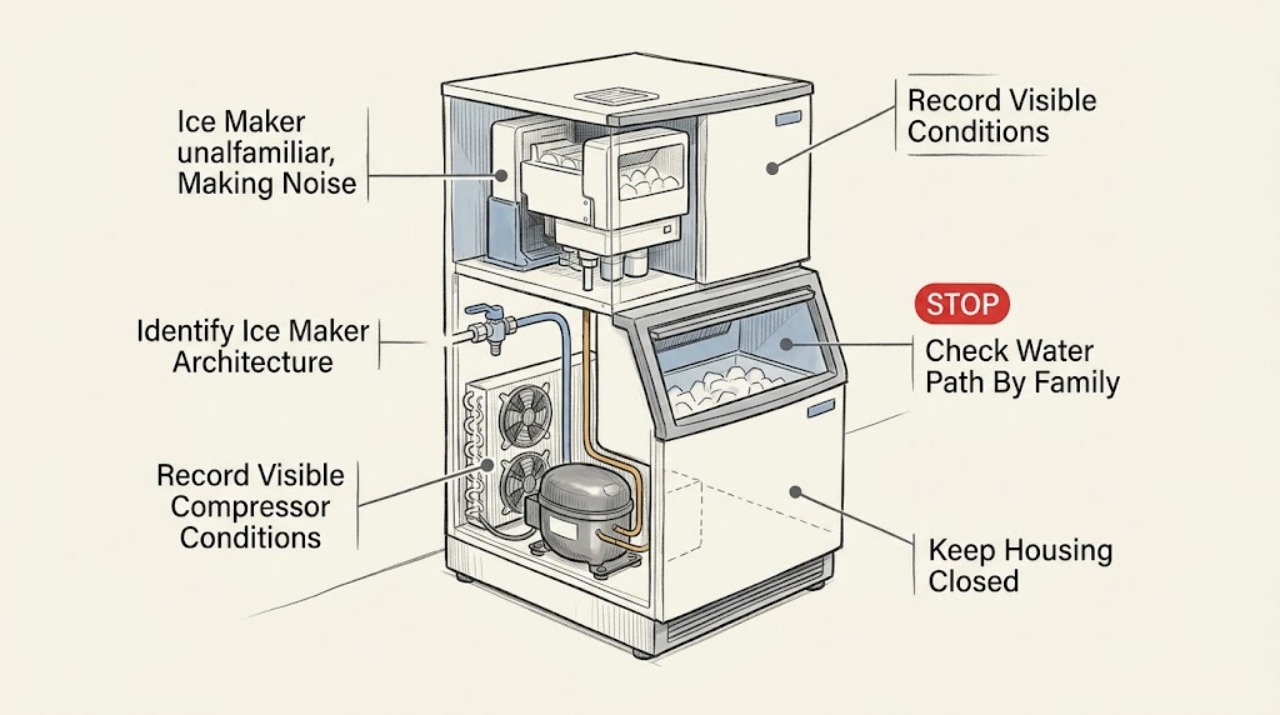
Work through in order
Diagnostic checks
Use only checks that match the exact appliance or system and its official guide.
-
Check 1
Identify whether the noisy KitchenAid ice maker is a freestanding or undercounter machine with its own cabinet and bin, or an ice maker installed inside a KitchenAid refrigerator. Record the exact model number before applying a sound description or maintenance step.
Expected result: The ice maker is freestanding/undercounter, built into a refrigerator, or the installation type and model cannot be confirmed.
Next step: Use the freestanding checks only for a freestanding/undercounter unit and refrigerator checks only for an integrated unit. If the model or architecture is unclear, stop at recording the sound and obtain the model guide or service assistance.
Stop if: Do not remove an ice maker, refrigerator panels, or sealed-system covers to identify the architecture.
Why this matters
Why: KitchenAid publishes different normal-sound explanations for freestanding ice makers and refrigerators. Without the family and model, a sound cannot be safely mapped to a valve, compressor, fan, or ice-ejection event.
-
Check 2
From outside the appliance, note whether the sound occurs during water fill, the initial rinse, ice release into the bin, refrigerator cooling or defrost, dispensing, or continuously. Describe it as a hum, buzz, click, splash, bang, gurgle, crack, rattle, grinding sound, or vibration, and note whether the unit is still making ice.
Expected result: The sound matches a documented fill, rinse, ice-drop, cooling, defrost, or ejection event and ice production continues, or it is continuous, harsh, unrelated to an event, or accompanied by reduced/no ice production.
Next step: For a matched normal event, continue with the architecture-specific water and placement checks. For a harsh, persistent, or production-related symptom, keep a record and arrange model-specific service rather than selecting a part by sound.
Stop if: Do not hold a fan, valve, auger, or ejector in place, reach into moving ice-making parts, or reproduce a suspected failure repeatedly.
Why this matters
Why: A sound tied to a documented operating event is more likely normal for that appliance family. An event-independent or worsening sound, especially with failed ice production, is not diagnosed by the normal-sound list alone.
-
Check 3
For a freestanding unit, observe whether the water supply is connected and whether a high-pitched sound occurs only during filling. For a refrigerator-integrated unit, check only that the ice maker is enabled when a water supply is present, that the accessible line is not kinked, and that the filter is seated as the exact refrigerator guide describes.
Expected result: The freestanding sound occurs during fill with suspected high supply pressure, or the refrigerator valve buzzes/clicks while the ice maker is on but the water supply is absent, restricted, or misrouted.
Next step: For suspected freestanding pressure, use a licensed qualified plumber. For a refrigerator without a water connection, turn the ice maker off using the exact model control; for a kink, filter, or leak, stop before plumbing disassembly and arrange qualified help.
Stop if: Do not adjust household pressure, disconnect a water line, handle a leaking fitting, or continue if water can reach electrical parts.
Why this matters
Why: KitchenAid associates freestanding high-pitched fill noise with water pressure above its stated range. It associates refrigerator buzz/click during fill with the water valve, including an ice maker left on without a water connection; neither observation proves a failed valve.
-
Check 4
For a freestanding unit, check from outside that it sits on a level, solid surface away from a wall or appliance that can amplify vibration, and clean only the accessible condenser and bin as the model instructions permit. For a refrigerator-integrated unit, observe whether the cabinet is level, clearances are blocked, items on top are vibrating, or the accessible condenser area needs model-approved cleaning.
Expected result: The freestanding unit is unstable, touching an amplifying surface, dusty, or has ice buildup in the bin, or the refrigerator is visibly unlevel, obstructed, or transmitting vibration from loose items.
Next step: Correct only a clearly accessible placement or loose-item issue and reassess once. Follow the exact model's cleaning procedure; if the noise remains harsh or the machine cannot make ice, arrange service.
Stop if: Do not pull out a built-in refrigerator, remove a rear panel unless the exact model allows it safely, work near energized parts, or scrape ice from an inaccessible mechanism.
Why this matters
Why: KitchenAid identifies level placement, condenser cleanliness, bin condition, refrigerator leveling, clearances, and loose items as factors that can increase operating noise. Correcting an external condition does not prove an internal component is sound.
-
Check 5
Record the model, architecture, sound description, timing, ice-production result, water-path observations, and any leak or electrical symptom. Stop operating when the sound is grinding, persistently harsh, associated with a leak or damaged connection, or accompanied by loss of ice production.
Expected result: The noise resolves after a safe external correction and the appliance continues its documented operation, or it persists, worsens, or occurs with a leak, damaged cord/plug, abnormal heat, or failed ice production.
Next step: If the symptom persists or a hazard is present, keep the appliance off as appropriate and contact KitchenAid or a qualified appliance technician with the recorded observations. Use qualified electrical or plumbing service for those systems.
Stop if: Do not open electrical or sealed refrigeration components, bypass controls, perform live tests, or order a motor, valve, fan, compressor, or ice-maker assembly from the sound alone.
Why this matters
Why: A resolved external vibration or documented operating sound is not evidence of a part failure. Persistent or hazardous behavior requires model-specific diagnosis; sound alone cannot establish a compatible replacement part.
Use your observations
Decision map
Find the observation that best matches what you see, then follow the next safe action.
-
PATH 01Safety boundary
What you see
The unit is a freestanding or undercounter KitchenAid ice maker, and the sound is splashing, initial water running, a bang as ice drops, reservoir overflow, or a soft compressor-related sound while ice production continues.
Do this next
Check level placement, clearance from sound-amplifying surfaces, accessible condenser cleanliness, and ice-bin condition according to the exact model guide. Reassess once without forcing or opening the machine.
Why this path and its safety boundary
Why it matters: These sounds match KitchenAid's freestanding ice-maker descriptions and are more likely part of the normal ice-making cycle than a confirmed failed component.
Safety stop: Stop for grinding, harsh persistent vibration, leaking water, damaged electrical parts, or loss of ice production.
-
PATH 02Safety boundary
What you see
The ice maker is inside a KitchenAid refrigerator, and the sound is a brief fill buzz/click, low hum, gentle gurgle, soft airflow, or cracking/banging timed to ice ejection or another refrigerator cycle.
Do this next
Check the exact refrigerator model's water connection, ice-maker-on setting, filter/line condition, level, and clearances. If the sound persists outside those events or ice production stops, arrange service.
Why this path and its safety boundary
Why it matters: KitchenAid describes these as normal refrigerator or ice-maker-related sounds when they coincide with filling, cooling, defrost, or ice release. The location near the ice maker does not by itself identify an ice-maker failure.
Safety stop: Do not reach into the ejector or fan, remove refrigerator panels, or continue if there is a water leak, damaged cord/plug, smoke, or abnormal heat.
-
PATH 03Safety boundary
What you see
The freestanding unit produces a high-pitched sound only while filling, or a refrigerator ice maker buzzes/clicks while it is enabled without a connected water supply or with a restricted line/filter.
Do this next
Use a licensed qualified plumber for freestanding pressure evaluation. For a refrigerator without water connected, turn the ice maker off using the model controls; for a restricted or leaking line/filter, stop and arrange qualified plumbing or appliance service.
Why this path and its safety boundary
Why it matters: The water-fill path is a more relevant next check than a compressor or motor diagnosis. KitchenAid specifically connects freestanding high-pitched fill noise with high supply pressure and refrigerator buzz/click with the fill valve.
Safety stop: Do not change water pressure, loosen fittings, disconnect hoses, or handle water near electrical parts.
-
PATH 04Safety boundary
What you see
The noise is grinding, harsh, continuously vibrating, unrelated to a documented operating event, worsening, or accompanied by no ice, a leak, damaged electrical connection, smoke, or abnormal heat.
Do this next
Stop use as appropriate, isolate water or power only from a safe accessible position when necessary, and arrange KitchenAid or qualified appliance service with the exact model and sound record.
Why this path and its safety boundary
Why it matters: The normal-sound sources do not establish a safe user-level repair or identify a compatible part for this pattern. Continuing to run the unit can worsen a mechanical, water, or electrical fault.
Safety stop: Do not recreate the noise, bypass controls, probe wiring, open sealed refrigeration components, or select a motor, valve, fan, compressor, or ice-maker part from the sound alone.
Helpful context
Understand the symptom
Start by separating the two ice-maker families
A freestanding or undercounter KitchenAid ice maker has its own compressor, water reservoir, evaporator plate, condenser area, and ice bin. A refrigerator-integrated ice maker shares the refrigerator's water valve, fans, compressor, defrost system, and cabinet, so a noise heard near the ice maker may actually be a refrigerator operating sound. KitchenAid publishes separate guidance for freestanding ice-maker noises and refrigerator noises; use the exact model manual before treating a sound as a failed part.
Match the sound to the event, not just the volume
On a freestanding unit, splashing or water running can occur while the machine fills or rinses, and a bang can be louder when ice falls into an empty bucket. On a refrigerator-integrated unit, a brief buzz or click may happen as the water valve fills the ice maker, while a hum, gurgle, crack, or soft airflow sound may come from the refrigerator's normal cooling, defrost, or ice-ejection cycle. A loud sound that has no matching event, is becoming harsher, or accompanies loss of ice production is not identified by these normal-sound descriptions alone.
Use architecture-specific water and placement checks
For a freestanding unit, an unlevel surface, nearby wall or cabinet, dusty condenser, or ice buildup can amplify vibration or make the machine work harder. For a refrigerator-integrated unit, check only accessible leveling, clearances, water-line routing, and filter seating described for that refrigerator. A high-pitched freestanding fill sound can be related to supply pressure above KitchenAid's stated range; pressure reduction is plumbing work for a qualified professional, not a user adjustment at the appliance.
Escalate when the noise is not a documented operating sound
Stop short of diagnosing a motor, valve, fan, compressor, sealed-system, or ice-maker assembly from sound alone. If the noise is grinding, repeated harsh vibration, accompanied by a water leak, damaged cord or plug, abnormal heat, or loss of ice production, keep the appliance off as appropriate and arrange KitchenAid or qualified appliance service. Do not remove sealed-system covers, probe wiring, bypass an ice-maker control, or use a pressure gauge unless the exact model procedure and qualified service scope require it.
Safety boundary
Stop conditions
- Stop using the ice maker or refrigerator for a water leak near electrical parts, smoke, abnormal heat, a damaged cord or plug, or a persistent harsh sound with loss of ice production.
- Do not reach into moving ejectors, fans, or augers, hold a valve or motor in place, or open a cabinet to reproduce a noise.
- Do not adjust water pressure, disconnect plumbing, remove sealed-system covers, bypass ice-maker controls, or perform live electrical tests without qualified service and the exact model procedure.
- Do not order a motor, water valve, fan, compressor, or ice-maker assembly from the sound alone; confirm the model and diagnosis first.
When checks do not resolve it
Need a professional?
Arrange KitchenAid or qualified appliance service when the noise is persistent, grinding, harsh, or unrelated to a documented fill, cooling, defrost, or ice-ejection event; when ice production stops; or when a leak, damaged electrical connection, abnormal heat, smoke, or repeated vibration is present. Use a licensed qualified plumber for suspected freestanding fill-pressure problems and qualified electrical service for a damaged power connection.
Safety scope: Owner checks stop at identifying the appliance family, recording sound timing, observing accessible water/level/clearance conditions, and following model-approved external cleaning or control steps. Plumbing pressure adjustment, electrical testing, sealed-system access, panel removal, moving mechanisms, and part replacement require qualified service.
Common questions
FAQ
Why is my KitchenAid ice maker making a buzzing sound?
On a freestanding unit, listen for whether the buzz occurs only during water fill; KitchenAid connects a high-pitched fill sound with high supply pressure. In a refrigerator, a brief buzz or click can occur as the water valve fills the ice maker, especially if the ice maker is on without a water connection. Check the exact model's water path and turn the ice maker off when no water supply is connected.
Is a loud bang from a KitchenAid ice maker normal?
It can be normal when ice drops into the bucket, especially when the bucket is empty. That explanation applies to KitchenAid freestanding ice makers and should not be used to dismiss continuous grinding, harsh vibration, a leak, or loss of ice production.
Why does my freestanding KitchenAid ice maker make a splashing sound?
KitchenAid says water moving from the evaporator plate to the water pan can make a splashing sound, and water may run during the initial rinse. Match the sound to that event and confirm that the machine continues making ice; an unrelated or worsening noise needs service.
Are clicking and cracking sounds normal in a KitchenAid refrigerator ice maker?
A brief water-valve click can occur during ice-maker fill, and cracking can occur as ice is ejected or refrigerator materials contract and expand. The sound should be tied to that operating event. Continuous harsh clicking, grinding, failed ice production, or a leak is not established as normal by the sound list.
How can I make a KitchenAid ice maker quieter?
For a freestanding unit, check level placement, distance from walls or sound-amplifying appliances, accessible condenser cleanliness, and ice-bin buildup. For a refrigerator, check accessible leveling, clearances, loose items, water-line routing, and filter seating according to the exact model. Do not pull out a built-in unit or open panels just to reduce noise.
When should I call for a noisy KitchenAid ice maker?
Arrange service when the noise is grinding, harsh, persistent, unrelated to a documented fill/cooling/defrost/ice-release event, or accompanied by no ice, a leak, damaged electrical parts, smoke, or abnormal heat. Do not select a valve, motor, fan, compressor, or ice-maker assembly from the sound alone.
Read the exact guide
Official sources
- Freestanding Ice Maker NoisesKitchenAid Product Help · KitchenAid freestanding or undercounter ice makers; do not generalize its component layout to an ice maker inside a refrigerator.
- Buzzing Noise - Built-In RefrigeratorKitchenAid Product Help · Built-in refrigerator page; use only for the documented unconnected-water-supply buzz/click and ice-maker-off check, not for internal part diagnosis.
- Refrigerator Normal Sounds and NoisesKitchenAid Product Help · KitchenAid full-size refrigerators; exact sound level and component arrangement vary by model.
- Tapping or Thumping Noise - Freestanding Ice MakerKitchenAid Product Help · KitchenAid freestanding ice makers; the described noise is tied to ice falling into the bucket.
- Water Circulating Noise - Freestanding Ice MakerKitchenAid Product Help · KitchenAid freestanding ice makers; exact controls and model behavior remain model-dependent.
- Owner's ManualKitchenAid · KitchenAid refrigerator owner manual for the covered model family; exact model manual controls the applicable sound and service procedure.
- Refrigerator Noise - BuzzingKitchenAid Product Help · KitchenAid full-size refrigerator guidance; it does not prove a valve or other part failure from buzzing alone.
Community feedback
Share a repair observation
Share a plain-text repair observation. Accepted observations are published automatically; this page may take a moment to update.