
On this page
Start here
Quick answer
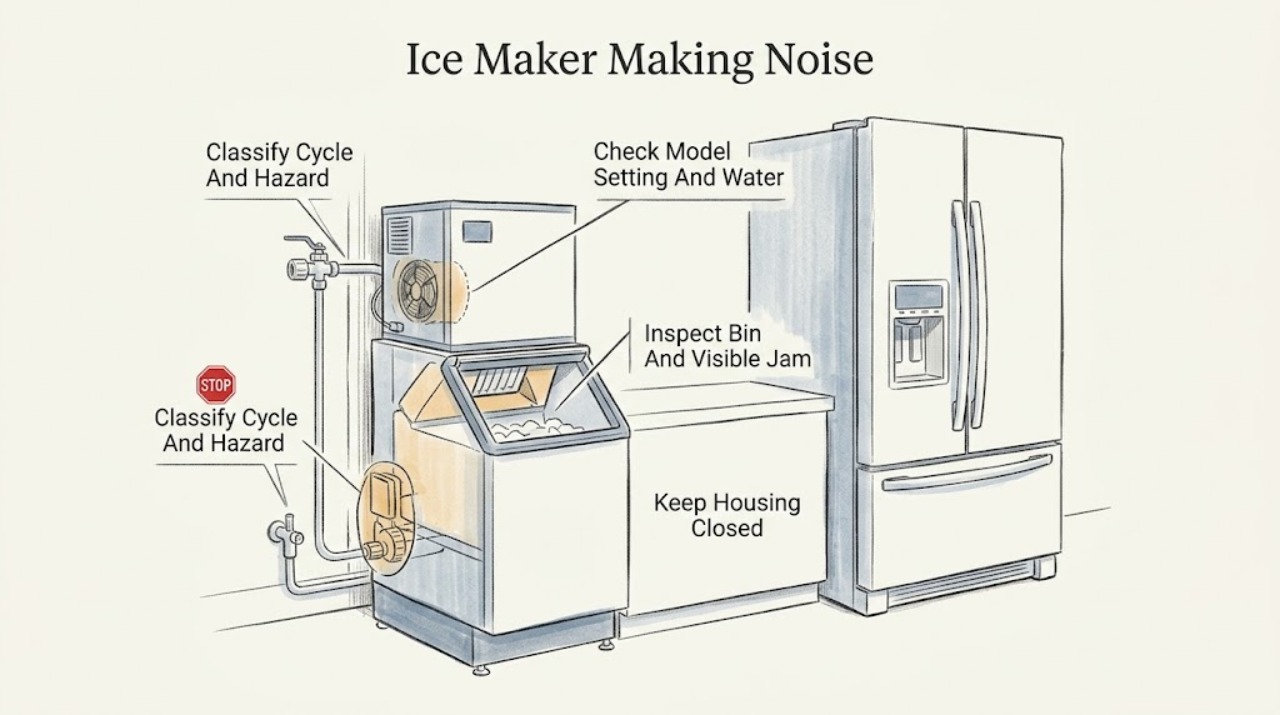
First identify when the noise occurs and whether the ice maker is actually making or dispensing ice. Electrolux says that a buzz can occur when the water valve fills the ice maker, a clunk or water-running sound can occur as cubes fall into the bin, and the ice-maker fan, valve, and refrigerant can make sounds during an ice-making cycle. Brief clicks from a chute or control can also be cycle-related. If the ice maker is switched on without a connected water supply, Electrolux warns that the fill valve may chatter loudly; turn that feature off until the supply is available. From outside, check the exact model's ice-maker setting, visible supply connection, bin seating, accessible ice jam, and cabinet contact. Do not hammer or chip ice, remove panels, reach a fan or valve, bypass an interlock, or make an energized test. Stop for grinding, scraping, harsh repeated clicking, smoke, burning odor, a leak near electrical parts, a hot or damaged cord, or repeated breaker operation; persistent abnormal noise or a noise with poor ice production needs qualified service.
Before you begin
Safety first
- The user may identify the exact model, listen from a dry position, use documented controls, check a visible water supply, inspect a removable bin or visible jam as the manual permits, and correct visible contact or seating. Panel removal, internal ice-maker or dispenser access, fan, motor, valve, auger, wiring, interlock, energized testing, and sealed-system work are for qualified personnel.
Work through in order
Diagnostic checks
Use only checks that match the exact appliance or system and its official guide.
-
Check 1
From a dry position, listen only long enough to record whether the noise occurs during water fill, harvest, cube drop, dispensing, startup, defrost, or continuously. Compare the timing with a brief fill buzz, cube-drop clunk, water-running sound, fan sound, or chute click described in the exact Electrolux guide. Look for smoke, sparks, burning odor, abnormal heat, a hot or damaged cord, water near electrical parts, or a breaker trip.
Expected result: The sound is brief and cycle-linked with normal ice output; it is a new scrape, grind, squeal, or harsh repeated click; it continues between cycles; or a hazard sign is present.
Next step: For a documented-sounding noise without hazards, continue with the external water, bin, jam, and contact checks. For a harsh or hazardous noise, stop the refrigerator's ice-making function and isolate power only from a dry, safe location if needed, then arrange qualified service.
Stop if: Do not restart repeatedly to reproduce smoke, sparks, burning odor, abnormal heat, water near electrics, or repeated breaker operation.
Why this matters
Why: A stable sound that follows fill, harvest, drop, or dispensing is more consistent with documented operation. A cycle-independent or worsening mechanical sound is not identified by the normal list. A hazard sign overrides further listening.
-
Check 2
Identify the full Electrolux model and region, then read the exact manual's ice-maker controls. Check from outside that the ice maker is ON only when a water supply is connected, that a visible shutoff is open if the installation provides one, and that an accessible inlet hose is not kinked or pulling on its fitting. Do not disconnect a water line or open a cover.
Expected result: The ice maker is enabled with no water supply, the visible supply is closed or kinked, the supply is normal, or the noise remains after the ice maker is turned off using the documented control.
Next step: If there is no water supply, turn the ice maker OFF and leave it off until connected. Correct only a visible valve or hose condition permitted by the installation instructions, then monitor one normal cycle. If the sound persists with the ice maker off or the supply correction does not change it, stop troubleshooting internally and arrange service.
Stop if: Do not pull the refrigerator, loosen water fittings, open the rear cover, reach a valve, or continue if water leaks or approaches electrical parts.
Why this matters
Why: Electrolux says an enabled fill valve without water can make loud chattering. A visible supply condition can explain repeated fill attempts, while noise that continues with the ice maker off makes an ice-making fill event less likely and needs broader refrigerator service diagnosis.
-
Check 3
If the noise occurs during dispensing or the bin is not seated, switch the ice maker or dispenser off as the exact manual directs. With moving parts stopped, inspect only the removable ice bin and visible chute for loose or bridged cubes; remove the bin only if the manual permits, let stuck ice thaw, empty and clean it, dry it, and reseat it. Never hammer, chip, pry, or force frozen ice.
Expected result: A visible jam clears and the bin reseats; cubes are packed around a chute or auger; the visible area is clear but the noise continues; or the bin cannot be removed without force.
Next step: After the bin is dry and correctly seated, perform only the manual's normal, hazard-free dispensing check. If the noise returns, the bin will not seat, or the obstruction is behind a cover, leave the ice maker or dispenser off and arrange qualified service.
Stop if: Do not use a knife, screwdriver, hammer, hot air, or other tool on ice; do not reach into a chute, auger, fan, or motor housing.
Why this matters
Why: A noise that stops after an accessible jam is cleared supports a bin or chute obstruction. A jam that is inaccessible, recurs, or needs force may involve the dispenser drive or internal mechanism. A clear bin with persistent noise does not prove a failed motor or fan.
-
Check 4
Without accessing the rear, check that the refrigerator is stable, that the ice bin and user-accessible covers are seated, and that no item inside, on top, beside, or behind an accessible edge is touching the cabinet. Confirm that the ventilation and clearance specified for the exact installation are not blocked. Correct only a visible object, seating, or cabinet-contact problem.
Expected result: The sound changes when a visible contact or loose bin is corrected; the cabinet is vibrating against a wall or object; ventilation is obstructed; or all visible contact and clearance conditions are normal.
Next step: Keep the appliance stable and clear, then observe one normal cycle if no hazard is present. Do not move a heavy or integrated refrigerator further. If vibration or noise remains, document it for qualified service.
Stop if: Do not pull out or tip the refrigerator, remove rear or interior panels, touch tubing or wiring, or place improvised supports under the appliance.
Why this matters
Why: Electrolux explains that cabinet or pipe contact and inadequate ventilation can transmit or amplify normal refrigerator operating sounds. If external contact and installation conditions are normal, an internal fan, motor, valve, drive, or control issue becomes more plausible, but cannot be identified by sound alone.
-
Check 5
After the safe external checks, record whether ice is being produced, whether dispensing works normally, and whether the noise repeats at the same fill, harvest, drop, or dispense moment. Use only the exact model's documented ON/OFF, bin, and reset controls; do not change several settings or repeatedly cycle the ice maker.
Expected result: Ice output and dispensing are normal and the sound is brief and repeatable; the sound is repeated without water or ice; production is poor or absent; or a display message, leak, temperature change, or electrical symptom accompanies it.
Next step: Continue use only when the sound is documented for the exact model and there is no abnormal performance or hazard. Otherwise leave the ice maker or dispenser off when safe, preserve the diagnostic notes, and arrange qualified service.
Stop if: Do not bypass controls, force a harvest or dispense cycle, make an energized electrical test, or continue operation with a leak or electrical warning sign.
Why this matters
Why: Normal output with a stable cycle-linked sound supports a model-specific operating sound. Repeated chatter without water, noise with poor production, or noise with a leak or performance change makes a supply, obstruction, valve, fan, motor, control, or wiring fault more likely; the observed pattern does not identify which part failed.
-
Check 6
If the noise remains, prepare the exact model and region, a sound recording made from a safe position, the cycle moment, ice and water behavior, display messages, and the visible checks already completed. Leave the ice maker or dispenser off, and leave the refrigerator unplugged only when safe and necessary for a hazard. Do not open the cabinet or attempt an internal diagnosis.
Expected result: The sound stops after a visible correction; remains as a stable documented cycle sound; persists with normal supply, bin, contact, and controls; or is accompanied by grinding, smoke, burning odor, water near electrics, abnormal heat, or repeated protection operation.
Next step: Use the refrigerator normally only when the exact manual supports the sound and no abnormal performance or hazard remains. Otherwise stop the affected function and arrange qualified Electrolux or appliance service with the record.
Stop if: Do not remove panels, reach moving parts, bypass an interlock, handle wiring or valves, chip ice from an inaccessible mechanism, or make live electrical or sealed-system tests.
Why this matters
Why: A corrected visible condition supports an external cause. Persistent or hazardous noise can involve an internal ice-maker motor or fan, fill valve, dispenser drive, wiring, or control, and the sound does not safely select a part.
Use your observations
Decision map
Find the observation that best matches what you see, then follow the next safe action.
-
PATH 01Next step
What you see
The noise is a brief fill buzz, water-running sound, clunk as cubes fall, fan sound, or chute click at the same ice-making or dispensing moment, while ice production and dispensing remain normal and there is no hazard.
Do this next
Keep the bin seated, the installation clear, and the ice maker operated according to the exact manual. Monitor for a change in timing, severity, ice output, or safety condition.
Why this path and its safety boundary
Why it matters: This pattern is consistent with sounds Electrolux documents for ice-making components and refrigerator controls. It is a model-family interpretation, not permission to ignore a newly worsening sound.
-
PATH 02Safety boundary
What you see
The sound is a loud repeated chatter at the attempted fill, the ice maker is ON, and the refrigerator has no connected water supply or the visible supply is not available.
Do this next
Turn the ice maker OFF until the water supply is correctly connected, then follow the exact installation and manual instructions. If chatter continues with a confirmed supply or with the ice maker OFF, arrange service.
Why this path and its safety boundary
Why it matters: Electrolux specifically warns that the fill valve may chatter when the ice maker tries to operate without water. This does not establish a failed valve.
Safety stop: Do not loosen water fittings, access the valve, or keep cycling the ice maker to test it.
-
PATH 03Next step
What you see
The sound occurs during dispensing or the bin does not seat, and visible cubes are bridging the chute or obstructing the removable bin area.
Do this next
Switch the affected function off, thaw and clear only the accessible bin as the exact manual permits, dry and reseat it, and stop if the jam is inaccessible or needs force. A recurring or internal obstruction needs service.
Why this path and its safety boundary
Why it matters: An accessible ice obstruction is more likely than a confirmed motor failure. Electrolux's ice-jam procedure is limited to the user-accessible bin and chute arrangement described for the applicable model.
-
PATH 04Next step
What you see
The sound changes when a visible bin, object, wall, cabinet contact, or installation-clearance issue is corrected, while the refrigerator and ice maker otherwise operate normally.
Do this next
Keep the corrected external condition and monitor one normal cycle. Do not move an integrated or heavy refrigerator farther; arrange service if vibration or noise remains severe.
Why this path and its safety boundary
Why it matters: Cabinet or installation vibration is more likely than an internal ice-maker component fault. Electrolux advises checking ventilation and objects touching the appliance, but the exact installation instructions control.
-
PATH 05Safety boundary
What you see
Grinding, scraping, harsh repeated clicking, or cycle-independent noise persists after the visible supply, bin, jam, contact, and control checks, or the noise is accompanied by poor ice output, a leak, smoke, burning odor, abnormal heat, or repeated protection operation.
Do this next
Turn off the ice maker or dispenser and isolate power only from a dry, safe location when necessary. Arrange qualified Electrolux or appliance service and provide the model, recording, timing, water status, ice output, and visible checks.
Why this path and its safety boundary
Why it matters: An internal fan, motor, fill valve, dispenser drive, control, wiring, or another refrigerator fault is more likely, but a sound cannot identify the failed part. Hazard signs make this an immediate stop-use condition.
Safety stop: Do not restart to reproduce the fault, remove panels, reach moving parts, bypass an interlock, handle wiring or valves, or perform energized testing.
Helpful context
Understand the symptom
The timing of the noise is more useful than the word loud
A short buzz during fill, a clunk when cubes drop, or a brief sound during harvest is different from a grinding noise that continues between cycles. Electrolux's refrigerator guide also lists the ice-maker fan, water valve, and refrigerant as possible sounds during ice making. Note whether the sound occurs at fill, harvest, cube drop, dispensing, startup, or continuously, and whether ice production and dispensing remain normal. Treat a new harsh mechanical or electrical sound as unresolved rather than assuming that another model's normal-sound list applies.
Account for the refrigerator family and water connection
Electrolux ice makers are not laid out identically across top-freezer, French-door, and side-by-side refrigerators. Use the model and region-specific manual for the ice-maker switch, wire arm, bin, dispenser, and reset behavior. If there is no connected water supply, leave the ice maker off; Electrolux explains that an enabled fill valve can chatter when it tries to operate without water. Only inspect a visible shutoff, hose connection, or kink without pulling on tubing or opening the cabinet.
A visible ice jam is a limited user check
If the sound happens while dispensing or the bin will not seat, switch the ice maker or dispenser off according to the exact manual and inspect only the user-removable bin and visible chute area. Electrolux's ice-jam guidance allows removing the bin, letting ice thaw, emptying and cleaning it, then drying and replacing it. Do not hammer, chip, pry, or use force or a heat tool on stuck ice; a jam around an auger, chute, or internal mechanism that remains after the accessible procedure needs service.
Do not mistake cabinet vibration for an ice-maker diagnosis
A refrigerator can transmit a normal compressor, fan, or valve sound through a wall or cabinet. With the appliance stable and the doors closed, check from outside that no object is touching the cabinet, that the bin and accessible covers are seated, and that installation ventilation and clearances match the exact instructions. Correct only visible contact or fit. Do not move a built-in or heavy refrigerator to reach its rear tubing, fan, valve, or wiring.
When the sound points beyond a safe external check
A cycle-linked sound with normal ice output and no hazard may be normal for that model. A persistent scrape, grind, harsh click, fan-like noise with weak production, repeated valve chatter despite a connected supply, leak, or noise that continues when the ice maker is off can involve an internal motor, fan, valve, drive, control, or wiring fault. The sound alone cannot select a replacement part. Record the model, sound timing, ice output, water connection, and any display message, then arrange qualified service when the external checks do not resolve it.
Safety boundary
Stop conditions
- Stop immediately for smoke, sparks, burning or electrical odor, abnormal heat, a hot or damaged cord or plug, water near electrical parts, or repeated breaker or protection operation.
- Stop the ice maker or dispenser if noise is grinding, scraping, harshly clicking, worsening, or accompanied by poor ice production, a leak, or a display warning.
- Do not hammer, chip, pry, or force ice; do not use knives, screwdrivers, hot air, or other tools in a chute or around an internal mechanism.
- Do not remove refrigerator or ice-maker panels, reach a fan, motor, valve, auger, wiring, or control, bypass an interlock, or perform an energized electrical or sealed-system test.
- Arrange qualified service when the noise persists after the exact model's safe external supply, bin, visible-jam, contact, and control checks, or when the noise returns after a temporary correction.
Only after diagnosis
Potential parts
- ice-maker fill valve
Consider this only if qualified diagnosis confirms repeated fill-valve chatter or no fill with a verified water supply and the exact model's valve circuit and water path are at fault.
Confirm the complete refrigerator model and regional fit information; a sound alone does not establish valve failure or compatibility. - ice-maker motor or fan module
Consider this only after qualified diagnosis links persistent grinding or cycle-related noise to the internal ice-maker motor or fan on the exact model.
Verify the exact model, ice-maker layout, and manufacturer's fit information before ordering; do not substitute a generic module from the noise description. - ice dispenser drive or auger assembly
Consider this only when the exact model's accessible bin and chute are clear and qualified diagnosis confirms the noise originates from the internal dispensing drive.
Confirm the complete model and dispenser configuration; top-freezer and dispenser refrigerator arrangements are not interchangeable by appearance.
When checks do not resolve it
Need a professional?
Arrange qualified Electrolux or appliance service when grinding, scraping, harsh repeated clicking, cycle-independent noise, repeated fill chatter with a confirmed water supply, or noise with poor ice output persists after the exact model's safe external checks. Stop immediately for smoke, burning odor, sparks, abnormal heat, a hot or damaged cord, water near electrical parts, a significant leak, or repeated breaker operation. Internal ice-maker fan, motor, fill valve, dispenser drive, control, wiring, panel access, and energized testing are professional tasks.
Safety scope: The user may identify the exact model, listen from a dry position, use documented controls, check a visible water supply, inspect a removable bin or visible jam as the manual permits, and correct visible contact or seating. Panel removal, internal ice-maker or dispenser access, fan, motor, valve, auger, wiring, interlock, energized testing, and sealed-system work are for qualified personnel.
Common questions
FAQ
Why is my Electrolux ice maker buzzing or chattering?
A brief buzz can occur when the water valve fills the ice maker. Electrolux also warns that an ice maker left ON without a connected water supply may make loud fill-valve chatter. Check the exact model's water connection and turn the ice maker OFF until water is available. Chatter that continues with a verified supply or with the ice maker OFF needs service; do not access the valve.
Is a clunk or water-running sound normal when the ice maker runs?
It can be. Electrolux lists cubes falling into the bin, water-valve activation, the ice-maker fan, and refrigerant gas as possible sounds during ice-making operation. A short, repeatable sound at the expected cycle moment with normal ice output is different from a new grinding, scraping, or harsh repeated click.
What can I safely check if the ice maker sounds like it is grinding?
Turn the ice maker or dispenser off as the exact manual directs, then inspect only the removable bin and visible chute for an ice obstruction. Electrolux's ice-jam guidance allows thawing, emptying, cleaning, drying, and replacing the bin. Do not hammer, chip, pry, use a heat tool, or reach the auger or internal mechanism. If grinding remains or the jam is inaccessible, arrange qualified service.
Why does the noise continue after I turn the ice maker off?
The sound may be from another refrigerator operating system, such as a compressor, evaporator or condenser fan, refrigerant flow, defrost, or cabinet contact. Check only visible object contact, bin seating, stability, and installation clearance. If the sound is harsh, persistent, or paired with poor cooling or another hazard, stop and arrange service rather than opening the refrigerator.
Should I replace the ice-maker motor or water valve because of the noise?
No. A buzz, clunk, or chatter can have several documented causes, and the sound alone does not prove a failed part. Record the exact model, water status, cycle timing, ice output, visible jam or contact, and any display message. A qualified technician can determine whether the valve, fan, motor, dispenser drive, control, or wiring is actually involved.
Read the exact guide
Official sources
- Refrigerators Noise GuideElectrolux · Applies to Electrolux refrigerator model families; use the exact model guide for controls, layout, and user-accessible parts.
- My refrigerator was just installed and the ice maker is not working, how do I fix it?Electrolux · Applies across the listed Electrolux French-door, side-by-side, and top-freezer refrigerator families; the exact model manual controls the installation procedure.
- Refrigerator Error Code DI SP or DISP - Ice JamElectrolux · Applies only to Electrolux models that display the stated DI SP or DISP condition or use the corresponding ice-jam arrangement; it is not a universal error code or universal bin procedure.
- Refrigerators - How do I use my ice maker in my Top-Freezer refrigerator?Electrolux · Limited to Electrolux top-freezer configurations covered by the page; French-door, side-by-side, and other layouts may use different controls and bins.
- Strange noises from Fridge FreezerElectrolux · Covers freestanding, integrated, and related refrigeration appliances; use the exact installation instructions for the appliance's ventilation and clearances.
Community feedback
Share a repair observation
Share a plain-text repair observation. Accepted observations are published automatically; this page may take a moment to update.