
On this page
Start here
Quick answer
Some Samsung ice-maker sounds are normal: a buzz while the water valve fills, a bang as ice drops, and a grind while the dispenser moves ice. Identify when the sound occurs, whether it stops when dispensing stops or a door opens, and whether the refrigerator has a connected water line. A very loud, continuous, new, or fan-hitting-ice noise needs service; never use a hair dryer to clear ice.
Work through in order
Diagnostic checks
Use only checks that match the exact appliance or system and its official guide.
-
Check 1
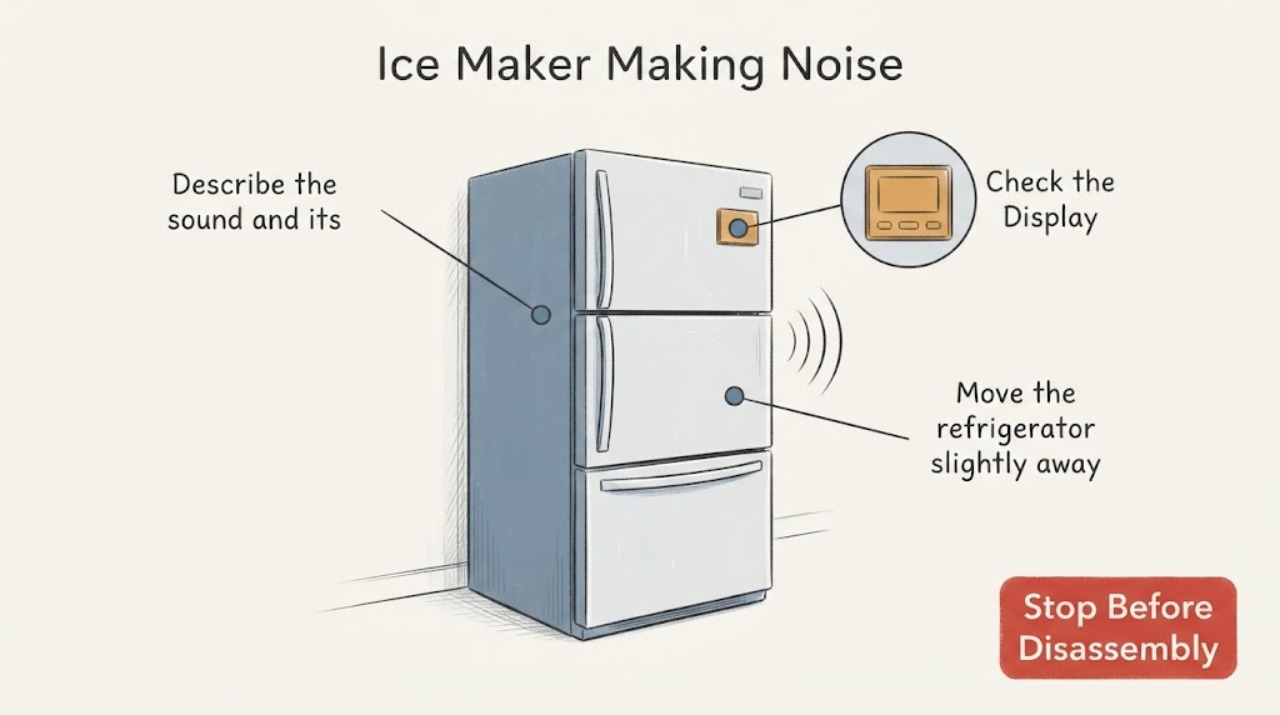
Describe the sound and its timing: buzz/hum during filling, bang when cubes fall, grind during dispensing, or rattle/whine while the ice maker is idle.
Expected result: The sound matches a fill/drop/dispense event, or it is loud and unrelated to any ice-maker action.
Next step: Continue with the water-line and bucket checks, and record a short description for service if it persists.
Why this matters
Why: Event-linked sounds can be normal operating sounds; an idle, loud, or persistent sound is more concerning.
-
Check 2
Confirm that the refrigerator has a connected and turned-on water line before using the ice maker; if it does not, turn the ice maker off using the model control.
Expected result: The ice maker is enabled without a water line, or the line is connected and water supply is on.
Next step: Turn off the ice maker when no water line is connected; do not run the valve dry.
Why this matters
Why: Samsung warns that an unconnected line can cause valve noise and potential damage; a connected line shifts attention to pressure, placement, or the ice path.
-
Check 3
Move the refrigerator slightly away from the wall only if safe and check whether the water line or cabinet is touching another object.
Expected result: The noise stops when contact is relieved, or it continues without cabinet/water-line contact.
Next step: Keep the clearance specified by the model guide and arrange service if the noise is loud or continuous.
Why this matters
Why: Vibration or a line touching the wall can amplify normal operation; continued noise points to the ice-maker or refrigerator mechanism.
-
Check 4
Inspect the ice bucket and chute for clumped ice or a visible obstruction; do not force a stuck bucket or apply heat.
Expected result: Ice is clumped/blocked, the bucket seats incorrectly, or the bucket/path is clear.
Next step: Use the model-approved bucket removal and safe clearing method; request service for a frozen or stuck assembly.
Why this matters
Why: A blocked path can cause grinding or strain during dispensing; a clear path with an idle loud noise suggests a motor, fan, or frost issue.
Use your observations
Decision map
Find the observation that best matches what you see, then follow the next safe action.
-
PATH 01Next step
What you see
A quiet buzz occurs only while the ice maker fills, or a bang occurs exactly when cubes drop.
Do this next
Monitor it; investigate only if it becomes unusually loud or continuous.
Why this path and its safety boundary
Why it matters: The sound matches Samsung-described normal water-fill or ice-drop operation.
-
PATH 02Next step
What you see
A grind occurs only while dispensing, especially with crushed ice, and stops when dispensing stops.
Do this next
Check the bucket/chute for clumps and reseat the bucket according to the manual.
Why this path and its safety boundary
Why it matters: The dispenser motor moving ice or a clump in the path is more likely than a constantly failing ice maker.
-
PATH 03Next step
What you see
The noise is very loud, happens while idle, stops when a door opens, or sounds like a fan hitting ice.
Do this next
Stop forcing or defrosting parts and request qualified Samsung service.
Why this path and its safety boundary
Why it matters: Frost obstruction, a mechanical fault, or another internal source is more likely and needs professional attention.
Helpful context
Understand the symptom
Timing matters more than volume alone
Samsung's noise guide distinguishes water-fill, ice-drop, dispensing, circulation-fan, and obstruction sounds. A sound that is tied to a normal event is different from a loud sound that continues when the ice maker is idle.
Only after diagnosis
Potential parts
- ice-maker or dispenser drive component
Consider a part only after a technician identifies a failed drive, motor, fan, or ice-maker assembly rather than a normal operating sound or clumped ice.
Confirm the complete refrigerator model and Samsung fit information before ordering; sound alone does not establish compatibility.
When checks do not resolve it
Need a professional?
Request qualified service if the sound is very loud, continuous, occurs while the ice maker is idle, returns after clearing a safe obstruction, or sounds like a fan striking ice. Turn off the ice maker if no water line is connected. Do not use a hair dryer, heat gun, knife, or force on a frozen bucket.
Common questions
FAQ
Is buzzing from a Samsung ice maker normal?
A buzz during water filling can be normal when the water line is connected. If the line is not connected, turn off the ice maker; if the buzz is very loud or occurs while idle, request service.
Can I defrost a noisy Samsung ice maker with a hair dryer?
No. Samsung warns that heat can damage the refrigerator. A fan-hitting-ice or frozen/stuck assembly should be handled through qualified service.
Read the exact guide
Official sources
- What can you do when you hear unusual noises from the back of your Samsung refrigeratorSamsung Electronics Canada · Samsung refrigerator rear noise, water-line connection, pressure, and clearance checks
- Understand the noises coming from your Samsung refrigeratorSamsung Electronics Canada · Samsung refrigerator and ice-maker normal sounds, water-line requirement, dispensing noise, and service boundary
- Samsung ice maker is not workingSamsung Electronics America · Samsung ice-bucket obstruction, frozen bucket safety, and service
Community feedback
Share a repair observation
Share a plain-text repair observation. Accepted observations are published automatically; this page may take a moment to update.