
On this page
Start here
Quick answer
First identify when the noise happens. A short buzz while the tray fills, a motor or ice-loosening sound during a cycle, running water, or cubes dropping into the bin can be normal for a refrigerator's automatic ice maker. A loud chattering sound when the ice maker is on but the water supply is not connected is a documented reason to turn the ice maker off until the supply is connected. Rattling that occurs while dispensing points more toward clumped ice, the bin, auger, or chute; a vibration that changes when the refrigerator is leveled or moved away from the wall points to installation or contact. Turn the ice maker off and disconnect power before removing or cleaning the bin, never use an ice pick or other sharp tool, and do not open the valve, fan, motor, wiring, or sealed system. If the sound is grinding, scraping, repeatedly chattering with a connected water supply, accompanied by a leak, burnt smell, heat, or a breaker trip, leave the appliance off and arrange model-specific service.
Before you begin
Safety first
- Owner checks are limited to external supply and control state, external cabinet contact, and the model-approved removal, cleaning, drying, and refitting of an ice bin with power disconnected. Internal valves, fill tubes, fans, motors, drives, controls, wiring, and sealed-system work require qualified service.
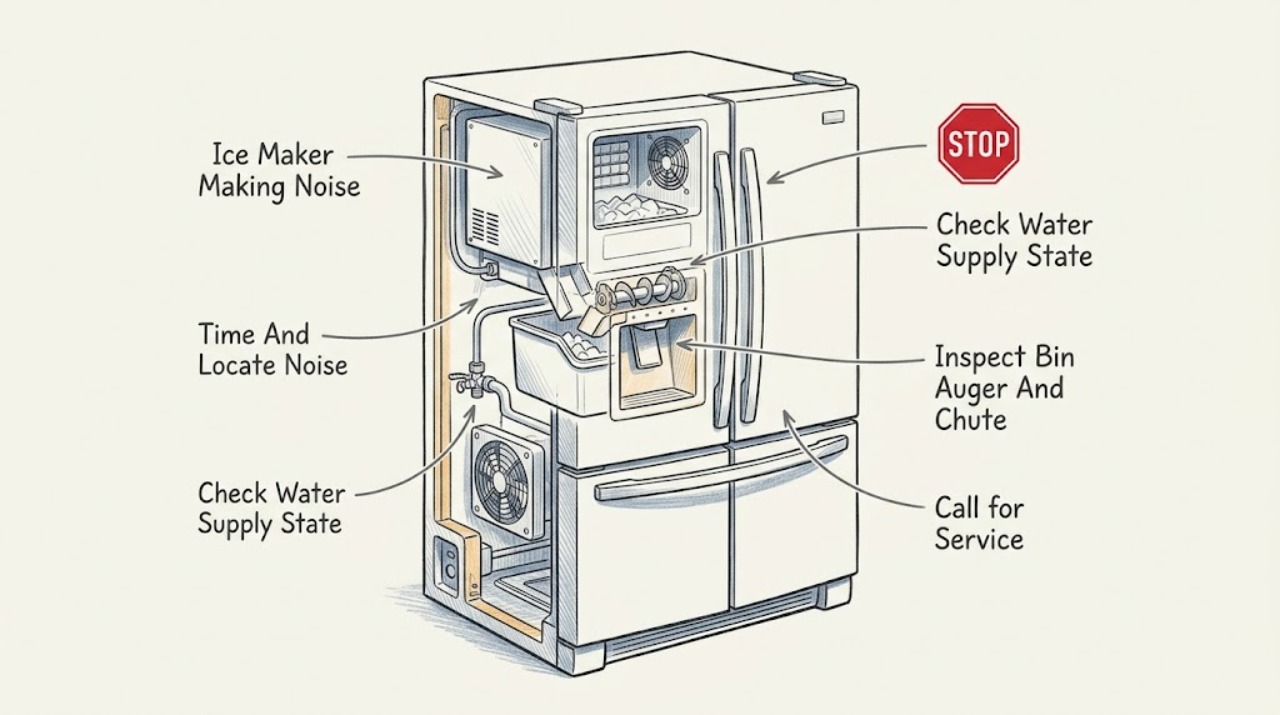
Work through in order
Diagnostic checks
Use only checks that match the exact appliance or system and its official guide.
-
Check 1
With hands clear of moving parts, note whether the sound occurs briefly while water enters, during tray release or motor movement, when cubes fall, only while dispensing, or continuously between ice cycles. Record whether it is a buzz, chatter, click, rattle, hum, grinding, or scraping and where it is loudest.
Expected result: The noise is brief and tied to filling, harvest, or ice dropping; appears only during dispensing; follows the cabinet or airflow; or is continuous and mechanically harsh.
Next step: Follow the matching branch below and confirm the full model before using a button sequence or removing a bin.
Stop if: Stop the observation if there is smoke, a burnt smell, sparking, a hot cabinet or cord, a water leak near electrical parts, or a breaker trip.
Why this matters
Why: A timed fill, harvest, water, or drop sound is consistent with documented automatic ice-maker operation. A dispensing-only sound shifts attention to the bin, auger, or chute; an airflow or cabinet sound shifts attention to fans, compressor, leveling, or contact; persistent grinding or scraping is an abnormal-mechanical branch.
-
Check 2
From outside the appliance, verify that the refrigerator's household water supply is connected and open. If the unit was recently installed or the line is disconnected, use the exact model's ice-maker control to turn the ice maker off; do not open panels or take live measurements.
Expected result: The line is not connected or is closed and the sound is a loud chatter; the line is connected and the noise is a short fill buzz; or the supply is sound but the chatter repeats.
Next step: Keep the ice maker off until an actually connected supply is available. If the supply is sound and the abnormal chatter returns, leave the maker off and arrange service.
Stop if: Do not repeatedly cycle the ice maker against a closed or disconnected water supply, loosen tubing, or work on the inlet valve.
Why this matters
Why: A disconnected or closed supply can explain loud valve chatter and does not by itself identify a failed ice-maker motor. A brief buzz with a connected supply is consistent with the valve filling the maker. Repeated chatter with a sound supply makes a valve, fill path, control, or model-specific fault more likely.
-
Check 3
If the noise occurs while dispensing or after long periods without use, turn the ice maker off, disconnect refrigerator power, and remove only the storage bin as shown in the exact manual. Empty clumped ice, clean the bin with mild detergent, let it dry completely, remove loose chips from the visible chute, and refit the bin without forcing the auger.
Expected result: Cubes are fused or packed around the auger, the bin is wet or damaged, the auger or bin does not seat correctly, or the bin and visible chute are clear and correctly seated.
Next step: Refit the fully dry bin and perform one brief supervised dispensing test only if there is no hazard. If the noise returns, stop using the dispenser and arrange service.
Stop if: Never use an ice pick, knife, screwdriver, hot air, or force to break ice; do not rotate or reach into the auger or chute while powered.
Why this matters
Why: Clumped or refrozen ice can load the dispensing mechanism and explain a rattle or stall during dispensing. A bin that will not seat or an auger that is damaged or persistently misaligned needs model-specific parts or service. A clear, correctly seated bin makes the internal drive, chute actuator, or another cabinet source more likely.
-
Check 4
With the refrigerator closed, check externally whether the cabinet rocks, touches a wall, has objects on top, or has loose items inside that can resonate. Do not remove rear covers. If a safe, small repositioning is possible without stressing water tubing, move the cabinet clear of the wall and recheck the sound.
Expected result: The sound changes after leveling or clearing contact; it is an airflow hum or compressor pulsation from the cabinet; or the sound remains a localized grinding or scraping near the ice-maker or fan area.
Next step: Leave the cabinet in the stable, non-contact position if the noise normalizes. If a mechanical sound persists, use service rather than opening the fan or motor housing.
Stop if: Do not pull the refrigerator far enough to kink or strain the water line, and do not reach behind energized equipment.
Why this matters
Why: Leveling and contact can amplify an otherwise normal operating sound, while fans and compressors can be heard through the freezer. A localized harsh sound that persists after external vibration is corrected makes a fan, motor, drive, or mounting fault more likely.
-
Check 5
After the supply, bin, and external vibration checks are complete, restore the bin and power exactly as the model guide describes and make one brief supervised test. Keep the door, chute, and moving mechanism closed; observe whether the sound is now a short documented cycle sound or an abnormal repeat.
Expected result: The noise stops or becomes a brief fill, harvest, water, or drop sound; it returns as chatter, grinding, scraping, or repeated rattling; or ice production and dispensing remain abnormal.
Next step: Keep the ice maker or dispenser off and arrange Frigidaire or qualified appliance service for a persistent abnormal sound. Provide the full model, noise timing, water-supply state, bin condition, and any leak or electrical symptom.
Stop if: Do not continue testing after smoke, sparking, burnt odor, water near electrical parts, abnormal heat, repeated breaker trips, or exposed/damaged wiring.
Why this matters
Why: Improvement after correcting supply, clumped ice, bin seating, or cabinet contact supports that external cause. Persistent abnormal noise, especially with poor ice production or dispensing, points to an internal valve, fill tube, fan, motor, drive, control, or sealed-system issue that cannot be identified safely without the exact model.
Use your observations
Decision map
Find the observation that best matches what you see, then follow the next safe action.
-
PATH 01Safety boundary
What you see
The sound is brief and occurs as the automatic ice maker fills, loosens ice, runs its motor, lets water run, or drops cubes into the bin, with no leak or electrical warning.
Do this next
Leave the assembly closed and monitor whether the sound stays brief and tied to a cycle. Investigate further if its duration, character, or timing changes.
Why this path and its safety boundary
Why it matters: This pattern matches the normal operating sounds described in Frigidaire refrigerator manuals more closely than a failed part.
Safety stop: Stop using the ice maker for a new grinding, scraping, burning, leaking, or electrical symptom.
-
PATH 02Safety boundary
What you see
A loud chatter occurs when the ice maker is on but the water line is disconnected, closed, or not yet installed.
Do this next
Turn the ice maker off until the water supply is correctly connected and open. If chatter continues with a sound supply, leave it off and arrange service.
Why this path and its safety boundary
Why it matters: The fill valve is being asked to operate without an available household supply; this does not establish an ice-maker motor failure.
Safety stop: Do not loosen the inlet valve or repeatedly run the maker without water.
-
PATH 03Safety boundary
What you see
The noise appears only when dispensing, and the bin contains fused cubes, loose chips, moisture, or an auger/bin that does not seat normally.
Do this next
With power disconnected, clean and dry the owner-removable bin and refit it as the exact manual shows. Stop and use service if the auger, bin, or chute is damaged or the noise returns.
Why this path and its safety boundary
Why it matters: A clumped storage bin or chute can load the dispensing mechanism and is more likely than a fill-cycle fault.
Safety stop: Do not use sharp tools, force the auger, or reach into the chute while powered.
-
PATH 04Safety boundary
What you see
The sound is a hum, airflow, or rattle that changes when the refrigerator is leveled, moved clear of the wall, or loose objects are removed; or it tracks a fan/compressor rather than an ice cycle.
Do this next
Correct only the external contact or leveling condition described by Frigidaire. If a localized mechanical sound remains, arrange service for the fan, motor, mounting, or drive.
Why this path and its safety boundary
Why it matters: Cabinet contact, leveling, loose objects, fan airflow, or compressor operation is more likely than the ice-maker tray or valve itself.
Safety stop: Do not strain water tubing or remove rear covers to access a fan or compressor.
-
PATH 05Safety boundary
What you see
Grinding, scraping, repeated chatter with a connected supply, a recurring rattle after a dry correctly seated bin, poor ice production, a leak, burning smell, smoke, sparking, abnormal heat, or a breaker trip remains.
Do this next
Turn the ice maker or dispenser off, isolate power from a safe location when an electrical hazard is present, and arrange model-specific qualified service.
Why this path and its safety boundary
Why it matters: The remaining possibilities include an internal valve, fill path, fan, motor, drive, control, wiring, or sealed-system fault; the symptom alone cannot identify a safe replacement part across Frigidaire models.
Safety stop: Do not operate through a hazard, bypass protection, perform live electrical tests, or open the sealed system.
Helpful context
Understand the symptom
Timing matters more than the word noisy
Listen for the stage of the ice-making cycle instead of judging the sound by volume alone. A brief fill buzz, a motor or tray-release sound, running water, and cubes dropping are all listed in Frigidaire refrigerator material as operating sounds. A noise that continues between cycles, begins only during dispensing, or changes when the cabinet vibrates deserves a different check. This page is for a refrigerator-integrated automatic ice maker; a countertop or other standalone unit needs its own model manual.
The water supply can create a loud chatter
If the ice maker is switched on before its household water line is connected or while that supply is closed, the fill valve may chatter loudly as it tries to operate. Turn the ice maker off from its model-approved control until the water connection is actually available. Do not treat this sound as proof that the ice-maker motor has failed, and do not test a disconnected supply by opening the appliance.
A bin or auger problem is a separate path
Noise during ice dispensing is not the same as noise during ice production. Melted or refrozen cubes can clump in the storage bin and load the auger or chute. With the ice maker off and power disconnected, use only the owner-removable bin procedure in the exact manual; empty it, clean it, dry it fully, and refit it without forcing or rotating the auger. Never attack a frozen blockage with an ice pick or other sharp tool.
Do not mistake cabinet vibration or a fan for the ice maker
Airflow from an evaporator or condenser fan and the hum or pulsation of a compressor can be transmitted through the freezer cabinet. Frigidaire's vibration guidance starts with level, wall contact, objects on top, and objects inside. Correct those external conditions first. A persistent grinding, scraping, or electrical sound after the bin and cabinet checks is not a reason to remove a fan or motor cover; it needs model-specific service.
Safety boundary
Stop conditions
- Turn the ice maker or dispenser off and isolate power from a safe location for smoke, sparking, burnt smell, abnormal heat, water near electrical parts, damaged wiring, or repeated breaker trips.
- Turn the ice maker off before removing or cleaning the bin, disconnect power before reaching into the bin or chute area, and let the bin dry completely before refitting it.
- Never use an ice pick, knife, screwdriver, hot air, or force to break up ice, and do not rotate or reach into a powered auger or chute.
- Do not open electrical covers, remove a fan or motor, service the water valve or fill tube, perform live measurements, or open the sealed system; use qualified service for those faults.
When checks do not resolve it
Need a professional?
Arrange Frigidaire or qualified appliance service when the abnormal sound persists after the water-supply, bin, and external vibration checks; when a bin, auger, chute, fan, valve, motor, or control needs access; or immediately for smoke, sparking, burnt smell, abnormal heat, water near electrical parts, damaged wiring, or repeated breaker trips.
Safety scope: Owner checks are limited to external supply and control state, external cabinet contact, and the model-approved removal, cleaning, drying, and refitting of an ice bin with power disconnected. Internal valves, fill tubes, fans, motors, drives, controls, wiring, and sealed-system work require qualified service.
Common questions
FAQ
Is a buzzing Frigidaire ice maker normal?
A brief buzz while the water valve opens to fill the automatic ice maker is documented as normal. A loud chatter when the ice maker is on without a connected household water supply is a different condition: turn the ice maker off until the supply is connected. Repeated chatter with a sound supply needs model-specific service.
Why does the ice maker make a clunk or running-water sound?
Frigidaire manuals list motor operation, ice loosening, running water, and cubes dropping into the bin among automatic ice-maker operating sounds. It is more concerning when the sound is continuous, turns into grinding or scraping, or appears with a leak, poor ice production, or an electrical warning.
Why is my Frigidaire ice maker noisy only when dispensing?
A dispensing-only rattle can come from cubes fused in the bin, loose chips, a wet or incorrectly seated bin, or a loaded auger/chute. Turn the ice maker off, disconnect power, and follow the exact manual to empty, clean, dry, and refit the bin. Do not use a sharp tool or force the auger; persistent noise needs service.
Could the refrigerator's fan or leveling cause an ice-maker noise?
Yes. Airflow and compressor sounds can transmit through the freezer cabinet, and Frigidaire recommends checking level, wall contact, objects on top, and loose items inside for vibration or rattling. Correct only those external conditions; do not remove rear covers to reach a fan or compressor.
Read the exact guide
Official sources
- Frigidaire User Manual (A31522001)Frigidaire · Opened Frigidaire manual for a specific refrigerator family; used to corroborate general sound mechanisms, not to infer the assigned appliance's exact controls.
- Is it normal for my freezer to make vibrating or rattling sounds?Frigidaire · General Frigidaire owner-support guidance for freezer/refrigerator cabinet vibration; it does not diagnose an internal ice-maker or fan component.
- Frigidaire Refrigerator User Manual (A29030501)Frigidaire · Opened Frigidaire manual for a specific refrigerator family; its control layout and installation details must be checked against the exact appliance model.
- Frigidaire Refrigerator User Manual (A19894606)Frigidaire · Opened Frigidaire manual for a specific refrigerator family; used only for the documented sound and safe bin-care guidance, not as a universal control or part-fit guide.
Community feedback
Share a repair observation
Share a plain-text repair observation. Accepted observations are published automatically; this page may take a moment to update.