
On this page
Start here
Quick answer
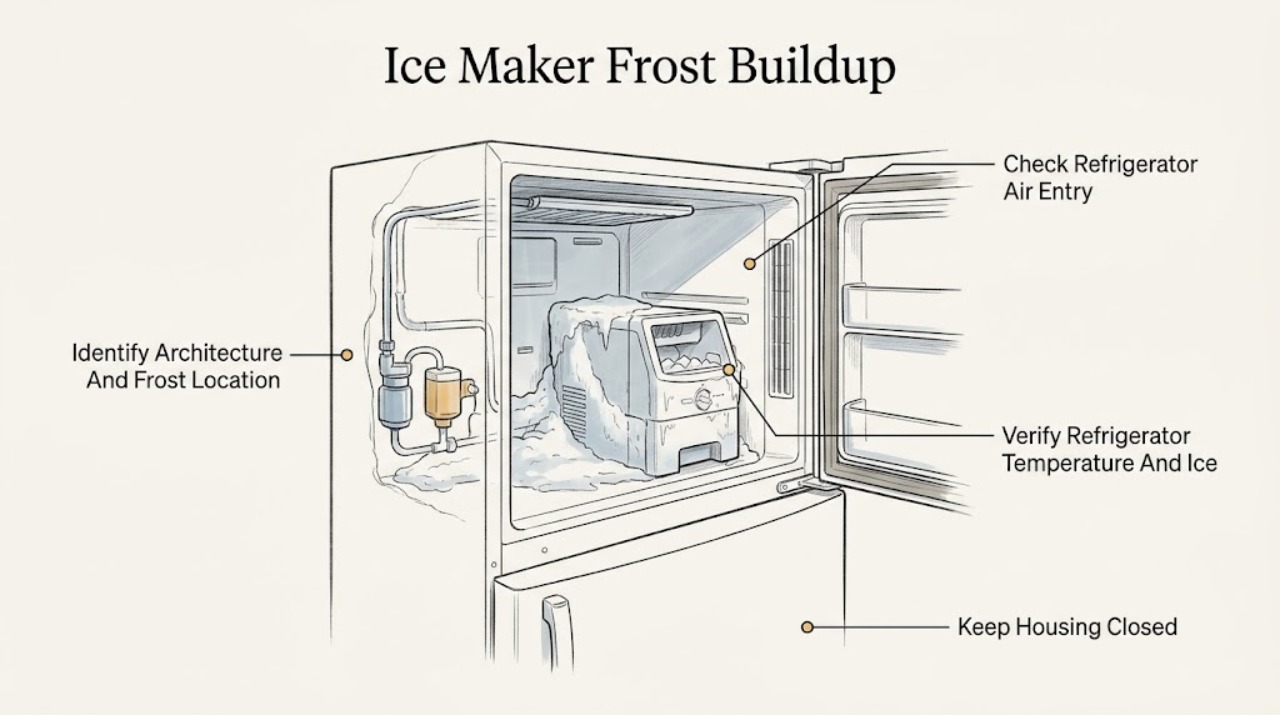
First identify the architecture and the exact frost location: KitchenAid documents both standalone or undercounter ice makers and ice makers built into refrigerators, and their cold surfaces and service steps are different. On a freestanding/undercounter KUIX or KUID-type machine, a hard deposit that keeps an ice block on the freezing plate can be mineral scale; keep the unit level and use only the model's approved cleaning cycle. On a refrigerator ice maker, frost around the ice maker, inlet tube, freezer wall, or vents more often points to humid air entry, a door or gasket that is not sealing, blocked airflow, or a temperature issue. Check only the door, gasket, vents, controls, and other model-approved user areas; never chip ice with a sharp tool. If the model or frost location is uncertain, frost returns after the external checks, water leaks, or the ice maker needs panel, wiring, sealed-system, or internal component access, stop and arrange qualified KitchenAid service.
Before you begin
Safety first
- Owner checks stop at reading the model, observing the accessible frost location, verifying model-approved controls, door and vent conditions, and following the exact manual's safe cleaning or thawing process. Panel removal, wiring, defrost components, water valves, pumps, motors, refrigerant tubing, and sealed-system work require qualified service.
Work through in order
Diagnostic checks
Use only checks that match the exact appliance or system and its official guide.
-
Check 1
Read the complete KitchenAid model number and classify the appliance before touching the buildup. A standalone or undercounter unit has its own drop-down door and ice bin; a refrigerator ice maker is inside a refrigerator or freezer compartment. Record whether the ice is on a freestanding machine's freezing plate or cutting-grid area, on a refrigerator ice maker or inlet tube, on freezer walls, or around an air vent.
Expected result: The model and architecture are clear and the buildup is localized, or the label, appliance type, or frost location remains uncertain.
Next step: Use only the matching branch below and the exact model manual. If the architecture cannot be identified without removing a panel, stop and arrange qualified service.
Stop if: Stop for water near electrical parts, a damaged cabinet or tube, burning odor, or any need to expose wiring or a sealed cooling system.
Why this matters
Why: KitchenAid documents different product families and different frost or deposit locations. A freestanding plate-and-grid symptom can follow mineral scale, while a refrigerator symptom can follow humid air, door sealing, vent, temperature, or inlet-tube conditions; the names are not interchangeable.
-
Check 2
For a refrigerator-built-in ice maker, inspect only the user-accessible door and compartment conditions: make sure the freezer or refrigerator door closes fully, move packages away from the gasket and air vents, clean and dry a visibly dirty gasket as the manual permits, and note whether the doors have been left open or opened frequently.
Expected result: The door was obstructed, the gasket is not contacting the cabinet, vents are blocked, or the buildup is concentrated near the door opening or vents; alternatively, these conditions are normal.
Next step: Remove only the obstruction, restore full door closure, clear the accessible vent openings, and monitor with the door closed. If the gasket is torn, the door will not align, or the buildup is behind a panel, stop and request model-specific service.
Stop if: Do not force the door, remove a liner or evaporator cover, or use a sharp tool to break the ice.
Why this matters
Why: KitchenAid identifies humid air from prolonged or frequent openings, poor gasket sealing, and blocked vents as causes of freezer frost or moisture. Clearing an external air-entry problem can prevent recurrence, but it does not prove that an internal defrost, sensor, inlet-valve, or ice-maker assembly is sound.
-
Check 3
Still on the refrigerator branch, compare the refrigerator and freezer settings with the exact model manual and confirm that the ice maker is enabled. KitchenAid's refrigerator troubleshooting guidance uses 0°F (-18°C) for the freezer and 33–40°F (0–4°C) for the refrigerator; use those values only where the model documentation agrees. Check whether the unit makes any ice and whether a frozen mass surrounds the ice maker or inlet tube.
Expected result: A control is off or set incorrectly, the freezer is outside the model-approved range, ice production is otherwise normal, or the ice maker or inlet tube is frozen despite normal external settings.
Next step: Correct only a clearly unintended model-approved setting, then allow the manual's stabilization period. If the ice maker or inlet tube remains frozen, follow the exact model's thaw instructions or arrange professional diagnosis rather than reaching behind the assembly.
Stop if: Do not bypass the ice-maker control, apply an open flame or high heat, probe wiring, or order a heater, valve, sensor, or module from the symptom alone.
Why this matters
Why: A wrong temperature or disabled ice maker can mimic a frost-related failure, while a frozen maker or inlet tube is a distinct refrigerator symptom. The setting check cannot identify a failed valve, sensor, heater, or control module.
-
Check 4
If the refrigerator manual permits user defrosting and the frost is in an accessible compartment, protect the food, turn cooling off and disconnect power exactly as directed, let the ice melt naturally or use the manual's safe method, then dry the area before restoring power. Use a plastic scraper only where the manual allows it; never attack the ice maker, inlet tube, liner, or freezer plate with a sharp object.
Expected result: The frost clears without damage and stays away after the door, vent, and temperature conditions are corrected, or it returns quickly, causes a leak, or is inaccessible behind an assembly.
Next step: Dry the compartment, restore the model-approved settings, and monitor. If frost returns, the inlet tube remains blocked, water escapes, or access requires a panel, stop and arrange qualified service.
Stop if: Do not use a heat gun, flame, electrical heater inside the compartment, or any method that can melt a liner or damage tubing.
Why this matters
Why: KitchenAid's defrost guidance treats frost as moisture that has frozen and warns against sharp tools; quick recurrence or hidden frost suggests an unresolved seal, airflow, defrost, water, or control issue that a surface thaw will not repair.
-
Check 5
For a standalone or undercounter KitchenAid ice maker, inspect the visible freezing-plate, water-pan, storage-bin, and cutting-grid area without removing internal panels. Compare a hard scaly deposit or an ice block stuck to the plate with loose surface frost. Confirm the machine is level, then use only the model's approved clean cycle and cleaner if the manual calls for it.
Expected result: The machine is out of level, a hard mineral-like deposit is restricting the ice block at the plate or grid, cleaning restores release, or the ice remains bonded, returns quickly, or the machine leaks or will not complete a cycle.
Next step: Level and clean only according to the exact freestanding model instructions, then observe one normal cycle. If the buildup remains, the plate or grid is damaged, the drain or pump is involved, or the model requires internal access, stop for service.
Stop if: Do not pry ice from the plate, scrape with metal, disassemble the cutter or pump, or work on the machine while energized.
Why this matters
Why: KitchenAid's freestanding support page specifically links mineral scale to an ice block that cannot slide from the freezer plate to the cutting grid and says leveling and regular cleaning matter. It does not establish that the same plate, pump, drain, or control arrangement exists in a refrigerator ice maker or every KitchenAid model.
-
Check 6
After the matching external checks and one model-approved cleaning or thaw, document the model, architecture, frost location, door and gasket condition, settings, water or leak symptoms, and whether the ice maker produces ice. Arrange qualified KitchenAid service when the buildup returns, a component is hidden behind a panel, the water line or drain leaks, or operation is abnormal.
Expected result: The buildup resolves and does not recur, or it returns despite correct user checks, affects cooling or ice production, produces water, or is accompanied by unusual heat, noise, odor, or an electrical symptom.
Next step: Keep food at a verified safe temperature, stop using the affected ice maker if water or electrical risk is present, and give the technician the model and symptom record. Let the technician determine the architecture-specific failed component.
Stop if: Do not open panels, bypass safety controls, perform live electrical tests, puncture tubing, or attempt refrigerant, defrost-system, valve, pump, or control repair.
Why this matters
Why: The official guidance supports external corrections, model-approved cleaning or thawing, and service escalation, but it does not support choosing a defrost heater, valve, sensor, motor, pump, control, or sealed-system repair from a generic frost symptom.
Use your observations
Decision map
Find the observation that best matches what you see, then follow the next safe action.
-
PATH 01Safety boundary
What you see
The appliance is a standalone or undercounter KitchenAid ice maker and a hard deposit or ice block is localized to the freezing plate or cutting-grid path.
Do this next
Verify level and run only the exact model's approved cleaning cycle. Escalate if the deposit remains, a plate or grid is damaged, or the cycle cannot complete.
Why this path and its safety boundary
Why it matters: This matches KitchenAid's freestanding support description of mineral scale restricting release from the freezer plate; it is not evidence of a refrigerator frost or defrost-system fault.
Safety stop: Do not pry, chip with a sharp tool, or remove the cutter, pump, or internal cover.
-
PATH 02Safety boundary
What you see
The ice maker is inside a KitchenAid refrigerator and frost or ice surrounds the ice maker, inlet tube, or nearby freezer area.
Do this next
Check the exact model's temperature and on/off state, inspect the door seal and vents, and follow model-approved thaw instructions. Use professional service if the frozen area is inaccessible or returns.
Why this path and its safety boundary
Why it matters: A frozen refrigerator ice maker or inlet tube is a different path from a freestanding plate deposit. Door air entry, incorrect temperature, water flow, or a model-specific internal issue remain possible.
Safety stop: Do not heat the assembly aggressively, probe the inlet tube, or access wiring or a valve.
-
PATH 03Safety boundary
What you see
Frost is thin or widespread on freezer walls or near vents, and the door has been left open, opened often, does not seal, or the vents are blocked.
Do this next
Restore door closure, clean and dry the accessible gasket, clear vents, and monitor after the model's recovery period. If the frost is heavy or returns, arrange service.
Why this path and its safety boundary
Why it matters: KitchenAid identifies humid air entry and restricted airflow as common frost or moisture contributors. This pattern makes an external air-entry condition more likely than an immediately proven failed ice-maker part.
Safety stop: Do not force alignment, remove the liner, or scrape frost with a sharp tool.
-
PATH 04Safety boundary
What you see
Frost returns after the matching user checks, blocks production, causes a leak, or lies behind an inaccessible cover; abnormal heat, noise, odor, or electrical symptoms are also present.
Do this next
Stop the affected appliance or ice-maker function when safe and arrange qualified KitchenAid service with the model and symptom record.
Why this path and its safety boundary
Why it matters: The symptom has moved beyond safe owner diagnosis. The official sources do not justify identifying a defrost heater, sensor, valve, pump, motor, control, or sealed-system failure from frost alone.
Safety stop: Do not operate through a leak or electrical hazard, bypass protection, open panels, perform live tests, or puncture refrigeration tubing.
Helpful context
Understand the symptom
Start with the appliance identity and frost location
Do not treat every KitchenAid ice maker as the same assembly. A standalone or undercounter model has its own door, storage bin, water pan, freezing plate, and cutting grid. A refrigerator model is part of a freezer or refrigerator compartment and can frost at the ice-maker area, inlet tube, vents, or freezer wall. Read the full model number from the appliance label and photograph the buildup before removing anything. If you cannot tell which architecture you have, use the exact owner's manual or stop for service rather than borrowing a freestanding clean-cycle sequence for a refrigerator ice maker.
A freestanding plate deposit is not the same as refrigerator frost
On the documented freestanding KitchenAid support path, a hard scaly deposit can form in the water system and keep the ice block from sliding off the freezer plate onto the cutting grid. That is a cleaning and leveling question for the freestanding family, not proof of a failed refrigerator defrost system. Follow the model's cleaning instructions and do not infer that a KUIX or KUID control, drain, pump, or plate layout applies to another model.
For a refrigerator ice maker, check air entry before internal parts
KitchenAid's refrigerator guidance links frost and moisture to warm humid air, doors left open, a gasket that does not seal, and blocked vents. Confirm the door closes, the gasket is unobstructed, the vents remain clear, and the controls match the exact manual. A KitchenAid troubleshooting article uses 0°F (-18°C) for the freezer and 33–40°F (0–4°C) for the refrigerator as its refrigerator-ice-maker guidance; use the temperature range only when it matches your model literature. Allow the documented recovery time after a setting change instead of repeatedly changing the control.
Stop before defrost-system, water-line, or sealed-system repair
Unplug or isolate the appliance only as the exact manual directs and keep water away from electrical parts. Never use a knife, ice pick, screwdriver, or other sharp tool to break frost. KitchenAid says a frozen refrigerator ice maker or inlet tube may need professional diagnosis, and its freezer guidance directs a safe manual defrost using the model instructions rather than invasive access. Repeated frost, a leak, damaged tubing, abnormal heat, or a need to remove panels is a service boundary.
When checks do not resolve it
Need a professional?
Safety scope: Owner checks stop at reading the model, observing the accessible frost location, verifying model-approved controls, door and vent conditions, and following the exact manual's safe cleaning or thawing process. Panel removal, wiring, defrost components, water valves, pumps, motors, refrigerant tubing, and sealed-system work require qualified service.
Common questions
FAQ
Is frost on a KitchenAid ice maker always a failed part?
No. First identify the architecture and location. Freestanding models can have a mineral-scale deposit that restricts an ice block at the freezing plate, while refrigerator ice makers can freeze around the maker or inlet tube or be affected by humid air, a door seal, blocked vents, or temperature. A recurring or hidden buildup needs model-specific service.
Can I use the freestanding KitchenAid ice-maker clean cycle on a refrigerator ice maker?
No. KitchenAid publishes separate freestanding ice-maker and refrigerator ice-maker support paths. Use the exact refrigerator owner's manual for its controls and cleaning instructions; do not transfer a plate, grid, drain, or clean-cycle procedure between architectures.
What temperature should I check on a KitchenAid refrigerator ice maker?
KitchenAid's refrigerator ice-maker troubleshooting page uses 0°F (-18°C) for the freezer and 33–40°F (0–4°C) for the refrigerator, but the exact model manual controls. After a setting change, allow the documented stabilization period rather than repeatedly changing the control.
What should I do if the ice maker freezes again after thawing?
Check the matching external conditions once—door closure, gasket contact, vent clearance, model-approved temperature, water supply, and enabled ice-maker state. If frost or ice returns, blocks production, causes a leak, or is behind a cover, stop and arrange qualified KitchenAid service instead of replacing a heater, valve, sensor, pump, or control based on the symptom alone.
What tool is safe for removing refrigerator frost?
Follow the exact model manual. KitchenAid's freezer guidance permits a plastic scraper or wooden spoon where appropriate and warns against an ice pick, knife, or other sharp-pointed tool. Do not heat an ice maker or inlet tube aggressively and do not remove panels to reach hidden frost.
Read the exact guide
Official sources
- Ice MakersKitchenAid Product Help · Brand-level category identity only; it directs the reader to model-specific manuals and separate troubleshooting paths.
- Ice Stuck on Freezer Plate - Freestanding Ice MakerKitchenAid Product Help · Freestanding ice-maker path only; it does not describe a refrigerator-built-in ice maker or authorize disassembly.
- Ice Maker Not Working - TroubleshootingKitchenAid Product Help · Full-size refrigerator ice makers covered by this KitchenAid support path; exact controls and reset steps vary by model.
- Frost or Condensation in Refrigerator - Built-In RefrigeratorKitchenAid Product Help · Built-in refrigerator frost path only; vent locations and controls vary by model.
- 18-Inch 35 lb. Automatic Ice Maker with Clear Ice Technology in PrintShield® Stainless Steel PrintShield™ Stainless Finish KUID318SPSKitchenAid · Exact KUID318SPS model example only; use its cleaning and drain details only when the reader's model matches.
- Refrigerator Ice Maker TroubleshootingKitchenAid · General refrigerator ice-maker guidance; the page says temperature, reset, and component arrangements vary by model.
- How to Manually Defrost a FreezerKitchenAid · Freezer-compartment defrost guidance; follow the exact appliance manual for the reader's model and do not infer that every freezer or ice maker is user-defrostable.
- 15-Inch Automatic Ice Maker with Clear Ice Technology in PrintShield® Finish Stainless Steel with PrintShield™ Finish KUIX535HPSKitchenAid · Exact KUIX535HPS model example only; do not transfer its controls, pump, dimensions, or service steps to another model.
Community feedback
Share a repair observation
Share a plain-text repair observation. Accepted observations are published automatically; this page may take a moment to update.