
On this page
Start here
Quick answer
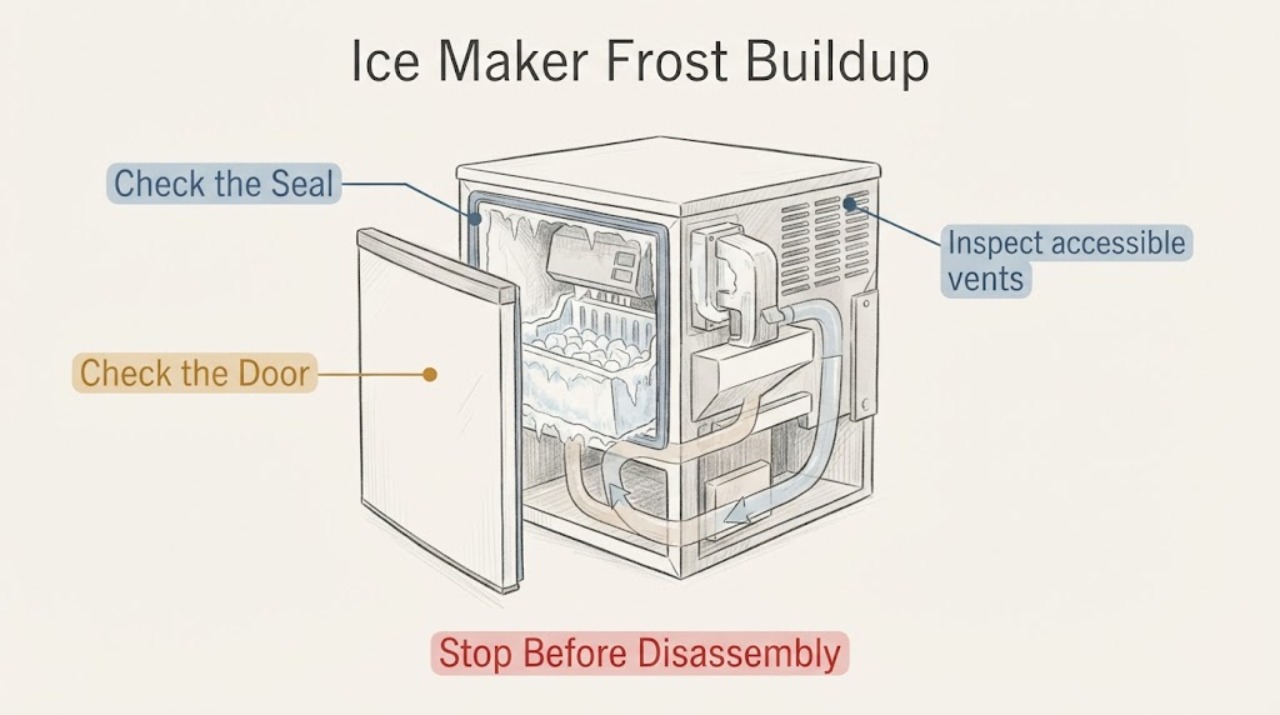
For frost around a Whirlpool ice maker, reduce humid-air entry by closing the freezer door fully and limiting long or frequent openings, check the gasket and vents, and confirm the bin is used and seated normally. Whirlpool says frost is normal on top of some ice bins from opening and closing, while moisture and frost can increase with humidity and poor sealing. Do not chip ice with sharp tools or disturb sealed refrigeration parts. Thick or rapidly returning frost, blocked airflow, or a warm freezer needs service.
Work through in order
Diagnostic checks
Use only checks that match the exact appliance or system and its official guide.
-
Check 1
Check the freezer door and gasket for gaps, food obstruction, warping, or a door left open; close the door fully after each check.
Expected result: The gasket leaks or door cannot close, or the seal is even and closed.
Next step: Reposition only visible food obstructions and clean the gasket with a suitable method, then monitor return.
Why this matters
Why: Warm humid air entering the freezer can condense and freeze around the ice maker.
-
Check 2
Limit long or frequent door openings and protect warm or uncovered food before returning it to the freezer.
Expected result: The pattern follows heavy use or humid conditions, or frost forms despite normal use.
Next step: Allow one stable period with the door closed and record frost growth.
Why this matters
Why: Whirlpool identifies humidity and door openings as common contributors; persistent frost after control of moisture needs another branch.
-
Check 3
Inspect accessible vents and the ice bin for obstruction, clumping, or an improperly seated bin; do not force frozen parts.
Expected result: Airflow or bin movement is obstructed, or the path is clear.
Next step: Clear only loose ice and reseat the bin as the manual shows; do not use sharp tools.
Why this matters
Why: Blocked circulation or bin misalignment can concentrate moisture and prevent normal ice movement.
-
Check 4
Check the ice-maker inlet tube and fill area for a small ice bridge, spray, or misdirected water without removing panels.
Expected result: The inlet is frozen or wet, or the fill path is dry and aligned.
Next step: Turn the ice maker off and arrange service for a recurring inlet freeze or spray; do not probe the tube.
Why this matters
Why: A fill-path leak or low-temperature freeze can add localized ice beyond normal door moisture.
-
Check 5
If frost is thick, defrost only with the exact manual's safe method and protect food; never chip the liner or apply an uncontrolled heat source.
Expected result: Frost is a light film, about 6 mm or thicker, or blocks a vent.
Next step: Monitor the pattern after safe defrost and service rapid return.
Why this matters
Why: Whirlpool recommends defrosting when frost reaches about 1/4 inch, but rapid recurrence signals a sealing or defrost problem.
-
Check 6
Apply the stop boundary after one controlled observation: check for a warm freezer, fan noise, water, heavy recurring frost, or ice around wiring.
Expected result: Frost stays minimal or returns quickly with a performance symptom.
Next step: Protect food and arrange Whirlpool service for recurrence or unsafe conditions.
Why this matters
Why: Rapid frost with poor cooling may involve fan, heater, sensor, gasket, or control diagnosis.
Use your observations
Decision map
Find the observation that best matches what you see, then follow the next safe action.
-
PATH 01Next step
What you see
A light frost film appears on top of the ice bin and follows normal door use.
Do this next
Keep the door sealed and monitor rather than dismantling the maker.
Why this path and its safety boundary
Why it matters: This can be normal moisture from opening and closing the freezer.
-
PATH 02Next step
What you see
Frost forms at the gasket or door edge and the seal has a gap.
Do this next
Clear the door obstruction and service a damaged gasket if the gap remains.
Why this path and its safety boundary
Why it matters: Humid-air entry is the leading cause.
-
PATH 03Next step
What you see
Localized ice surrounds the fill tube or ice maker while the door seal is normal.
Do this next
Turn the maker off and arrange qualified service for a repeated freeze or leak.
Why this path and its safety boundary
Why it matters: A fill-path or inlet issue is more likely than general humidity.
-
PATH 04Next step
What you see
Thick frost blocks vents or the freezer is warm and frost rapidly returns.
Do this next
Protect food and obtain service; do not chip or heat the liner.
Why this path and its safety boundary
Why it matters: Airflow, defrost, sensor, or control fault requires diagnosis.
Helpful context
Understand the symptom
Photograph the frost pattern and note whether it is a light film on the bin lid, a bridge at the inlet tube, or a thick layer on walls and vents. Pattern and speed of return separate normal moisture from airflow or defrost faults.
Use the exact Whirlpool manual for bin removal, filter or inlet access, and defrost guidance. Never chip ice with a knife or heat sealed tubing.
Only after diagnosis
Potential parts
- freezer door gasket
Only if the door-seal inspection confirms a torn or deformed gasket.
Match exact model and door configuration.
When checks do not resolve it
Need a professional?
A technician may inspect gasket compression, inlet valve/tube, fans, defrost heater, sensors, airflow, and controls. Provide frost pattern, growth rate, freezer temperature, and door observations.
Common questions
FAQ
Is frost on top of a Whirlpool ice bin normal?
Whirlpool says some frost on top of the ice storage bin is normal from opening and closing the freezer. Thick, spreading, or rapidly returning frost needs diagnosis.
Can frequent freezer door openings cause ice-maker frost?
Yes. Humid air entering during frequent or long openings can freeze. Minimize openings and verify the door gasket seals.
Can I chip ice away with a knife?
No. Use the exact manual's safe defrost method; sharp tools can damage the liner, tubing, or wiring.
Why does frost keep returning around the fill tube?
A localized freeze can indicate an inlet or fill-path issue. Turn off the ice maker and arrange service if it returns after the door and airflow checks.
Read the exact guide
Official sources
- How to Avoid Frost Build UpWhirlpool · Use for Whirlpool freezer and ice-maker frost symptoms; exact defrost procedures remain model-specific.
- Whirlpool Manuals & LiteratureWhirlpool · Use before defrost, access, or part selection.
- Ice Maker Troubleshooting: How to Fix an Ice MakerWhirlpool · General Whirlpool ice-maker guidance; model-specific access remains in the manual.
- Owner's ManualWhirlpool · Use for Whirlpool refrigerator ice-maker symptoms; exact controls vary by model.
Community feedback
Share a repair observation
Share a plain-text repair observation. Accepted observations are published automatically; this page may take a moment to update.