
On this page
Start here
Quick answer
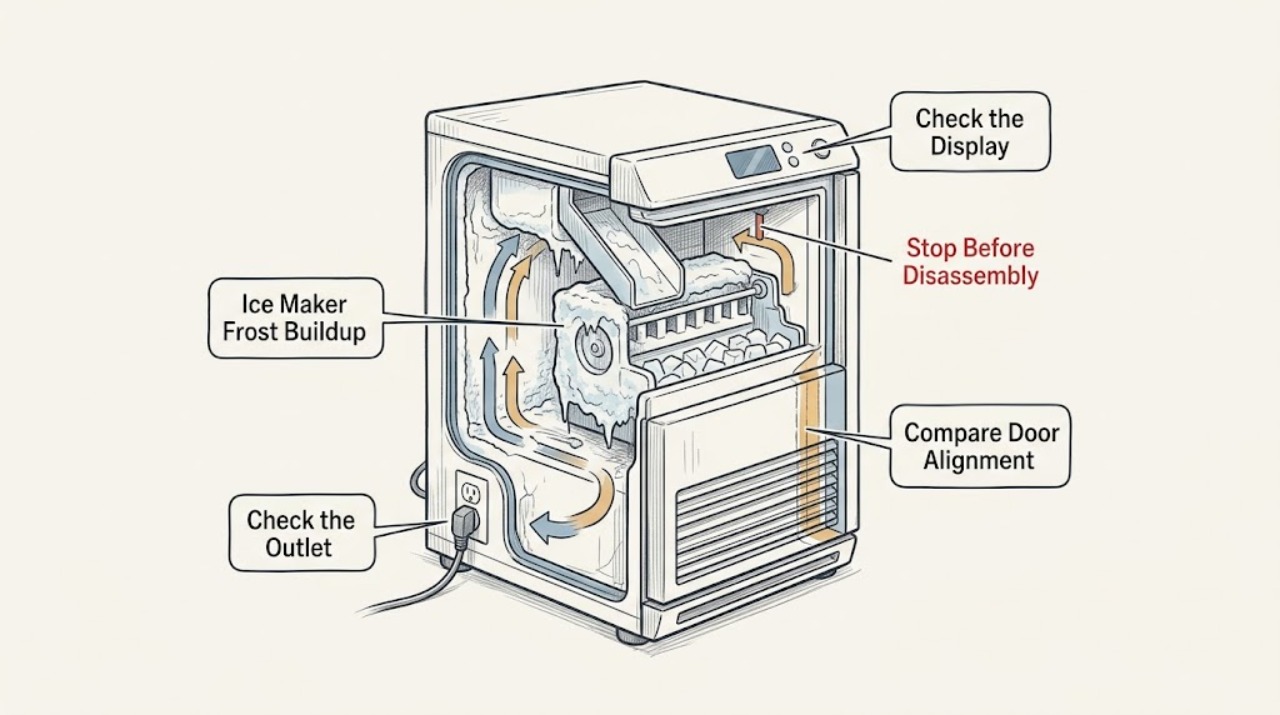
First identify whether this is a GE refrigerator's built-in ice maker or a separate GE Profile Opal countertop ice maker; their frost and defrost behavior is different. In a refrigerator, frost on the freezer wall or around the ice chute commonly follows warm humid air entering through a door, gasket, package, or dispenser flap; a small amount in a chute after repeated crushed-ice dispensing can be normal. In an Opal, the machine has an automatic defrost mode, but frequent defrosting can indicate blocked vents, and mineral buildup may require the exact model's cleaning cycle. Keep vents and door seals clear, unplug before cleaning, and never chip frost with a knife, force a frozen door or auger, bypass a sensor, or open the refrigeration system. Persistent heavy frost, a fan that does not run, a chute flap that does not close, or repeated Opal defrost requires qualified service or model-specific support.
Work through in order
Diagnostic checks
Use only checks that match the exact appliance or system and its official guide.
-
Check 1
Identify the appliance from its physical layout and label before changing settings: a refrigerator/freezer with an ice maker or dispenser, or a standalone GE Profile Opal with a reservoir or side tank. Unplug the appliance before cleaning; keep water away from the plug and outlet, and do not force a frozen door, bin, auger, or chute.
Expected result: Record whether frost is on a freezer wall, around a built-in ice maker, on a dispenser chute or flap, inside an Opal chute/bin, or around an Opal's mechanism. Note whether it is a one-time patch, returns continuously, or coincides with an automatic defrost indication.
Next step: Follow only the refrigerator or Opal branch that matches the appliance. If frost prevents a door from closing, water reaches electrical parts, plastic or tubing is damaged, or a component is frozen solid, leave the appliance unplugged and arrange qualified service.
Why this matters
Why: The location and architecture determine the safe diagnostic path. Refrigerator wall frost suggests moisture entry or airflow; chute frost can be normal in small amounts; Opal defrost is a built-in operating mode with different timing and vent requirements.
-
Check 2
For a refrigerator with frost in the freezer or around a built-in ice maker, check that no food package, shelf, bin, or ice container holds the door or drawer open. Inspect the gasket for a visible split or poor seal, confirm the door alignment is normal, and keep packages away from the rear wall and air outlets. Do not remove the ice maker housing or freezer panels.
Expected result: Frost is concentrated near the door opening or rear wall, a package has blocked closure, the gasket is torn or loose, the freezer is humid, or the door closes fully with no visible obstruction. Note whether the freezer fan is audibly or visibly operating only if it can be observed without disassembly.
Next step: Rearrange the load, close the door fully, and clean or replace a gasket only as the exact refrigerator manual permits. If heavy frost remains after the air-entry cause is corrected, the fan does not run, or frost returns, keep the unit out of service for qualified refrigerator service.
Why this matters
Why: GE lists frequent or prolonged openings, high humidity, warm or uncovered food, packages against the rear wall, and packages holding the door open as frost causes; a torn gasket or non-running fan makes an appliance fault more likely.
-
Check 3
For frost in a refrigerator dispenser chute, inspect the accessible flap and chute after stopping the dispenser. A small patch after repeated crushed-ice dispensing can be wiped with a warm damp sponge once the area is safe and dry; do not pry the flap or reach into the ice maker mechanism. For a built-in ice maker, also confirm its on/off control and any visible stuck cube without touching a potentially hot mold.
Expected result: The frost is small and temporary, or the chute flap does not close completely and frost continuously returns. The ice maker may be off, the ejector area may contain a visible stuck cube, or frost may be accompanied by poor freezer temperature or a blocked air path.
Next step: Dry the accessible chute and ensure the flap closes without force. Use the exact model manual for the ice-maker switch or visible cube guidance. If the flap, ejector, ice maker, or surrounding housing is damaged or the frost returns continuously, arrange service.
Why this matters
Why: GE says a small amount of chute frost is often normal after repeated crushed ice, while continuous accumulation with a flap that stays open needs service. A built-in ice maker also depends on model-specific power, temperature, water, and ejector conditions; frost alone does not identify a failed part.
-
Check 4
For a GE Profile Opal, determine whether the unit is in its normal automatic Defrost mode or is entering that mode too frequently. Keep at least the clearance specified in the official guidance around the rear and sides, and position the side tank so it does not block side vents. Do not open the cabinet or try to turn the auger by hand.
Expected result: The Opal defrosts for a normal interval and resumes ice making, or it defrosts every day, has no audible sign of a frozen auger, remains in Defrost for more than an hour, or has blocked vents or a side tank pushed against the unit.
Next step: Clear only external vent obstructions and restore the model's clearance. If an Opal stays in Defrost beyond an hour, follow the exact model reset instruction once; if it returns to Defrost, keep it unplugged and contact qualified Opal support or service.
Why this matters
Why: GE says automatic defrost is normal and temporarily stops ice production. Frequent defrost without a frozen-auger sound is highly likely to involve restricted airflow; remaining in Defrost beyond the documented limit is not normal.
-
Check 5
If an Opal has visible mineral residue, a blocked chute, a false full-bin or Add Water indication, or ice production changes with frost, turn it off and unplug it before following the cleaning or descaling procedure for the exact model. Reinstall the required reservoir screen or filter arrangement and rinse as the manual directs; never substitute soap or unapproved chemicals.
Expected result: The frost or ice obstruction clears after the model-approved cleaning cycle, the sensors become readable, or the unit still defrosts too often, shows a persistent alert, or cannot circulate water.
Next step: Return the Opal to Ice mode only after the model procedure is complete and the unit is dry. If the symptom persists, the appliance leaks, a fan or auger is abnormal, or internal access is required, stop and arrange Opal support or qualified service.
Why this matters
Why: GE links mineral buildup to impaired Opal ice production and sensor or chute behavior, but a cleaning result does not rule out an airflow, auger, fan, control, or refrigeration fault. Different Opal models use different cleaning controls and procedures.
-
Check 6
After one safe external correction, observe the appliance through a normal operating period without repeatedly resetting it. For a refrigerator, watch whether the door seals and frost recedes after the moisture-entry cause is corrected; for an Opal, watch whether it exits Defrost and resumes ice production with clear vents. Stop for smoke, burning odor, a hot or damaged cord, a leak, or abnormal electrical noise.
Expected result: Frost recedes and does not return, or it remains heavy, returns quickly, blocks a door or chute, accompanies a non-running fan, or causes an Opal to repeat Defrost or stop making ice.
Next step: Keep the appliance unplugged when a safety symptom or internal fault is present and arrange qualified service. Provide the exact model, architecture, frost location, operating mode, frequency, and any displayed indication; do not chip ice, bypass a sensor, or perform live tests.
Why this matters
Why: Improvement after correcting a door, load, chute, vent, or model-approved cleaning condition supports that external cause. Persistent frost or repeated defrost points to an internal fan, defrost, auger, sensor, control, water, or sealed-system condition that cannot be safely identified generically.
Use your observations
Decision map
Find the observation that best matches what you see, then follow the next safe action.
-
PATH 01Next step
What you see
Frost is on the freezer wall or around a refrigerator's built-in ice maker.
Do this next
Correct only the accessible load, door, gasket, or setting issue allowed by the model manual. Escalate heavy recurring frost, a non-running fan, or any need to remove freezer panels.
Why this path and its safety boundary
Why it matters: Moisture entering through the door or restricted airflow is more likely in the first pattern. Persistent frost with a good seal points toward a defrost or airflow fault.
-
PATH 02Next step
What you see
Frost is limited to a refrigerator dispenser chute or flap.
Do this next
Wipe only the accessible chute with a warm damp sponge and confirm the flap closes without force. Arrange service for a flap that stays open, damaged dispenser parts, or recurring frost.
Why this path and its safety boundary
Why it matters: A small patch can be normal condensation or moisture behavior; continuous accumulation suggests a flap, seal, or dispenser fault.
-
PATH 03Next step
What you see
A GE Profile Opal shows frost, squeaks, or enters Defrost mode.
Do this next
Restore external clearance and follow the exact model reset or cleaning instruction once. If Defrost repeats or remains stuck, stop and use Opal support or qualified service.
Why this path and its safety boundary
Why it matters: Normal defrost is an operating cycle. Frequent or prolonged Defrost is more consistent with restricted airflow or an internal Opal fault than with refrigerator door frost.
-
PATH 04Next step
What you see
Frost or ice persists after the architecture-specific external checks.
Do this next
Unplug the affected appliance when safe, protect food and the surrounding area, and arrange qualified service. Do not use sharp tools, heat guns, electrical defrost devices, bypasses, or live tests.
Why this path and its safety boundary
Why it matters: An internal fan, defrost system, auger, sensor, control, water circuit, or sealed refrigeration fault is more likely and cannot be safely distinguished from generic symptoms.
Helpful context
Understand the symptom
Separate a refrigerator ice maker from an Opal
A built-in ice maker shares the refrigerator or freezer's door seal, temperature, air ducts, and automatic-defrost system. A GE Profile Opal is a separate nugget-ice appliance with its own reservoir, vents, auger, sensors, and automatic defrost behavior. Frost on a refrigerator wall or dispenser chute should not be diagnosed with Opal procedures, and an Opal's defrost indicator should not be treated as a refrigerator error code.
Correct air entry and airflow before suspecting a component
For a refrigerator, check door closure, gasket condition, packages, humidity, and the freezer fan only from safe observation. For an Opal, preserve the specified clearance around the rear and sides and keep the side tank from blocking its vents. These checks change whether frost is likely caused by moisture entering or by restricted heat rejection; they do not prove a failed defrost heater, fan, auger, or sealed system.
Use gentle, model-specific cleaning only
Unplug before maintenance or cleaning. Remove accessible frost gently according to the owner's manual; do not use sharp or metallic tools, boiling water, or an electrical device to force defrosting. Opal mineral residue and sensor or chute cleaning vary by model, so use the exact GE cleaning procedure and return all filters or screens required by that model before operating.
When checks do not resolve it
Need a professional?
Arrange qualified service if refrigerator frost remains heavy after the door, load, gasket, and accessible airflow checks; a freezer fan does not run; a dispenser flap will not close; an ice maker or auger is damaged; or an Opal repeatedly enters Defrost, stays there beyond its documented limit, leaks, or continues to show a sensor or water alert after the exact cleaning procedure. Unplug before cleaning when safe. Never chip frost with metal, use boiling water or an electrical device to force defrosting, open the refrigeration system, bypass a sensor, or perform live electrical tests.
Common questions
FAQ
Why is frost building up around my GE refrigerator ice maker?
First check that the freezer door or drawer closes fully and that no package, shelf, or ice container blocks the gasket or rear air path. GE lists frequent openings, humidity, warm or uncovered food, packages against the rear wall, damaged gaskets, and a non-running freezer fan as frost-related conditions. Persistent heavy frost needs refrigerator service rather than ice-maker disassembly.
Is frost in a GE refrigerator ice dispenser chute normal?
A small amount of frost or ice in the chute can occur after repeated crushed-ice dispensing and may evaporate. If frost continuously accumulates, check whether the flap closes fully without forcing it; a flap that stays open should be checked by a service technician.
Why does my GE Profile Opal keep going into Defrost mode?
Opal automatically defrosts when needed, so a temporary Defrost cycle is normal. GE says frequent Defrost without signs of a frozen auger is highly likely when the air vents are blocked. Restore the required clearance and keep the side tank from blocking the vents; if the unit remains in Defrost for more than an hour or repeatedly returns to it, use the exact model support path.
Read the exact guide
Official sources
- Refrigerator & Freezer - Ice on Freezer WallGE Appliances · GE refrigerator freezer-wall frost and safety guidance
- Opal Ice Maker Dispenser - Defrost IssuesGE Appliances · GE Opal dispenser frequent-defrost airflow diagnosis
- Opal Ice Maker - TroubleshootingGE Appliances · GE Opal standalone ice-maker operating and symptom distinctions
- Refrigerator - Frost or Ice on Dispenser ChuteGE Appliances · GE refrigerator ice-dispenser chute frost behavior
- GE Refrigerator Use and Care GuideGE Appliances · Older GE refrigerator frost-removal safety context
- Opal Ice Maker - Defrost ModeGE Appliances · GE Opal automatic defrost mode and prolonged-defrost boundary
- Refrigerator - Frost in FreezerGE Appliances · GE refrigerator frost, door closure, gasket, alignment, and leveling guidance
- Refrigerator - Automatic Defrost SystemGE Appliances · GE full-size refrigerator automatic-defrost behavior and service boundary
- Opal Ice Maker - Cleaning and DescalingGE Appliances · GE Opal model-dependent cleaning, descaling, sensor, and reservoir-screen procedures
- Opal Ice Maker - Cleaning the SensorGE Appliances · GE Opal ice-chute sensor and mineral-residue cleaning context
- Refrigerator - Icemaker Not Producing IceGE Appliances · GE built-in refrigerator ice-maker controls, temperature, water filter, and stuck-cube context
Community feedback
Share a repair observation
Share a plain-text repair observation. Accepted observations are published automatically; this page may take a moment to update.