
On this page
Start here
Quick answer
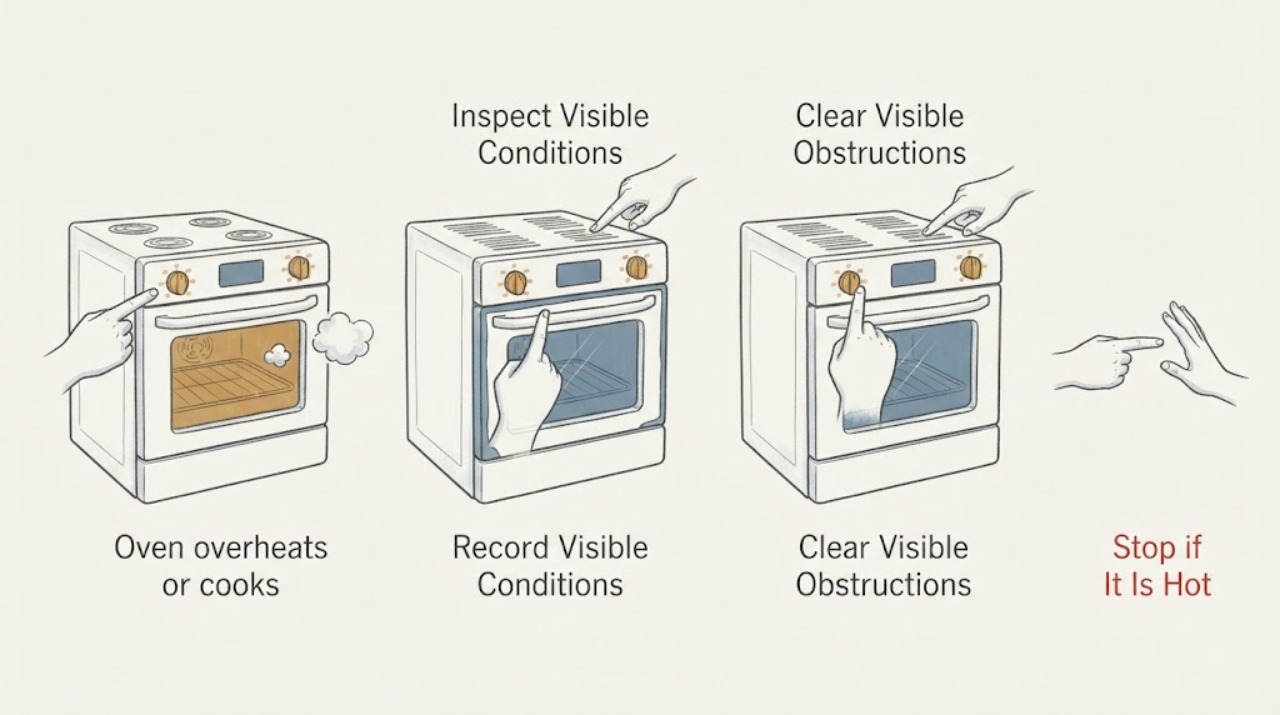
Treat a KitchenAid KSEB900ESS0 that stays hot after Cancel or continues heating after it is switched off as a stop-use fault, not a calibration problem: if it is safe to do so, isolate power at the household control panel and arrange qualified service. If the oven merely cooks food too quickly or the temperature seems different from the setting, first confirm the exact model, standard Bake versus a convection mode, rack and bakeware setup, and whether the behavior is repeatable. KitchenAid recommends a controlled biscuit test for calibration decisions and says calibration is a small adjustment made through the model-specific instructions; do not perform a long high-temperature test, open the range, or guess at a sensor or control board.
Work through in order
Diagnostic checks
Use only checks that match the exact appliance or system and its official guide.
-
Check 1
Cancel the oven and observe it from outside while keeping clear of the hot cavity. Check whether heating stops normally as the oven cools, or whether the oven continues producing heat after Cancel or after the controls are switched off. Also look for smoke, a burning smell, arcing, a hot or discolored cord, or a breaker that trips again.
Expected result: The oven cools normally after Cancel, or it continues heating, smokes, smells scorched, arcs, overheats the supply, or trips protection.
Next step: For continued heating or any hazard, stop using the range. If it can be done without touching damaged parts, isolate power at the household electrical control panel and arrange qualified service; otherwise leave the area and obtain appropriate emergency help.
Stop if: Do not run another high-temperature cycle, repeatedly reset a breaker, remove covers, or reach into a hot oven to investigate.
Why this matters
Why: Normal post-cycle warmth or a cooling fan is different from active heating that continues after shutoff. Continued heating or visible heat/electrical damage is a fire or electrical hazard, not a temperature-calibration error.
-
Check 2
When the range is cool and safe, read the rating label and record the complete model suffix, then confirm that the appliance is the electric KSEB900ESS0/KSEB900ESS family range. Record whether the display is normal, locked, delayed, or showing a code, and whether the problem occurs in Bake, Convect Bake, or another mode.
Expected result: The plate matches KSEB900ESS0 and the mode is known, or the suffix is incomplete/different or the selected mode is uncertain.
Next step: Use KitchenAid's Owner's Center and the owner's literature for the complete model before changing settings. If the plate or mode cannot be confirmed, limit checks to safety observations and request service or model-identification help.
Stop if: Do not use a button sequence, temperature offset, or fault-code meaning copied from another KitchenAid range.
Why this matters
Why: A suffix can change the control layout and instructions. A convection or timed mode can intentionally change the temperature or cooking time, while an unverified model cannot safely inherit another model's calibration sequence.
-
Check 3
With the oven cool, select the exact model's standard Bake mode, set the recipe temperature, and verify that the control shows an active Bake/preheat state. Do not compare a convection result with a standard-Bake result until the exact manual's convection conversion and rack guidance are known; remove only a visible obstruction and keep vents clear.
Expected result: Standard Bake produces the expected result, only a convection mode is different, or both modes cook too hot/too quickly despite correct settings.
Next step: Correct only a clearly documented mode, rack, bakeware, or vent obstruction. If both modes remain abnormal, stop changing settings and proceed to the controlled test and service decision rather than naming a component.
Stop if: Do not cover the oven floor or vents with foil, use a self-clean cycle as a heat test, or leave an uncertain test unattended.
Why this matters
Why: A mode, rack, bakeware, liner, crowded cavity, or blocked vent can make food appear overcooked without a runaway heater. A consistent offset across a controlled standard-Bake test is more consistent with calibration or a fault requiring diagnosis.
-
Check 4
If there is no runaway-heating or electrical warning, perform KitchenAid's short calibration check: use one can of refrigerated biscuits on a shiny, low-sided aluminum sheet, place it on the middle rack with at least 2 inches of clearance, use the package temperature, allow the documented preheat indication, and inspect only at the package's minimum time. Do not use foil or an oven-floor liner and do not extend the test into a prolonged high-temperature run.
Expected result: The biscuits are evenly browned and done within the package time range, or they are consistently too dark/too light or outside that range.
Next step: If the result is repeatably outside the range, record the mode, rack, bakeware, setting, and result, then follow the exact KSEB900ESS0 owner instructions for a calibration decision. If the result is normal, investigate recipe, rack, bakeware, and convection selection instead of replacing parts.
Stop if: Stop immediately for smoke, scorched wiring, abnormal odor, active heating after Cancel, or any unsafe heat; do not repeat the test at progressively higher temperatures.
Why this matters
Why: A repeatable result within the stated range supports normal temperature control; consistent early browning or delayed cooking supports checking calibration or another cooking-variable difference. One dish or one instant thermometer reading is not enough to identify a failed part.
-
Check 5
Only after the controlled test shows a consistent offset and the oven is otherwise safe, open the exact model's calibration setting from the owner's manual and make a small correction in the direction of the observed error. Save it using the documented control, then repeat the same short test once; do not remove a panel or measure live circuits.
Expected result: A small documented offset correction brings the repeat test into the expected range, or the error remains, becomes unstable, or the control will not save the setting.
Next step: If the offset remains after the allowed small adjustment, or temperature swings are severe, turn the oven off and arrange service. Give the technician the exact model, mode, setting, test method, and before/after result.
Stop if: Do not make large repeated offsets, guess a calibration key sequence, open the control panel, or replace a sensor, relay, or board based only on this symptom.
Why this matters
Why: Calibration can address a stable cooking offset, but it cannot repair active heating after shutoff, unstable temperature control, damaged wiring, or a failed component. Persistent or unstable error moves the problem to qualified diagnosis.
-
Check 6
Prepare a service handoff with the full KSEB900ESS0 model and serial, country, energy type, mode, set temperature, whether the oven continued heating after Cancel, controlled-test results, calibration setting if documented, and any smoke, odor, scorch, arcing, or breaker history.
Expected result: The oven has a repeatable offset that calibration did not correct, active heating after shutoff, an abnormal display, visible damage, or a condition that would require internal testing.
Next step: Keep the oven out of service and have a qualified appliance technician diagnose the exact KSEB900ESS0 platform before any part is ordered or replaced.
Stop if: Do not bypass safety controls, energize exposed wiring, move the range to inspect connections, or continue cooking while it is overheating or electrically unstable.
Why this matters
Why: The remaining possibilities include the temperature-control system, sensor, heating circuit, relay/control, wiring, cooling airflow, or another model-specific fault. The symptom does not safely identify one part.
Use your observations
Decision map
Find the observation that best matches what you see, then follow the next safe action.
-
PATH 01Next step
What you see
The oven stops heating normally after Cancel, the controlled Bake test is within the package time range, and only a recipe, rack, bakeware, or convection result seemed too hot.
Do this next
Use the documented mode and rack position, keep vents clear, and monitor one normal supervised bake. Do not change calibration unless a repeatable controlled offset is demonstrated.
Why this path and its safety boundary
Why it matters: The evidence favors a cooking-setup or normal cycling difference over a runaway fault or a proven failed component.
-
PATH 02Next step
What you see
Standard Bake repeatedly cooks too hot or too quickly under the same controlled setup, but the oven stops heating normally and there is no smoke or electrical warning.
Do this next
Record the test and use only the complete KSEB900ESS0 owner's instructions to make a small calibration change, then repeat the same test once. If it remains wrong or unstable, call qualified service.
Why this path and its safety boundary
Why it matters: A stable cooking offset may justify the model-specific calibration path, while an offset that remains after a small correction points to professional diagnosis rather than more user adjustments.
-
PATH 03Next step
What you see
The oven continues heating after Cancel or shutoff, or there is smoke, a burning smell, arcing, visible scorching, a hot/damaged supply, or a repeated breaker trip.
Do this next
Stop using the range. If safe, isolate power at the household panel without touching damaged parts; otherwise leave the area and contact qualified emergency, electrical, or appliance help.
Why this path and its safety boundary
Why it matters: This is an immediate heat, fire, or electrical stop condition. Calibration, convection settings, and a replacement-part guess are unsafe responses.
-
PATH 04Next step
What you see
The exact model cannot be confirmed, the controls are abnormal, or Bake and convection modes both remain inaccurate after the external checks and one documented calibration attempt.
Do this next
Leave the oven off and provide the model/serial, mode, settings, test results, and safety observations to a qualified KitchenAid appliance technician.
Why this path and its safety boundary
Why it matters: The model-specific control, sensor, heating, relay, wiring, or airflow path cannot be distinguished safely from public symptom checks.
Helpful context
Understand the symptom
Separate normal cycling from a true overheat
The KSEB900ESS family is an electric convection range, so the selected mode matters. Heating elements are not expected to remain continuously energized; they cycle to hold a target range. A dish browning too fast, a single thermometer snapshot, or a different result in convection mode does not by itself prove that the oven has run away. Repeat the same controlled test only under the normal recipe conditions, and stop if there is smoke, a burning smell, damaged wiring, or heat that continues after Cancel.
Calibration is for a consistent cooking offset
KitchenAid's evaluation procedure uses refrigerated biscuits on a shiny, low-sided aluminum sheet, centered on the middle rack with clearance from the oven walls. It compares the result with the package time range rather than relying on an instant reading. If the result is consistently too dark or too light, use only the calibration method shown for this exact model and make no more than a small adjustment before repeating the same test.
Why a part cannot be named from the symptom
KitchenAid lists several possible contributors to overheating, including calibration, the temperature-control system, a damaged temperature sensor, heating elements, cooling airflow, liners, and blocked venting. These possibilities overlap and cannot be separated safely by the displayed temperature or by repeatedly running the oven. A qualified technician should diagnose the exact KSEB900ESS0 before a sensor, control, relay, or heating component is selected.
Only after diagnosis
Potential parts
- oven temperature sensor
Consider only if a qualified diagnosis shows that the sensor or its circuit is out of specification after the exact model and wiring are confirmed; an inaccurate-temperature symptom alone does not identify it.
Confirm the complete KSEB900ESS0 model suffix and manufacturer fit information before any part decision. - electronic oven control or relay module
Consider only when qualified service confirms that heating continues after shutoff or the control/relay path is defective; do not use a part guess as a test.
This is an electrical repair requiring qualified service and exact model verification; no compatibility is assumed from the symptom. - oven heating element
Consider only if a technician confirms visible or measured element damage as the cause; an oven that runs hot is not proof that an element is the failed part.
Verify the exact KSEB900ESS0 platform and approved fit before ordering; do not remove or test the element as a user repair.
When checks do not resolve it
Need a professional?
Call when the oven continues heating after Cancel or shutoff, the display is abnormal, a breaker trips again, the controlled Bake offset persists after the model-specific small calibration attempt, both modes remain inaccurate, or internal testing would be needed. Stop immediately for smoke, burning odor, arcing, scorching, damaged supply, exposed wiring, or uncontrolled heat.
Have this ready
- Provide the complete KSEB900ESS0 model and serial, country, mode, set temperature, rack and bakeware setup, controlled-test method and result, calibration setting if changed, and any post-Cancel heating, odor, smoke, arcing, scorch, or breaker observations.
Common questions
FAQ
Is a KitchenAid oven that cycles its elements on and off overheating?
Not necessarily. Heating elements cycle to maintain temperature, so one instant reading or one browned dish is not proof of a runaway condition. Use the same short, controlled Bake test and compare the result with the package time range. Continued heating after Cancel is different and requires stopping use.
How should I check whether the KSEB900ESS0 needs calibration?
KitchenAid's evaluation procedure uses refrigerated biscuits on a shiny, low-sided aluminum sheet in the middle of the oven with clearance from the walls. If the result is consistently outside the package time range, consult the complete KSEB900ESS0 owner's instructions and make only the small correction they document before repeating the same test.
What if the oven keeps heating after I press Cancel?
Stop using it. If safe without touching damaged parts, isolate power at the household electrical panel and arrange qualified service. Do not keep testing, reset the breaker repeatedly, open the control panel, or replace a sensor, relay, or control based only on the symptom.
Read the exact guide
Official sources
- KSEB900ESS | KitchenAidKitchenAid · The opened US KitchenAid Owner's Center identifies KSEB900ESS as a 30-Inch 5-Element Electric Convection Slide-In Range with Baking Drawer and links the model-specific manuals and service path. It is used here for the assigned model family and for the identity boundary, not to infer an unverified suffix-specific control sequence.
- Why Is My Oven Overheating & How Can I Fix It?KitchenAid · The opened KitchenAid guidance distinguishes calibration from thermostat/temperature-sensor, heating-element, cooling-fan, liner, and venting concerns; it says an oven that continues heating after being switched off should be shut off at the home's electrical control panel and professionally inspected.
- How to Calibrate the OvenKitchenAid Product Help · The opened KitchenAid page says the oven may cook faster or slower than a previous oven, lists common calibration methods and small offset ranges, and explicitly directs the user to the owner's manual when the model is not listed. It supports the calibration decision but not a guessed KSEB900ESS0 key sequence.
- How to Evaluate if Temperature Calibration is NeededKitchenAid Product Help · The opened KitchenAid Product Help page provides the controlled biscuit test, rack and clearance setup, preheat and package-time comparison, and the instruction to calibrate only in small increments when the result is consistently outside the expected range. It does not authorize a suffix-independent control sequence.
Community feedback
Share a repair observation
Share a plain-text repair observation. Accepted observations are published automatically; this page may take a moment to update.