
On this page
Start here
Quick answer
The LG LRE3194BD is a US electric range, so a reported voltage drop while the oven is baking is an electrical-supply warning, not a reason to keep testing the bake element during Thanksgiving cooking. Stop using the oven and do not reset it to try another batch. From a safe distance, note whether the display flickers, the clock resets, the cooktop also loses power, the breaker trips, the cord or receptacle is hot or discolored, or the oven simply heats weakly. LG says freestanding electric ranges require a properly powered dedicated circuit and directs service when power or settings do not resolve operation; an electrician or qualified appliance technician must perform any voltage, current, terminal, cord, or circuit measurement. Do not remove panels, open the terminal block, probe live wiring, tighten energized connections, or name a heating element until the supply and connections are professionally verified. If there is smoke, burning odor, arcing, a hot outlet, repeated trips, or visible damage, leave the range off and seek urgent electrical help.
Before you begin
Safety first
- Voltage-drop troubleshooting is not a homeowner live-test task. Keep the range off, do not use an extension cord or improvised circuit, do not touch energized terminals or loosened connections, and do not restore power near smoke, heat damage, water, arcing, or a hot outlet. Isolate power only through a safe, normal user-accessible method and only when that can be done without contact with danger.
Work through in order
Diagnostic checks
Use only checks that match the exact appliance or system and its official guide.
-
Check 1
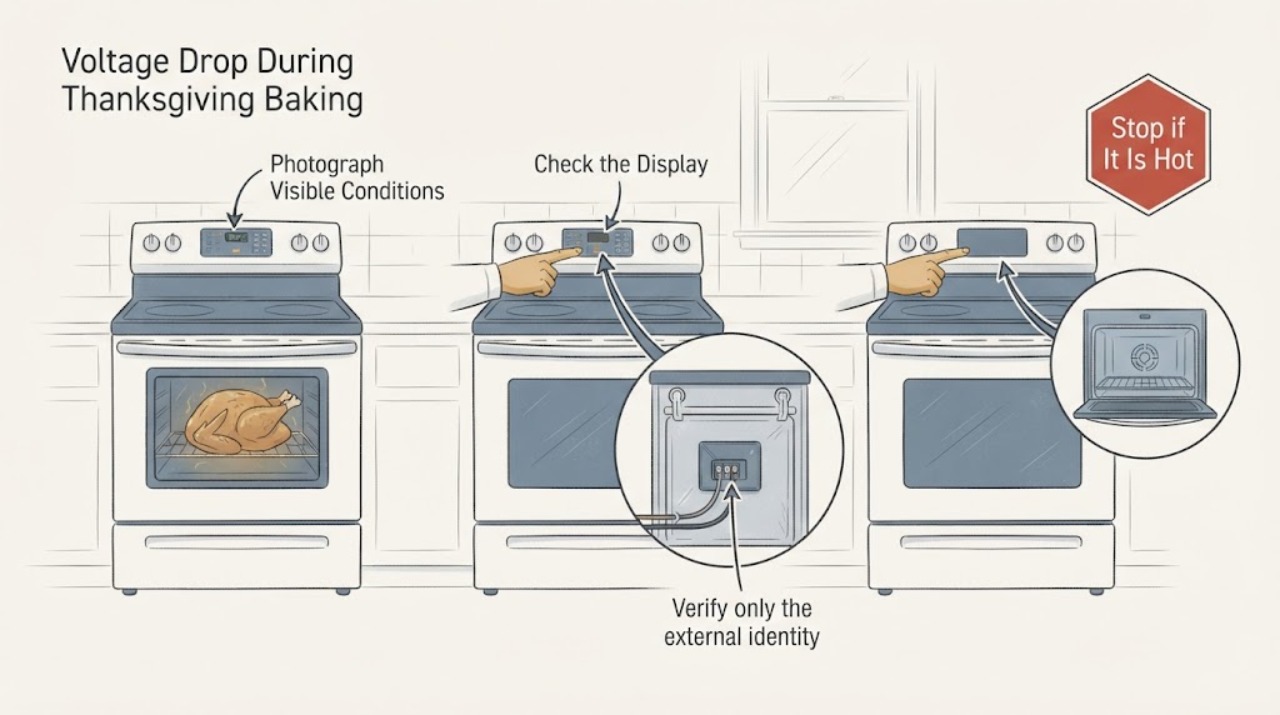
Stop the bake cycle through the normal control if it can be done without approaching heat, smoke, sparks, or a damaged outlet. Keep clear of the rear, cord, receptacle, and hot cavity; do not restart the oven to reproduce the voltage drop. From a safe position, photograph or record the display, mode, set temperature, and any warning.
Expected result: The display flickers or resets, the oven shuts off, the breaker trips, the heat cycles weakly, or the control stays on while the measured or reported supply appears to sag.
Next step: Leave the range off and arrange electrician or qualified appliance service. Give the provider the sequence, timing, mode, and display behavior rather than trying another bake.
Stop if: For smoke, burning smell, arcing, a hot or discolored outlet, melted insulation, repeated trips, or exposed wiring, keep clear and seek urgent electrical help; do not touch the range or breaker if that would bring you near danger.
Why this matters
Why: A power interruption or visible electrical symptom moves the problem out of ordinary oven-temperature troubleshooting. The symptom does not identify an element, relay, control, cord, receptacle, or building-circuit fault.
-
Check 2
Without touching wiring or opening the range, check whether the cooktop elements, oven display, clock, and interior light show the same interruption. Note whether the symptom affects the whole range or only the oven during bake, and whether other high-load appliances in the home dim, stop, or trip their circuit.
Expected result: The entire range loses power, only the oven heats poorly, the cooktop remains normal, the display clock resets, or other loads show a simultaneous supply problem.
Next step: Tell the electrician or appliance technician which loads were affected and whether the breaker operated. Do not swap circuits, use an extension cord, or open the terminal block.
Stop if: Stop if the outlet, cord, plug, or wall area is hot, wet, scorched, loose, or emitting odor.
Why this matters
Why: A whole-range or multi-load symptom makes a supply, breaker, cord, receptacle, or connection issue more relevant; an oven-only symptom leaves the oven control or heating circuit in the branch. Neither observation is safe proof of a component failure.
-
Check 3
Verify only the external identity and installation context: confirm the rating label says LG LRE3194BD, note the US market, and check from a safe visual distance that the range is not connected through an extension cord and that the dedicated-circuit breaker is not visibly damaged or repeatedly tripping. Do not remove the rear cover or pull the range out to inspect wiring.
Expected result: The model or market differs, the range is on an extension cord or non-dedicated setup, the breaker is repeatedly tripping, or the external installation appears normal.
Next step: Provide the exact label and installation information to the electrician or service provider. Do not reset repeatedly or make assumptions about the heating element from the installation appearance.
Stop if: Do not move the range, remove panels, touch a breaker with wet hands, or work on a circuit that is hot, damaged, or arcing.
Why this matters
Why: LG's power guidance says freestanding electric ranges require a properly powered dedicated circuit and does not recommend an extension cord. A mismatch or noncompliant installation must be corrected by an electrician; a normal-looking exterior does not rule out a loaded-circuit or connection fault.
-
Check 4
Record the cooking behavior without another powered test: whether the oven reached preheat, whether the temperature dropped only when the heating load engaged, whether convection and bake behaved differently, whether the food was undercooked, and whether the fault began only during Thanksgiving cooking or has occurred on other days. Do not infer a heating-element failure from weak heat while voltage is unresolved.
Expected result: The problem appears only under heating load, all oven modes are weak, one mode is weak, the temperature recovers normally, or the range is now isolated from use.
Next step: Give the technician the mode, timing, preheat behavior, and food result. Ask for supply-under-load and appliance-side findings to be documented separately.
Stop if: Do not run another preheat, self-clean, broil, or bake cycle while a voltage drop, odor, heat damage, or unstable supply is suspected.
Why this matters
Why: A symptom that appears when a high-power heating load engages is useful supply and connection evidence, but it can coexist with an oven-side component fault. A single-mode failure may help the technician narrow the circuit after supply verification; it does not authorize element replacement.
-
Check 5
Use the exact LRE3194BD LG support page to obtain the matching owner's manual and repair route, and give the provider the complete model suffix shown on the label. Do not use instructions for a gas LRG range or a sibling LRE model, and do not use an undocumented reset to clear a supply symptom.
Expected result: The exact support page provides a matching manual, the label suffix differs, the manual cannot be retrieved, or the voltage symptom is still present after the appliance is left unused.
Next step: Arrange qualified appliance or electrical service with the model, serial, market, event record, and any safe photographs. Ask the provider to verify supply, cord/terminal connections, control, and heating circuit in that order.
Stop if: Do not open the cabinet, access the terminal block, measure live voltage, or authorize a heating-element part solely from the no-heat symptom.
Why this matters
Why: LG's support materials are model-specific and identify LRE3194BD as electric; a sibling model or gas manual can change circuit and heating instructions. A continuing voltage report after the appliance is idle still requires electrical diagnosis rather than a reset.
-
Check 6
Prepare a written service request stating that the oven was in Thanksgiving cooking, a voltage drop or sag was observed or reported during bake, and the oven then heated poorly. Include the exact mode, time from start, display and breaker behavior, whole-range versus oven-only symptoms, and any cord or receptacle heat or discoloration seen from outside.
Expected result: The provider can reproduce a supply sag under load, finds stable supply but an appliance-side fault, or cannot safely reproduce the event because the installation is already isolated.
Next step: Request a written diagnosis that states the supply measurement, connection condition, appliance-side test result, and the evidence supporting any proposed part. Keep the range out of service until the electrical risk is cleared.
Stop if: Do not restore power for a customer demonstration if the electrician or technician identifies unsafe voltage, heat damage, arcing, or a loose connection.
Why this matters
Why: Separating supply results from appliance results prevents a high-power circuit problem from being misnamed as a bake element failure. A stable supply does not prove the element; it simply permits the technician to move to the model-specific appliance circuit.
Use your observations
Decision map
Find the observation that best matches what you see, then follow the next safe action.
-
PATH 01Next step
What you see
The display or clock resets, the breaker trips, the cooktop also loses power, or another high-load appliance shows the same drop during bake.
Do this next
Leave the range off and have an electrician assess the circuit and connections under appropriate load. Do not reset or swap circuits yourself.
Why this path and its safety boundary
Why it matters: A household circuit, breaker, cord, receptacle, or supply connection is more likely than an isolated bake-element problem. LG requires a dedicated, properly powered circuit for a freestanding electric range.
-
PATH 02Next step
What you see
The range's display and cooktop remain stable, but only the oven heats weakly or one oven mode fails after the supply is professionally verified as stable.
Do this next
Arrange LG or qualified appliance service using the exact LRE3194BD documentation and request a test-supported diagnosis before ordering a part.
Why this path and its safety boundary
Why it matters: An appliance-side heating circuit, control, sensor, or connection becomes more relevant, but stable supply does not select a particular element or relay.
-
PATH 03Next step
What you see
The outlet or cord is hot, discolored, loose, wet, damaged, or accompanied by smoke, burning smell, arcing, or repeated trips.
Do this next
Stay clear, do not touch the range or breaker if unsafe, and seek urgent qualified electrical help. Do not restart the oven for the holiday meal.
Why this path and its safety boundary
Why it matters: This is an immediate electrical/fire-safety stop. A heating symptom cannot be safely investigated while the connection or circuit may be damaged.
-
PATH 04Next step
What you see
The reported voltage drop cannot be verified from a safe external observation, the model suffix or market is uncertain, or the exact manual is unavailable.
Do this next
Keep the range off and provide the label and event record to an electrician or LG-qualified technician for model-matched diagnosis.
Why this path and its safety boundary
Why it matters: The evidence is insufficient to name a heating part or to transfer instructions from a sibling LG range. The risk remains unresolved rather than disproven.
-
PATH 05Next step
What you see
The oven is left unused, no electrical or thermal hazard is visible, and one professional confirms the circuit and appliance connections are safe but the oven still heats poorly.
Do this next
Request a written appliance diagnosis and a test-supported part recommendation; do not continue self-clean or bake cycles while the fault persists.
Why this path and its safety boundary
Why it matters: The case can move from supply safety to an appliance-side no-heat diagnosis, but a control, sensor, or heating circuit must still be distinguished by the exact model procedure.
Helpful context
Understand the symptom
LRE3194BD is an electric LG range, not a gas oven. During a high-demand Thanksgiving bake, a reported voltage drop can make the oven heat weakly or intermittently, but the same symptom can also be caused by a damaged connection, control, or heating circuit. Because the appliance is a high-power load, the safe first decision is to stop using it and have the supply checked under the relevant load by a qualified electrician or appliance technician.
LG's public guidance gives the range's dedicated-circuit requirements and user-level power checks, not permission for a homeowner to measure energized terminals. Record what happened to the display, breaker, cooktop, cord, receptacle, and heat output, then provide that record with the exact model and market. Do not keep restarting the oven to save a holiday meal when the supply may be unstable.
Only after diagnosis
Potential parts
- range power cord, terminal connection, or receptacle component
Consider this class only if an electrician or qualified technician documents a damaged, loose, overheated, or incorrectly installed supply connection; a voltage-drop report alone does not identify the failed connection.
Confirm the exact LRE3194BD model, US installation requirements, cord configuration, and test evidence before ordering or changing any connection. - electronic oven control or relay path
Consider this class only after the dedicated supply and connections are professionally verified stable and appliance-side testing shows the control is not delivering the required heating sequence.
Do not infer a control failure from weak heat or a reported voltage sag. Verify exact model, revision, and qualified test results. - oven heating element or element connection
Consider this class only after supply and terminal safety are cleared and the exact model procedure confirms a failed element or its appliance-side connection.
Do not touch or test an energized element and do not assume fit from the LRE family name; confirm exact model compatibility and evidence.
When checks do not resolve it
Need a professional?
Stop using the LG LRE3194BD immediately for a reported voltage drop during bake, a breaker trip, flickering or resetting display, a hot or discolored cord or receptacle, smoke, burning odor, arcing, abnormal heat, or any visible wiring damage. Seek urgent qualified electrical help when the connection or circuit may be unsafe. Otherwise arrange an electrician or qualified LG appliance technician before the next cooking cycle; the provider should verify the dedicated supply and connections under appropriate load, then diagnose the appliance-side circuit if the supply is stable. Do not reset the range repeatedly, make live measurements, remove panels, open the terminal block, or name a heating element from the symptom alone.
Have this ready
- Provide the exact US model LRE3194BD, serial or rating label, cooking mode and set temperature, time to the symptom, display/clock behavior, breaker behavior, cooktop comparison, external cord or receptacle observations, and whether other loads were affected.
Common questions
FAQ
Can a voltage drop make the LG LRE3194BD oven heat poorly?
It can, but the observation does not prove that the bake element is bad. A supply, breaker, cord, receptacle, terminal connection, control, or heating circuit can produce similar symptoms. Stop using the range and have the supply checked professionally under the relevant load.
Can I reset the breaker and try baking again for Thanksgiving?
No. With a reported voltage drop, repeated reset-and-retry can worsen an electrical fault or conceal a dangerous connection. Leave the range off and have an electrician or qualified appliance technician assess it.
Should I replace the bake element first?
No. LG identifies LRE3194BD as an electric range and requires a properly powered dedicated circuit. Supply and connection safety should be established first; only then should a technician diagnose an element or control using the exact model procedure.
Read the exact guide
Official sources
- LG LRE3194BD: 6.3 cu. ft. Capacity Electric Single Oven RangeLG USA · Opened LG's US product page for the exact LRE3194BD model. It confirms the electric single-oven range identity and product family, not a voltage-fault diagnosis.
- LG LRE3194BD.FBDLLGA: Support, Manuals, Warranty & MoreLG USA · Opened LG's exact US support page for LRE3194BD.FBDLLGA. It identifies the product as an electric single-oven range and provides the model-specific manual and repair/support route.
- Oven Not Heating- Gas and Electric RangesLG USA Support · Opened LG's official oven no-heating support entry point for the distinction between electric and gas range guidance. It is used to route to the electric-range branch, not to infer an LRE3194BD element or control failure.
- LG Electric Range / Gas Range: Power IssuesLG USA Support · Opened LG's official power-issues guidance and used only its electric-range branch. It provides user-level external checks and circuit requirements; it does not authorize consumer voltage measurement or identify a heating part for LRE3194BD.
Community feedback
Share a repair observation
Share a plain-text repair observation. Accepted observations are published automatically; this page may take a moment to update.