
On this page
Start here
Quick answer
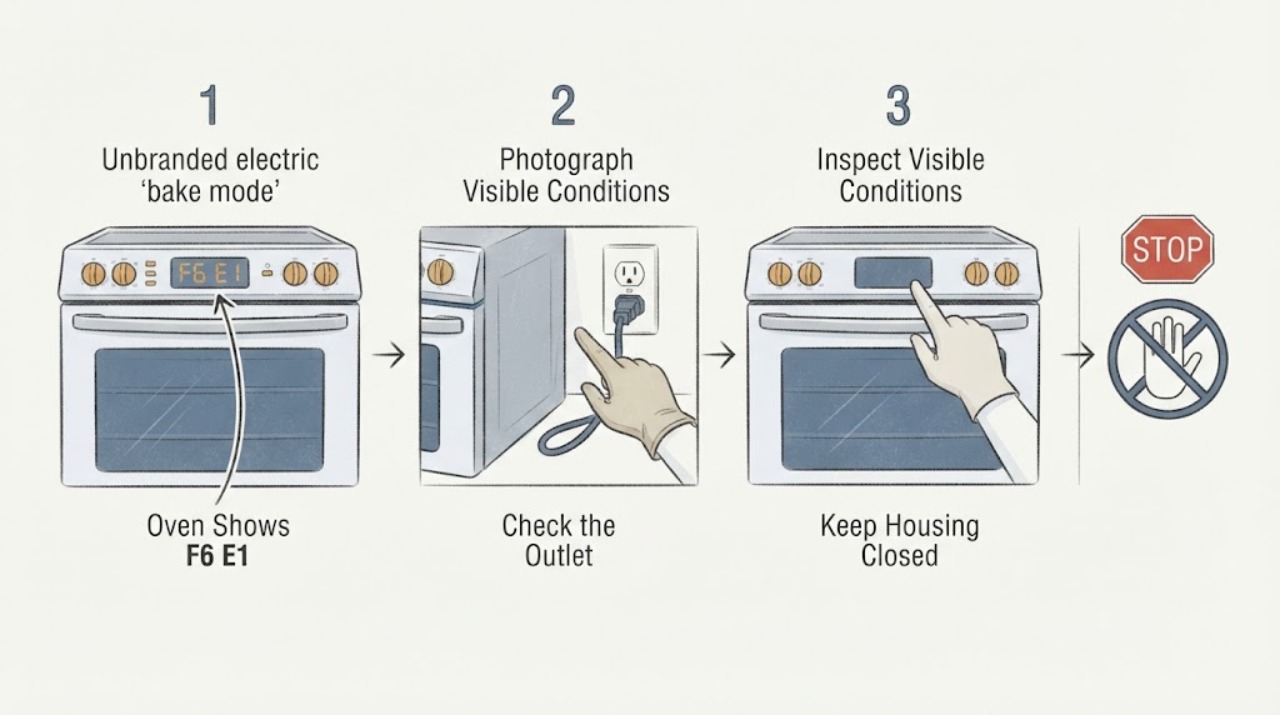
Do not treat F6 E1 as a generic no-heat code or choose a part from the letters alone. Whirlpool's official range support tells owners to turn the product off at the circuit breaker for one minute, restore power, monitor the oven for one minute, and verify operation; Whirlpool service documentation for particular range platforms describes F6E1 as an oven-temperature or over-temperature condition and may lock the affected oven out. Because the model is unspecified, that technical meaning cannot be applied to every Whirlpool oven. First record the complete display, model and serial information, fuel type, cavity, and what happened in Bake. From a safe, dry position rule out gas odor, smoke, burning smell, arcing, repeated breaker trips, wet or hot electrical parts, or heating that continues unexpectedly. If any danger sign is present, leave the oven off and get the appropriate emergency or qualified service help. If the area is safe, use only the exact model manual or Whirlpool product-help page for one authorized power reset. If F6 E1 returns, the oven remains cool, the oven is actually overheating, or Bake still does not work, stop using it and arrange qualified Whirlpool appliance service; do not enter diagnostics, open panels, take live measurements, or replace a sensor, control, igniter, or element by code alone.
Before you begin
Safety first
- Do not enter diagnostics, remove panels, access the control board, disconnect a sensor, measure resistance or voltage, test an igniter or element, bypass a lockout, relight gas, or repeatedly reset a tripping circuit. Keep the oven off when the code or heating behavior is unresolved.
Work through in order
Diagnostic checks
Use only checks that match the exact appliance or system and its official guide.
-
Check 1
From in front of the cool oven, photograph and transcribe the entire display exactly, including spaces, dashes, additional letters or numbers, and any text such as lock or call service. Record the model and serial plate without moving the appliance, the fuel type, the affected cavity, and whether F6 E1 appeared during preheat, Bake, broil, cleaning, startup, or after a power interruption.
Expected result: The display is a complete F6 E1, the code is accompanied by another message, the model or fuel type is unavailable, or the code was only inferred from a partial display.
Next step: Keep the photograph and rating-plate information for the exact Whirlpool manual or service request. Do not copy a diagnostic sequence, sensor value, or replacement part from another Whirlpool model.
Stop if: Stop the investigation at identity collection if the display or rating plate cannot be read safely; do not remove trim, pull out the range, or open a control panel.
Why this matters
Why: Whirlpool's published reset page is for a specific F6 E1 range support path, while the opened service sheets cover selected range platforms. A partial code or missing model cannot establish whether the display is an oven-temperature condition, a control state, or a different code family.
-
Check 2
From a dry, safe position, look only for external danger signs: gas odor or hissing on a gas or dual-fuel appliance; smoke, burning odor, arcing, a hot or damaged cord or outlet, water near electrical equipment, a repeated breaker trip, or heating that continues unexpectedly. Do not start another Bake cycle to reproduce the message.
Expected result: Any gas, smoke, burning, arcing, overheating, wet electrical equipment, repeated trip, or uncontrolled-heating sign is present, or none is present.
Next step: For gas odor or hissing, do not use switches, flames, or another ignition attempt; leave and contact gas-emergency help from a safe location. For smoke, fire, or electrical danger, leave the oven off and use emergency fire, electrical, or appliance service as appropriate. If none is present, continue only with the exact manual's external guidance.
Stop if: Do not touch wet or hot electrical parts, relight a gas burner, test an igniter, or reach inside a hot oven to reproduce F6 E1.
Why this matters
Why: A danger sign changes the task from code interpretation to immediate gas, fire, thermal, or electrical safety. The absence of a visible danger sign only permits a limited model-authorized reset; it does not prove that the internal control, sensor, element, igniter, or valve is safe.
-
Check 3
If the model is identified and the area is dry and free of danger signs, open the exact Whirlpool owner manual or product-help page and confirm that its F6 E1 instruction allows a power reset. Perform no more than that one documented breaker reset, then observe the display and normal Bake behavior for the manual's stated period; do not enter diagnostics.
Expected result: The code clears and Bake operates normally, the code returns immediately, the oven remains cool, or the oven becomes excessively hot or locks out.
Next step: If the code returns, Bake remains abnormal, or the oven overheats or locks out, leave it unused and give qualified service the exact code, model, fuel type, cycle stage, and reset result. If it clears and operation is normal, monitor for recurrence and stop immediately if the code or unsafe heating returns.
Stop if: Do not repeat power cycles, clear history repeatedly, start self-clean, or continue baking to see whether the fault will disappear.
Why this matters
Why: A code that clears once can follow a transient control or power event, but it does not prove the underlying condition is repaired. A returning F6 E1, a cool oven with an over-temperature report, or actual excessive heat is a mismatch requiring model-specific diagnosis.
-
Check 4
Compare the reported heating behavior with the code without dismantling the appliance: note whether Bake never warms, warms weakly, heats briefly then stops, shows an over-temperature condition, or heats normally after reset. Preserve any new display code and the time in the cycle when it appeared.
Expected result: The cavity stays cool while F6 E1 is displayed, the cavity becomes abnormally hot, Bake heats briefly then stops, or the oven behaves normally but the code returns later.
Next step: Stop using the oven for every recurring or abnormal pattern and request Whirlpool or qualified appliance service. Provide the exact model, fuel type, cavity, code photograph, actual heat observation, and reset history rather than asking for a generic F6 E1 part.
Stop if: Do not remove the temperature sensor, test resistance, inspect relays, check element-to-ground resistance, or access wiring; the service sheets place those tasks beyond ordinary owner checks.
Why this matters
Why: A cool cavity with an over-temperature-style code suggests that the displayed temperature and actual heat do not agree; abnormal heat or lockout keeps a real over-temperature or control condition open; brief or recurring operation keeps the sensor, wiring, control, or heating system unresolved. None of these patterns identifies a compatible part without the model and qualified testing.
-
Check 5
Before authorizing a repair, provide the technician or Whirlpool support with the complete model and serial information, purchase market, fuel type, cavity, code photograph, Bake setting and timing, actual heat behavior, any power event, and the result of the one allowed reset.
Expected result: The provider confirms a model-specific F6 E1 procedure, finds a persistent code or heat mismatch, or cannot verify the model or fuel system.
Next step: Use qualified Whirlpool appliance service, and use a qualified electrician when supply wiring or repeated breaker operation is suspected. Ask for a model-matched diagnosis before a control, sensor, element, igniter, or valve is ordered.
Stop if: Do not accept a generic F6 E1 part recommendation, bypass a lockout, or continue operation while the code or heating behavior is unresolved.
Why this matters
Why: Whirlpool service material differs by platform and covers internal sensor, harness, control, and temperature paths that cannot be safely distinguished from the front. Without the exact identity, a part or diagnostic sequence is not reliably compatible.
Use your observations
Decision map
Find the observation that best matches what you see, then follow the next safe action.
-
PATH 01Next step
What you see
Gas odor, hissing, smoke, burning odor, arcing, a hot or wet electrical connection, repeated breaker operation, or heating that continues unexpectedly accompanies F6 E1.
Do this next
Leave the oven off without touching hazardous parts. From a safe location contact gas-emergency, fire, electrical, or qualified appliance help as the observed hazard requires; do not retry Bake or use a flame to test it.
Why this path and its safety boundary
Why it matters: This is an immediate gas, fire, thermal, or electrical safety condition rather than a code-clearing problem.
-
PATH 02Next step
What you see
The model is still unknown, the display may contain additional characters, or the code was copied from another Whirlpool appliance or a partial photograph.
Do this next
Keep the oven unused if Bake is abnormal, obtain a clear rating-plate photograph and full display record, and request the exact model manual or qualified service. Do not select a sensor, control, igniter, valve, or element from the code alone.
Why this path and its safety boundary
Why it matters: F6 E1 is not a safe universal Whirlpool code interpretation. The opened official support page and service sheets apply to identified product families, and the control sequence and internal cause can vary.
-
PATH 03Next step
What you see
There is no external danger sign, the exact model manual permits the public one-minute breaker reset, and F6 E1 clears without abnormal heat or a repeat code while Bake is verified normally.
Do this next
Monitor only under normal safe use and record the model, reset result, and operation. Stop using the oven and arrange service if F6 E1, a heating mismatch, lockout, or unusual temperature returns.
Why this path and its safety boundary
Why it matters: A transient control or supply event is possible, but clearing once is not proof that the oven's temperature sensing or heating system is healthy.
-
PATH 04Next step
What you see
F6 E1 returns, the oven stays cool in Bake, the oven becomes excessively hot or locks out, or Bake heats briefly and then stops after the reset.
Do this next
Leave the appliance off and request model-matched Whirlpool or qualified appliance service. Provide the exact code, model, fuel type, cavity, cycle stage, heat observation, and reset result; do not open panels or order parts by code.
Why this path and its safety boundary
Why it matters: The actual heat and the displayed temperature condition do not form a resolved, model-independent diagnosis. Selected Whirlpool service sheets keep sensor, harness, control, and heating paths in the professional branch.
Helpful context
Understand the symptom
This symptom contains a built-in contradiction: the displayed F6 E1 is associated with an oven-temperature condition in some Whirlpool range service documents, while the reported result is that Bake is not heating properly. That mismatch is useful evidence, not a reason to guess that the bake element or control board has failed. A wrong temperature reading, an over-temperature lockout, a control or wiring problem, or a separate heating problem can look different on different Whirlpool platforms. The exact model and the actual temperature behavior must be established before any component decision.
Whirlpool's public F6 E1 page gives a limited owner action: a one-minute breaker power-down, restoration, one-minute observation, and operation check. The detailed service sheets are for qualified service work and include internal sensor, harness, control, and temperature checks; they are not permission for an owner to enter diagnostics or probe a live oven.
When checks do not resolve it
Need a professional?
Use the exact Whirlpool model support route for a persistent F6 E1 or Bake failure. Use a qualified electrician for suspected supply wiring or repeated breaker operation, and emergency gas or fire help for the relevant danger signs.
Safety scope: Do not enter diagnostics, remove panels, access the control board, disconnect a sensor, measure resistance or voltage, test an igniter or element, bypass a lockout, relight gas, or repeatedly reset a tripping circuit. Keep the oven off when the code or heating behavior is unresolved.
Have this ready
- Provide the complete model and serial information, market, fuel type, cavity, exact display photograph, Bake setting and timing, whether the cavity stayed cool or became abnormally hot, any lockout or other code, power-event history, and the result of the single model-authorized reset.
Common questions
FAQ
Does Whirlpool F6 E1 prove that the bake element is bad?
No. Whirlpool's opened service sheets for selected range platforms describe F6E1 as an oven-temperature or over-temperature condition, with sensor, harness, and control paths still in the professional diagnosis. The model is required before a part can be considered.
Why would the oven say F6 E1 if Bake is not heating?
That is a heat-versus-display mismatch. It may reflect a temperature-sensing, control, wiring, lockout, or separate heating condition, and Whirlpool code behavior varies by platform. Record the exact model and actual heat behavior, perform only the exact manual's one safe reset if allowed, and arrange service if the mismatch remains.
Can I keep using the oven after F6 E1 clears?
Only if the exact model guidance permits the reset, there are no gas or electrical danger signs, Bake verifies normal operation, and the code does not return. Stop immediately for abnormal heat, a lockout, a repeat code, smoke, odor, arcing, or a breaker problem.
Read the exact guide
Official sources
- Tech Sheet W11401666 Rev AWhirlpool · Official technician sheet covering a different Whirlpool range platform; it confirms that the code is documented as an oven-temperature condition on that platform but does not identify the assigned model or authorize owner testing.
- F6 E1 - Error Code - Range - Product HelpWhirlpool · Official Whirlpool range support page for the F6 E1 path; the assigned oven's exact model, fuel type, and control layout are not supplied, so the page does not establish universal cross-model behavior.
- Tech Sheet W11324926 Rev AWhirlpool · Official technician sheet for a particular Whirlpool range platform, not a universal manual for an unspecified Whirlpool oven; used only to establish the documented over-temperature interpretation and professional service boundary.
Community feedback
Share a repair observation
Share a plain-text repair observation. Accepted observations are published automatically; this page may take a moment to update.