
On this page
Start here
Quick answer
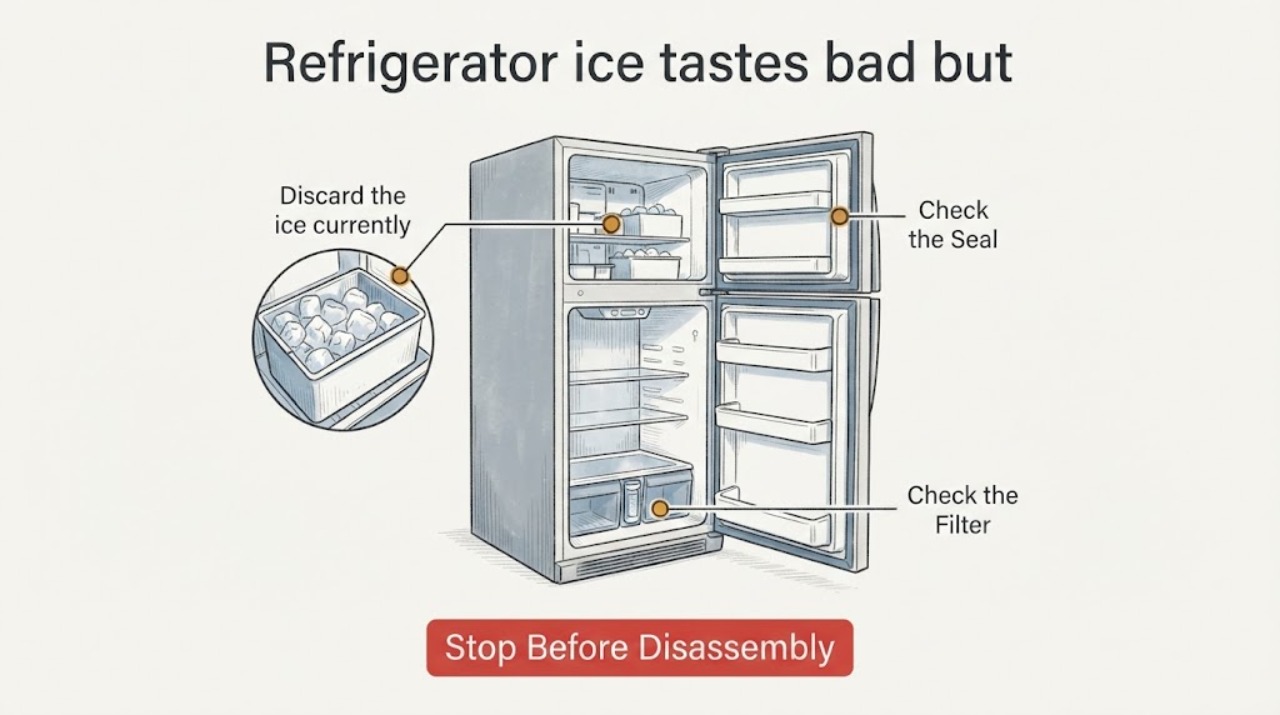
When KitchenAid refrigerator water tastes normal but the ice tastes bad, start with the ice itself: discard the stored ice, wash and dry the bin, check for uncovered or strong-smelling food, and make fresh ice. If the taste returns, check the water filter's age and installation, flush it according to that filter's instructions, and review any recent plumbing or water-line work. A good-tasting water sample does not prove the ice maker is faulty; it narrows the first checks toward stored ice, odor transfer, filter preparation, supply-line history, and the water source. If fresh ice still has a persistent chemical, salty, or otherwise abnormal taste, stop using it and arrange KitchenAid service or water-quality advice rather than guessing at an internal part.
Work through in order
Diagnostic checks
Use only checks that match the exact appliance or system and its official guide.
-
Check 1
Discard the ice currently in the bin, wash the removable bin according to the owner's instructions, dry it fully, and allow the ice maker to produce a fresh batch before tasting it.
Expected result: The bad taste disappears in the first fresh batch, or it remains after the bin is clean and new ice has formed.
Next step: Use only the fresh batch for the comparison and follow the next branch based on whether the taste returns.
Why this matters
Why: If the taste disappears, stale stored ice or residue in the bin was a plausible source. If it remains, continue with the filter, food-odor, plumbing, and water-source checks; this result does not prove an internal ice-maker failure.
-
Check 2
Inspect the refrigerator and freezer for uncovered, leaking, spoiled, or strongly scented food; seal or remove the source and clean visible spills without using an unapproved cleaner in the ice bin or chute.
Expected result: A strong odor is present near the ice bin or freezer, or food is properly sealed and no unusual odor is present.
Next step: After correcting storage and cleaning as directed by the manual, discard the affected ice and let a new batch form before reassessing.
Why this matters
Why: KitchenAid says improperly stored or potent-smelling foods can transfer odors to ice. No visible odor makes this cause less likely but does not identify a different failed part.
-
Check 3
Check the water filter's installation, indicator, and replacement history, then replace it only with the filter specified for the refrigerator and flush the system using that filter's instructions.
Expected result: The filter is overdue, was recently installed without a complete flush, is not seated as the manual shows, or the filter history is unknown; alternatively, the filter is current and correctly installed and flushed.
Next step: Follow the exact filter instructions. KitchenAid's general flush guidance says the required amount varies by filter; do not substitute a guessed volume or filter model.
Why this matters
Why: An overdue or improperly prepared filter can contribute to taste problems and reduced ice-maker water flow. A current, correctly prepared filter shifts attention toward ice storage, the supply line, the household source, or model-specific service.
-
Check 4
Review whether the refrigerator was recently installed, connected to new plumbing or a new supply line, connected to the cold-water line, or connected to softened water, and compare the installation with the exact model manual.
Expected result: The taste began after plumbing or filter work, the line material or connection is uncertain, or the ice maker is supplied by softened water; alternatively, the installation and source have not changed.
Next step: Correct only an obvious installation issue allowed by the model instructions, discard affected ice, and flush or cycle fresh ice as directed. Seek qualified help if the source or plumbing requires work outside the refrigerator manual.
Why this matters
Why: KitchenAid says new plumbing, supply-line materials, incorrect hot-water connection, and softened-water chemicals can affect ice taste. These findings do not establish that a particular line or valve is defective.
-
Check 5
Compare a fresh ice sample after the external checks with the dispensed water, and stop consuming the ice if the taste is persistent, chemical, salty, or accompanied by visible debris, leakage, or an unusual odor.
Expected result: Fresh ice now tastes normal, or the abnormal taste persists despite a clean bin, fresh ice, correct filter preparation, and reasonable source checks.
Next step: If the taste persists, keep the ice maker unused and contact KitchenAid service or a qualified water professional with the model number and the checks already completed.
Why this matters
Why: Normal fresh ice supports a storage or preparation issue. Persistent abnormal ice needs model-specific or water-quality assessment; taste alone cannot identify an internal component.
Use your observations
Decision map
Find the observation that best matches what you see, then follow the next safe action.
-
PATH 01Next step
What you see
Only the old ice tastes bad, while a washed bin and a fresh batch taste normal.
Do this next
Keep the bin clean, rotate unused ice, and store strong-smelling foods in sealed packaging.
Why this path and its safety boundary
Why it matters: Stored ice, residue, or odor transfer is more consistent with the result than an established ice-maker fault.
-
PATH 02Next step
What you see
The taste started after a filter change or installation and improves after the correctly specified filter is flushed according to its instructions.
Do this next
Follow the filter's replacement and flushing guidance for future changes; do not carry a guessed flush amount to another model or filter.
Why this path and its safety boundary
Why it matters: Filter preparation or initial plumbing residue was a plausible contributor.
-
PATH 03Next step
What you see
The fresh ice remains abnormal while water tastes good, and the bin, food storage, filter preparation, and installation checks show no obvious issue.
Do this next
Stop using the questionable ice and arrange KitchenAid service or water-source evaluation with the full model number and symptom history.
Why this path and its safety boundary
Why it matters: The symptom remains unresolved and cannot be narrowed to a valve, ice-maker assembly, or other internal part from the available evidence.
Helpful context
Understand the symptom
Why good-tasting water does not clear the ice system
Water and ice share a supply, but the ice can also sit in a bin and be exposed to freezer odors, old stored cubes, or residue from a recent filter or plumbing change. KitchenAid's refrigerator guidance lists stored food odors, old ice, filter condition, supply-line materials, and household water quality as possible contributors. The symptom points to an ice-specific check first; it does not identify a failed ice-maker part.
Use the exact filter instructions
KitchenAid says filters should be replaced about every six months, when the indicator light comes on, or as needed, and that the water system should be flushed after a replacement. The amount varies by filter, so use the instructions for the installed filter rather than assuming one universal volume or procedure.
Do not diagnose a hidden part from taste alone
If a clean bin, fresh ice, a correctly installed and flushed filter, and normal food storage do not resolve the taste, the remaining possibilities include the incoming water or a model-specific refrigerator issue. KitchenAid's public guidance does not support selecting an internal valve, ice-maker assembly, or other part from this symptom alone.
When checks do not resolve it
Need a professional?
Stop consuming the ice and seek KitchenAid service or qualified water advice if a persistent chemical, salty, or otherwise abnormal taste remains after the external checks, or if there is visible debris, a leaking filter, water damage, or an unexplained refrigerator problem. Do not open the sealed refrigerator system or replace an internal valve or ice-maker assembly based on taste alone.
Have this ready
- Provide the complete KitchenAid model number, whether the water tastes normal at the same time, when the taste began, filter age and installation history, recent plumbing or supply-line work, food-odor findings, and the external checks already completed.
Common questions
FAQ
Why can the ice taste bad when the refrigerator water tastes good?
The ice may have absorbed odors while stored, the bin may need cleaning, or a recent filter, plumbing, supply-line, or water-source condition may affect the ice-making path. Good-tasting water does not by itself prove that the ice maker is faulty.
How much water should I use to flush a KitchenAid refrigerator filter?
Use the instructions for the installed filter. KitchenAid says the required amount varies; its general guidance describes filters that require 1, 2, or 4 gallons, and a refrigerator without a water dispenser may require discarding three full ice containers after a filter or water-source connection.
Should I keep eating ice that has a chemical or salty taste?
No. Discard the affected ice and do not keep using it while checking the filter, storage, installation, and water source. If fresh ice remains abnormal, obtain KitchenAid service or qualified water advice.
Read the exact guide
Official sources
- Correcting Odd Tasting Water or IceKitchenAid Product Help · Opened KitchenAid official guidance for full-size refrigerators. It directly covers odd-tasting ice and water, food odor transfer, water filters, plumbing or supply lines, water sources, softened water, and fresh-ice replacement; exact model instructions remain controlling.
- How to Flush the Water System in a RefrigeratorKitchenAid Product Help · Opened KitchenAid official flushing guidance. It supports the model/filter-dependent flush process and no-dispenser alternative; the assigned topic has no model, so the article defers to the installed filter and owner's instructions.
- Ice Cubes are Off Colored or DebrisKitchenAid Product Help · Opened KitchenAid official ice-quality guidance. It is used for conditional ice-quality checks such as water source, plumbing, food storage, filter replacement and filter flushing; it is not used to claim that the assigned refrigerator is a French-door model.
- Refrigerator Ice Maker TroubleshootingKitchenAid · Opened KitchenAid official refrigerator ice-maker article. Its bad-taste section directly supports filter replacement, rotating or dumping old ice, and protecting ice from freezer odors; it does not identify a failed internal component for this symptom.
Community feedback
Share a repair observation
Share a plain-text repair observation. Accepted observations are published automatically; this page may take a moment to update.