
On this page
Start here
Quick answer
On the LG LRYKC2606S, changing the filter does not by itself prove that the ice taste problem is in the filter. First compare known-safe household water with refrigerator water and fresh ice, then discard old ice, flush the dispenser after the filter change or a long period of non-use, and clean and air-dry the ice bin. Seal odor-producing food and check only the visible, accessible supply line for a kink or unsuitable tubing; do not disconnect the water system or add chemicals. If water tastes normal at the tap but ice still tastes or smells wrong after a proper purge, clean bin, and fresh batch, stop using the questionable ice and arrange LG appliance service rather than guessing at a valve or ice-maker part.
Before you begin
Safety first
- Keep the water and ice isolated until the taste source is understood. Do not disconnect tubing, open the dispenser or ice-maker assembly, apply chemicals, or perform pressure or live electrical tests as a household diagnostic.
Work through in order
Diagnostic checks
Use only checks that match the exact appliance or system and its official guide.
-
Check 1
Confirm the appliance identity from the rating label or the LG support page, recording the complete model suffix as LRYKC2606S.ASTCNA0 when it matches; also record when the taste began, whether it is musty, plastic-like, metallic, chemical, or food-like, and whether water from the dispenser is affected.
Expected result: The full model matches the LG support entry, only ice tastes wrong, both water and ice taste wrong, or the reported suffix differs from the support entry.
Next step: Use the exact manual for any model-specific operation; if the water has a chemical, sewage-like, or otherwise questionable taste, stop drinking it and stop using the ice until the source is resolved.
Stop if: Do not open covers, disconnect tubing, or continue consuming water or ice that may be contaminated.
Why this matters
Why: The exact identity determines the applicable filter, bin, and water-path instructions. A taste in both water and ice points earlier in the water path than an ice-only odor, while a suffix mismatch prevents safely borrowing model-specific instructions.
-
Check 2
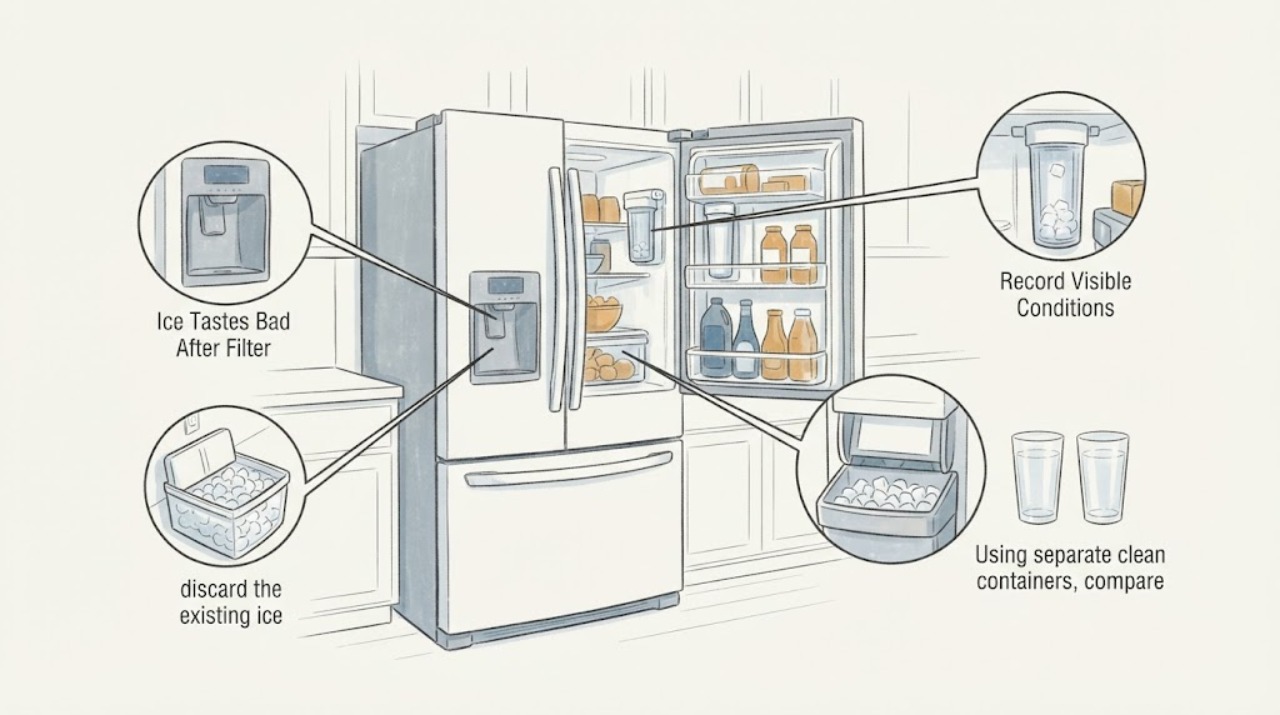
Using separate clean containers, compare known-safe cold tap water with refrigerator dispenser water and a newly made ice cube; do not taste anything if the household water itself is questionable, and note whether the odor or flavor follows the water or appears only after freezing and storage.
Expected result: Tap and refrigerator water match, refrigerator water differs from the tap, or water is normal while only ice has the off taste.
Next step: Follow the matching branch below instead of installing another filter without isolating the source.
Stop if: Stop using the dispenser and ice if the water has an unexplained chemical odor, visible discoloration, or other sign of possible contamination.
Why this matters
Why: A matching tap taste keeps the home supply, treatment equipment, or source water in consideration. A refrigerator-water-only result points to the filter, supply tubing, or internal water path; an ice-only result makes the bin, freezer odors, stale cubes, and ice path more important.
-
Check 3
After confirming the replacement filter is seated according to the LRYKC2606S instructions, discard the existing ice and flush the dispenser with the model-approved volume of known-safe water; LG's general guidance is about 2.5 to 3 gallons, while its newer guidance describes discarding about 10 liters, so follow the exact manual when it differs.
Expected result: The taste improves after the flush and a fresh batch, improves only briefly, or remains unchanged in both flushed water and new ice.
Next step: Allow a fresh normal ice batch and reassess without mixing it with old cubes; if the taste persists, continue to the bin and source checks rather than repeatedly replacing filters.
Stop if: Do not force the filter, bypass it except through an LG-approved model procedure, run a disconnected line, or add cleaner to the water system.
Why this matters
Why: Improvement after purging supports stale water or a newly changed filter needing flushing rather than proving a failed component. No improvement after the approved purge keeps the filter fit, tubing, home water, bin, and internal path in consideration.
-
Check 4
Remove and clean the ice bin only by the ordinary LRYKC2606S manual procedure; discard old cubes, wash the bin with water, let it air-dry fully, and inspect the freezer for unsealed or strongly scented food and spills before storing a fresh batch.
Expected result: The empty bin or freezer has a food or musty odor, the taste disappears with a clean dry bin and new ice, or the fresh ice still tastes wrong despite no odor in the storage area.
Next step: Keep food sealed and use only fresh ice while monitoring; arrange service if the bin is cracked, cannot be cleaned, or the taste returns without an identifiable odor source.
Stop if: Do not use bleach, drain cleaner, solvents, or mixed chemicals in the bin, dispenser, or water path, and do not remove internal liners or tubing.
Why this matters
Why: A bin or freezer odor can transfer to otherwise normal ice, so bin cleaning is an independent check from filter replacement. Persistence with a clean bin shifts attention back to water source, tubing, or an internal ice/water path.
-
Check 5
From outside the refrigerator, inspect only visible supply tubing and the accessible shutoff area for a kink, damage, or a recently changed connection; compare the tubing material and filter fit with the exact LG instructions without loosening a fitting or moving the appliance.
Expected result: The visible line is kinked or damaged, the connection or filter does not match the manual, the line material is associated with a plastic, rubber, greasy, or metallic taste, or the accessible path looks normal.
Next step: Correct only an accessible installation issue that the exact manual explicitly permits; otherwise keep the water supply isolated and request qualified service for line, filter-seat, valve, or internal-path evaluation.
Stop if: Do not disconnect a pressurized line, cut or splice tubing, use tape or an unapproved filter, pull the refrigerator out, or perform a pressure or electrical test.
Why this matters
Why: LG identifies water-line material and household water supply as possible taste sources. A visible issue can explain a refrigerator-water taste without proving an inlet valve or ice-maker failure; a normal visible path does not rule out an internal problem.
-
Check 6
After one documented purge, a clean dry bin, sealed food, and the tap-versus-ice comparison, record whether the off taste remains in refrigerator water, only in ice, or in both; preserve the full model suffix and the filter change details for service.
Expected result: The taste persists after fresh water and ice, appears with the household tap, returns only after storage, or is accompanied by a leak, discoloration, mold, chemical odor, or abnormal dispenser behavior.
Next step: Stop consuming questionable water or ice and arrange LG appliance service; if the household supply itself is affected, contact the water provider or a qualified water professional separately.
Stop if: Do not keep replacing parts, bypass water controls, dismantle the dispenser or ice maker, or operate with a leak or exposed electrical area.
Why this matters
Why: Persistence after source isolation is not enough to identify a particular valve, filter, or ice-maker assembly. It is evidence for a water-quality or internal-path assessment, while a safety symptom raises the priority and changes the task from taste troubleshooting to safe isolation.
Use your observations
Decision map
Find the observation that best matches what you see, then follow the next safe action.
-
PATH 01Next step
What you see
Tap water and refrigerator water have the same off taste.
Do this next
Stop consuming it if the taste is chemical, sewage-like, or otherwise unsafe, and have the household water source assessed; use a known-safe alternative until resolved.
Why this path and its safety boundary
Why it matters: The home supply, treatment equipment, groundwater, or a household connection is at least as plausible as the refrigerator; changing another refrigerator filter is unlikely to solve a source-water taste.
-
PATH 02Next step
What you see
Tap water is normal, but old ice or the ice bin smells and a clean, dry bin plus a fresh batch removes the taste.
Do this next
Keep the bin dry, seal odor-producing foods, and make fresh ice in normal use; do not mix old cubes back into the clean batch.
Why this path and its safety boundary
Why it matters: Odor migration, stale ice, or residue in storage better explains the symptom than a failed filter or ice-maker component.
-
PATH 03Next step
What you see
Tap water is normal, refrigerator water and ice remain unpleasant after the exact filter is seated and the approved purge is complete.
Do this next
Stop using the dispenser and ice and arrange qualified LG service with the model suffix, filter details, purge result, and tap-versus-refrigerator comparison.
Why this path and its safety boundary
Why it matters: A filter-seat issue, water-line material, or internal water path is more likely than stale ice alone, but the observations do not identify a particular replacement part.
-
PATH 04Next step
What you see
Only ice remains unpleasant after the water is normal, the bin is clean and dry, and a fresh batch has been purged.
Do this next
Stop consuming the ice and request model-specific diagnosis; provide when the taste returns and whether it follows storage time or each new batch.
Why this path and its safety boundary
Why it matters: The remaining issue is localized to the ice storage or ice-making path, but the evidence is not enough to call the ice-maker assembly, valve, or another part defective.
-
PATH 05Next step
What you see
The taste is accompanied by a leak, visible mold or discoloration, chemical odor, exposed electrical area, or abnormal water behavior.
Do this next
Stop using the refrigerator water and ice, keep water away from electrical parts, isolate the supply only if the accessible shutoff operates normally, and arrange prompt qualified service.
Why this path and its safety boundary
Why it matters: This is a safety or contamination concern rather than a routine filter-selection question.
Helpful context
Understand the symptom
This symptom is different from an ice maker that produces no cubes: the refrigerator can be making ice while the water source, filter purge, storage bin, or freezer odors change its taste. The useful first decision is whether the same taste is present in the household tap water, refrigerator water, or only the ice. Keep the LRYKC2606S model and full suffix available because the owner's instructions control any filter or bin procedure.
A filter change can leave stale water or old ice in the system if the dispenser and ice bin were not flushed. LG also says sealed food, an infrequently used dispenser, and a dirty or old ice bin can transfer odors to ice. A clean, dry bin and a fresh batch are therefore a separate check from installing another filter.
If the tap water itself has the same taste, the refrigerator is not the only possible source. LG notes that household water quality and water-line materials can contribute plastic, rubber, chemical, greasy, or metallic notes. Do not open the water path to investigate: stop consuming ice for an unexplained chemical taste, leak, discoloration, or suspected contamination and use qualified service or the appropriate water professional.
When checks do not resolve it
Need a professional?
Arrange qualified LG appliance service when the taste persists after the exact filter procedure, an approved purge, a clean dry bin, and a tap-versus-refrigerator comparison; when a visible water line or filter connection is damaged or unclear; or when the symptom is confined to fresh ice with normal water. Stop using the dispenser and ice immediately for a chemical or sewage-like odor, visible discoloration or mold, a leak, water near electrical parts, or any suspected contamination. Do not dismantle the water path, bypass a control, or keep replacing parts based only on taste.
Safety scope: Keep the water and ice isolated until the taste source is understood. Do not disconnect tubing, open the dispenser or ice-maker assembly, apply chemicals, or perform pressure or live electrical tests as a household diagnostic.
Common questions
FAQ
Why does the LG ice still taste bad after I changed the filter?
A new filter may need the model-approved purge, and old water or cubes can remain in the system. Compare tap water with refrigerator water, discard old ice, flush as the manual directs, and clean and dry the bin before deciding that a refrigerator part has failed.
How can I tell whether the taste comes from the house water or the refrigerator?
Compare known-safe tap water with refrigerator water and fresh ice in clean containers. If the tap has the same taste, investigate the household source; if only refrigerator water or ice is affected, continue with the filter, bin, tubing, and service checks.
Can the ice bin make otherwise good ice taste bad?
Yes. LG identifies old or dirty ice bins and odors from unsealed food as possible contributors. Discard old cubes, clean the bin using the ordinary model procedure, let it air-dry, seal food, and reassess with a fresh batch.
Should I replace the water line because the ice tastes like plastic or metal?
Do not choose a replacement line from taste alone. LG says line material can affect taste, but the visible connection and exact model instructions must be checked first; do not cut, splice, disconnect, or pressure-test the water line yourself.
When should I stop drinking the LG refrigerator water or using its ice?
Stop for a chemical or sewage-like odor, visible discoloration or mold, a leak, water near electrical parts, or any suspected contamination. Keep using neither water nor ice until the source is resolved by the appropriate qualified service or water professional.
Read the exact guide
Official sources
- LG Refrigerator – Why Does the Ice or Water Taste Bad?LG US · LG discusses filter condition, household water, water-line materials, comparing tap and refrigerator water, and flushing the dispenser.
- [LG Refrigerator smells] The ice smells and tastes badLG US · LG explains that food odors, infrequent dispenser use, groundwater, and filter or tubing conditions can affect ice smell and taste.
- Ice Has Bad Taste - RefrigeratorLG US · LG covers new-installation purging, discarding initial ice, comparing tap water and ice, stale water, and odors from the refrigerator or ice bin.
- LRYKC2606S.ASTCNA0LG US · The opened support page identifies the exact refrigerator model and links its owner's manual, user guide, specifications, and warranty information.
- If the Water or Ice from Your LG Refrigerator Tastes or Smells UnusualLG US · LG identifies filter, infrequent use, food, ice bin, water-line, and home water causes and recommends discarding water and ice, replacing the filter per model guidance, and cleaning the bin.
Community feedback
Share a repair observation
Share a plain-text repair observation. Accepted observations are published automatically; this page may take a moment to update.