
On this page
Start here
Quick answer
A small amount of condensation can be normal on a new KitchenAid refrigerator, especially in humid conditions or during frequent door opening, but constant moisture needs to be classified by location and temperature. Allow up to 24 hours for a recently installed refrigerator to stabilize, use the owner’s manual settings, keep vents clear, and check that shipping material, shelves, bins or a misaligned door are not preventing the gasket from sealing. For moisture on the center mullion or vertical hinged seal, use the model’s Humidity Control or Energy Saver instructions; controls vary by model. Wipe moisture, cover liquids and hot food only after it cools, and minimize door openings. If the refrigerator remains warm, the doors do not seal, condensation is heavy or persistent after the setup checks, or water is pooling, arrange KitchenAid service while the appliance is under its new-installation or warranty process; do not diagnose a sealed cooling fault from condensation alone.
Work through in order
Diagnostic checks
Use only checks that match the exact appliance or system and its official guide.
-
Check 1
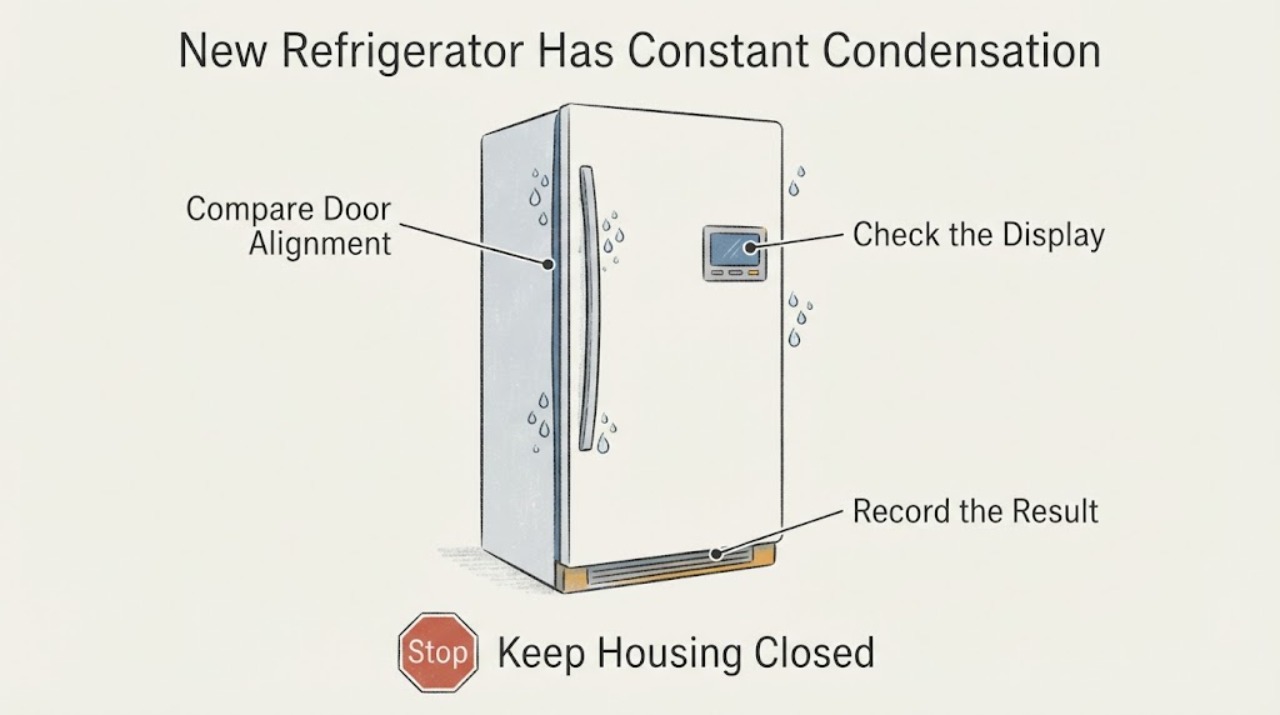
Map the condensation before changing anything: note whether it is inside on shelves/back wall, on the center mullion or vertical hinged seal, on the cabinet exterior, or pooled as liquid. Check the refrigerator and freezer temperatures with the model’s display or a suitable appliance thermometer.
Expected result: Only a small amount appears on a divider or after door opening and temperatures are stable, or moisture is widespread/pooling and a compartment is warmer than its setting.
Next step: Continue with the setup, seal and humidity checks if temperatures are stable. If a compartment is warm, food is at risk or water is pooling, keep doors closed as much as possible and arrange service rather than diagnosing the sealed system from condensation.
Why this matters
Why: KitchenAid describes limited humidity-related moisture as normal in some conditions, but widespread moisture with warm food, pooling water or an unsealed door is not explained by normal fog alone.
-
Check 2
For a newly installed refrigerator, verify the controls are at the owner-manual settings and allow the full 24-hour stabilization period before judging the result. Do not load a full amount of warm food during the pull-down period; keep any necessary door openings brief.
Expected result: The appliance has been powered for less than 24 hours or had a large warm load/frequent openings, or it has stabilized for 24 hours and moisture remains heavy.
Next step: Leave the control at the manual-recommended setting through the stabilization period. If moisture or temperature problems remain after that period, proceed to the closure and airflow checks and preserve the installation/warranty record.
Why this matters
Why: KitchenAid says warm room conditions, door openings and the amount loaded affect pull-down time, and its new-refrigerator guidance allows up to 24 hours for full stabilization. Repeatedly selecting a colder setting does not make the appliance cool instantly.
-
Check 3
Inspect only the accessible door edges, gaskets, shelves, bins and cabinet alignment for shipping tape or packaging, a tall container, a mis-seated drawer, a dirty or damaged gasket, or a door that does not sit flush. Check that the newly installed refrigerator is level according to its manual; do not remove doors or adjust hinges without the model instructions.
Expected result: A package, shelf, bin, gasket or alignment issue prevents full closure, or the doors close and the gaskets contact the cabinet all the way around.
Next step: Remove only visible packaging or a placement obstruction and clean the gasket with the model-approved method. If the door remains misaligned, the gasket is damaged, or the seal fails, stop relying on the unit and arrange installation or service support.
Why this matters
Why: KitchenAid identifies packaging, obstructions, an unlevel unit, incorrect door installation and gasket condition as causes of incomplete sealing. A clean, closed gasket makes humid-room and control/airflow checks more relevant, but does not prove every cooling component is healthy.
-
Check 4
Keep the refrigerator and freezer vents clear, leave room around the back wall for circulation, cover liquids, cool hot food before storage and organize the load so the doors can close. Reduce unnecessary door openings and wipe accessible moisture dry.
Expected result: Vents or air paths were blocked/overpacked, uncovered warm or liquid food was present, or airflow and loading were already clear.
Next step: Make the external loading correction and observe through a stable cooling period. If the same moisture returns with clear vents, proper loading and a closed seal, continue to the model-specific humidity feature or service boundary.
Why this matters
Why: KitchenAid says blocked vents, overloading, uncovered liquids, warm food and frequent openings can increase moisture or temperature swings. Correcting a visible loading condition can reduce condensation without proving that the refrigerator has an internal fault.
-
Check 5
If moisture is on the center mullion or vertical hinged seal, check whether this KitchenAid model has Energy Saver or Humidity Control and follow the owner manual. On models with that feature, use the manufacturer’s humidity guidance; do not assume the switch direction or availability from another model.
Expected result: The model has a moisture-control feature and exterior divider moisture improves after the manual-based setting, or there is no such feature/condensation persists.
Next step: Keep the model-specific setting only as directed. If the refrigerator remains warm, the door will not seal, moisture is heavy or condensation persists after the setup checks, arrange KitchenAid service or an installation/warranty inspection.
Why this matters
Why: KitchenAid says some models use a heater to reduce moisture on the vertical hinged seal, but controls and automatic-heater behavior vary. Persistent interior moisture, poor cooling, pooling water or a failed seal is not solved by assuming a mullion heater exists.
Use your observations
Decision map
Find the observation that best matches what you see, then follow the next safe action.
-
PATH 01Next step
What you see
The refrigerator is within its first 24 hours, reaches the model’s expected temperatures, doors seal, and the only moisture is light fog or droplets after humid-room door openings.
Do this next
Keep doors closed as much as possible, cover liquids, allow the full stabilization period and monitor the location and amount of moisture. Escalate if it becomes heavy, persistent or is accompanied by warm food.
Why this path and its safety boundary
Why it matters: The pattern is consistent with normal humidity and stabilization rather than proof of a refrigerator failure.
-
PATH 02Next step
What you see
Packaging, bins, shelves, an unlevel installation or a dirty/damaged gasket prevents one or more doors from sealing fully.
Do this next
Remove only visible packaging or obstructions and follow the model’s installation instructions. Request installation correction or service for a misaligned door, damaged gasket or seal that still fails.
Why this path and its safety boundary
Why it matters: Warm humid air can enter continuously, making condensation and temperature swings an installation or closure problem.
-
PATH 03Next step
What you see
The doors seal, the vents and loading are clear, the controls have stabilized for 24 hours, but moisture remains heavy or a refrigerator section is warm.
Do this next
Keep the doors closed, protect food and arrange KitchenAid or qualified refrigerator service. Do not remove panels, pierce tubing, add refrigerant or order a compressor, fan or gasket solely from the moisture symptom.
Why this path and its safety boundary
Why it matters: The documented external setup causes did not resolve the condition; condensation alone cannot distinguish airflow, control, defrost or sealed-system causes.
-
PATH 04Next step
What you see
Moisture is limited to the center mullion or vertical hinged seal and the model has an Energy Saver/Humidity Control feature.
Do this next
Use the owner manual to set the feature and allow the manufacturer’s stated time for the surface to clear. If condensation remains or moves to the interior, request service.
Why this path and its safety boundary
Why it matters: KitchenAid says some models use a heater in that seal to reduce exterior moisture, so this is a model-specific moisture-control decision rather than an interior cooling diagnosis.
Helpful context
Understand the symptom
Start with where the water is
Condensation on interior walls or shelves, on a French-door center mullion, on the vertical hinged seal, and on the cabinet exterior do not have the same first check. KitchenAid says humid room air and frequent door openings can create interior droplets, while the center divider or hinged seal may use a moisture-control heater on some models. Wipe the moisture and note its location before changing settings or assuming the refrigerator is defective.
A new installation needs time and a complete seal
KitchenAid says a new refrigerator can take several hours and up to 24 hours to stabilize. Its installation guidance identifies leftover packaging, an unlevel cabinet, bins or containers in the way, dirty or damaged gaskets and incorrectly installed doors as reasons a new door may not close or seal. These checks are more useful than repeatedly turning the control colder.
Keep humidity and cooling decisions separate
Condensation can be caused by humid air entering through normal use, but persistent moisture together with a warm compartment or a door that will not seal needs service. KitchenAid recommends clear vents, covered liquids, cooled food, organized loading and a model-specific setting for the Energy Saver or Humidity Control feature. The available guidance does not support naming a compressor, refrigerant leak or other sealed-system fault from droplets alone.
When checks do not resolve it
Need a professional?
Stop relying on the refrigerator for perishable storage and arrange service or installation correction for a warm compartment, heavy or pooling moisture, a door that will not seal, returning frost, visible water damage, or condensation that persists after the full new-installation stabilization and external checks.
Common questions
FAQ
Is condensation normal in a brand-new KitchenAid refrigerator?
A small amount can be normal in humid conditions or after door openings, and KitchenAid says a new refrigerator may need up to 24 hours to stabilize. Heavy or constant condensation, a warm compartment, pooling water or a door that does not seal needs further setup checks and possibly service.
Why is water forming on the divider between the French doors?
KitchenAid says the vertical hinged seal or center mullion can collect moisture in high humidity, and some models use an Energy Saver or Humidity Control heater for that surface. Check the owner manual because feature direction and availability vary by model; this does not explain heavy moisture on interior shelves.
Should I turn the refrigerator colder to stop condensation?
Use the owner manual setting and allow the full stabilization period first. KitchenAid identifies door sealing, humidity, airflow, warm food and frequent openings as contributors, and says control behavior varies by model. Repeatedly turning the control colder is not a substitute for checking the seal and installation.
What should I check before asking for an exchange or warranty visit?
Photograph the moisture location, record refrigerator/freezer temperatures and the installation date, check for shipping material or bins blocking the doors, inspect the gasket contact, note whether vents are blocked, and document whether the issue remains after 24 hours. Use KitchenAid service or the installer when a door will not seal, the compartment is warm, water pools or the setup checks do not resolve the problem.
Read the exact guide
Official sources
- How to Use the Humidity Control or Energy Saver FeatureKitchenAid Product Help · Opened KitchenAid Product Help. Used only for the conditional exterior divider/vertical seal moisture feature; the page states that controls and automatic-heater behavior vary by model and directs readers to the owner manual.
- Troubleshoot Your Refrigerator’s Possible ProblemsKitchenAid · Opened KitchenAid's official refrigerator troubleshooting page. Used for gasket cleaning, package/shelf obstruction and the recommendation to consult a professional when a water source cannot be determined; it does not identify a sealed-system fault from condensation.
- What to Check If Your KitchenAid Refrigerator Door is Not Closing ProperlyKitchenAid Product Help · Opened KitchenAid Product Help. Used for new-installation settling, level, gasket, obstruction, shipping material, door removal and vertical-hinge seal observations; no hidden hinge or internal repair is instructed.
- How to Help Eliminate Condensation and FrostKitchenAid Product Help · Opened KitchenAid Product Help. Used for humid-air, door-opening, gasket, blocked-vent and model-specific Energy Saver checks. It explicitly says controls vary and to use the owner manual for the model.
- What's Normal Condensation or FrostKitchenAid Product Help · Opened KitchenAid Product Help. Used for the distinction between light humidity-related condensation and excessive moisture, 37–40°F/0°F guidance, 24-hour stabilization, gasket/closure, airflow, covered liquids and mullion moisture. The page directs model-specific controls to the owner manual.
- Refrigerator Section is Not Cooling - Built-In RefrigeratorKitchenAid Product Help · Opened KitchenAid Product Help. Used for 24-hour stabilization after installation, packaging/door-seal checks, airflow, door-opening and service escalation. It is not used to assert a model-specific internal fault.
Community feedback
Share a repair observation
Share a plain-text repair observation. Accepted observations are published automatically; this page may take a moment to update.