
On this page
Start here
Quick answer
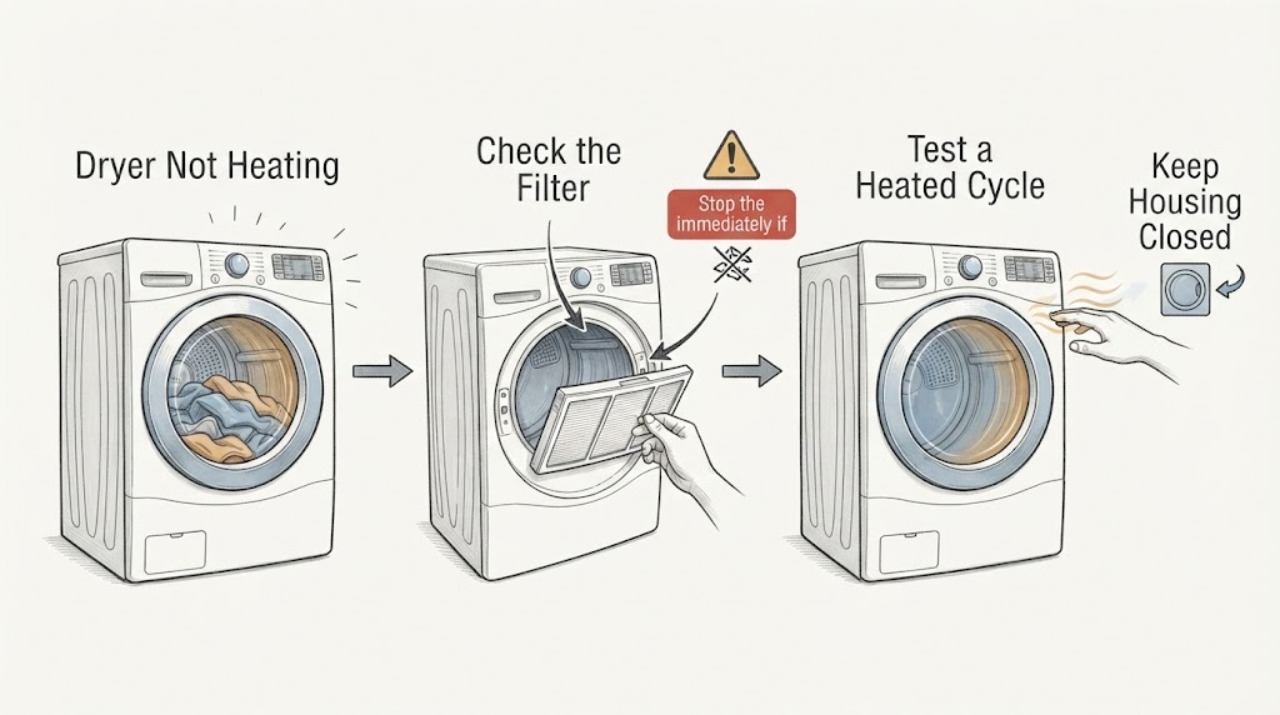
LG identifies the DLE2514W as an electric dryer. The report that its thermal fuse is blowing is not, by itself, a confirmed diagnosis or a reason to keep replacing the fuse. Stop using the dryer for smoke, burning or electrical odor, sparks, melting, an unusually hot cabinet or plug, or another breaker trip. If it is cool and there is no hazard, clean and fully dry the lint filter and inspect only the accessible exhaust hose and outside hood for crushing, kinks, lint, or a blocked flap. LG says restricted venting can keep a heater from staying on safely and recommends professional inspection when the restriction persists or is in the home duct. Do not bypass the fuse, repeatedly replace it, run for a long period with the exhaust disconnected, open the cabinet, or perform a live electrical test. If the drum tumbles but remains cold after a single safe external check, leave the DLE2514W off and request qualified appliance service to diagnose the complete airflow, thermal, heating, wiring, and control path.
Before you begin
Safety first
- Do not bypass or repeatedly replace a thermal fuse, operate with panels removed or the exhaust disconnected for a prolonged test, probe live wiring, alter the electric connection, or open the cabinet. Stop immediately for smoke, burning or electrical odor, sparks, melting, abnormal heat, or recurring breaker trips.
Work through in order
Diagnostic checks
Use only checks that match the exact appliance or system and its official guide.
-
Check 1
Stop the DLE2514W immediately if there is smoke, a burning or electrical odor, visible sparking or melting, an unusually hot cabinet, plug, or receptacle, or a breaker that trips again. From a dry, safe position, turn it off and isolate power only if that can be done without approaching a hazard.
Expected result: A hazard sign is present, the breaker has operated again, or the dryer can be safely left off without touching damaged parts.
Next step: Keep the dryer out of service and obtain qualified appliance or electrical help; use emergency assistance for active smoke or fire. Do not run another cycle to reproduce the report.
Stop if: Do not bypass a thermal device, reset a repeatedly operating breaker, open panels, or handle a hot or damaged cord or receptacle.
Why this matters
Why: This is a fire or electrical-safety branch, not a normal no-heat setting problem and not a reason to reset and retry.
-
Check 2
Read the rating label and controls without moving the appliance and confirm LG DLE2514W. Record whether the drum turns, whether heat is absent from every heated cycle or only after the dryer warms up, whether the display shows an airflow or other code, and whether anyone has already replaced a fuse or other part.
Expected result: The label matches DLE2514W, the suffix is different or unreadable, the drum turns but stays cold, heat stops after warming, or the reported fuse event cannot be verified.
Next step: If the label or controls do not match, stop using DLE2514W-specific instructions. If a fuse was changed or opened again, keep a dated record and stop part swapping; give the full history to service.
Why this matters
Why: The exact model anchors the electric-dryer literature, while timing separates a general no-heat report from a recurrence after a protective event. The user's part label remains unconfirmed unless a qualified diagnosis documents it.
-
Check 3
With the dryer cool and off, remove lint from the filter and inspect it for heavy coating or damage. If it is washed under the exact model instructions, let it dry completely before reinstalling it; do not put a wet filter back in the dryer.
Expected result: The filter is coated, wet, damaged, incorrectly seated, or clean and correctly seated.
Next step: Correct only the accessible filter condition. If no hazard is present, continue to the external hose check; if the filter is damaged or the problem returns, arrange model-specific service rather than choosing a fuse.
Why this matters
Why: LG treats regular lint-filter care as part of dryer maintenance, and a blocked or wet filter can reduce drying performance. A clean filter does not rule out a restriction farther along the exhaust path or an internal heating fault.
-
Check 4
Without pulling the dryer forward or disconnecting the duct, inspect the visible exhaust hose and the outside termination from a safe position. Look for a crushed, kinked, dented, detached, or lint-packed section and whether the outside flap can open freely; do not reach into a moving or hot outlet.
Expected result: The visible hose is crushed or kinked, the outside hood is visibly blocked or its flap cannot open normally, or the accessible path looks clear.
Next step: Correct only a plainly visible external obstruction with the dryer off. If the restriction is persistent, hidden, or the fuse report recurs, stop using the dryer and arrange professional vent and appliance inspection.
Stop if: Do not run the appliance for a long-term test with the exhaust disconnected, move a stacked or obstructed installation, dismantle the wall duct, or open the cabinet.
Why this matters
Why: LG identifies crushed or kinked ducting and a restricted outside or home ventilation path as airflow problems. A clear short visible section cannot exclude a blockage inside the wall, and it cannot prove that a fuse, heater, sensor, or control is healthy.
-
Check 5
If the control panel has Flow Sense or an airflow code, record the exact characters and indicator state rather than translating the user's wording. LG's current code guidance uses d75, d80, d90, and d95 for increasing exhaust restriction on applicable models; do not assume that an older DLE2514W displays every current code.
Expected result: An airflow indicator or code appears, the indicator returns after the visible hose is checked, or there is no airflow indication while the drum remains cold.
Next step: Use a professional vent cleaner or qualified appliance technician for a persistent indication. If airflow evidence is adequate but the drum remains cold, request internal heating-system diagnosis instead of another fuse replacement.
Why this matters
Why: A returning airflow indication increases the priority of the vent path, including hidden ductwork or the outside termination. No indication does not rule out a heating, supply, thermal, sensor, or wiring fault.
-
Check 6
Check only the external power state: whether the display responds, whether the dryer circuit breaker is on, and whether the cord or receptacle shows heat or damage. Do not remove the terminal cover, work on internal electrical connections, alter wiring, or perform a live test.
Expected result: The display is blank, the breaker has operated, the cord or receptacle looks damaged or hot, or the controls power normally while the drum remains cold.
Next step: For a supply, cord, or receptacle concern, use a qualified electrician. For a recurring no-heat or reported fuse event with normal external power, leave the dryer off and request qualified LG appliance service.
Stop if: Do not reset repeatedly, alter the 240-volt connection, bypass protection, or make a live measurement.
Why this matters
Why: LG's electric-dryer guidance separates supply or cord problems from a heating element that cannot heat properly. A powered, tumbling dryer with no heat still needs a qualified diagnosis; external power does not identify the failed component.
-
Check 7
Prepare a service handoff: provide DLE2514W, the complete symptom timeline, cycle and temperature setting, whether the drum tumbles, how long heat lasts, any airflow display, the filter and visible hose observations, breaker or odor history, and every part already changed.
Expected result: A technician can reproduce a documented pattern, can show a measured fault, cannot reproduce the issue, or proposes another fuse without explaining the overheat or no-heat cause.
Next step: Ask for a written, model-specific diagnosis that covers the vent path, thermal protection, heating circuit, wiring, sensors, and control response before approving a replacement. If evidence is absent, seek a second qualified diagnosis.
Stop if: Do not treat a reset, one short successful cycle, or a fuse replacement alone as proof that the recurring fault is repaired.
Why this matters
Why: A reproducible result tied to the complete airflow and heating path is stronger evidence than a component label or time sequence. A fuse that opens again without a root-cause explanation leaves the safety risk unresolved.
Use your observations
Decision map
Find the observation that best matches what you see, then follow the next safe action.
-
PATH 01Next step
What you see
There is smoke, burning or electrical odor, sparks, visible melting, abnormal heat, a damaged power connection, or a breaker trip that repeats.
Do this next
Keep the DLE2514W off and obtain urgent qualified appliance or electrical help. Do not reset, bypass, or reopen the dryer.
Why this path and its safety boundary
Why it matters: This is an immediate fire or electrical branch; the dryer must not be used to confirm a fuse or heating diagnosis.
-
PATH 02Next step
What you see
The filter is dirty or wet, or the visible exhaust hose or outside hood is clearly restricted, and no safety symptom is present.
Do this next
Clean and fully dry the filter and correct only a plainly visible hose or hood issue while the dryer is off. Arrange professional vent inspection if the indication or no-heat problem persists; do not run long with the exhaust disconnected.
Why this path and its safety boundary
Why it matters: An accessible airflow or filter issue is plausible, but LG's guidance also warns that a hidden home-duct restriction may remain after the visible section looks better.
-
PATH 03Next step
What you see
The user reports that a thermal fuse has blown or been replaced more than once, or the no-heat condition returns after a replacement.
Do this next
Stop replacing or bypassing the fuse and leave the dryer out of service until qualified appliance service documents the root cause and a safe repair check.
Why this path and its safety boundary
Why it matters: The report establishes recurrence, not a confirmed fuse-only failure. Repeated protection events raise the priority of finding an overheat, airflow, wiring, thermal, heating, sensor, or control cause.
-
PATH 04Next step
What you see
The drum tumbles on a normal heated setting, the accessible filter and exhaust look clear, external power appears normal, and the drum remains cold or heat stops again.
Do this next
Stop troubleshooting and request qualified LG appliance service for a complete model-specific diagnosis. Do not open the cabinet or order a part from the symptom alone.
Why this path and its safety boundary
Why it matters: The remaining possibilities include the internal heating and thermal path, sensing, wiring, or control response; the observations do not select an element, fuse, sensor, or board.
-
PATH 05Next step
What you see
The display is blank, the breaker or receptacle is abnormal, or the cord shows heat or damage.
Do this next
Do not reset repeatedly or open the terminal area. Have a qualified electrician assess the supply and a qualified appliance technician assess the dryer if the external supply is sound.
Why this path and its safety boundary
Why it matters: The external supply branch must be separated from an appliance heating fault, and a damaged connection can be a shock or fire risk.
Helpful context
Understand the symptom
Why a reported blown fuse changes the first decision
The exact DLE2514W is an electric LG dryer, but the phrase “thermal fuse blowing” is a user report, not proof that one replaceable part is the root cause. A protective device that opens again can be a sign that heat, airflow, wiring, or another part of the heating system needs to be traced. The useful new decision is therefore to stop blind fuse replacement and first separate an immediate hazard from a safe, external airflow observation. A clear visible hose does not prove that the wall duct or the complete heating path is clear.
What LG's airflow guidance can and cannot show
LG's installation-check guidance distinguishes no temperature change, slowly increasing temperature, and rapidly increasing temperature. It associates slow increase with restricted airflow and lists the lint filter, crushed exhaust, outside termination, home duct, and incompatible installation as possible causes. The same guidance says no temperature change can involve power or the heating element, while rapid increase can fit a setting or sensor-related branch. These are observations for a qualified decision, not permission to open the DLE2514W, defeat thermal protection, or choose an internal part from the symptom.
When checks do not resolve it
Need a professional?
Arrange qualified LG appliance service when a reported fuse event recurs, no heat returns after one safe external filter and vent check, an airflow indication persists, or diagnosis would require access to the heating, thermal, sensor, wiring, blower, or control path. Use a qualified electrician for a damaged cord, receptacle, breaker, or suspected supply problem.
Safety scope: Do not bypass or repeatedly replace a thermal fuse, operate with panels removed or the exhaust disconnected for a prolonged test, probe live wiring, alter the electric connection, or open the cabinet. Stop immediately for smoke, burning or electrical odor, sparks, melting, abnormal heat, or recurring breaker trips.
Have this ready
- Provide the exact DLE2514W label, cycle and temperature setting, drum behavior, time-to-no-heat, exact display or Flow Sense state, filter and visible exhaust observations, any odor or overheating, breaker history, and every repair or fuse replacement already attempted.
Read the exact guide
Official sources
- Product Support: Help Library | LG USA SupportLG Electronics · Opened LG USA support page for DLE2514W; the page identifies DLE2514W and labels it an LG electric dryer with five drying programs, and provides the exact model's owner-manual and service-support route.
- LG Dryer - Error Code List(New)LG Electronics · Opened official LG dryer error-code page; used conditionally for models that display d75/d80/d90/d95 or Flow Sense, not to assert that the older DLE2514W displays every listed code.
- LG Dryer – Proper Venting and Installation TipsLG Electronics · Official LG dryer guidance used for the general exhaust path and accessible inspection boundary; it is not treated as an exact DLE2514W service manual.
- Installation Check - Laundry DryerLG Electronics · Official LG installation-check guidance for applicable LG dryers; used for the general distinction between restricted airflow, supply/heating observations, and professional vent service, not as a claim that every DLE2514W panel has the same test or indicator.
- LG Dryer – How to Perform Dryer MaintenanceLG Electronics · Opened official LG dryer maintenance guidance used for lint-filter cleaning and drying and routine duct cleaning; not treated as an exact DLE2514W repair manual.
Community feedback
Share a repair observation
Share a plain-text repair observation. Accepted observations are published automatically; this page may take a moment to update.