
On this page
Start here
Quick answer
Before troubleshooting an LG dryer that is not heating, stop for gas odor, burning smell, smoke, sparks, visible melting, overheating, or a breaker that trips again. If the appliance is safe and cool, check whether Air Dry or Energy Saver is intentionally using little or no heat, then try a normal heat setting only if the model manual permits it. Clean and fully dry the lint filter, inspect the accessible exhaust path for crushing or blockage, and note any Flow Sense or d75/d80/d90/d95 indication. A gas dryer also needs a confirmed gas supply, but gas-line work belongs to a qualified installer or gas service. An nP or PS code, correct external supply with persistent no heat, or any recurring safety symptom requires qualified service; do not open the cabinet or test live wiring.
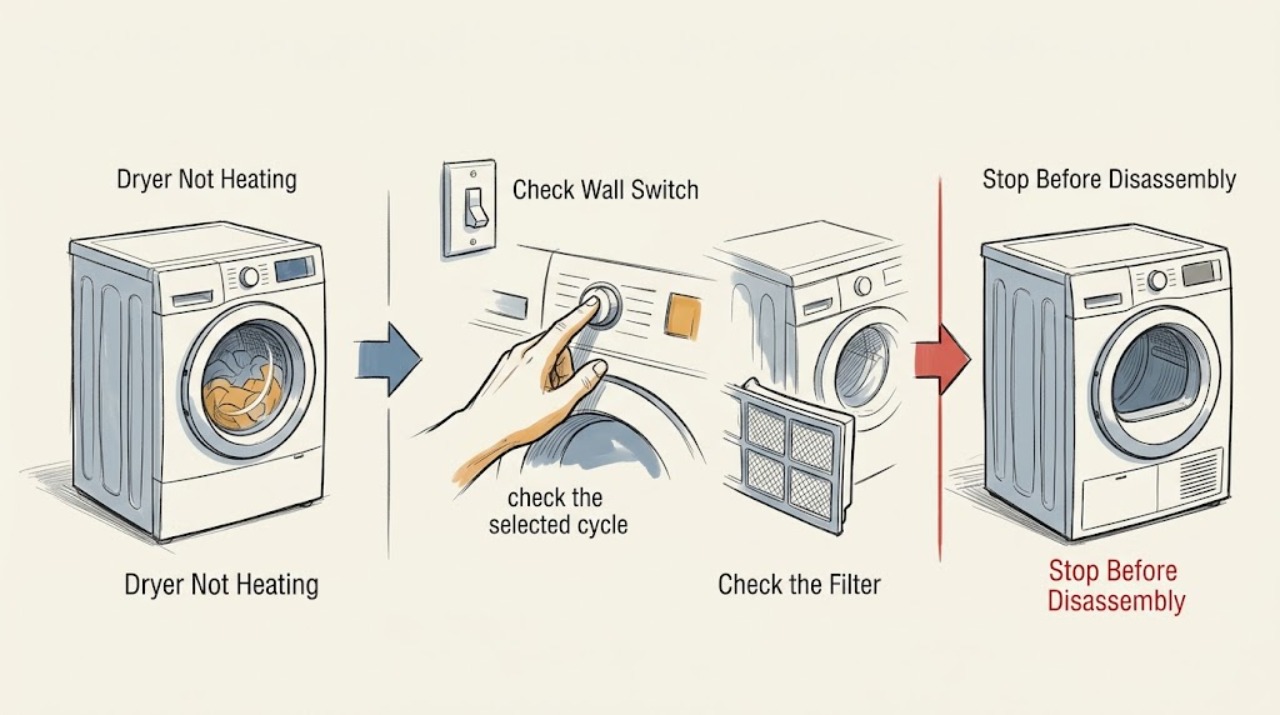
Work through in order
Diagnostic checks
Use only checks that match the exact appliance or system and its official guide.
-
Check 1
Stop using the dryer immediately for a gas smell, burning or electrical odor, smoke, flame, sparks, visible melting, an unusually hot cabinet or plug, or a breaker that trips again. Keep away from a suspected gas leak and do not operate electrical switches in the affected area.
Expected result: Any of those hazard signs is present, or the appliance cannot be safely isolated from a dry accessible location.
Next step: Leave the dryer out of service and obtain appropriate emergency, gas, electrical, or appliance help. Do not reset and retry it.
Why this matters
Why: This is a fire, gas, or shock risk rather than a normal no-heat setting issue.
-
Check 2
With the dryer cool and no safety symptom, check the selected cycle and modifiers. Make sure Air Dry, a no-heat option, or Energy Saver is not selected; on supported LG models, Energy Saver can air-dry without heat for most of the cycle. Confirm the temperature and dryness setting in the exact model manual.
Expected result: The cycle is Air Dry/no-heat or Energy Saver is active, or a normal heated cycle is selected.
Next step: If safe, select the model's normal heated cycle for one controlled observation; if the appliance shows any odor, spark, overheat, or electrical problem, stop instead of running it.
Why this matters
Why: An unheated setting can look like a failed heater. If a normal heated cycle still produces no heat, continue to airflow, supply, and fault-code checks.
-
Check 3
Remove lint from the filter and inspect it for a heavy coating or damage. If the model permits washing the filter, clean it as LG directs and let it dry completely before reinstalling it. Check the visible exhaust connection for a crushed, kinked, detached, or heavily linted section without dismantling the dryer.
Expected result: The filter is blocked or wet, the hose is crushed/kinked, or the filter and visible hose are clear.
Next step: Correct only the accessible filter or hose issue, then use a normal cycle only if there has been no safety symptom. If restriction remains or the Flow Sense indication returns, arrange professional vent inspection.
Why this matters
Why: Restricted airflow can reduce heating and lengthen drying; a wet filter should not be installed. A clear accessible path does not rule out a blockage in the wall or outside termination.
-
Check 4
If the dryer has Flow Sense or an airflow code, note the exact display and inspect the outside exhaust outlet only from a safe position. The LG code list identifies d75, d80, d90, and d95 as restriction levels; do not reach into a moving or hot outlet and do not pull the appliance away from the wall.
Expected result: The Flow Sense bars or d-code rises, the outside flap does not open normally, or airflow appears normal but the dryer remains cold.
Next step: Stop the heated test and use a qualified vent-cleaning or appliance professional for persistent restriction. If airflow is adequate, continue to supply and heating-system service rather than replacing a part by guesswork.
Why this matters
Why: A restriction may be between the dryer and outside termination, possibly inside the wall; normal visible airflow does not prove the heater is healthy.
-
Check 5
Identify whether the dryer is electric or gas and record the power state without opening the cabinet. Look for a blank display or drum light, a recently operated breaker, an nP or PS code, or a gas-supply indication. Do not measure voltage, adjust a terminal block, reconnect wiring, or open a gas connection.
Expected result: The dryer has no power, a breaker has operated, nP/PS is displayed, the gas dryer has a gas-related indication, or the controls power normally.
Next step: Have a qualified electrician assess supply or cord concerns and a qualified gas installer/service provider assess gas concerns. If external supply is correct but heat is absent, request appliance service.
Why this matters
Why: LG associates nP/PS with electrical supply or power-cord conditions and notes that gas and electric models have different supply paths; a powered dryer with persistent no heat needs diagnosis.
-
Check 6
Record every display message and the behavior of the drum: whether it turns, whether the cycle starts, whether the drum stays cold, and whether an error returns. Include the model number and whether the problem is only on one cycle or on all heated cycles.
Expected result: The drum turns but stays cold, an error code returns, the drum will not turn, or only one cycle lacks heat.
Next step: Do not bypass the door or thermal safety system and do not perform an internal test after a hazard. Give the full record to LG or qualified service for a safe diagnosis.
Why this matters
Why: A turning cold drum points toward setting, airflow, supply, sensor, thermal, or heating-system branches; a non-turning drum is a separate start/motor diagnosis; a recurring code needs model-specific service.
Use your observations
Decision map
Find the observation that best matches what you see, then follow the next safe action.
-
PATH 01Next step
What you see
Air Dry, a no-heat option, or Energy Saver is active and there is no safety symptom.
Do this next
Use the exact model controls to select a normal heated cycle and observe once. If heat remains absent, continue with airflow and supply checks.
-
PATH 02Next step
What you see
The lint filter is dirty/wet or Flow Sense/d75/d80/d90/d95 indicates restricted airflow.
Do this next
Clean and fully dry the filter, inspect the accessible hose for crushing or kinks, and arrange professional vent inspection when the indication persists or the restriction is beyond the appliance.
-
PATH 03Next step
What you see
An electric dryer has nP or PS, loses power, or repeatedly operates the breaker.
Do this next
Do not reset repeatedly or alter wiring. Have the outlet, cord, circuit, and appliance assessed by a qualified electrician and service technician as appropriate.
-
PATH 04Next step
What you see
A gas dryer has a gas odor, a gas-related display, a closed or damaged supply line, or no heat after the supply is confirmed.
Do this next
For gas odor, leave the area and follow gas-emergency guidance without operating switches. Otherwise, gas-line and conversion/service work must be handled by a qualified installer or gas service provider.
-
PATH 05Next step
What you see
The dryer tumbles on a normal heated cycle with clear airflow and correct external supply, but the drum remains cold.
Do this next
Stop troubleshooting and request qualified appliance service for the heating system, thermal protection, sensor, or control path. Do not open the cabinet or select a replacement part from the symptom alone.
-
PATH 06Next step
What you see
There is gas odor, burning/electrical odor, smoke, flame, sparks, visible melting, overheating, or a recurring breaker trip at any point.
Do this next
Stop immediately, keep the dryer out of service, and obtain emergency or qualified gas/electrical/appliance help. Do not re-run or repeatedly reset it.
Helpful context
Understand the symptom
“Not heating” can mean the dryer is deliberately using an unheated option, has insufficient airflow or supply, or has a failed heating circuit. The first safe distinction is whether the drum runs and whether the selected cycle is supposed to add heat. After a gas odor, electrical odor, spark, smoke, or overheating, do not use a cycle as a diagnostic tool.
The checks below are external and model-aware. LG dryer layouts and controls vary. Keep the lint filter and any cleaned sensor completely dry, and do not remove panels, bypass a thermal device, open a gas line, or perform a live electrical measurement.
Safety boundary
Stop conditions
- Stop immediately for gas odor, burning or electrical smell, smoke, flame, sparks, visible melting, overheating, water near electrical parts, or a breaker that trips again.
- Do not open the cabinet, access a terminal block, test live voltage, bypass a thermal or door safety device, open a gas line, or repeatedly reset the breaker.
- Do not run a heated cycle when airflow is severely restricted, the filter is wet, or an error returns after the model-specific low-risk check.
Only after diagnosis
Potential parts
- dryer heating element or burner assembly
Only relevant after qualified diagnosis confirms a heating-source fault on the exact electric or gas model.
Electric and gas dryers use different heating systems; confirm the exact model and approved service procedure before any part decision. - thermal fuse or temperature sensor
Only relevant when a technician isolates a thermal protection or sensor fault after airflow and supply causes are assessed.
Do not bypass a thermal device or infer its failure from no heat alone; verify exact fitment and cause with qualified service. - gas valve or igniter assembly
Only relevant for a gas model after qualified diagnosis of the ignition path with no active gas hazard.
Gas components require qualified installation/service and exact model confirmation; never open or test the gas circuit as a consumer check.
When checks do not resolve it
Need a professional?
Use urgent gas or emergency assistance for a gas odor, smoke, flame, sustained sparks, or a hazard that cannot be safely isolated., Use a qualified electrician for nP/PS, damaged power connections, suspected supply problems, or a breaker that operates again., Use qualified appliance service when airflow is clear but the drum remains cold, a fault code returns, or the heating system needs internal diagnosis.
Have this ready
- LG model and serial information
- Electric or gas dryer type
- Cycle, temperature, Energy Saver/Air Dry state, and whether the drum turns
- Exact code or Flow Sense indication
- Filter/vent observations and whether a breaker operated
- Any odor, smoke, spark, heat damage, or gas symptom
Common questions
FAQ
Can Air Dry make an LG dryer seem like it is not heating?
Yes. Air Dry is an unheated option, and supported models may also air-dry for much of a cycle with Energy Saver. Check the exact cycle and temperature setting before treating the symptom as a heater failure.
What does Flow Sense or a d80 code mean on an LG dryer?
Flow Sense with d75/d80/d90/d95 signals an exhaust restriction. Clean and dry the filter, check the accessible hose for crushing or kinks, and arrange professional vent inspection if the indication persists.
What should I do if my LG gas dryer smells like gas?
Do not try to light the appliance or operate electrical switches. Leave the area and follow local gas-emergency guidance; gas-line and appliance service must be handled by qualified personnel.
When does an LG dryer that is not heating need service?
Request qualified service when the drum stays cold on a correct heated cycle after safe filter and airflow checks, when nP/PS or another code returns, when supply concerns remain, or whenever there is odor, smoke, sparking, overheating, or a repeated breaker trip.
Read the exact guide
Official sources
- LG Dryer - Error Code ListLG USA Support · LG dryer Flow Sense, airflow, power, gas, thermistor, and related display-code interpretation
- LG Dryer – Why is My Dryer Not Heating, Not Drying or Taking a Long Time Drying?LG USA Support · LG dryer no-heat troubleshooting, Energy Saver, installation test, airflow, sensors, and service guidance
- [LG Washer Dryer] Is the vent pipe bent or clogged?LG USA Support · LG washer-dryer lint-filter and exhaust-pipe obstruction checks
- Part 9 — OPERATING YOUR DRYERLG · LG dryer Air Dry cycle behavior and model manual operating context
- LG Dryer - What to Do If You Smell Gas Around Your LG DryerLG USA Support · LG dryer gas-odor emergency and qualified gas service guidance
- [LG Dryer power] The power turns off during use, or there is no power supplyLG USA Support · LG dryer supply, breaker, outlet, cord, electric/gas distinction, and service escalation
Community feedback
Share a repair observation
Share a plain-text repair observation. Accepted observations are published automatically; this page may take a moment to update.