
On this page
Start here
Quick answer
The LG DLEX3875W is an electric dryer with Sensor Dry System and FlowSense, but a photograph or an unlisted-looking component does not prove that a sensor is faulty. First separate the reported symptom: a powered drum that stays cold on a heated cycle is a different path from a Sensor Dry cycle that ends early. With no gas, burning or electrical odor, smoke, sparks, visible melting, unusual heat, or repeat breaker trip, check the selected cycle and temperature, clean and fully dry the lint filter, and inspect only the accessible exhaust path. If a small load makes the displayed time drop abruptly and the dryer stops, LG attributes that pattern to inadequate clothing contact with the front sensors or residue on the sensors; use a suitable load or the model's Manual Dry/Timed Dry option once, without opening the cabinet. If the drum still stays cold, will not turn, loses power, or the suspected component is not clearly identified by the DLEX3875W documentation, stop and arrange qualified appliance or electrical service rather than ordering a guessed sensor, heater, fuse, or control part.
Before you begin
Safety first
- No user cabinet removal, live voltage or terminal-block testing, connector probing, door/thermal bypass, internal sensor removal, or improvised part substitution. Keep the dryer out of service for smoke, sparks, burning odor, visible melting, unusual heat, violent movement, or repeated breaker operation.
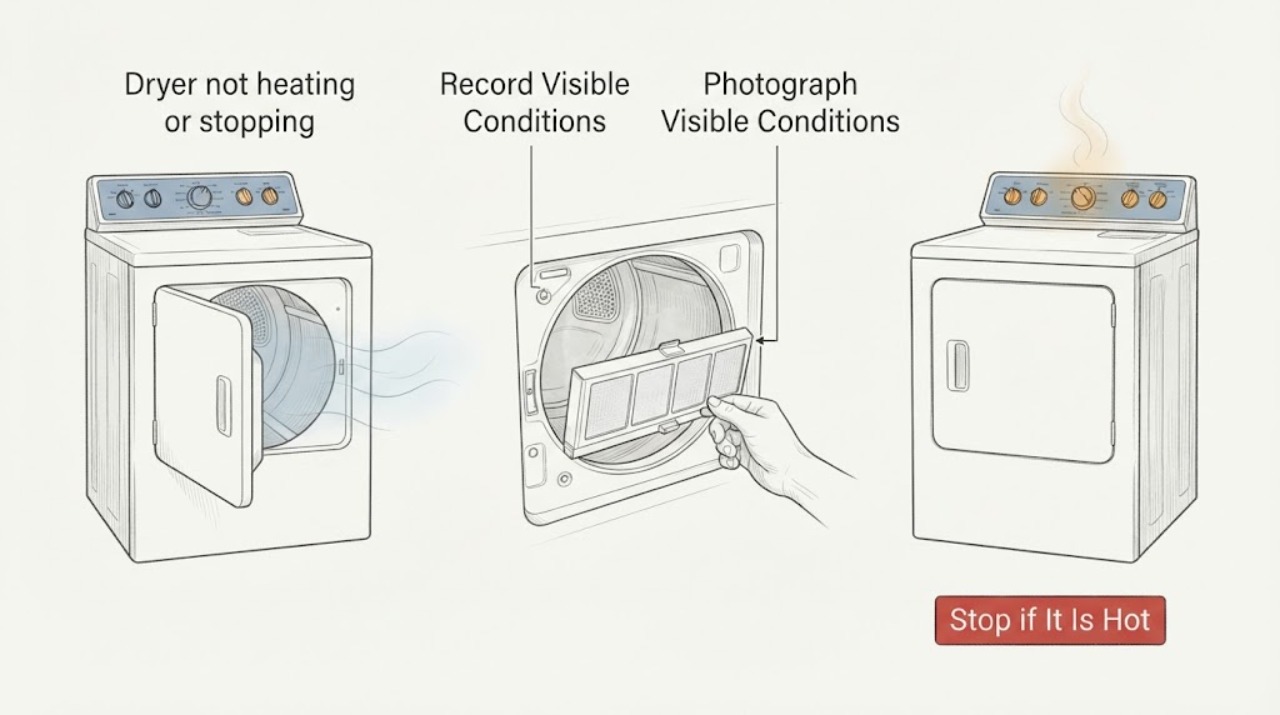
Work through in order
Diagnostic checks
Use only checks that match the exact appliance or system and its official guide.
-
Check 1
Stop the dryer and let the drum and cabinet cool. From a dry, safe position, record whether there was smoke, a burning or electrical smell, a spark, visible melting, unusual heat, violent movement, or a breaker that opened again. Do not restart to reproduce any warning.
Expected result: No hazard sign is present, or any fire, shock, overheating, gas-like, or repeated-breaker warning is present.
Next step: If any warning is present, keep the dryer out of service, isolate power only from a safe accessible location, and obtain qualified appliance/electrical help. If there is no warning, continue with the symptom record.
Stop if: Do not run another cycle for a smell, spark, smoke, hot plug or cabinet, visible damage, violent movement, or repeat breaker trip.
Why this matters
Why: A warning sign changes this from a normal no-heat or sensing question to a fire, electrical, or mechanical safety issue. The absence of a warning permits only external observations; it does not prove the dryer is safe internally.
-
Check 2
With the dryer cool and safe, record the exact cycle, temperature, dryness level, Energy Saver or no-heat setting, whether the controls power on, whether the drum turns, and whether the complaint is a cold drum, an early stop, or both. Do not identify a part from a photograph alone.
Expected result: The selected cycle is Air Dry or another manual/no-heat option, Energy Saver is active, the drum turns but remains cold, the drum does not turn, or the timer drops and the cycle ends early.
Next step: If the manual permits and no safety symptom exists, make only one controlled observation on the model's normal heated cycle. If the drum does not turn, the display is dead, or the cycle still stops, stop testing and preserve the exact behavior for service.
Stop if: Do not use an internal test, bypass a door or thermal control, or continue operating when an electrical or overheating warning appears.
Why this matters
Why: DLEX3875W supports both Sensor Dry and Manual Dry cycles, so a no-heat selection can look like a failed heater. A turning cold drum is different from a non-turning drum, while an abrupt early stop is a separate sensing/load branch.
-
Check 3
After the dryer is off and cool, remove lint from the filter and reinstall it only when fully dry. Inspect the visible exhaust connection and outside termination from a safe position for a crushed or kinked hose, obvious lint, or a flap that cannot open normally; do not pull the dryer out or insert tools.
Expected result: The filter or visible hose is wet, blocked, crushed, detached, or the outside flap appears restricted, or the accessible path is clear.
Next step: Correct only an accessible filter or obvious external obstruction. If FlowSense or an airflow indication persists, arrange professional vent inspection; if airflow is adequate but the drum stays cold, use the heating-system service branch.
Stop if: Do not remove guards, dismantle the duct, reach into a hot or moving outlet, or run with the lint filter removed.
Why this matters
Why: LG links restricted airflow and lint accumulation with poor heating or long drying. A clear visible path does not rule out a wall-duct restriction and does not establish that a sensor or heater has failed.
-
Check 4
If the dryer powers back on after an early shutdown, record the load size and the timer behavior. Look for the LG-described pattern in which a small load fails to brush the sensors at the front of the drum and the time drops abruptly before stopping. Do not reach inside a moving drum or scrape an unidentified part.
Expected result: The problem occurs only with a very small or single-item load and the timer drops sharply, residue is visible only where the user manual permits cleaning, or the same early stop occurs with a suitable load.
Next step: If there is no safety symptom, use a suitable load or the DLEX3875W Manual Dry/Timed Dry option for one controlled observation, and clean sensor surfaces only as the exact owner manual allows. If the cycle still ends early with a suitable load or the sensor location/identity is uncertain, arrange service.
Stop if: Do not open the cabinet, scrape, bend, disconnect, bypass, or replace a sensor based on a photo or a community guess.
Why this matters
Why: LG says small loads may not maintain contact with the front sensors and that residue on the sensors can prevent correct load detection. This makes a load/contact or cleanable-residue explanation more plausible, but it does not prove that a photographed or 'undocumented' sensor is defective.
-
Check 5
If the drum turns on a normal heated cycle but stays cold, note whether FlowSense or an airflow code is present and whether the accessible filter and exhaust path are clear. If the drum will not turn or the display remains dead, record the drum-light and control state instead of opening the machine.
Expected result: The drum tumbles but remains cold with adequate visible airflow, the drum does not turn, the display or drum light is dead, or a fault/power indication returns.
Next step: Leave the dryer off and provide the model, exact cycle, display messages, drum behavior, load, airflow observations, and any prior repair history to qualified appliance service. Use an electrician for supply, cord, or breaker concerns.
Stop if: Do not measure live voltage, open the terminal block or cabinet, reset repeatedly, or order a component from the symptom alone.
Why this matters
Why: A cold turning drum, a non-turning drum, and a no-power condition are different service paths. LG directs service when the dryer remains cold after the safe airflow/settings checks or does not power back on; the result does not identify a particular heater, fuse, motor, sensor, or control board.
-
Check 6
Before service, capture the exact DLEX3875W model label, every display message, cycle and modifier, whether the drum turns, when heat is absent or the timer falls, load size, filter/vent observations, and a photo only of the suspected component in place. Do not remove it to make the photo clearer.
Expected result: The component is not named in the DLEX3875W owner documentation, the photo does not show its connector or mounting identity, or the same symptom persists after the safe external checks.
Next step: Keep the dryer out of service if heat is absent, the cycle is unreliable, or the component identity is unresolved. Ask qualified service to match the component and diagnose the heating, sensing, power, and control paths under the DLEX3875W procedure.
Stop if: Do not open the cabinet, remove panels, probe connectors, bypass safety devices, or install a sensor/heater/fuse/control part without exact model confirmation and qualified diagnosis.
Why this matters
Why: The available evidence supports Sensor Dry and airflow behavior, not a component-level failure conclusion. An unidentified component may be a sensor, bracket, shield, harness, or another assembly, and model-family parts are not interchangeable by appearance.
Use your observations
Decision map
Find the observation that best matches what you see, then follow the next safe action.
-
PATH 01Next step
What you see
The DLEX3875W powers on, the drum turns, and a Sensor Dry cycle ends early with a very small or single-item load; the timer drops sharply and there is no odor, smoke, abnormal heat, or airflow warning.
Do this next
Use a suitable load or Manual Dry/Timed Dry once, and clean only the sensor surfaces permitted by the exact owner manual. Escalate if the pattern repeats with a suitable load or the sensor cannot be identified safely.
Why this path and its safety boundary
Why it matters: That pattern is consistent with LG's documented small-load/contact limitation or residue affecting load detection, not proof of a failed sensor.
-
PATH 02Next step
What you see
The drum turns on a normal heated cycle but remains cold after the accessible filter and exhaust path are clear, or a no-heat result persists across heated cycles.
Do this next
Stop using the dryer and request qualified appliance service. Do not open the cabinet or choose a heating or sensor part from the symptom or photograph.
Why this path and its safety boundary
Why it matters: Settings and the simplest visible airflow explanation are less likely, but the symptom does not distinguish the heater, thermal protection, sensor, wiring, or control path.
-
PATH 03Next step
What you see
The dryer will not turn, has no display or drum light, shows a recurring power indication, or operates the breaker again.
Do this next
Do not repeatedly reset or test live wiring. Have the supply/cord/circuit assessed by a qualified electrician and the appliance assessed by qualified service as appropriate.
Why this path and its safety boundary
Why it matters: This is a separate start or electrical-supply branch rather than evidence that the unidentified sensor caused the no-heat complaint.
-
PATH 04Next step
What you see
FlowSense or an airflow indication persists, the filter is wet or blocked, the visible hose is crushed, or the outside termination does not open normally.
Do this next
Correct only the safe, accessible filter or external obstruction and arrange professional vent inspection when the indication or weak airflow persists. Do not pull the dryer out or dismantle the duct.
Why this path and its safety boundary
Why it matters: An air-path restriction is more plausible than a confirmed sensor or heater failure; a wall-duct restriction can remain even when the visible hose looks clear.
-
PATH 05Next step
What you see
The suspected component is inside the cabinet, has an unknown connector or mounting, is damaged, or the dryer has smoke, sparks, burning odor, visible melting, unusual heat, or a repeated breaker trip.
Do this next
Leave the dryer disconnected when safe, keep it out of service, and obtain qualified appliance/electrical help. Use emergency assistance for an active fire or immediate danger.
Why this path and its safety boundary
Why it matters: The issue exceeds safe external troubleshooting and may involve fire, shock, thermal, or mechanical risk. A photo or community description cannot certify the component or appliance.
Helpful context
Understand the symptom
The exact model matters here. LG's US support record identifies DLEX3875W.ABWEEUS, and the matching specification identifies DLEX3875W as the white electric version of the DLEX3875 family. That document lists Sensor Dry System, FlowSense, Sensor Dry cycles, Manual Dry cycles such as Speed Dry and Air Dry, and five temperature levels. It does not identify an arbitrary photographed part by appearance, so an 'undocumented sensor' should remain an observation until the exact owner documentation or a technician matches it to the model.
Use the symptom timing to choose the safe branch. A drum that turns but remains cold on a heated cycle points toward settings, airflow, supply, thermal protection, sensor, heating, or control diagnosis; a cycle that ends early with a small load can instead be a sensing/contact result. Neither pattern authorizes opening the cabinet or selecting a replacement sensor from a photograph.
This is an electric dryer, so do not measure the 240-volt supply, open the terminal block, remove a guard or panel, bypass a door or thermal safety device, or work on live wiring. Stop immediately for smoke, sparks, burning or electrical odor, visible melting, an unusually hot plug or cabinet, or a breaker that trips again.
When checks do not resolve it
Need a professional?
Arrange qualified LG or appliance service when the DLEX3875W remains cold on a normal heated cycle after safe filter and airflow checks, a sensor-related early stop repeats with a suitable load, the suspected component cannot be matched to the exact model documentation, the drum will not turn, or a fault returns. Use a qualified electrician for a dead supply, damaged cord or connection, nP/PS-type power indication, or a breaker that operates again. Stop immediately for smoke, sparks, burning or electrical odor, visible melting, unusual heat, violent movement, or any condition that cannot be safely isolated. Do not open the cabinet, remove panels, perform live tests, bypass door or thermal protection, or choose a replacement part from a photograph.
Safety scope: No user cabinet removal, live voltage or terminal-block testing, connector probing, door/thermal bypass, internal sensor removal, or improvised part substitution. Keep the dryer out of service for smoke, sparks, burning odor, visible melting, unusual heat, violent movement, or repeated breaker operation.
Common questions
FAQ
Does the LG DLEX3875W have a sensor system?
Yes. LG's matching DLEX3875W specification lists Sensor Dry System, Sensor Dry cycles, and FlowSense. That confirms the product feature, not the identity or failure of a particular component seen in a photo.
Can a small load make this LG dryer stop before the time reaches zero?
It can. LG says a small load may not brush the sensors at the front of the drum consistently, so the Sensor Dry time can drop abruptly and the cycle can end early. A suitable load or Manual Dry/Timed Dry may separate that behavior from a persistent fault, but a repeat with a suitable load needs service.
Can I replace the undocumented sensor from a picture?
No. The DLEX3875W specification confirms sensing features but does not identify an arbitrary component by appearance. Do not open the cabinet, disconnect a connector, bypass a safety device, or order a sensor until qualified service matches the component and diagnoses the circuit for the exact model.
What if the dryer tumbles but never gets warm?
After checking the selected heated cycle and safe, accessible airflow path, treat a persistently cold turning drum as a heating-system service issue. Do not measure the 240-volt supply or select a heater, fuse, sensor, or control part from the symptom alone.
Read the exact guide
Official sources
- LG Dryer - Why is My Dryer Not Heating, Not Drying or Taking a Long Time Drying?LG USA Support · Official LG dryer guidance used for airflow, Energy Saver, sensor-contact behavior, Manual/Time Dry selection, safe external vent checks, and service escalation. The current installation-test button chart does not list DLEX3875W and is not reproduced here.
- LG Dryer - Why Does My Dryer Turn Off Abnormally?LG USA Support · Official LG dryer guidance directly supports the sensor/load decision used here. It is not used to claim that an unidentified DLEX3875W part is defective or to provide internal repair instructions.
- DLEX3875V/W and DLGX3876V/W Stylish SteamDryer specificationLG Electronics U.S.A. · The specification explicitly lists DLEX3875W as the white electric dryer. It establishes product features and supply type, but does not identify an arbitrary photographed internal part or authorize cabinet service.
- Power Issues - Laundry DryerLG USA Support · Official LG dryer guidance used for no-power, no-run, drum-turning, cold-drum, abnormal-shutdown, and safety escalation. It does not identify a component on DLEX3875W from a symptom or photograph.
- LG DLEX3875W: Support, Manuals, Warranty & MoreLG USA · Exact LG US support page for the assigned DLEX3875W dryer; it links the owner manual and specification and confirms the model-label suffix.
Community feedback
Share a repair observation
Share a plain-text repair observation. Accepted observations are published automatically; this page may take a moment to update.