
On this page
Start here
Quick answer
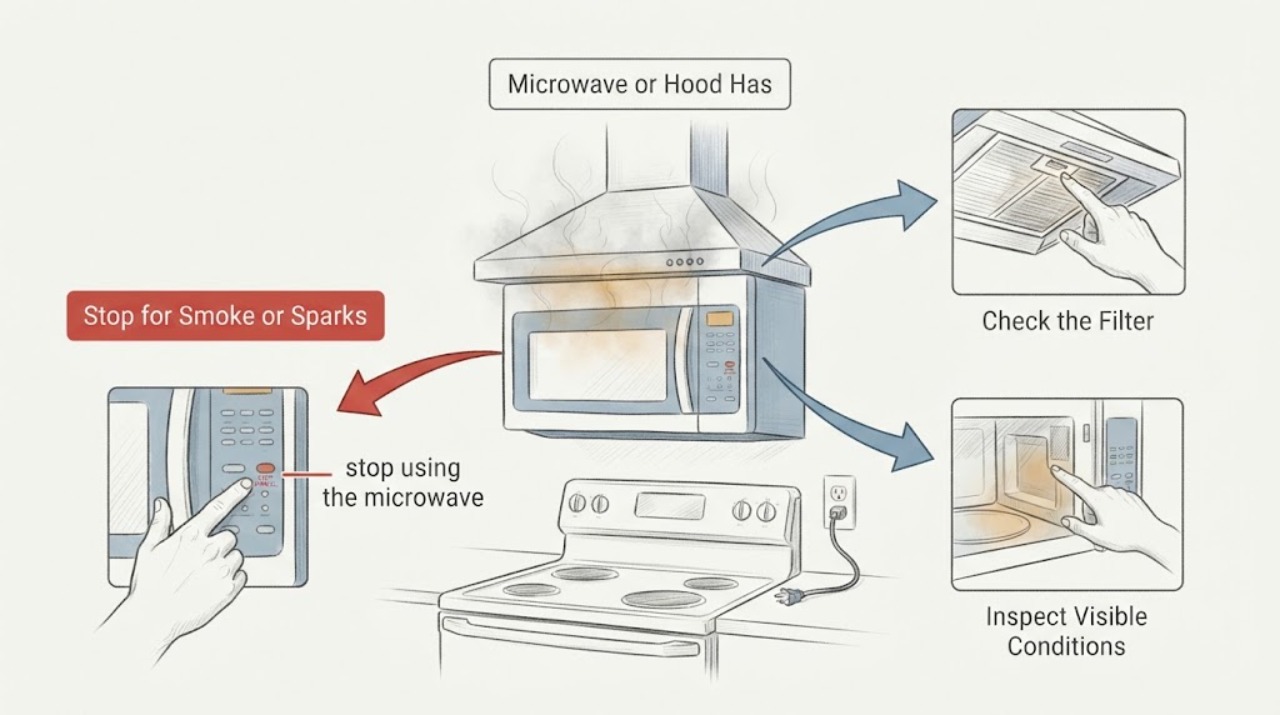
Treat an unexplained burning or plastic-like smell from an LG microwave/hood combination as a stop-use electrical and appliance-safety issue. From a safe location, switch off the microwave circuit; unplug it only if the plug and outlet are cool, visible and safe to reach. Do not run the microwave or hood to locate the smell, open the cabinet, remove the hood, or test the high-voltage section. After the appliance is isolated and cool, make only external observations of the cavity, vents, grease-filter area, cord, plug and outlet. If the smell is strongest at the outlet or wall, keep the circuit off and arrange qualified electrical service; if it is strongest at the microwave or hood, use LG service. If there is smoke, flame, active heat, sparking or a worsening odor, leave the area and use local emergency/fire guidance.
Work through in order
Diagnostic checks
Use only checks that match the exact appliance or system and its official guide.
-
Check 1
From a safe position, stop using the microwave and hood. Turn off the circuit breaker supplying the unit; unplug it only if there is no smoke, flame, sparking or heat at the plug or receptacle and the plug can be reached without touching a hot or damaged connection. Keep the area clear and do not run either appliance to reproduce the odor.
Expected result: The odor stops changing after the circuit is isolated, or smoke, flame, active heat, sparking or a rapidly worsening smell is present.
Next step: For any smoke, flame, active heat or sparking, leave the area and contact local emergency/fire services as appropriate. Otherwise keep the breaker off and continue only with the external, no-touch observations below; do not reconnect for a test.
Why this matters
Why: Isolation removes normal appliance power but does not identify whether the source was inside the microwave, the hood/vent path or the electrical connection. Smoke, flame, heat or sparking is an emergency stop-use condition rather than a troubleshooting branch.
-
Check 2
After the appliance and surrounding surfaces have cooled, note from a distance where the odor is strongest without removing panels or touching the connection: inside the microwave cavity, at the lower vents or grease-filter area, at the cord/plug/outlet/wall, or around the hood and room ventilation path. Do not lean into smoke or reach behind the mounted unit.
Expected result: The smell is localized to the outlet/plug/wall, to the microwave cavity or vent area, or remains distributed through the hood/room after the microwave circuit is off.
Next step: Keep the circuit off for an outlet or wall odor and arrange qualified electrical inspection. For a cavity or microwave-vent odor, use LG service without operating the unit. If the odor persists away from the isolated unit, notify building management or a qualified electrician/ventilation professional rather than powering the unit back on to trace it.
Why this matters
Why: A concentration at the outlet or wall raises an electrical-connection concern. A concentration at the cavity or microwave vents keeps the appliance in the service scope. A smell that remains after the microwave is isolated does not prove a microwave fault and may involve the hood, duct, shared ventilation or another nearby source.
-
Check 3
With power still isolated, inspect only visible surfaces: look through the microwave door for scorch marks or melted material, check the visible cord and plug for cracking or heat damage, and look at the accessible hood underside and grease-filter area for heavy residue or visible damage. Do not remove the microwave cover, door, hood assembly, receptacle faceplate or wiring.
Expected result: There is cavity scorching, melted material, a damaged cord or plug, a loose-looking receptacle, visible smoke residue, or damage around the hood/vent; or all visible surfaces appear normal.
Next step: Leave the breaker off and arrange LG appliance service for microwave/hood evidence, or qualified electrical service for cord, plug, receptacle or wall evidence. Do not wipe, remove or replace parts while the source is uncertain, and do not power up to see whether the mark or odor returns.
Why this matters
Why: Visible cavity damage or continued evidence of arcing is outside a cleaning explanation and requires service. A damaged cord, plug or receptacle needs electrical attention. A dirty or damaged filter area can affect the vent path, but it does not prove that the filter caused a burning electrical odor. Normal-looking surfaces do not clear the appliance because the source may be internal or in the wall/duct.
-
Check 4
Record the LG model and serial label from an accessible location, the breaker or outlet involved, whether the odor began after cooking or ventilation elsewhere in the building, and the location and appearance of any visible residue. Give those details to LG support, an electrician or building management; do not perform a powered confirmation test.
Expected result: The model is available and the odor can be tied to the microwave/hood area, or the model is unavailable and the odor is intermittent or not localized.
Next step: Keep the appliance isolated until the appropriate professional has assessed it. Ask LG for appliance service when the odor is at the unit, an electrician when it is at the outlet or wall, and building management when shared ventilation or another unit may be involved.
Why this matters
Why: A model number lets LG match the installed microwave and hood instructions, but it does not make a strong burning odor safe to test. An intermittent or nonlocalized odor remains a source-identification problem and cannot be resolved by guessing a microwave part.
Use your observations
Decision map
Find the observation that best matches what you see, then follow the next safe action.
-
PATH 01Next step
What you see
Smoke, flame, active heat, sparking or a rapidly worsening burning smell is present.
Do this next
Leave the area, keep people away and contact local emergency/fire services as appropriate. Do not approach the plug, spray water, open the microwave or try another cycle.
Why this path and its safety boundary
Why it matters: This is a fire or electrical safety condition, not a normal odor-removal problem.
-
PATH 02Next step
What you see
The smell is strongest at the outlet, plug, wall or cord while the microwave circuit is isolated.
Do this next
Leave the breaker off and arrange qualified electrical inspection. Do not loosen the outlet, change the wiring or reconnect the microwave.
Why this path and its safety boundary
Why it matters: The electrical connection is within the suspected source area, and an appliance-only explanation is not established.
-
PATH 03Next step
What you see
The smell is strongest inside the microwave or at its vents, with visible scorching, melted material, arcing evidence or smoke residue.
Do this next
Keep the unit disconnected and request LG service. Do not open the cabinet, remove the door, access the high-voltage section or repeat a heating or fan test.
Why this path and its safety boundary
Why it matters: LG's guidance treats cavity damage, continued sparking and a continuing strong burning smell as service conditions; the internal part cannot be identified safely from outside.
-
PATH 04Next step
What you see
The odor persists after the microwave circuit is off and is stronger around the hood, duct, room or another nearby appliance than at the microwave itself.
Do this next
Do not re-energize the microwave to trace the odor. Notify building management and/or arrange qualified electrical or ventilation inspection, keeping the microwave circuit isolated until the source is assessed.
Why this path and its safety boundary
Why it matters: The assigned microwave identity does not establish the source; the hood/ventilation path, shared building ventilation or another electrical appliance remains possible.
Helpful context
Understand the symptom
Isolate first, then separate the three possible sources
The report describes a combination oven hood and LG microwave that was not being used, with the odor noticed around the microwave, vents and electrical connection. That location does not prove which part is producing the smell. A microwave fault, grease or residue in the hood/vent path, the cord or receptacle, or odor entering a shared ventilation route can look similar from the room. Because the model is unknown, use the outside of the installed unit and the power isolation point as the limit of user checks. Do not restart either fan or microwave to make the smell easier to find.
Do not open or repeatedly test a microwave with a burning odor
LG's support guidance routes a continuing strong burning smell or smoke to stop-use and service. Its sparking guidance also treats cavity damage or continued sparking as a service condition. The cabinet, door, interlocks and high-voltage section are outside ordinary user inspection. If the smell is at the outlet, plug or wall, keep the circuit isolated and have an electrician assess it; do not loosen the receptacle, change wiring or substitute a power strip.
Common questions
FAQ
Can I run the LG microwave or hood briefly to find where the burning smell comes from?
No. Keep the circuit isolated. A strong burning smell or smoke is a stop-use condition in LG's guidance, and a powered test cannot safely distinguish the microwave, hood, duct or outlet as the source.
What if the smell is strongest near the electrical outlet or plug?
Leave the breaker off and do not touch a hot, loose or damaged connection. Arrange qualified electrical inspection; do not change the receptacle, wiring or power arrangement yourself.
Could the hood or vent be responsible even when the microwave is an LG?
It is possible, but the smell location alone cannot prove it. An over-the-range microwave has a vent path and grease-filter area, and an odor that remains after the microwave circuit is isolated should be assessed as a hood, ventilation, building or nearby electrical-source issue rather than tested by powering the microwave.
Can I open the LG microwave to inspect the source?
No. Keep the cabinet, door and electrical connection closed to user servicing. Report the accessible model number and visible observations to LG or a qualified professional instead.
Read the exact guide
Official sources
- LG Accessories 5230W1A012G Microwave Grease FilterLG USA · Opened official LG accessory page showing that select over-the-range microwave models use an underside grease filter that helps keep grease and debris from entering the vent system; no fitment is claimed for the unknown appliance.
- LG Over-the-Range Microwave Installation Guide (3828W5U0377)LG Electronics · Opened official LG over-the-range installation guide for general installation context only. The assigned model is unknown, so its model-specific dimensions or wiring instructions are not applied.
- Appliance and Electrical Fire SafetyU.S. Fire Administration · Opened official U.S. Fire Administration guidance used for general outlet, cord and electrical-fire safety; it does not diagnose the LG appliance.
- New LG Microwave Burning Smell or Noise: Causes and SolutionsLG USA Support · Opened official LG support guidance for general LG microwave/oven odor safety; it does not identify the unknown model or prove whether the source is the microwave, hood or outlet.
- LG Microwave: Why is my Microwave Arcing or Sparking?LG USA Support · Opened official LG microwave guidance used only for external residue/damage observations and the service boundary; no model-specific part or internal diagnosis is inferred.
Community feedback
Share a repair observation
Share a plain-text repair observation. Accepted observations are published automatically; this page may take a moment to update.