
On this page
Start here
Quick answer
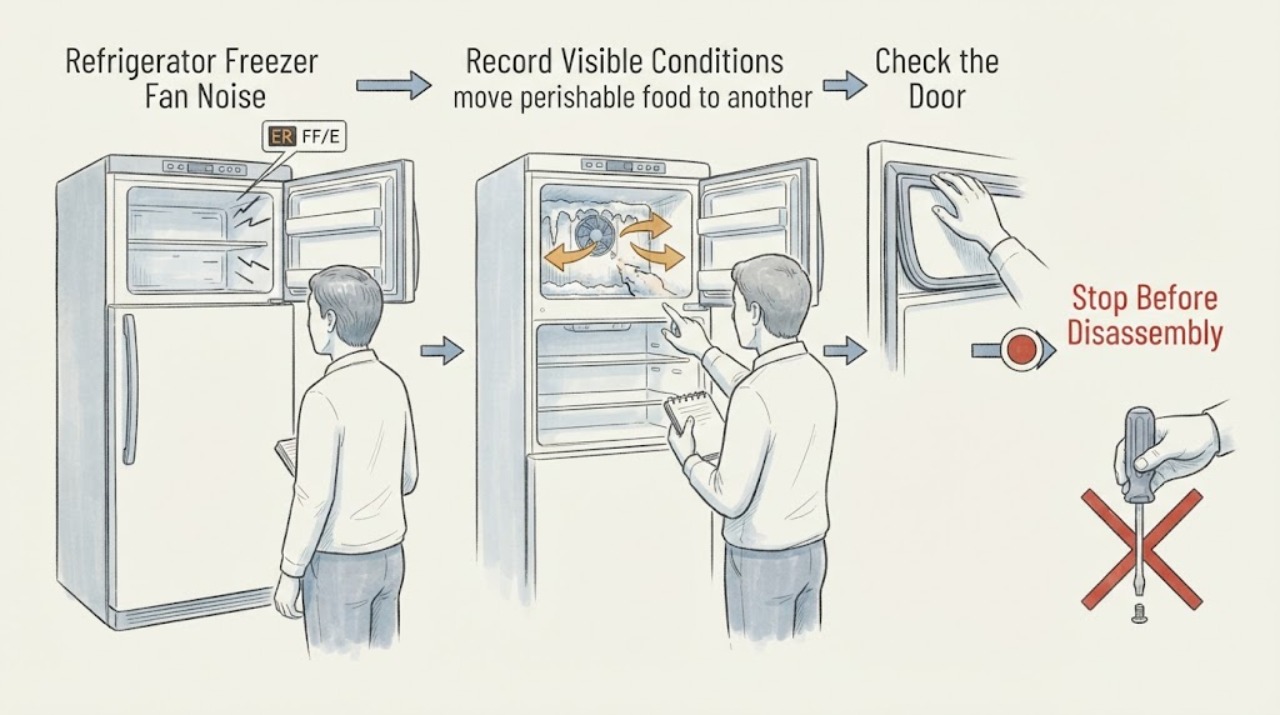
First record the exact LG model and whether the display says ER FF/E FF, ER rF/E rF, or shows only a sound. LG says ER FF/E FF points to abnormal freezer-fan operation and that frost around the fan can prevent it from turning; ER rF refers to the refrigerator-compartment fan. Move food to safe cold storage, place towels for meltwater, and if the exact LG guidance applies, unplug the refrigerator and leave both doors open so ice can melt naturally rather than using a hair dryer or opening panels. After the model-documented thaw and restart, allow the refrigerator time to return to temperature. If the same indication or irregular noise returns, or the fan issue is present without visible frost, stop and request qualified LG service; do not infer or replace the fan motor, wiring, or control board yourself.
Work through in order
Diagnostic checks
Use only checks that match the exact appliance or system and its official guide.
-
Check 1
Record the exact LG model number, the full display text or LED pattern, where the sound is heard, whether the freezer is still cold, and whether the noise is a normal hum, clatter, or irregular continuous sound.
Expected result: The display clearly shows ER FF/E FF, ER rF/E rF, another code, or no code at all.
Next step: Use the matching code branch below and the exact model support page. Do not assign an FF meaning to an unrelated code or to sound alone.
Why this matters
Why: LG distinguishes freezer-fan ER FF/E FF from refrigerator-fan ER rF/E rF, while a sound without a code can be normal fan operation or an irregular condition.
-
Check 2
Before any unplugging or thawing, move perishable food to another refrigerator or an insulated cooler if available, and place dry towels around the appliance to catch meltwater.
Expected result: Food can be safely moved and the floor can be protected, or food/water conditions make a long thaw impractical.
Next step: If food cannot be kept safely cold or the area cannot be protected from water, request service rather than extending the diagnostic process.
Why this matters
Why: LG specifically warns about food spoilage and meltwater during the freezer-fan defrost procedure; the food decision can determine whether service is safer than waiting for a thaw.
-
Check 3
For a confirmed ER FF/E FF condition where the LG guidance applies, unplug the refrigerator from a safe, dry position and leave the freezer and refrigerator doors fully open so frost can melt naturally. Do not use a hair dryer, sharp tool, heat source, or internal panel removal.
Expected result: Frost or ice melts and the fan indication clears, or the indication/sound remains after the model-appropriate natural thaw.
Next step: Wipe residual moisture with a dry towel, reconnect only as the applicable LG guidance permits, and allow the refrigerator to return to normal temperature. If the indication remains or returns, arrange service.
Why this matters
Why: LG says frost around the freezer fan can stop it and provides a natural-thaw path; it expressly warns against a hair dryer in the newer guide. The thaw does not prove which internal part caused the frost.
-
Check 4
After the refrigerator is restarted under the exact LG instructions, check only visible conditions that can promote frost: doors closing completely, food or packaging not blocking the door, and vents not obstructed. Do not remove the fan cover.
Expected result: The doors seal and airflow openings are clear, or a package/door alignment issue remains visible.
Next step: Correct only the visible loading or closure issue and monitor. If no visible condition explains the return, do not keep dismantling the freezer; use qualified service.
Why this matters
Why: LG links freezer-fan frost problems with too much food or a door that is not fully closed; its error list also asks owners to verify vents, leveling, and complete door closure after defrosting.
-
Check 5
Allow the refrigerator the manufacturer-stated recovery period after reconnection and observe whether the same code, fan noise, poor cooling, or irregular/continuous sound returns.
Expected result: The refrigerator returns to normal operation, or the same indication/noise returns after the thaw and recovery period.
Next step: For a recurring code, noise without visible frost, or poor cooling after recovery, stop user diagnosis and request qualified LG service. Do not replace a fan motor, harness, sensor, or board based on the symptom alone.
Why this matters
Why: LG says compartments may need 24–48 hours to return to normal temperatures after the newer natural-thaw procedure and recommends technician inspection when the same symptom/code repeats or an irregular sound continues.
Use your observations
Decision map
Find the observation that best matches what you see, then follow the next safe action.
-
PATH 01Next step
What you see
The display shows ER FF/E FF and frost is present or the freezer fan appears blocked by ice.
Do this next
Move food, protect the floor, and follow the applicable LG natural-thaw procedure with power isolated safely; do not use a hair dryer or open the fan panel.
Why this path and its safety boundary
Why it matters: LG identifies this as abnormal freezer-fan operation and says frost around the motor can prevent the fan from turning.
-
PATH 02Next step
What you see
The display shows ER rF/E rF or the issue is clearly in the refrigerator compartment rather than the freezer.
Do this next
Use the exact model support path and arrange service if the code persists. Do not transfer freezer-fan assumptions or parts to the refrigerator compartment.
Why this path and its safety boundary
Why it matters: LG identifies ER rF/E rF as an abnormality of the refrigerator-compartment fan, not the freezer-fan branch.
-
PATH 03Next step
What you see
There is only a steady humming or buzzing sound, cooling is normal, and no freezer-fan indication is shown.
Do this next
Monitor the sound and temperature. If it becomes irregular, continuous, or is accompanied by poor cooling or a code, request service rather than opening the appliance.
Why this path and its safety boundary
Why it matters: LG says air-circulation fans can make a normal electric-fan-like hum during operation.
-
PATH 04Next step
What you see
The sound is clattering, zinging, irregular, or continuous, but no visible frost explains it or it returns after natural thawing.
Do this next
Keep the refrigerator closed and operating only if safe for food and electrical conditions, record the model and sound behavior, and request qualified service.
Why this path and its safety boundary
Why it matters: LG says an irregular or continuous fan-related sound warrants technician inspection; the sound does not identify the motor or control part.
-
PATH 05Next step
What you see
The same ER FF/E FF indication or freezer-fan symptom returns after the manufacturer-guided thaw and recovery period.
Do this next
Request qualified LG service. Do not repeat prolonged defrost cycles indefinitely or replace internal fan, sensor, wiring, or control parts yourself.
Why this path and its safety boundary
Why it matters: LG directs repeated symptoms or inspection codes to a service technician for accurate diagnosis.
Helpful context
Understand the symptom
Separate the freezer-fan code from ordinary refrigerator noise
An LG refrigerator can make a normal fan hum, but ER FF/E FF is a specific freezer-fan indication. Begin by recording the exact code and model, then protect the food and use only the manufacturer’s natural-thaw guidance if frost is locking the fan.
The code narrows the branch, not the repair part
The ER FF/E FF indication supports a freezer-fan operation problem and possible frost interference. It does not identify whether the eventual cause is ice, airflow, wiring, motor, sensor, or control electronics, and no panel or live test is needed for the user-level path.
When checks do not resolve it
Need a professional?
Request qualified service for a recurring ER FF/E FF or ER rF/E rF indication, a fan symptom without visible frost, irregular or continuous noise, poor cooling after the documented recovery period, water near electrical parts, damaged wiring, or food-safety conditions that make a long thaw unsafe. Do not use a hair dryer, sharp tool, heat source, fan-panel removal, live test, or unverified replacement part.
Have this ready
- exact LG model number
- complete code or LED pattern
- freezer versus refrigerator sound location
- visible frost and door/vent observations
- whether the symptom returned after the manufacturer-guided thaw and recovery period
Common questions
FAQ
Does ER FF mean the freezer fan itself must be replaced?
No. LG says ER FF/E FF indicates abnormal freezer-fan operation and that frost around the motor can prevent turning. A natural-thaw procedure may clear frost, but a repeated code needs technician diagnosis rather than an assumed part.
Can I use a hair dryer to melt frost around the freezer fan?
No. LG’s newer guidance specifically says not to use a hair dryer; unplug safely, leave the doors open for natural thawing under the applicable model guidance, and protect food and the floor from spoilage and meltwater.
Is a humming freezer fan always a fault?
No. LG says a fan can make a normal electric-fan-like hum. Irregular or continuous noise, a code, poor cooling, or recurrence after thawing needs qualified service.
Read the exact guide
Official sources
- LG Refrigerator – Error Code ListLG USA · Official LG USA refrigerator error list; used for FF freezer-fan scope, visible vent/door/leveling checks after defrost, and model-scoped error boundaries.
- How to Fix ER FF and ER rF Error Codes on Your LG RefrigeratorLG USA · Official LG USA Help Library article for ER FF/ER rF freezer- and refrigerator-fan indications; used for frost mechanism, food/meltwater preparation, natural thaw, recovery time, and service boundary. The article notes that settings/content may vary by model.
- [LG refrigerator - noise] A noise is heard during operation.LG USA · Official LG USA refrigerator-noise guidance; used to distinguish normal fan hum from irregular/continuous sounds requiring service.
- LG Refrigerator - Troubleshooting an E FF or E rF Error CodeLG USA · Official LG USA fan-error guidance for E/ER FF and E/ER rF; used for freezer versus refrigerator fan meaning, frost lock, reset/thaw boundary, and repeated-code service. The page states that content/images may differ by model.
Community feedback
Share a repair observation
Share a plain-text repair observation. Accepted observations are published automatically; this page may take a moment to update.