
On this page
Start here
Quick answer
Needing to manually defrost an LG LFXS32726S/00 about every three months is a recurring fault pattern, not a maintenance interval to accept without checking the cause. LG says its refrigerators automatically defrost every 4–16 hours, and its support procedure treats manual defrost as a way to clear current ice while the cause is investigated. First photograph where the ice returns, check that the French doors and freezer drawer close against a clean, intact gasket, and keep food and vents clear. If a sheet of ice returns on the freezer floor after a complete safe defrost, LG says a blocked drain may require a trained technician; repeated rear-wall or fan ice, unstable temperatures, or a defrost code also require service. Do not remove panels, probe a drain, test live wiring, or diagnose the sealed system yourself.
Before you begin
Safety first
- Do not chip or scrape ice, pour boiling water or chemicals into a drain, use a hair dryer or heat gun, remove the evaporator or rear panel, reach into a fan, measure live voltage, handle refrigerant, bypass a safety device, or open the sealed system. Disconnect power only for the exact model-authorized defrost procedure and only from a dry, safe location. Stop immediately for smoke, burning odor, sparking, damaged wiring, water near electrical parts, an unusually hot cabinet, or unsafe food temperatures.
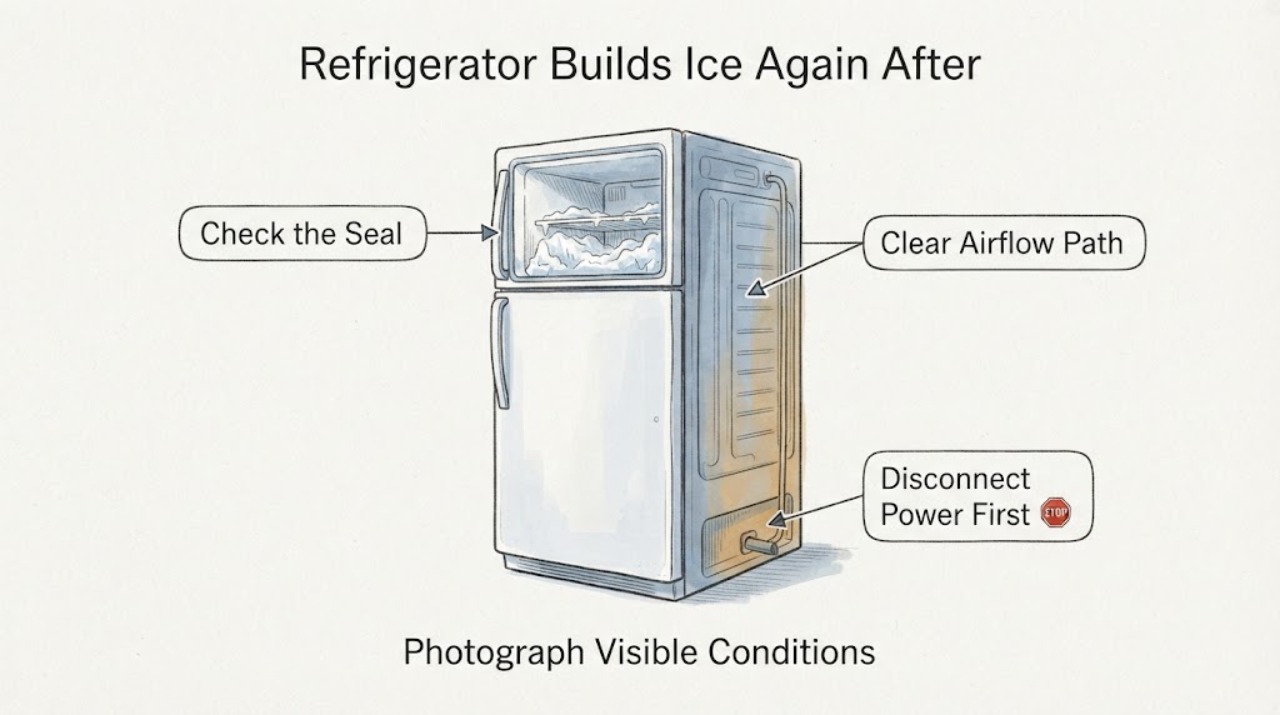
Work through in order
Diagnostic checks
Use only checks that match the exact appliance or system and its official guide.
-
Check 1
Before moving food or scraping anything, photograph the ice and record whether it is on the French-door edge, around a gasket, on the rear wall, around a vent or fan cover, or as a sheet on the freezer floor. Note whether cooling is stable and whether this is the third-month recurrence after a prior manual defrost.
Expected result: The ice is light and limited to a door edge or blocked package, or it is thick, returns in the same place, covers the rear wall or fan area, or forms a sheet on the freezer floor.
Next step: Keep the photo and recurrence interval with the model number. Continue only with visible door, gasket, and loading checks when food remains safe; arrange service for thick, recurrent, or internal-panel ice.
Why this matters
Why: A location tied to a door gap or obstruction keeps humid-air entry in scope. Recurrent rear-wall, fan-area, or floor ice is more concerning for drain, airflow, or defrost-system service than for a one-time humidity event.
-
Check 2
Check the refrigerator doors and bottom freezer drawer without forcing them. Move only food, bins, or packages that prevent full closure, then visually inspect the affected gasket for dirt, a tear, a twist, a gap, or a compressed section. Wipe a visibly dirty gasket with the mild cleaning method allowed by the model instructions.
Expected result: The gasket contacts the cabinet continuously and the doors close fully, or an obstruction, damaged gasket, misalignment, or gap is visible.
Next step: Remove only the obstruction and clean the visible gasket. If the gasket is torn, loose, twisted, or cannot seal, stop reshaping attempts and arrange LG appliance service; do not pull the gasket from its channel or heat it.
Why this matters
Why: A small opening can admit warm humid air and create frost. If the seal is continuous but the same ice returns every few months, the door check did not explain the recurrence and an internal drain or defrost branch remains open.
-
Check 3
Check accessible airflow only: keep packages away from the model's visible supply and return vents and avoid packing food against the rear wall. Do not remove a vent, evaporator cover, or fan guard, and do not reach into a fan.
Expected result: A package blocks an airflow path and the ice is limited to that area, or vents are clear but ice repeatedly covers a rear panel or fan area and temperatures are uneven.
Next step: Restore only the visible loading clearance and monitor the same location. If ice still blocks a cover or fan, the fan is noisy or stopped, or food temperatures fluctuate, arrange qualified service without opening the cabinet.
Why this matters
Why: Loading can contribute to uneven cooling and frost, but clear vents with recurrent internal ice make an airflow, fan, sensor, or defrost fault more likely. The observation does not identify a replaceable part.
-
Check 4
Inspect the freezer floor and front edge for a water film or a sheet of ice after the frost has melted, and read any exact display code without entering a service test. Do not pour hot water or chemicals into a drain and do not probe it with a tool.
Expected result: A sheet of ice or recurring water appears on the freezer floor, or a defrost, fan, sensor, refrigerant, or other service code is displayed.
Next step: Protect food and arrange qualified LG service. Give the technician the exact code, ice location, recurrence interval, and prior defrost date; do not remove the rear panel or attempt drain, heater, sealed-system, or electrical repair.
Why this matters
Why: LG says floor ice that returns after defrost can indicate a blocked drain. LG's error guidance treats defrost-sensor, defrost-fault, fan, and sealed-system leak codes as requiring accurate professional diagnosis rather than user component testing.
-
Check 5
If the exact LG documentation for this model authorizes a manual defrost, follow that procedure once as a controlled reset: move food to safe storage, disconnect power only from a dry and safe location, leave the doors open for the documented period, and protect the floor from meltwater. Do not use a knife, scraper, hair dryer, heat gun, or direct heat.
Expected result: The ice clears and cooling returns normally, but the same pattern returns within the next interval, or the refrigerator does not cool normally after the defrost.
Next step: Do not schedule another routine three-month defrost as the solution. Arrange qualified LG service and provide the exact LFXS32726S/00 identity, photos, temperature behavior, and recurrence history. Stop immediately for smoke, burning odor, sparking, water near electrical parts, or unsafe food temperatures.
Why this matters
Why: A temporary recovery does not prove the cause was fixed. Recurrence after a complete defrost supports a persistent seal, drain, airflow, defrost, sensor, or control problem; failure to recover raises a separate cooling or electrical concern.
Use your observations
Decision map
Find the observation that best matches what you see, then follow the next safe action.
-
PATH 01Next step
What you see
Ice is limited to a door edge and the gasket or a package prevents full closure, while the refrigerator remains at stable temperatures.
Do this next
Remove the obstruction and clean the visible gasket as the model instructions allow. Request service if the seal remains damaged or if the same ice returns after the correction.
Why this path and its safety boundary
Why it matters: Warm humid air entering through the visible seal path is more likely than a sealed-system or internal electrical failure.
-
PATH 02Next step
What you see
A sheet of ice returns on the freezer floor after a full safe defrost, even though the drawer closes and visible loading obstructions are gone.
Do this next
Keep the refrigerator off if water is approaching electrical parts, protect food, and arrange a trained technician. Do not probe or flush the drain yourself.
Why this path and its safety boundary
Why it matters: LG identifies a returning freezer-floor sheet as evidence consistent with a blocked drain that may require refrigerator disassembly.
-
PATH 03Next step
What you see
The ice returns at the rear wall or fan area about every three months, temperatures become uneven, or a defrost, fan, sensor, or sealed-system code appears.
Do this next
Arrange qualified LG appliance service with the exact code, photos, temperature history, and previous defrost dates. Do not remove covers, measure live voltage, handle refrigerant, or choose a part from the ice pattern.
Why this path and its safety boundary
Why it matters: The recurrence after automatic and user-performed defrost points away from a normal maintenance interval and toward an internal defrost, airflow, sensor, control, or sealed-system fault.
-
PATH 04Next step
What you see
A single light frost event follows a door-open or warm-food event, the gasket seals, cooling is stable, and the pattern does not recur.
Do this next
Keep food covered, let hot food cool before storage, close the doors promptly, and monitor without scraping or forcing a defrost. Escalate if the pattern returns or cooling changes.
Why this path and its safety boundary
Why it matters: A temporary moisture event is more likely than a failed component, but this does not match a three-month manual-defrost recurrence.
Helpful context
Understand the symptom
Treat the three-month interval as evidence
Manual defrosting can make the refrigerator cool normally for a while, but it does not identify why ice formed. LG says the appliance normally runs automatic defrost cycles every 4–16 hours. When the same ice returns and another manual defrost is needed roughly every three months, record that interval and the exact ice location instead of treating it as routine cleaning.
What the user can check safely
The useful user checks are visible and reversible: door and drawer closure, gasket condition, package and vent clearance, food temperature, water pooling, and the exact display code. The sealed system, defrost heater, sensors, fan wiring, control board, and electrical measurements are technician work.
Only after diagnosis
Potential parts
- LG refrigerator defrost drain component
Consider only when a freezer-floor ice sheet returns after a complete safe defrost and a qualified technician confirms a drain restriction or failed drain component.
Confirm the full LFXS32726S/00 identity and the manufacturer's fit information before any part decision; the three-month interval alone is not a part diagnosis. - LG refrigerator evaporator fan or defrost component
Consider only after recurrent rear-wall or fan-area ice, uneven temperatures, or a documented defrost or fan error has been assessed by qualified service.
Do not access the fan, heater, sensor, or control board. Verify model fit and the technician's diagnosis before ordering anything. - LG refrigerator or freezer door gasket
Consider only when the visible gasket is torn, twisted, loose, or unable to seal after an obstruction and cleaning check.
Confirm the full model suffix and door location before ordering; do not reshape or heat a gasket as a test.
When checks do not resolve it
Need a professional?
Arrange qualified LG appliance service when manual defrosting is needed again about every three months, the same rear-wall or fan ice returns, a freezer-floor sheet returns after defrost, a gasket cannot seal, temperatures are unstable, or any defrost, fan, sensor, control, or sealed-system code appears. Use prompt or emergency help for electrical, fire, water, or food-safety hazards.
Safety scope: Do not chip or scrape ice, pour boiling water or chemicals into a drain, use a hair dryer or heat gun, remove the evaporator or rear panel, reach into a fan, measure live voltage, handle refrigerant, bypass a safety device, or open the sealed system. Disconnect power only for the exact model-authorized defrost procedure and only from a dry, safe location. Stop immediately for smoke, burning odor, sparking, damaged wiring, water near electrical parts, an unusually hot cabinet, or unsafe food temperatures.
Have this ready
- Provide the full model LFXS32726S/00, the support-page identity if requested, photos of the frost location, whether it is on the door edge, rear wall, fan area, or floor, the manual-defrost dates and interval, food-temperature changes, gasket and vent observations, water pooling, and any exact display code.
Common questions
FAQ
Is manually defrosting an LG LFXS32726S/00 every three months normal maintenance?
Not as a documented interval in the LG guidance opened for this topic. LG says its refrigerators automatically defrost every 4–16 hours; a manual defrost can clear current ice, but recurring ice on a three-month cycle should be investigated rather than accepted as routine care.
What does it mean if ice returns on the freezer floor after defrosting?
LG says a sheet of ice that returns on the freezer floor can indicate a blocked defrost drain. Check only the visible door closure and loading conditions, then arrange trained service because the repair may require disassembly. Do not probe or flush the drain.
Can I remove the rear panel to find the cause of the ice?
No. Rear-panel access can expose the fan, heater, sensor, controls, and electrical parts. Record the ice pattern and any code, then have qualified LG service diagnose the internal defrost or airflow system.
What if a full manual defrost makes the refrigerator work again?
Temporary recovery does not prove the cause is fixed. If the same ice returns, keep the recurrence record and arrange service. A successful defrost is useful evidence for the technician, not a reason to repeat the procedure indefinitely.
Read the exact guide
Official sources
- LG Refrigerator - Troubleshooting Ice Buildup in an LG Refrigerator | LG USA SupportLG USA Support · Opened LG troubleshooting page used to distinguish a returning freezer-floor ice sheet from a one-time frost event; page notes the guide applies to all models and images or content may differ.
- LG Refrigerator – Error Code List | LG USA SupportLG USA Support · Opened LG error-code guidance used only for safe interpretation and escalation; exact code display format and model coverage must be confirmed against the LFXS32726S/00 owner's documentation.
- LG Refrigerator - Frost Buildup | LG USA SupportLG USA Support · Opened LG refrigerator frost guidance used for the assigned French-door refrigerator symptom; it is general LG guidance, so exact model instructions remain controlling.
- LFXS32726S.ASTCNA0 - Support, Manuals, Warranty & More | LG USA Product SupportLG USA · Opened LG product support page identifies the exact LFXS32726S.ASTCNA0 refrigerator family, provides the owner's manual route, and shows the task's /00 suffix as a model variant that must be retained for service.
Community feedback
Share a repair observation
Share a plain-text repair observation. Accepted observations are published automatically; this page may take a moment to update.