
On this page
Start here
Quick answer
If an LG refrigerator's ice maker water path appears frozen, first stop any water use if there is a leak and close the refrigerator's water-supply valve. Check the valve, the accessible hose behind the refrigerator, the filter, the refrigerator temperature, the ice-maker setting, and whether the door or ice compartment is closing fully. LG says a temperature set too low can freeze an internal water tank, filter, or water line; its standard guidance allows careful thawing of an accessible frozen area with a steam cleaner or warm, damp towel, followed by a leak check. Do not use a flame, heat gun, sharp tool, or cabinet disassembly to reach a hidden line. If thawing reveals a crack, leakage, repeated refreezing, or no water/ice recovery, keep the water off and request model-specific LG service.
Before you begin
Safety first
- Close the water valve for any leak; do not use flame, heat guns, sharp tools, forced air, panel removal, bypasses, or live electrical tests. Do not repeatedly thaw a hidden line or order an internal part without model-specific service guidance.
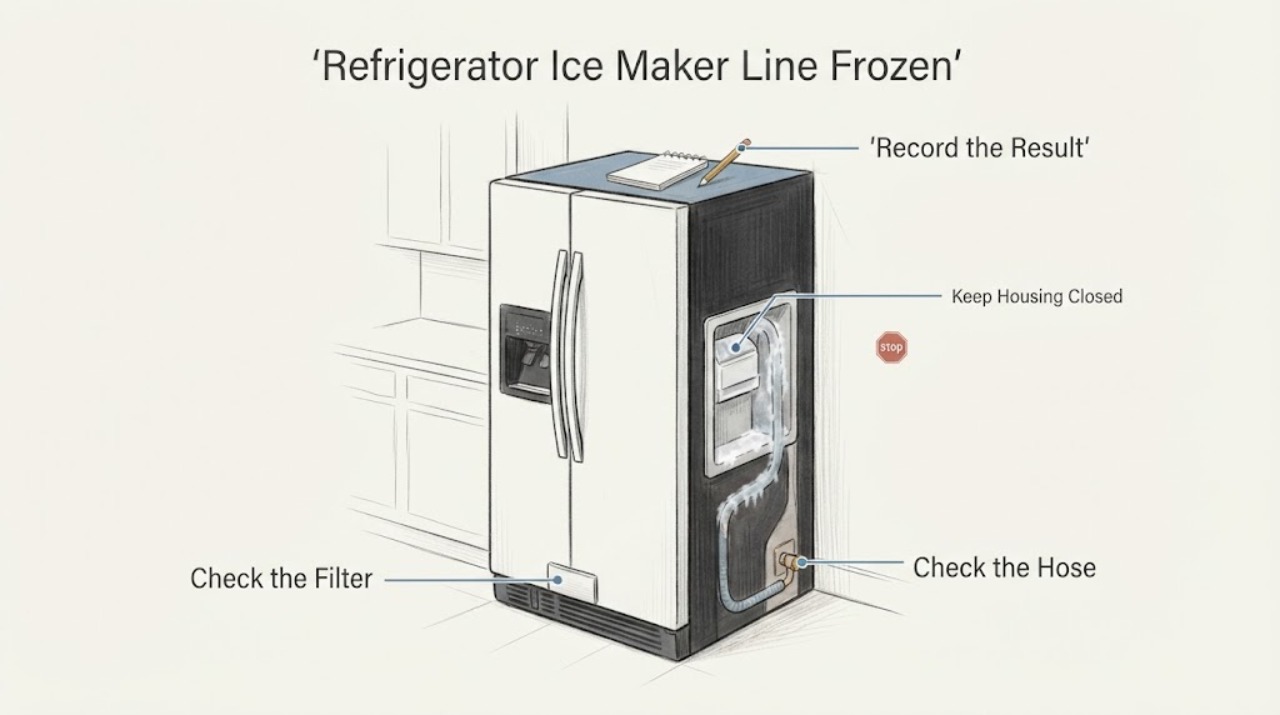
Work through in order
Diagnostic checks
Use only checks that match the exact appliance or system and its official guide.
-
Check 1
Stop water use and close the refrigerator water-supply valve if any hose, filter, connection, or interior area is leaking.
Expected result: Water is actively leaking, the floor or electrical area is wet, or there is no leak visible.
Next step: For a leak, keep the valve closed and arrange service or qualified plumbing help. Do not handle a wet electrical connection. If dry, continue with the external checks.
Why this matters
Why: A leak can create property-damage and electric-shock risk; no visible leak leaves a possible flow restriction or freeze to investigate.
-
Check 2
Check the household shutoff valve and the accessible water hose behind the refrigerator or under the sink without disconnecting the line.
Expected result: The valve is closed, the hose is kinked or compressed, or the valve is open and the hose is clear.
Next step: Open the valve only if the connection is dry and intact, and straighten a visible kink by hand. If the hose or fitting is damaged or leaking, leave water off and call service/plumbing help.
Why this matters
Why: A closed valve or restricted hose can prevent water from reaching the ice maker and can look like a frozen line.
-
Check 3
Check the filter indicator and the filter area using the exact model instructions, without forcing a stuck filter or opening a sealed housing.
Expected result: The filter is overdue, the indicator is on, flow stopped after a filter change, or the filter is current and the housing is dry.
Next step: Replace the filter only with the model-compatible filter specified by the manual, then follow the model's flushing instructions. If the housing is cracked or leaking, stop and request service.
Why this matters
Why: LG says a clogged or old filter can reduce or stop water flow, and air can remain in a line after filter replacement; a current dry filter does not prove the ice-maker line is clear.
-
Check 4
Review the refrigerator temperature, clear food from any sensor area, and confirm that the ice maker and its door or compartment are fully closed and enabled.
Expected result: The temperature is unusually low, food blocks a sensor, the ice maker is off, or the door/gasket does not close; or these conditions are absent.
Next step: Follow the exact model controls and allow the appliance to stabilize. Do not change several settings at once or infer a failed component from this check.
Why this matters
Why: LG links overly low refrigerator settings to a frozen internal tank, filter, or line and links poor cold-air sealing or an off ice maker to ice problems. A normal setting does not rule out a hidden restriction.
-
Check 5
If the suspected frozen area is accessible and the appliance is dry, thaw it only with the model-supported method described by LG, such as a warm, damp towel; do not use flame, a heat gun, sharp tools, or panel removal.
Expected result: The ice clears and water flow returns without a leak, the ice clears but a leak appears, or the area remains frozen/inaccessible.
Next step: For dry restored flow, monitor using the model instructions. For any leak, close the valve and request service. For a hidden or recurring freeze, do not continue thawing experiments; provide the model and observations to LG service.
Why this matters
Why: Restored flow supports a temporary freeze or restriction but does not identify why it occurred. LG warns that expanding ice can crack a tank or line, so a leak after thawing requires immediate water shutoff.
-
Check 6
Only if the water path is dry and the exact model supports an ice-maker test, use the model's documented test control and record whether the mechanism moves and water reaches the tray.
Expected result: The test completes with water, the motor moves but no water arrives, the motor does not move, or the model has no documented test for the observed design.
Next step: If the test fails, the line refreezes, or no model-specific test is available, keep the water off if there is any leak and arrange LG service. Do not bypass the ice-maker mechanism or order a part from the symptom alone.
Why this matters
Why: LG uses these observations to decide whether service is needed, but they do not prove a valve, heater, inlet tube, or control-board failure.
Use your observations
Decision map
Find the observation that best matches what you see, then follow the next safe action.
-
PATH 01Next step
What you see
Water is leaking from the supply hose, filter, connection, or refrigerator near an electrical area.
Do this next
Close the refrigerator water-supply valve immediately if it can be reached safely, keep the appliance area dry, and request qualified service or plumbing help.
Why this path and its safety boundary
Why it matters: The water path is unsafe to leave pressurized, and thawing or repeated cycling can worsen property or shock risk.
-
PATH 02Next step
What you see
The valve is closed, the accessible hose is kinked, or the filter is overdue or clogged.
Do this next
Restore the valve or replace the filter only according to the model instructions, straighten a visible kink, and check for leaks; do not disconnect a pressurized line.
Why this path and its safety boundary
Why it matters: An external supply restriction can prevent the ice maker from filling and can mimic a frozen internal line.
-
PATH 03Next step
What you see
The refrigerator compartment is set unusually cold, a sensor area is blocked, or the ice-maker compartment does not seal.
Do this next
Correct only the model-supported setting or obstruction and allow the unit to stabilize. If the line remains frozen or refreezes, arrange model-specific service.
Why this path and its safety boundary
Why it matters: LG identifies these conditions as possible causes of a frozen internal water path or poor ice production, but they do not confirm a particular part failure.
-
PATH 04Next step
What you see
A model-supported, accessible thaw restores flow without leakage, but the path freezes again or flow remains absent.
Do this next
Stop repeated thawing and request LG service with the model, temperature settings, valve/filter history, and leak or test observations. Do not open the cabinet or choose an internal part from the symptom.
Why this path and its safety boundary
Why it matters: Temporary flow recovery does not identify the cause; recurring freeze, a hidden obstruction, a crack, or another model-specific fault remains possible.
Helpful context
Understand the symptom
A frozen ice-maker line is a water-flow symptom, not proof that a particular inlet valve, fill tube, or control part has failed. LG publishes several refrigerator forms and notes that settings and component locations vary by model, so start with accessible water and temperature checks and keep hidden-line work for model-specific service.
Stop leaks before trying to thaw anything
If water is escaping from the supply hose, a connection, the filter area, or inside the refrigerator, close the refrigerator water-supply valve immediately. LG warns that an unattended leak can cause electric shock or property damage. Do not pull the refrigerator out over a wet floor or handle a wet electrical connection; use service if the valve or connection cannot be safely isolated.
Check the supply path and filter from the outside
Confirm that the household valve is open, the accessible hose is not sharply kinked or compressed, and the filter is not overdue or clogged. LG says the water line must use designated tubing and that model locations vary. Do not loosen a fitting, cut tubing, or substitute an adapter while the line is pressurized; shut off the water first and follow the exact model instructions.
Check temperature, ice-maker state, and cold-air sealing
If there is no leak, check that the ice maker is on, the freezer is cold enough for ice production, and the refrigerator or freezer door and ice compartment close completely. LG says food blocking a temperature sensor or a refrigerator temperature set too low can freeze an internal tank, filter, or line; it also says an open ice-maker door can let cold air escape and melt ice. Settings and controls differ by model, so use the model's manual for any control combination.
Thaw only an accessible frozen area
LG's standard water-dispensing guidance allows careful thawing of a frozen filter, tank, or water-line area with a steam cleaner or warm, damp towel. Use only the method and accessible location that the exact model supports. Never use an open flame, heat gun, boiling water, sharp object, or a forced blow-through; do not open panels to reach a concealed line. Once thawed, inspect for water or a new leak before restoring the supply.
Use the ice-maker test only when the model supports it
LG describes different ice-maker test-button layouts and says the test assumes the refrigerator water supply is secure. Do not insert a tool, remove an ice maker, or force a cycle because a generic video shows a different design. If a model-supported test does not produce a motor movement or water, LG directs the owner toward service rather than a guessed valve or heater diagnosis.
When checks do not resolve it
Need a professional?
Request LG service when the frozen area is hidden or inaccessible, a leak appears after thawing, the line refreezes, the ice-maker test fails, or flow does not return after the model-supported external checks.
Safety scope: Close the water valve for any leak; do not use flame, heat guns, sharp tools, forced air, panel removal, bypasses, or live electrical tests. Do not repeatedly thaw a hidden line or order an internal part without model-specific service guidance.
Have this ready
- Exact LG model and serial, refrigerator form factor, whether the water supply is plumbed or tank-based, temperature settings, filter age, valve and hose observations, location of any ice or leak, thaw result, and any model-supported ice-maker test result.
Common questions
FAQ
Can I use a hair dryer or heat gun to thaw the LG ice-maker line?
Do not use a heat gun, flame, sharp tool, or cabinet disassembly. LG's standard guidance mentions careful thawing with a steam cleaner or warm, damp towel for an accessible frozen filter, tank, or line area. If the area is hidden or the model does not support the method, use service.
Does no ice prove the ice-maker water line is frozen?
No. LG also lists a closed valve, kinked hose, clogged filter, ice maker turned off, insufficient freezer temperature, recent installation, and door or ice-bin sealing conditions. Check those accessible causes before assuming a frozen line.
What should I do if water leaks after the frozen line thaws?
Close the refrigerator water-supply valve immediately and keep the area dry. LG warns that expanding ice can crack a water tank or line and that an unattended leak can cause electric shock or property damage; arrange qualified service.
Can I run an ice-maker test to clear the frozen line?
Only if the exact LG model documents that test and the water supply is secure. LG says its test assumes a sound water supply and that a failed motor or no water result calls for service. Do not insert tools into an unknown design or bypass the mechanism.
Read the exact guide
Official sources
- If Your LG Refrigerator Is Not Dispensing WaterLG USA Support · LG standard-model refrigerator guidance. It supports the listed external checks and careful thawing boundary; settings and component locations may vary by model.
- LG Refrigerator – Why is My Refrigerator Not Making Ice?LG USA Support · LG refrigerator family guidance. It presents multiple ice-maker styles and says the test assumes secure water supply; it is not used to identify a specific internal part without a model.
- LG Refrigerator - Troubleshooting Leaking From The Ice MakerLG USA Support · LG family guidance used only for the ice-maker on/off, door-seal, and service observations; it does not diagnose a frozen line or internal part.
- LG Refrigerator – How to Connect the Water LineLG USA Support · LG refrigerator water-line installation guidance used for supply-line safety and model-dependent location/installation cautions; it is not a hidden-line repair manual.
- If Your LG Refrigerator Is Not Making Ice or Not Making EnoughLG USA Support · LG standard-model family guidance. It is used for conditional external checks and timing only; settings and test controls vary by model.
Community feedback
Share a repair observation
Share a plain-text repair observation. Accepted observations are published automatically; this page may take a moment to update.