
On this page
Start here
Quick answer
For an LG refrigerator that makes ice slowly, first confirm the ice maker is on, the freezer is cold enough, the ice-room door and bin are seated, and the water supply is available. LG says warmer freezer temperatures slow production and recommends -4°F (-20°C) or colder for ice production, followed by up to 24 hours of observation. Do not assign a valve, fan or sensor fault from slow output alone; if the model-specific test fails or the refrigerator remains warm, use LG service.
Before you begin
Safety first
- Do not reach into a powered ice-making mechanism, bypass a sensor or control, probe live wiring, loosen a pressurized connection or continue using a leaking refrigerator without closing the water supply.
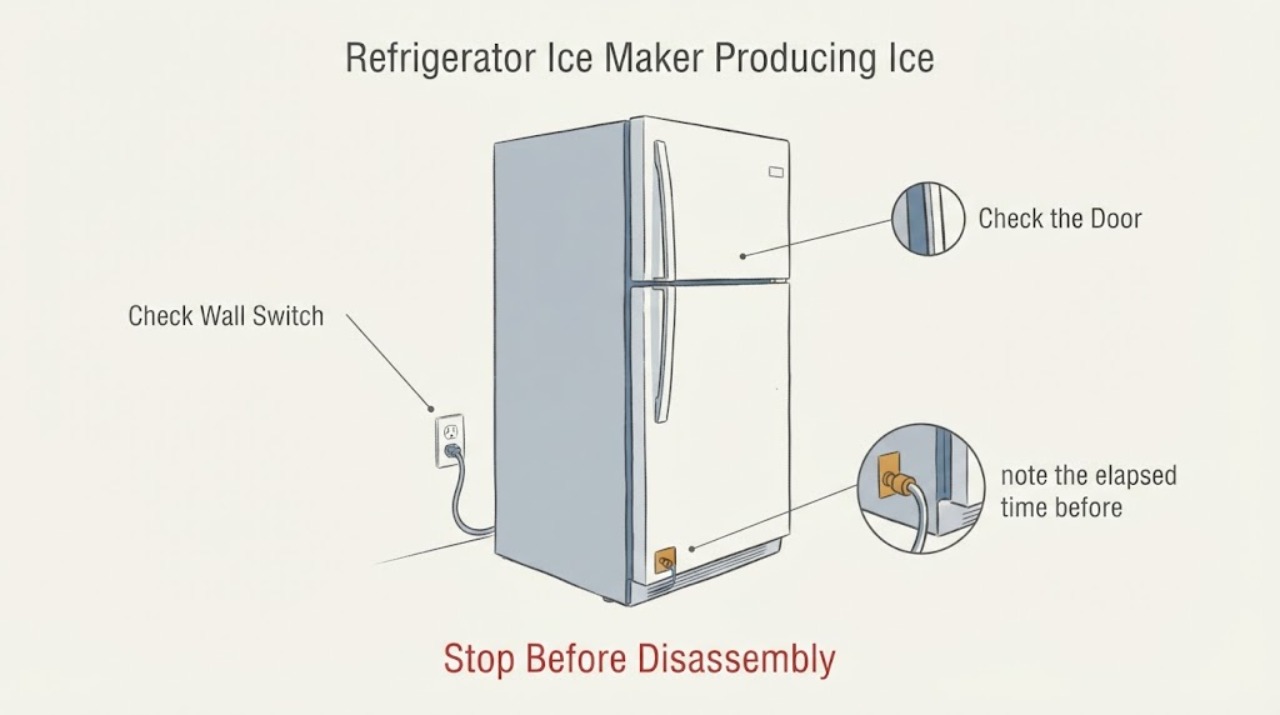
Work through in order
Diagnostic checks
Use only checks that match the exact appliance or system and its official guide.
-
Check 1
Check whether the ice maker is switched on and whether the control panel is locked. Use only the Ice On/Ice Off control shown for this refrigerator style; do not copy a button sequence from another LG model.
Expected result: Ice On is illuminated/active, or the ice maker is off/locked.
Next step: Unlock the panel if needed and enable Ice On using the matching manual/control layout, then allow the stated production interval before judging output.
Why this matters
Why: LG says an off ice maker will not make ice, and its control location and layout vary by model.
-
Check 2
Check the freezer setting and whether the freezer is actually colder or warmer than the ice-making target; keep vents and the ice compartment door clear and fully closed.
Expected result: The freezer is warmer than the LG ice-production recommendation, or temperature/door/airflow appears normal.
Next step: For a model that supports it, lower the freezer setting to -4°F or colder and allow 24 hours. If the whole refrigerator is warm or the door/gasket cannot seal, stop treating this as an ice-maker-only issue and arrange service.
Why this matters
Why: LG states that ice production slows when the freezer is warmer; warm air from an open compartment door, blocked airflow or heavy loading can also reduce cooling.
-
Check 3
If the refrigerator is newly installed or recently powered back on, note the elapsed time before testing production.
Expected result: The unit has been operating less than 24 hours, or it has been running long enough for normal production to be expected.
Next step: Keep the ice maker on and wait the model-appropriate interval. If it remains slow after that interval, continue with water and ice-maker checks rather than repeatedly resetting it.
Why this matters
Why: LG says initial cooling and ice production can take 12 hours to two days, and one guide allows up to 24 hours for ice production to begin.
-
Check 4
For a plumbed LG refrigerator, inspect the household shutoff valve, the visible supply hose for kinks, the filter status and any connection leak. Do not loosen a pressurized fitting.
Expected result: The valve is closed, the hose is kinked, flow is weak/filter overdue, or a connection is leaking; otherwise water supply appears available.
Next step: Open the correct valve or straighten only a visible kink; follow the exact model’s filter procedure. If a connection leaks, close the water valve immediately and arrange repair.
Why this matters
Why: LG identifies closed valves, kinked hoses, clogged filters and water-pressure conditions as causes of reduced or absent water reaching the ice maker.
-
Check 5
Inspect the ice bin and ice-maker compartment for clumping, a bin that is not seated, a door that is not closing, or ice blocking the mechanism; keep hands out of the mechanism while powered.
Expected result: Ice is clumped/full, the bin or compartment door is mis-seated, or the compartment is clear and closed.
Next step: Remove and dry/replace the bin as the model manual permits, separate or discard clumped ice, and close the compartment correctly. If the condition returns, use service rather than forcing the mechanism.
Why this matters
Why: LG says clumped ice can prevent dispensing, a full bin pauses production, and a poorly closed ice-room door can let cold air escape and melt ice.
-
Check 6
If the model-specific test mode is available, follow only the exact LG manual/control layout; observe whether the motor cycles and whether water or ice is present in the tray.
Expected result: The test cycles and water/ice is present, or the motor does not run / water or ice is absent.
Next step: If the test fails or production remains slow after the temperature, water and timing checks, request LG service. Do not probe wiring, bypass a sensor or repeatedly force the mechanism.
Why this matters
Why: LG uses those observations to distinguish a cycling ice maker from a condition requiring service, but the test button and tray style vary by model.
Use your observations
Decision map
Find the observation that best matches what you see, then follow the next safe action.
-
PATH 01Next step
What you see
The freezer is warmer than the LG ice-production target, or the refrigerator has just been installed or restarted.
Do this next
Set the freezer according to the model guidance, keep doors closed and allow up to 24 hours before judging production.
Why this path and its safety boundary
Why it matters: Slow output may be a recovery or temperature condition rather than an identified ice-maker component failure.
-
PATH 02Next step
What you see
The Ice On control is active and the freezer is cold enough, but the water valve is closed, the visible hose is kinked, the filter is overdue or a connection leaks.
Do this next
Correct only the visible external condition; close the water valve for any leak and arrange service if flow does not recover.
Why this path and its safety boundary
Why it matters: Water delivery can limit or stop ice production even when the ice-maker motor is otherwise operating.
-
PATH 03Next step
What you see
The bin is full or clumped, is not seated, or the ice-maker compartment door does not close correctly.
Do this next
Reseat/clean the bin as the exact manual allows, separate clumps and close the compartment; request service if it returns.
Why this path and its safety boundary
Why it matters: LG says these conditions can pause production or allow cold air to escape, so the symptom is not enough to diagnose a part.
-
PATH 04Next step
What you see
After the model-appropriate wait, temperature, water and bin checks pass, but the ice-maker test does not cycle or no water/ice reaches the tray.
Do this next
Record the full model and test observations and request LG service; do not open the ice maker or bypass its controls.
Why this path and its safety boundary
Why it matters: LG’s troubleshooting flow treats a failed cycle or absent water/ice observation as requiring repair service.
Helpful context
Understand the symptom
Start with temperature and time
LG says a freezer warmer than the ice-production target produces ice more slowly. Its current no-ice guidance recommends -4°F (-20°C) or colder for ice production and up to 24 hours after changing the setting; another LG guide says first ice can take 12 hours to two days and the bin can take two to three days to fill. This is a production-rate check, not proof of a failed sensor or compressor.
Check the ice room, bin and settings
Make sure Ice On is active and the control panel is unlocked for this model. A full bin pauses production, clumped ice can prevent dispensing, and an ice-maker compartment door or bin that is not seated can let cold air escape. The exact control layout varies across LG refrigerator styles.
Separate water supply from cooling
For plumbed units, check the household valve, visible hose routing, filter condition and leaks. If the whole refrigerator is warm, the door does not seal, food blocks cold-air outlets, or the unit lacks clearance, address the cooling condition and seek service instead of treating the ice maker as an isolated part.
Use the exact model test only when documented
LG describes different ice-maker styles and test controls. If the matching manual provides a test, the useful observations are whether the motor cycles and whether water or ice is present. A failed test or continued slow output after the external checks is a service decision; do not bypass wiring or sensors.
When checks do not resolve it
Need a professional?
Request LG service when the model-specific test fails, production remains slow after the documented wait and external checks, the whole refrigerator is warm, or water leaks. Close the water valve immediately for a supply leak.
Safety scope: Do not reach into a powered ice-making mechanism, bypass a sensor or control, probe live wiring, loosen a pressurized connection or continue using a leaking refrigerator without closing the water supply.
Have this ready
- Provide the complete model number, refrigerator style, freezer and refrigerator settings, installation/restart timing, Ice On status, water-supply/filter observations, test result and any error code.
Common questions
FAQ
How cold should an LG freezer be for ice production?
LG’s current no-ice guidance says the freezer should remain below 19°F and recommends -4°F (-20°C) or colder for ice production; after changing the setting, allow up to 24 hours before judging the rate.
Could a full or clumped bin look like slow ice production?
Yes. LG says a full bin pauses production and ice that clumps after sitting can interfere with dispensing. Reseat the bin and separate or discard clumps as the matching manual permits.
Should I replace the water valve or ice-maker fan?
Not from slow output alone. Check external temperature, timing, bin, door and water conditions first. Use the exact model test and let LG service diagnose internal components if the test fails.
Read the exact guide
Official sources
- LG Refrigerator - Troubleshooting Leaking From The Ice MakerLG USA Support · Opened official LG USA leak guidance. It supports ensuring the ice-maker is on, compartment door/bin is closed correctly, purging after installation/filter change and service escalation if leaking persists.
- LG Refrigerator - Troubleshooting water/ice related issues in an LG fridgeLG USA Support · Opened official LG support article. It covers first-ice timing, ice-maker switch, water valve, clumping, door/temperature effects and notes that content/images can differ by model.
- [LG refrigerator refrigeration] The fridge is not cold enough. Not cold enough.LG USA Support · Opened official LG USA cooling guidance. It supports external checks for temperature setting, blocked airflow, door gasket/closure, clearance and ambient location; it does not diagnose internal components.
- LG Refrigerator – Why is My Refrigerator Not Making Ice?LG USA Support · Opened official LG USA troubleshooting article. It covers ice-maker power, freezer temperature, installation wait time, test/reset observations and service escalation; control locations and steps can vary by model.
- LG Refrigerator – How to Connect the Water LineLG USA Support · Opened official LG water-line guidance. It supports checking a plumbed connection, leak inspection, model-dependent tubing and water-supply pressure boundaries; it is not evidence for a specific unseen model fitting.
Community feedback
Share a repair observation
Share a plain-text repair observation. Accepted observations are published automatically; this page may take a moment to update.