
On this page
Start here
Quick answer
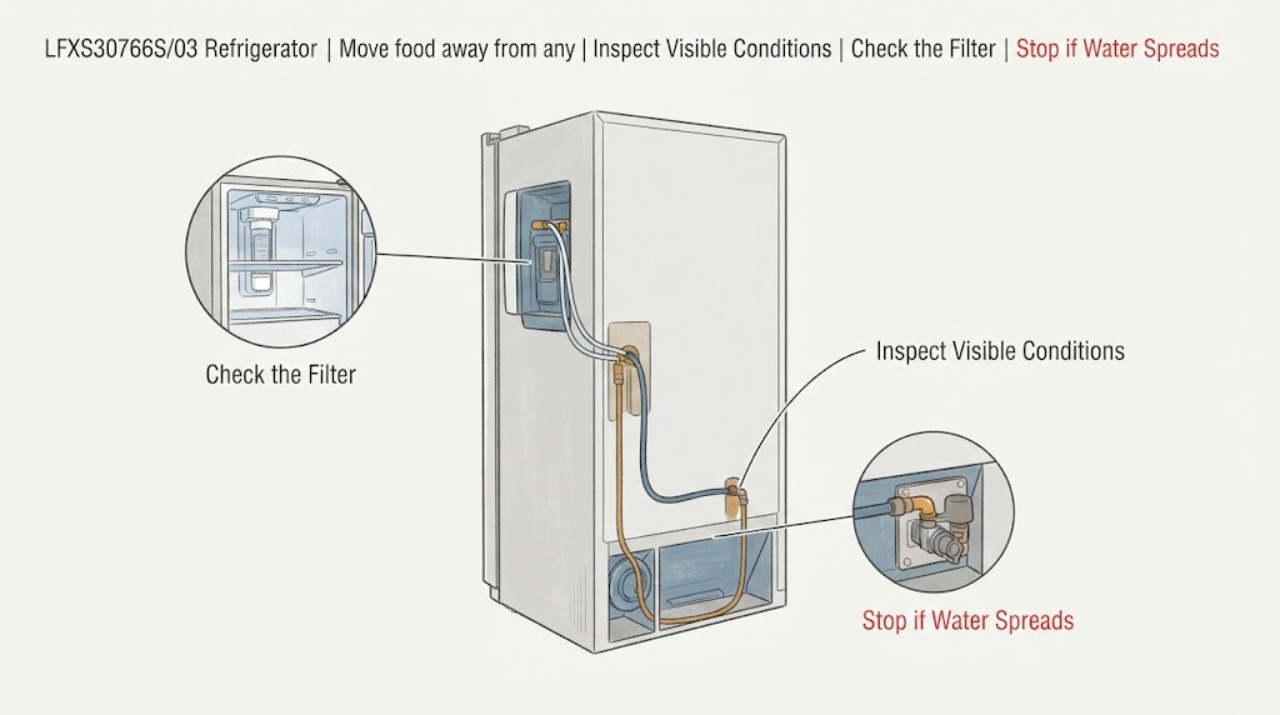
Do not assume the water inlet valve is the leak source just because water appears near the back or bottom. LG’s LFXS30766S owner manual covers the LFXS30766* family and shows the refrigerator’s rear water-line connection, while LG’s leak guidance says a leak can come from a loose or damaged water line, filter, dispenser tubing or another nearby source. Stop the icemaker/dispenser water supply at the home shutoff, unplug the refrigerator before handling the rear connection, and use towels to locate the first wet fitting without opening the sealed refrigerator or energizing exposed parts. If the tube is cracked, kinked, or still leaks after an external fitting check, leave the water off and arrange LG service; the symptom does not prove that the valve itself needs replacement.
Work through in order
Diagnostic checks
Use only checks that match the exact appliance or system and its official guide.
-
Check 1
Move food away from any water, place towels or a shallow tray on the floor, turn off the refrigerator’s home water shutoff/saddle valve, and turn the icemaker off. Unplug the refrigerator before touching the rear water-line connection; do not reach into wet electrical areas.
Expected result: Water continues with the home supply shut off, stops when the supply is shut off, or the shutoff cannot be reached safely.
Next step: Keep the water supply off until the source is identified. If the shutoff is inaccessible, water contacts wiring, or the floor is flooding, use qualified appliance/plumbing service rather than moving the powered refrigerator through water.
Why this matters
Why: A leak that stops when the supply is isolated is in the pressurized water path or a connected dispenser/icemaker path. Continued water may be residual water, meltwater, condensation or another plumbing source and does not prove a valve failure.
-
Check 2
With water and power isolated, dry the rear tubing and fittings, then inspect the first wet point without removing the valve cover or cabinet panel. Look for a loose tube at the fitting, two visible insertion marks where LG expects one, cracks, splits, kinks, or water tracking down from a higher connection.
Expected result: The rear fitting is wet or the tube is visibly damaged; the tube is dry and intact; or the first wet point cannot be reached safely.
Next step: If the exact fitting is visibly loose and the manual permits the connection check, reseat/tighten only with water and power isolated, then leave the water off until a leak check is performed. If the tube is damaged, the wet point is inside the cabinet, or the source is unclear, arrange service.
Why this matters
Why: LG says rear/bottom leaks can result from a tube that is not fully seated or is cracked, split or kinked. A dry external tube does not establish that the internal inlet valve is faulty, and a wet fitting may be a connection issue rather than a failed valve body.
-
Check 3
Check alternative LG water paths before naming the valve: inspect the water filter for correct installation or housing damage, look below the left refrigerator door for dispenser tubing moisture, and look under the sink or nearby water-purifier connections for water flowing toward the refrigerator.
Expected result: The filter is loose/damaged, the lower-door dispenser line is wet, nearby plumbing is wet, or all these areas are dry.
Next step: Correct only a documented filter seating issue with water isolated; do not pull a filter straight out or push it in without turning it. For damaged tubing, housing or nearby plumbing, keep water off and use the appropriate qualified service.
Why this matters
Why: LG lists incorrectly installed filters, damaged filter housings, dispenser/reservoir tubing and nearby plumbing as separate leak sources. These observations can mimic a rear valve leak and should not be merged into one component diagnosis.
-
Check 4
If the water-line connection has been serviced, follow the LFXS30766* manual and LG’s water-line guidance for the correct tubing, compression nut/ferrule and fitting. Turn the home water supply on only after the power is disconnected as directed, dry the connection, and watch for a new bead of water from a dry position.
Expected result: The fitting stays dry, leaks immediately, or the leak appears from the valve body, hidden tubing or another internal location.
Next step: Turn the water back off at the first sign of leakage. If the valve body or hidden tubing is wet, do not remove the rear cover or test the valve electrically; arrange LG-authorized service with the exact model and leak location.
Why this matters
Why: A dry connection after a controlled check makes that fitting less likely, while a valve-body or hidden-line leak remains a service diagnosis. The manual’s connection check cannot identify the failed internal valve coil or seal.
-
Check 5
Record the exact model suffix, whether water was from the icemaker, dispenser or continuous supply, the first wet location, and whether the leak stops at the home shutoff. Photograph the dry-to-wet trail only after water and power are isolated.
Expected result: The evidence points to the rear fitting, filter/dispenser path, nearby plumbing, or an inaccessible internal location.
Next step: Provide LG service the exact model/serial, shutoff result, leak location, photos and any recent filter, tubing or relocation work. Keep the water supply off if the source cannot be ruled out.
Why this matters
Why: The model support page identifies LFXS30766S.ASTCNA0 and directs owners to the exact manual, parts and repair channels. A documented leak path is more useful for service than a valve label inferred from the puddle location.
Use your observations
Decision map
Find the observation that best matches what you see, then follow the next safe action.
-
PATH 01Next step
What you see
The leak stops when the home water shutoff is closed and a rear fitting or tube becomes the first wet point.
Do this next
Keep water off, correct only the exact manual’s accessible connection check, and use LG service for cracked tubing, an internal connection or a valve-body leak.
Why this path and its safety boundary
Why it matters: The pressurized water-line path is implicated, but a loose fitting, tube defect or valve connection remains possible; the symptom alone does not select the valve.
-
PATH 02Next step
What you see
The rear connection is dry but the filter, filter housing, lower-door dispenser tubing or nearby plumbing is wet.
Do this next
Follow LG’s matching filter or dispenser guidance only with water isolated; arrange service for damaged housing/tubing or persistent leakage.
Why this path and its safety boundary
Why it matters: The observed source is a filter/dispenser/plumbing path rather than evidence of the rear inlet valve.
-
PATH 03Next step
What you see
Water continues after the supply is shut off, or it appears as meltwater/condensation inside the refrigerator or freezer rather than at a pressurized fitting.
Do this next
Keep food safe, dry the area and use LG’s leak-troubleshooting path; do not replace the inlet valve without a confirmed pressurized leak.
Why this path and its safety boundary
Why it matters: Residual water, defrost/condensation or an unrelated plumbing source is more plausible than a continuously supplied inlet valve leak.
-
PATH 04Next step
What you see
A dry controlled check still produces water from the valve body, hidden tubing or an inaccessible rear compartment.
Do this next
Leave the water off and unplug the refrigerator if safe, then arrange LG-authorized service. Do not remove the rear cover, bypass a valve or perform live voltage checks.
Why this path and its safety boundary
Why it matters: The component or connection requires internal diagnosis, and water plus power make further owner testing unsafe.
Helpful context
Understand the symptom
“Inlet valve leaking” is a hypothesis, not a confirmed diagnosis
On this French-door refrigerator, the water inlet valve, rear supply fitting, tubing, filter, dispenser reservoir and icemaker path can produce water in nearby areas. The exact LFXS30766S/03 variant was assigned, but the opened owner manual covers the LFXS30766* family and does not establish that a visible puddle came from a failed valve. Find the first wet connection with the water supply isolated before ordering an internal part.
Use the exact manual for the rear connection
LG’s manual says water-line work can cause water damage, calls for a cold potable supply, and says the refrigerator power cord must be unplugged before connecting the tubing. It also instructs turning the water on only after the connection is made and checking for leaks. Those instructions support a controlled external connection check, not live probing or an internal valve replacement tutorial.
Rule out filter, dispenser and nearby plumbing sources
LG’s support material says water on the floor can come from a water-purifier hose or sink area, while leaks at the water filter or dispenser line have separate checks. A leak inside or below the left refrigerator door can involve dispenser tubing. Do not relabel those observations as an inlet-valve failure without the exact leak location.
Only after diagnosis
Potential parts
- exact-model refrigerator water inlet valve or water-line fitting
Only consider this part after the leak is confirmed at the valve body or its exact model-specific connection by service diagnosis; a rear puddle can originate from tubing, filter, dispenser or nearby plumbing.
Confirm the LFXS30766S/03 suffix and LG’s current model-specific parts information before ordering; no valve part number is asserted here.
Common questions
FAQ
Does water under an LG LFXS30766S/03 prove the inlet valve is leaking?
No. LG lists rear tubing/fitting damage, filter installation, dispenser tubing and nearby plumbing as other leak sources. Find the first wet point with the water supply isolated before naming a valve.
Can I tighten the rear connection myself?
Only the exact manual’s accessible water-line connection may be checked, with water and power isolated and a dry work area. LG’s LFXS30766* manual says to check for leaks after restoring water; stop immediately if the tube is cracked or the leak is from a hidden connection or valve body.
What if the leak is near the water filter or left refrigerator door?
LG says a filter can leak when it is not installed correctly or its housing is damaged, and water below the left door can involve dispenser tubing. Do not replace the inlet valve until those paths are ruled out.
When should I keep the refrigerator water off and call service?
Keep water off for a cracked or kinked tube, valve-body or hidden leak, water near wiring, an inaccessible shutoff, or any leak that continues after the documented external connection check. Give LG the exact LFXS30766S/03 model and the leak trail.
Read the exact guide
Official sources
- OWNER’S MANUAL — French Door Refrigerator (LFXS30766* family)LG Electronics · Official LG manual whose cover lists LFXS30766* and whose installation section applies to the assigned LFXS30766S/03 family. Used for the water-line connection, power-disconnect, cold-water, pressure and leak-check boundaries, not as proof of a failed valve.
- LG LFXS30766S: Support, Manuals, Warranty & MoreLG Electronics USA · Exact LG support page for the LFXS30766S product family. It verifies the model family and provides the official manual, parts and repair channels; it does not diagnose a leaking valve.
- [LG Refrigerator] Troubleshooting Water LeaksLG Electronics USA · Official LG family-level leak screening used to distinguish internal condensation/spills from water arriving from nearby sink, purifier or other plumbing. It is not a component diagnosis for the assigned model.
- LG Refrigerator – How to Connect the Water LineLG Electronics USA · Official LG water-line guide used to support unplugging before connection, designated tubing, cold-water supply and post-connection leak inspection. Exact connection location and model details remain controlled by the LFXS30766S/03 manual.
- LG Refrigerator - Troubleshooting a Leaking RefrigeratorLG Electronics USA · Official LG refrigerator leak guide used for rear/bottom water-line checks, filter/dispenser alternatives and the service boundary. It is family-level and does not assign a failed valve to LFXS30766S/03.
Community feedback
Share a repair observation
Share a plain-text repair observation. Accepted observations are published automatically; this page may take a moment to update.