
On this page
Start here
Quick answer
Do not order parts just because an LG LFXS26596S was left unused and now has mold. First remove food and ice from the affected area, record whether growth is limited to cleanable surfaces or reaches a door gasket, dispenser/ice area, drain or air path, and keep questionable food out of use. LG's exact-model support page identifies LFXS26596S and provides its owner manual and service route. For visible, accessible surfaces, follow LG's cleaning boundary: remove detachable shelves and bins, let cold glass warm before washing, use a soft cloth or sponge with mild detergent, rinse and dry, and never use abrasive or flammable cleaners. Clean a visibly dirty gasket gently and dry it. Mold on a gasket does not by itself prove the gasket needs replacement. If growth or odor persists in an inaccessible channel, insulation, rear mechanical compartment, or water/ice path, or the gasket remains torn or unable to seal, stop guessing parts and arrange qualified LG appliance service or a cleaning/replacement assessment.
Before you begin
Safety first
- Do not mix cleaning chemicals, spray liquid into vents or controls, use abrasive or flammable cleaners, remove the rear mechanical cover, disconnect water tubing, open sealed refrigeration tubing, probe a drain, or touch wiring or a fan. Do not select a gasket, filter, valve, drain component, fan, or tubing by appearance or by a different LG model.
Work through in order
Diagnostic checks
Use only checks that match the exact appliance or system and its official guide.
-
Check 1
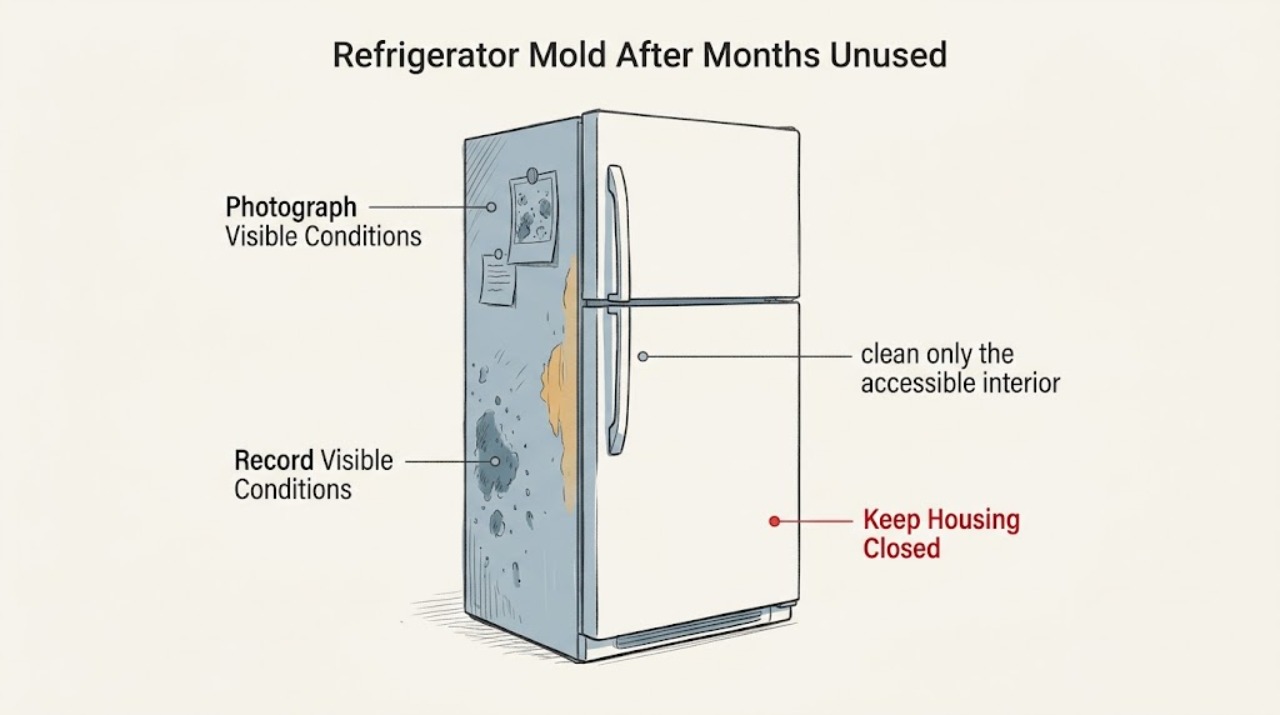
Keep the refrigerator out of normal food service while you document the condition. Remove questionable food or ice from the affected compartment without tasting or sniffing it, and photograph where the mold or residue is located before wiping it away. Note whether it is on shelves, drawers, door liners, the gasket, the dispenser or ice-bin area, around a visible drain or vent, or only as an odor with no visible source.
Expected result: Growth is limited to a visible shelf, bin, liner, or gasket, or it is in an inaccessible opening, water/ice path, rear compartment, insulation, or accompanied by a strong persistent odor.
Next step: Continue only with safe, accessible surface cleaning when there is no electrical or refrigerant concern. Keep food and ice isolated and arrange qualified service for inaccessible growth, persistent odor, or any water/ice-path contamination concern.
Stop if: Stop handling and seek help if the refrigerator is wet around electrical parts, the cord or plug is damaged or hot, the cabinet is unusually hot, refrigerant tubing appears damaged, or anyone develops breathing or other health symptoms.
Why this matters
Why: A bounded, accessible surface can be evaluated using LG's cleaning guidance. An inaccessible location or odor without a visible source is not evidence that a particular replaceable part is bad and may need professional cleaning or appliance assessment.
-
Check 2
Confirm the complete model and product variant from the refrigerator's rating label and compare it with LG's LFXS26596S support page before choosing a manual, filter, gasket, bin, or service instruction. Record any suffix or service-model variation rather than assuming every LFXS26596S-family document has the same parts or removable panels.
Expected result: The label matches LFXS26596S and the support page offers the matching documentation, or the label has a different suffix, is unreadable, or the appliance cannot be positively identified.
Next step: Use only the matching LG documentation for model-specific removal or replacement. If identity remains uncertain, give the label photo and mold-location photos to LG or a qualified technician instead of ordering a part by appearance.
Stop if: Do not remove trim, panels, water tubing, or a rear cover to find a model label, and do not use a part number from a different LG model.
Why this matters
Why: A confirmed model anchors cleaning and parts decisions. An uncertain identity makes a replacement part or panel procedure unreliable even if the refrigerator looks similar.
-
Check 3
With food removed, clean only the accessible interior surfaces using LG's opened guidance: take out removable shelves and bins, allow cold glass to warm to room temperature, wash with a soft clean sponge or cloth and mild detergent, rinse as appropriate, dry completely, and reinstall only after everything is dry. Do not put shelves or drawers in a dishwasher unless the exact manual explicitly permits it.
Expected result: Mold or residue is removed from the accessible shelves, bins, liner, and door surfaces and the area dries without damage, or staining, odor, or growth remains after cleaning.
Next step: If the surfaces clean and the odor resolves, inspect the gasket and visible dispenser/ice area before returning food. If the problem persists, stop repeated chemical or abrasive cleaning and arrange service or a replacement assessment.
Stop if: Do not use steel wool, abrasive cleaners, flammable cleaners, concentrated chemicals, or liquid sprayed into vents, controls, lights, or seams.
Why this matters
Why: A cleanable surface problem does not establish a failed component. Persistent growth or odor after the accessible surfaces are cleaned points to a source that is not being reached or to a material that needs professional assessment.
-
Check 4
Inspect the visible door gasket and its folds without pulling it from the channel. If there is surface residue or black staining, clean it gently with a damp or warm cloth and a soft brush or sponge as LG describes, then dry it. Check that the gasket is seated and that no package, shelf, or drawer prevents the door from closing fully.
Expected result: The gasket becomes clean and continuous and the door seals, or it remains torn, loose, deformed, persistently moldy, or unable to contact the cabinet.
Next step: Use the refrigerator only when the door closes and seals normally. If the gasket remains damaged or the door does not seal, ask LG or qualified service to confirm the exact replacement before ordering it.
Stop if: Do not pull out the gasket, use heat to reshape it, adjust hinges, or force the door to make a seal.
Why this matters
Why: LG identifies moisture and debris as reasons mold can form on a gasket and says a loose gasket can be pressed back into place. Mold alone is not proof that the gasket is the failed part; a persistent tear or sealing failure is a separate service decision.
-
Check 5
If the visible mold is near the dispenser, ice bin, a vent, or a drain opening, inspect only the surfaces that the exact LFXS26596S owner instructions identify as user-removable. Keep suspected ice or water out of use until the contact path is cleared; do not spray cleaner into a channel, disconnect water tubing, probe a drain, or remove an internal cover.
Expected result: The contamination is confined to a removable, cleanable surface, or it appears to continue into an enclosed water/ice, drain, air, or insulation path.
Next step: Keep the dispenser and ice maker out of use and arrange qualified LG appliance service when the source cannot be reached safely or odor returns after surface cleaning. Do not buy a water filter or valve as a substitute for source identification.
Stop if: Do not pour chemicals into the drain or dispenser, flush unknown cleaners through the water line, remove tubing, or reach behind covers.
Why this matters
Why: A removable surface can be cleaned and dried under the matching instructions. An enclosed path cannot be diagnosed as a failed filter, valve, fan, drain, or tube from mold appearance alone and may require sanitation, component inspection, or replacement assessment.
-
Check 6
If dust, residue, or suspected mold is visible at the rear mechanical compartment, unplug the refrigerator only from a dry, safe position and clean the accessible exterior of the cover with the method LG describes. Do not remove the rear cover, open sealed-system tubing, or reach into the compressor or fan compartment.
Expected result: The concern is limited to dust or residue on the accessible exterior cover, or growth, odor, damage, or moisture appears behind the cover or near tubing and electrical parts.
Next step: For an accessible exterior surface, clean and dry it without opening the compartment. For anything behind the cover, arrange qualified service and provide the model and photos.
Stop if: Do not disassemble the rear cover, touch wiring or a fan, puncture tubing, use solvents, or restore power to a wet or damaged appliance.
Why this matters
Why: LG allows external cleaning after unplugging but warns that disassembling the rear mechanical cover can cause an accident and increase internal gas-pipe damage risk. A behind-cover condition is a professional boundary, not a DIY parts-identification step.
-
Check 7
After the accessible cleaning is complete, leave the interior and removable parts fully dry, restore only the model-approved operating state, and monitor the same locations rather than repeatedly applying stronger chemicals. Keep a service record with the model suffix, photographs, odor status, gasket condition, dispenser/ice status, and whether cooling and door sealing remain normal.
Expected result: The refrigerator is clean and odor-free with a sound gasket and no inaccessible growth, or mold/odor returns, cooling is abnormal, the door will not seal, or the contamination remains in an enclosed area.
Next step: Return food gradually only when the interior is clean, dry, and cooling normally. If the condition recurs or any internal access is needed, stop use as appropriate and request an LG or qualified appliance assessment rather than replacing parts by guesswork.
Stop if: Stop using the appliance for persistent strong odor, visible spread into inaccessible areas, water near electrical components, smoke, sparking, damaged wiring, refrigerant damage, or unsafe food conditions.
Why this matters
Why: A stable result supports a cleanable-surface or storage-related problem and does not require a replacement part. Recurrence or an inaccessible source means the root cause has not been identified and may involve sanitation, a seal, water/ice path, airflow, or internal materials.
Use your observations
Decision map
Find the observation that best matches what you see, then follow the next safe action.
-
PATH 01Next step
What you see
Mold is confined to removable shelves, bins, smooth liners, or a visibly dirty but intact gasket, and it clears after the LG-approved gentle cleaning and drying steps.
Do this next
Reassemble only when dry, confirm the door seals, and monitor. Do not order a gasket or filter unless a separate model-specific defect is confirmed.
Why this path and its safety boundary
Why it matters: The evidence supports a cleanable surface or moisture/debris condition, not an automatically failed part.
-
PATH 02Next step
What you see
The gasket is torn, loose, persistently deformed, or unable to seal after visible obstruction removal and gentle cleaning.
Do this next
Keep the door closed as far as it safely will and request LG or qualified service to confirm the exact gasket and door condition from the full model label. Do not pull out or heat-reshape the gasket.
Why this path and its safety boundary
Why it matters: A seal problem is plausible, but the mold itself still does not identify the correct replacement part or variant.
-
PATH 03Next step
What you see
Mold or odor appears to continue through a dispenser/ice, drain, vent, insulation, or rear mechanical path, or it returns after accessible surfaces are clean and dry.
Do this next
Keep questionable food, ice, and water out of use and arrange qualified LG appliance service. Provide photos and the exact model suffix; do not flush chemicals, remove covers, or disconnect tubing.
Why this path and its safety boundary
Why it matters: The source is not established by appearance and may require sanitation, internal inspection, or a replacement-versus-cleaning assessment.
-
PATH 04Next step
What you see
The refrigerator is wet around electrical parts, has a damaged or hot cord or plug, shows smoke or sparking, has damaged tubing, or has unsafe food conditions.
Do this next
Stop using the refrigerator, keep people away from the hazard, move food only if safe, and obtain qualified appliance or electrical help. Do not restore power to test a wet or damaged unit.
Why this path and its safety boundary
Why it matters: This is a safety or food-protection event, not an ordinary mold-cleaning decision.
-
PATH 05Next step
What you see
The model label does not clearly match LFXS26596S or its suffix, or a proposed filter, gasket, bin, fan, valve, drain, or tubing part comes from a different LG model.
Do this next
Pause parts ordering and obtain the complete rating-label information and matching LG documentation or service diagnosis. Treat the mold scope with the generic safe surface boundary only until identity is confirmed.
Why this path and its safety boundary
Why it matters: The identity and compatibility evidence is insufficient; visual similarity is not a safe parts match.
Helpful context
Understand the symptom
Months of non-use can leave moisture, old spills, or spoiled contents in a closed refrigerator, but the word mold does not identify a failed part. Before cleaning, separate the question into three scopes: visible food-contact surfaces, a gasket or removable bin that can be cleaned, and growth or odor that seems to come from an enclosed air, drain, water/ice, or insulated area. The third scope needs service assessment rather than a guessed replacement gasket, filter, fan, or tubing.
LG's opened guidance supports gentle surface cleaning and a dry reassembly. It does not authorize mixing chemicals, spraying into vents or controls, removing the rear mechanical cover, opening sealed refrigeration tubing, or replacing a part solely because a surface has mold. Use the exact LFXS26596S documentation for any component-specific removal, and treat persistent odor or inaccessible growth as a service or replacement-assessment question.
When checks do not resolve it
Need a professional?
Use LG or qualified appliance service for persistent or inaccessible mold/odor, contamination in a water/ice or enclosed air path, a gasket that will not seal, rear-compartment or tubing concerns, abnormal cooling, or any electrical or water hazard.
Safety scope: Do not mix cleaning chemicals, spray liquid into vents or controls, use abrasive or flammable cleaners, remove the rear mechanical cover, disconnect water tubing, open sealed refrigeration tubing, probe a drain, or touch wiring or a fan. Do not select a gasket, filter, valve, drain component, fan, or tubing by appearance or by a different LG model.
Have this ready
- Provide the complete LFXS26596S rating-label model and suffix, serial information if requested, photographs before and after cleaning, exact mold locations, odor status, gasket and door-seal observations, dispenser/ice status, cooling status, and the cleaning products or steps already used.
Common questions
FAQ
Does mold in an LG LFXS26596S refrigerator automatically mean I need a new part?
No. First locate the growth and determine whether it is on an accessible shelf, bin, liner, or gasket. LG provides gentle cleaning and drying guidance for those surfaces. A part becomes a separate decision only when a confirmed defect such as a torn, loose, or non-sealing gasket is present, or a qualified technician identifies an inaccessible contamination source or damaged component for the exact model.
Can I use bleach or a strong mold remover inside the refrigerator?
Do not improvise chemical mixtures or spray cleaner into vents, controls, seams, the dispenser, or a drain. LG's opened interior guidance specifies a soft cloth or sponge with mild detergent and warns against abrasive cleaners; follow the exact owner documentation for any model-specific sanitation instruction.
Should I replace the door gasket because it has black mold?
Not from staining alone. LG says moisture and debris can produce gasket mold and describes gentle cleaning, drying, checking obstructions, and pressing a loose gasket back into place. Replace or service it only when the complete model is confirmed and the gasket remains torn, loose, deformed, or unable to seal.
What if the refrigerator still smells moldy after cleaning?
Keep food, ice, and dispenser water out of use while you document the odor and its location. Persistent odor after accessible surfaces are clean and dry can mean the source is in an enclosed water/ice, drain, air, insulation, or rear mechanical area; arrange qualified service or a cleaning-versus-replacement assessment instead of repeatedly applying stronger chemicals.
Can I remove the back cover to clean mold or dust?
No. LG's rear-cleaning guidance permits cleaning the accessible exterior of the mechanical cover after unplugging from a safe, dry position, but warns not to disassemble the cover because of accident and internal gas-pipe damage risk. Anything behind that cover is a service boundary.
Read the exact guide
Official sources
- LG Refrigerators – How to Clean the Inside of Your RefrigeratorLG Electronics USA · Opened LG refrigerator cleaning guidance; LG notes that the guide is general to models, so model-specific removal beyond detachable parts must use the LFXS26596S documentation.
- LG Refrigerator- How to Remove Mold Buildup from the Door GasketLG Electronics USA · Opened LG gasket-mold guidance; it is general to models and is used only for visible cleaning, checking obstructions, and reseating a loose gasket, not for selecting an LFXS26596S replacement part.
- LG Refrigerator - How Do I Clean The Rear of My LG Refrigerator?LG Electronics USA · Opened LG rear-cleaning guidance; used for the safe external cover check only, not for opening the compartment or diagnosing a sealed-system part on LFXS26596S.
- LG LFXS26596S: Support, Manuals, Warranty & MoreLG Electronics USA · The opened LG USA product support page identifies the exact LFXS26596S.ASTCNA0 model, lists its owner manual and user guide, and provides the model-specific support and service route.
Community feedback
Share a repair observation
Share a plain-text repair observation. Accepted observations are published automatically; this page may take a moment to update.