
On this page
Start here
Quick answer
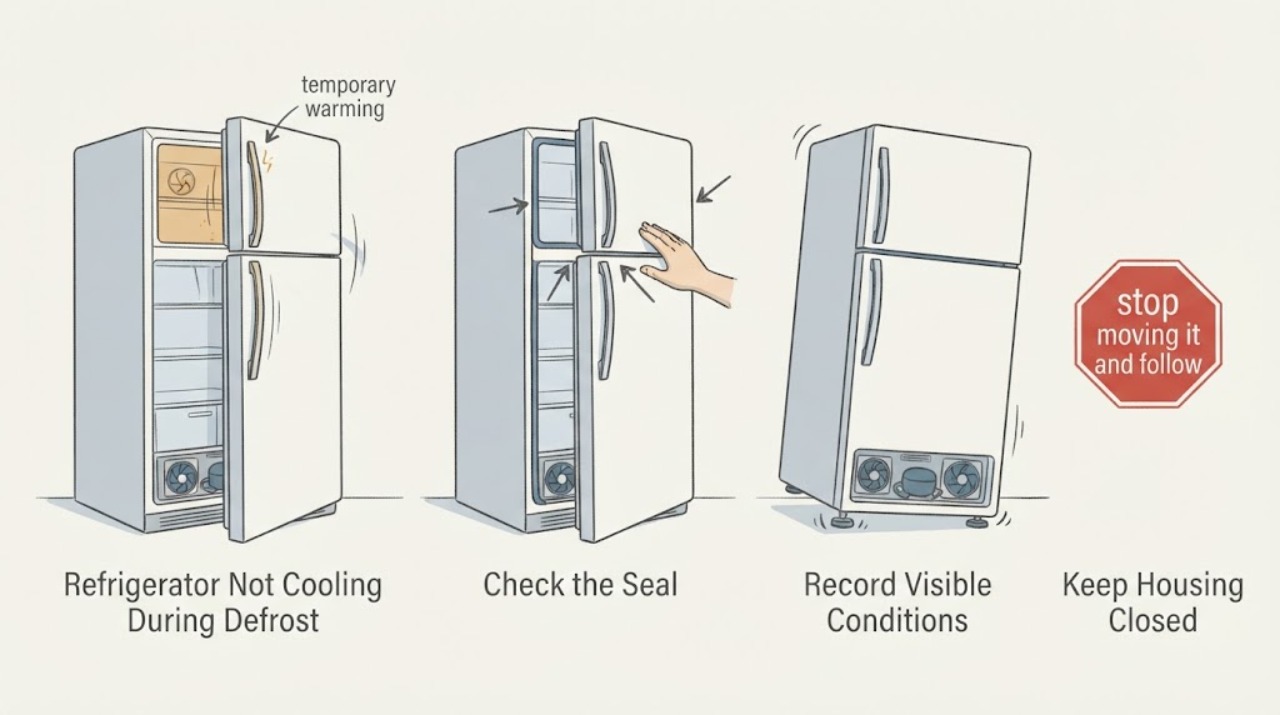
A short temperature rise, dripping or hissing during LG's defrost cycle can be normal, but the refrigerator should recover cooling afterward. Door slamming and a wobbling cabinet point first to floor level, rear tilt, door alignment, overloaded or obstructed bins, and gasket closure; an unlevel unit can also allow frost and warm-air leakage. Check the actual food compartment temperature, frost pattern, door closure, gasket, vents, wall clearance, and whether the cabinet sways. If cooling does not recover after the documented defrost period, frost returns quickly, a door remains open, or the unit leaks or shows electrical damage, protect food, stop repeated tests, and arrange LG service. Do not infer a failed defrost heater, sensor, fan, compressor, or control board from these symptoms alone.
Before you begin
Safety first
- Stop repeated tests for persistent warming, leakage near electrical areas, smoke, burning odor, damaged wiring, or an unstable cabinet. Do not open panels, test live circuits, access the sealed system, or replace a defrost, fan, compressor, sensor, or control part from the symptom alone.
Work through in order
Diagnostic checks
Use only checks that match the exact appliance or system and its official guide.
-
Check 1
Record the refrigerator and freezer temperatures or food condition without repeatedly opening the doors. Note when the cooling loss starts, whether it coincides with defrost sounds or dripping, and whether normal cooling returns after the defrost interval; protect perishable food if temperatures are rising.
Expected result: Cooling returns after a short defrost event, or the compartments remain warm, food is thawing, or frost returns quickly after defrost.
Next step: If cooling recovers and no hazard is present, continue with door and leveling checks. If warming persists, food is thawing, or frost rapidly returns, keep doors closed as much as possible, protect food, and arrange LG or qualified refrigeration service.
Why this matters
Why: LG says internal temperature can rise temporarily during defrost and that hissing or dripping can be normal. Continued warming or recurring frost is different from a transient cycle effect and does not identify the failed internal part.
-
Check 2
With the refrigerator stable and the doors unloaded enough to inspect, check that shelves, drawers, packages, and door bins do not prevent closure. Inspect the visible gasket for dirt, twisting, gaps, tears, or a section that has pulled out of its channel; close each door and confirm it seals without being held.
Expected result: A bin or package blocks the door, the gasket has dirt or a gap, the door slams because the cabinet is tilted, or closure and gasket contact look even.
Next step: Remove only visible food or shelf obstructions and clean or reseat an intact gasket using the model guidance. Request service for a torn gasket, persistent gap, or door that still slams after leveling; do not force hinges or change door hardware from appearance alone.
Why this matters
Why: LG says an incompletely closed door admits warm air and can weaken cooling or create frost. Door slamming can result from the refrigerator's front-to-back tilt, but a good seal and correct tilt do not prove the refrigeration system is healthy.
-
Check 3
If the cabinet wobbles, stop moving it and follow the matching LG leveling instructions: check whether the floor is even, confirm the unit is firmly positioned, and inspect the leveling feet or screws. Unplug and remove food before leveling only when that is safe and practical, and do not move the refrigerator alone.
Expected result: The cabinet rocks, one side is lower, the back is too low and the door slams, or the unit is stable and level.
Next step: Use only the exact LG leveling procedure for the refrigerator type and stop if the unit cannot be made stable. If the cabinet remains unlevel, the floor or hinge needs professional assessment; do not improvise permanent shims or remove panels.
Why this matters
Why: LG directly associates wobble and front-to-back tilt with door slamming and noisy movement. An unlevel refrigerator can also contribute to frost or poor door sealing, but leveling alone does not diagnose a defrost or compressor fault.
-
Check 4
Check that interior cold-air outlets are not blocked by food, the doors and drawers are fully seated, and the refrigerator has the model-required clearance from walls or nearby heat sources. Look only at accessible rear or side ventilation and remove dust or objects after safely disconnecting power if the matched guide permits it.
Expected result: Food blocks an outlet, the unit is too close to a wall, rear ventilation is obstructed, or the visible airflow path is clear.
Next step: Rearrange only visible obstructions and restore the exact installation clearance. If cooling remains poor after the door and level checks, arrange service rather than opening the sealed or electrical areas.
Why this matters
Why: LG says blocked outlets, overfilling, inadequate clearance, and unsuitable installation can make cooling weak. These observations can explain cooling symptoms without proving a defrost heater, fan, compressor, or board problem.
-
Check 5
Listen from outside the cabinet after the refrigerator resumes cooling. Record whether the sound is hissing/dripping during defrost, a brief compressor or fan vibration after the door is opened or closed, or a persistent abnormal sound; check whether the cabinet or nearby objects amplify the vibration.
Expected result: The sound is limited to defrost or compressor restart and fades, or it remains loud and is associated with sway, poor cooling, a leak, or a new change after moving or cleaning.
Next step: Correct only a visible stability or contact issue. If the noise persists after the cabinet is level or the refrigerator was recently moved, use the exact manual or request service; do not touch the compressor, fan, wiring, or refrigerant circuit.
Why this matters
Why: LG describes defrost hissing/dripping and temporary compressor, fan, refrigerant-flow, and pressure sounds as normal in the relevant circumstances. Persistent noise combined with wobble or cooling loss needs more than a sound classification.
-
Check 6
Arrange LG or qualified refrigeration service when cooling does not recover after the documented defrost period, frost quickly returns, the door gasket is torn or cannot seal, the cabinet cannot be leveled, or the unit has a leak, electrical damage, smoke, or burning odor.
Expected result: The condition is persistent or recurring despite visible door, leveling, airflow, and installation checks, or any stop-use hazard is present.
Next step: Keep food at a safe temperature, avoid repeated test cycles, and provide the model, temperature trend, frost location, door and leveling observations, photos, and any error display to service. Do not open panels or perform live electrical or sealed-system tests.
Why this matters
Why: The combined symptoms can arise from separate installation and cooling conditions. Without the model and a direct inspection, they do not establish a defrost heater, sensor, fan, compressor, drain or control-board failure.
Use your observations
Decision map
Find the observation that best matches what you see, then follow the next safe action.
-
PATH 01Next step
What you see
Cooling is briefly weaker while defrost-related dripping or hissing occurs, then temperatures recover and food remains safely cold.
Do this next
Monitor the recovery and keep doors closed as much as practical. Escalate if cooling does not return, frost rapidly recurs, or food warms.
Why this path and its safety boundary
Why it matters: LG describes the defrost heater, temporary internal temperature rise, and dripping or hissing as normal defrost behavior.
-
PATH 02Next step
What you see
The refrigerator wobbles, the rear is low and a door slams, a door remains slightly open, or the gasket has a gap or visible damage.
Do this next
Remove visible obstructions, inspect the gasket, and follow the exact LG leveling procedure. Use professional service for a damaged gasket, unstable cabinet, or persistent door problem.
Why this path and its safety boundary
Why it matters: LG links these observations to floor level, cabinet tilt, door closure, and warm-air entry; they can promote frost and weaken cooling without proving an internal refrigeration fault.
-
PATH 03Next step
What you see
Food blocks a vent, the refrigerator is overfilled, clearance is insufficient, or the rear ventilation area is obstructed.
Do this next
Restore visible airflow and model-required clearance. If temperatures remain high after the change, arrange service rather than diagnosing the compressor or fan.
Why this path and its safety boundary
Why it matters: LG identifies blocked cold-air circulation and inadequate heat release as causes of weak cooling and frost-related symptoms.
-
PATH 04Next step
What you see
The refrigerator remains warm after defrost, frost returns quickly despite a sealed and level door, or a displayed error persists.
Do this next
Protect food, stop repeated testing, and request model-specific LG service with photos, temperature history, frost location, door/gasket and leveling results, and any code.
Why this path and its safety boundary
Why it matters: The symptoms are outside a normal transient defrost explanation. LG's public guidance routes persistent frost or cooling issues to service, but the symptoms do not select a heater, sensor, fan, compressor, or board.
-
PATH 05Next step
What you see
There is water near electrical parts, smoke, a burning odor, damaged wiring, or the cabinet is unstable enough to move dangerously.
Do this next
Keep clear, protect food only if safe, and arrange qualified service; disconnect power or water only when safely accessible. Do not open panels, touch the compressor or wiring, or continue running the refrigerator to reproduce the symptom.
Why this path and its safety boundary
Why it matters: This is a stop-use safety condition and should not be treated as a normal defrost sound or a leveling experiment.
Helpful context
Understand the symptom
Separate a normal defrost interval from a cooling failure
LG explains that the defrost heater periodically melts evaporator frost. During that interval the compartment temperature can rise temporarily, and dripping or hissing may be heard. The useful observation is what happens after the cycle: cooling should return, while persistent warming, food thawing, or rapidly returning frost needs a model-specific service decision. The phrase “not cooling during defrost” alone does not identify a failed heater or sensor.
Door slamming and wobbling can be one installation clue
LG says that a refrigerator with the back too low can make a door slam, while a low front can prevent proper closure. The same support guidance asks the owner to check an uneven floor and wobble. A door that does not seal can admit warm air and promote frost, but a door symptom does not prove that the sealed cooling system or defrost parts have failed.
Use visible checks before any service decision
Check food placement, shelves and drawers, gasket contact, vents, wall clearance, and the cabinet's stability. LG's general cooling guidance identifies temperature setting, overfilling, incomplete door closure, installation location and insufficient post-installation time as possible causes of weak cooling. If these checks do not explain the condition, use the model manual or professional service instead of opening panels or naming an internal part.
When checks do not resolve it
Need a professional?
Request LG or qualified refrigeration service when cooling does not recover after a documented defrost interval, frost returns quickly, a door or gasket cannot seal after visible checks, the refrigerator cannot be leveled, an error persists, or there is a leak, smoke, burning odor, damaged wiring, or unsafe movement. Do not open panels or diagnose an internal part from the combined symptoms.
Safety scope: Stop repeated tests for persistent warming, leakage near electrical areas, smoke, burning odor, damaged wiring, or an unstable cabinet. Do not open panels, test live circuits, access the sealed system, or replace a defrost, fan, compressor, sensor, or control part from the symptom alone.
Have this ready
- Provide the full LG model and region, refrigerator/freezer temperature trend, food-thawing status, frost location and recurrence, door/gasket and obstruction observations, level and wobble result, wall clearance, recent move or cleaning history, photos, and any displayed error.
Common questions
FAQ
Is it normal for an LG refrigerator to feel warmer during defrost?
LG says the defrost heater periodically melts evaporator frost, during which the refrigerator compartment temperature can rise temporarily and dripping or hissing can occur. Cooling should recover afterward; persistent warming, food thawing, or rapidly recurring frost needs model-specific service.
Why does my LG refrigerator door slam and the cabinet wobble?
LG links a low rear or front-to-back tilt and an uneven floor to door slamming or wobble. Check visible floor stability, leveling feet or screws, door bins, shelves, packages, and the gasket. Follow the exact leveling guide and request service if the unit remains unstable.
Can a door problem cause an LG refrigerator not to cool?
Yes, an incompletely closed door or damaged gasket can let warm air in and weaken cooling or promote frost. That does not prove the defrost system is faulty. Correct visible obstructions and gasket dirt, then escalate if the seal remains open or cooling does not recover.
Should I replace the defrost heater or compressor for these symptoms?
No. Door slamming, wobble, temporary defrost warming, and noise can arise from separate normal or installation conditions. LG's public guidance supports external checks and model-specific service, not selecting an internal part from this symptom combination.
Read the exact guide
Official sources
- [LG refrigerator refrigeration] The fridge is not cold enough. Not cold enough.LG USA Support · Opened LG's official general refrigerator cooling page. It supports external checks and does not diagnose a defrost or sealed-system component.
- Noise (hissing, gurgling, cracking, clicking, rattling, thumping & humming) [refrigerator]LG USA Support · Opened LG's official all-refrigerator support page. It supports family-level sound and defrost behavior only; no model-specific internal diagnosis is claimed.
- LG Refrigerator - Troubleshooting Refrigerator Noises After It Was Moved or CleanedLG USA Support · Opened LG's official all-model support page. It is used only when movement or cleaning is relevant and for the external stability boundary, not for a component diagnosis.
- LG Refrigerator – How to Level a FridgeLG USA Support · Opened LG's official leveling guide. It presents multiple refrigerator types and states that images and hardware vary; only the general leveling and service boundaries are used.
- LG Refrigerator - Frost BuildupLG USA Support · Opened LG's official general refrigerator frost support page. It is used for external door, airflow, gasket, and leveling checks; exact controls and service procedures remain model-specific.
- [LG refrigerator door] Not level. I would like to know how to do leveling.LG USA Support · Opened LG's official all-model leveling guidance. Images may vary by model; the article uses it for the observed door and wobble relationship and directs readers to the exact model procedure.
Community feedback
Share a repair observation
Share a plain-text repair observation. Accepted observations are published automatically; this page may take a moment to update.