
On this page
Start here
Quick answer
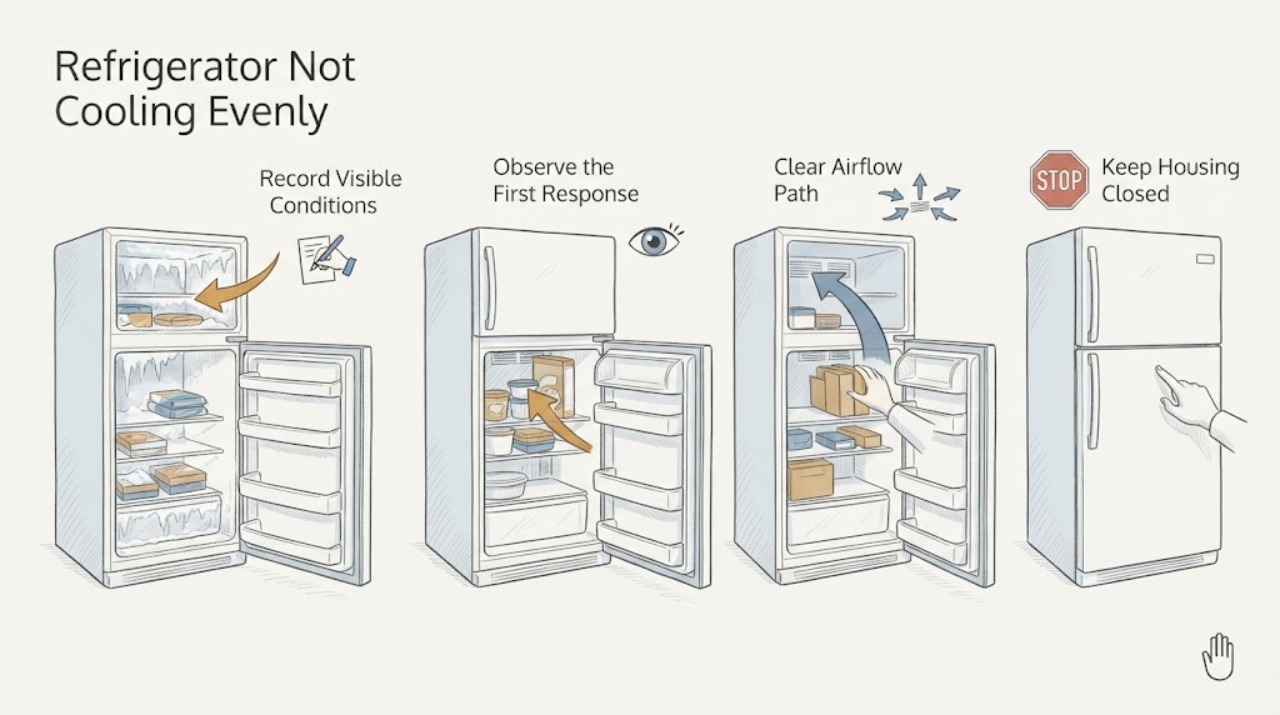
For the LG LRSES2706V, do not judge cooling by touching one shelf or by general product opinions. First record the actual temperature in the fresh-food compartment and freezer, then move the thermometer through the upper, middle, lower, rear, and Door-in-Door areas while keeping the doors closed between readings. LG identifies this model as a side-by-side InstaView Door-in-Door refrigerator with Multi-Air Flow and four temperature sensors, so a warm pocket is a different decision from both compartments being warm. Set the refrigerator within LG's 1–3°C (34–37°F) guidance, clear vents, avoid overfilling, and verify that the main doors and Door-in-Door panel seal. Treat any fresh-food area above the FDA's 40°F limit as a food-safety problem; if temperatures remain unsafe after these external checks and recovery time, arrange qualified service without guessing at a compressor or sealed-system part.
Before you begin
Safety first
- User checks stop at the display, thermometer, food arrangement, accessible gaskets, doors, and external clearance. Do not remove the rear machine-room cover, open the refrigeration circuit, access internal wiring, chip ice, use heat tools, or perform powered component tests. Stop for smoke, burning odor, a hot/damaged cord, water near electrical parts, or repeated breaker operation.
Work through in order
Diagnostic checks
Use only checks that match the exact appliance or system and its official guide.
-
Check 1
Confirm the rating label says LG LRSES2706V and use the matching LG support page and owner's manual for the controls. Record the country or market, refrigerator setting, freezer setting, any lock or alarm indicator, and whether the complaint is about the fresh-food side, freezer side, door bins, or a particular shelf.
Expected result: The label and support record match LRSES2706V, or the model suffix/market is different or unreadable; the warm area is localized or both compartments are affected.
Next step: Use only the matching manual for controls. If the identity is uncertain, keep the checks symptom-level and provide the label photo to LG service rather than selecting a part from a similar model.
Stop if: Do not enter an unverified service mode, change wiring, or infer a compressor or sealed-system failure from the title or model family.
Why this matters
Why: The official LRSES2706V material confirms the side-by-side Door-in-Door/Multi-Air-Flow configuration, but LG notes that settings and menus can vary by model. A different or incomplete identity cannot safely inherit this model's settings or component conclusions.
-
Check 2
Create a temperature map with a refrigerator/freezer appliance thermometer. Measure the fresh-food compartment at the upper, middle, and lower shelves, then near the rear air outlet and the Door-in-Door storage area; measure the freezer separately. Keep the doors closed between readings and record the time, reading, and whether food itself or air was measured.
Expected result: All fresh-food locations are at or below 40°F, one area is above 40°F while others are cold, the freezer is cold but the refrigerator side is warm, or both compartments are above their safe/expected ranges.
Next step: Move or protect perishable food immediately if a fresh-food location is above 40°F, then continue only with external checks. Give the temperature map to service if the pattern persists.
Stop if: Do not taste or smell-test food to decide if it is safe, and do not keep opening the doors repeatedly to chase a reading.
Why this matters
Why: The pattern separates a localized circulation or closure problem from a whole-appliance cooling problem. FDA's 40°F limit is a food-safety threshold, not proof of which refrigerator component failed; touch and the display setting are not substitutes for the measurement.
-
Check 3
With the appliance operating normally, inspect the visible refrigerator and freezer air outlets and temperature-sensor area. Move food away from outlets, avoid packing the cabinet tightly, and place easily melted items toward the back rather than in the Door-in-Door or other door bins. Change only the placement that is visibly blocking airflow.
Expected result: An outlet or sensor is covered, the cabinet is heavily packed, or the air paths are clear and the same location remains warm after rearrangement.
Next step: Keep the vents clear and repeat the same temperature map after the model has had time to stabilize. If only one area remains warm, request service with the map and loading position.
Stop if: Do not remove an interior air panel, probe a vent, chip ice, or use a heat tool to open an air path.
Why this matters
Why: LG says blocked vents or food in front of the sensor can reduce or misdirect cooling, and its fresh-storage guidance identifies the back as the stronger-cooling area for easily melted items. A clear air path with a repeatable one-zone temperature gap is evidence for the next branch, not a license to name a damper or fan part.
-
Check 4
Inspect the closure points from outside: the main refrigerator and freezer doors, the Door-in-Door panel, door bins, shelves, and gaskets. Look for a protruding container, misplaced shelf, food residue, a loose section of gasket, a door that springs back open, or visible condensation/frost along one edge. Clean only accessible gasket residue with a warm damp cloth and dry it.
Expected result: A door or Door-in-Door panel does not close flush, a gasket has a gap or loose section, condensation/frost is concentrated at one edge, or every closure point appears normal.
Next step: Correct a plainly visible obstruction, re-seat a loose gasket only if it fits back into its groove, keep the doors closed, and remap temperatures. Arrange LG service for a damaged gasket, hinge/alignment issue, or persistent gap.
Stop if: Do not force the Door-in-Door mechanism, remove the door, adjust a hinge under load, or dismantle a gasket or panel.
Why this matters
Why: LG identifies protruding food, misplaced shelves, debris, and a loose gasket as causes of poor sealing; warm air entering through a gap can reduce cooling and create condensation. A normal external seal makes a persistent measured temperature split more significant, but it still does not identify an internal part.
-
Check 5
Check the setting and external environment once: use the exact manual to set the refrigerator within LG's 1–3°C (34–37°F) guidance, confirm the unit is not packed against the wall or a heat source, and note whether it was recently installed, moved, repaired, or loaded with a large amount of warm food. Do not repeatedly cycle power to force a result.
Expected result: The setting was outside the guidance, the back/sides have restricted clearance or an unusually hot location, the unit is still within LG's two-to-three-day recovery window after installation/repair, or the external conditions are normal and the mapped temperatures remain abnormal.
Next step: Correct only the visible setting, loading, or clearance issue and remap after stabilization. If the refrigerator or freezer remains unsafe or uneven, book qualified LG/refrigeration service with the exact model, readings, and timeline.
Stop if: Do not remove the rear machine-room cover, touch refrigerant tubing, or attempt a sealed-system, compressor, control-board, or sensor repair.
Why this matters
Why: LG links high settings, restricted ventilation, unsuitable ambient conditions, and insufficient recovery time to weak or uneven cooling. When those explanations are absent and the readings stay abnormal, the case has moved beyond a user adjustment; the model sheet's compressor/sealed-system information is not a diagnosis.
Use your observations
Decision map
Find the observation that best matches what you see, then follow the next safe action.
-
PATH 01Next step
What you see
The temperature map is within the food-safety range throughout the fresh-food side, the freezer is stable, and the perceived difference is mainly between the rear and door areas.
Do this next
Organize items around the vents and use the measured map as the baseline. Monitor for a change in actual readings rather than relying on touch or a product opinion.
Why this path and its safety boundary
Why it matters: This pattern does not establish a cooling failure. LG specifically describes vents in each section and recommends keeping easily melted items toward the back rather than near a door; access zones can feel different even when food is being kept safely.
-
PATH 02Next step
What you see
The main refrigerator and freezer are near their targets, but the Door-in-Door area or one door shelf repeatedly runs warmer, especially with condensation or a closure gap.
Do this next
Clear the obstruction, clean or re-seat only an accessible gasket section, close the panel, and remap. Escalate to LG service for a persistent gap, damaged gasket, alignment issue, or unsafe temperature.
Why this path and its safety boundary
Why it matters: The combined pattern makes a local loading or seal problem more likely than a whole refrigeration-system failure. The exact LRSES2706V product page confirms that the Door-in-Door is a distinct access feature, while LG's seal guidance points to obstructions, gasket debris, or a loose gasket.
-
PATH 03Next step
What you see
The freezer is cold but the fresh-food side remains above 40°F in more than one location after vents are clear, the doors seal, the setting is correct, and recovery time has passed.
Do this next
Protect food and arrange qualified LG refrigeration service. Provide the exact model, mapped locations, readings and times, settings, door observations, and any frost or condensation pattern; do not open panels.
Why this path and its safety boundary
Why it matters: A persistent compartment-specific result is more consistent with a circulation/control condition than with a simple product preference, but the public LG material does not justify naming a damper, fan, sensor, or other part from temperature readings alone.
-
PATH 04Safety boundary
What you see
Both compartments remain warm or the refrigerator cannot maintain 40°F or below despite correct settings, clear airflow, intact closures, suitable clearance, and stabilization.
Do this next
Keep perishable food in a safe cold appliance and request qualified LG/refrigeration service with the model and temperature log. Ask the provider to document the confirmed failed path before authorizing a part.
Why this path and its safety boundary
Why it matters: This is no longer a Door-in-Door organization question. It warrants professional cooling-system or control diagnosis; the LRSES2706V support page lists sealed-system and compressor warranty categories but does not make a failed component diagnosis for this symptom.
Safety stop: Stop immediately for burning smell, smoke, a hot or damaged cord, water at electrical parts, repeated breaker trips, or physical damage; isolate only from a safe dry position and seek appropriate emergency, electrical, or appliance help.
Helpful context
Understand the symptom
What is specific about this LG model
LG's LRSES2706V product page and model sheet identify a 26.8 cu. ft. side-by-side refrigerator with InstaView Door-in-Door, Multi-Air Flow, digital temperature controls, and four temperature sensors. LG says the Door-in-Door design reduces cold-air loss during access and that vents are placed in each section. Those features make the location of the warm area useful evidence: a single door-bin or shelf pattern is not the same as a warm refrigerator side and warm freezer.
Use measured temperatures, not touch
A hand can tell that one item feels warmer, but it cannot establish whether the stored food is safe. FDA recommends an appliance thermometer and a refrigerator at 40°F or below. Map the readings by position and time, including the area nearest the Door-in-Door access, without leaving the doors open while comparing locations. The map determines whether to correct loading and seals, monitor a localized pattern, or request refrigeration service.
When checks do not resolve it
Need a professional?
Arrange qualified LG or refrigeration service when temperatures remain unsafe or uneven after the external checks and stabilization period, when a door or Door-in-Door seal cannot be restored, or when both compartments are warm. Protect perishable food first; use emergency electrical help for an active electrical hazard.
Safety scope: User checks stop at the display, thermometer, food arrangement, accessible gaskets, doors, and external clearance. Do not remove the rear machine-room cover, open the refrigeration circuit, access internal wiring, chip ice, use heat tools, or perform powered component tests. Stop for smoke, burning odor, a hot/damaged cord, water near electrical parts, or repeated breaker operation.
Have this ready
- Provide the exact LRSES2706V model and market, temperature settings, a time-stamped map of upper/middle/lower/rear/Door-in-Door and freezer readings, food-safety decisions, vent and loading changes, closure/gasket observations, installation or movement date, and any frost, condensation, odor, noise, leak, or breaker event.
Common questions
FAQ
Is a warmer Door-in-Door shelf on the LG LRSES2706V automatically a failed refrigerator?
No. The Door-in-Door is a separate access feature and LG's Multi-Air Flow system uses vents throughout the cabinet. First measure that area and the main shelves, clear obstructions, and verify the panel and gasket close. A repeatable unsafe reading or a visible seal problem needs service; it does not identify a compressor or other part by itself.
What temperature proves the fresh-food side is unsafe?
FDA says the refrigerator should be kept at 40°F or below and recommends an appliance thermometer because a control display may not show actual temperature. If a measured storage area is above that limit, move or protect perishables and do not rely on smell or touch to clear them.
Should I replace a fan, damper, sensor, or compressor for uneven cooling?
Not from this symptom alone. A zone-by-zone temperature map, airflow and closure observations, settings, and recovery history can separate a loading/seal issue from a service condition, but the opened LG materials do not authorize a model-independent part diagnosis. Give that evidence to a qualified technician.
Read the exact guide
Official sources
- If Your LG Refrigerator Is Not Cold EnoughLG USA Support · Opened LG refrigerator troubleshooting guide supports the external checks used here. LG notes the guide is based on standard models, so the exact LRSES2706V manual governs any menu difference.
- [LG Refrigerator] Refrigerator Door Seal IssuesLG USA Support · Opened LG door-seal guide supports accessible obstruction, gasket cleaning, and re-seating checks for this refrigerator topic; guide states images may differ by model.
- LG LRSES2706V: 27 cu. ft. Side-By-Side InstaView™ Door-in-Door® RefrigeratorLG USA · Exact model product page opened and used to confirm the LRSES2706V identity, Door-in-Door feature, Multi-Air Flow, vents in each section, digital controls, and four temperature sensors.
- [LG Refrigerator] Self-maintenance for fresh storageLG USA Support · Opened LG guidance supports food-placement and external-clearance checks; it does not authorize removal of LRSES2706V covers or identify a failed part.
- Refrigerator & Freezer Storage ChartU.S. Food and Drug Administration · Opened FDA storage chart supports treating 40°F (4°C) as the refrigerator cold-storage limit in the safety branch; it does not identify an appliance fault.
- LRSES2706V EnLG Electronics · Exact LRSES2706V specification PDF opened to verify the side-by-side Door-in-Door configuration, Multi-Air Flow, four temperature sensors, digital controls, and model identity.
- LG Refrigerator - How to Troubleshoot a Refrigerator Door Not Closing ProperlyLG USA Support · Opened LG guide supports the distinction between visible food/shelf/gasket issues and a hinge problem requiring service; it is not a model-specific internal diagnosis.
- LRSES2706V.APZCNA0: Support, Manuals, Warranty & MoreLG USA · Exact LG support page opened to confirm the model suffix, owner's-manual route, and service/warranty categories; it does not diagnose the uneven-temperature symptom or select a part.
- Refrigerator Thermometers - Cold Facts about Food SafetyU.S. Food and Drug Administration · Opened FDA food-safety page supports the 40°F refrigerator threshold and use of appliance thermometers; it does not diagnose the LG appliance.
Community feedback
Share a repair observation
Share a plain-text repair observation. Accepted observations are published automatically; this page may take a moment to update.