
On this page
Start here
Quick answer
For the assigned Crosley CT15A2 report, measure both compartments before changing a setting or moving the appliance. Protect perishable food if the refrigerator is above 40°F (4°C) or the freezer is above 0°F (-18°C). From outside the cabinet, check visible vent clearance, door closure, and gasket condition, and ask the apartment manager before moving or opening the refrigerator. An opened Crosley top-freezer family manual says a one-step colder control change may need 24 hours, but the exact CT15A2 manual was not located in the official sources opened here, so do not transfer internal repair steps or exact settings from another family. If temperatures remain unsafe, frost or water returns, or access requires moving or removing a panel, document the readings and request landlord or qualified appliance service.
Before you begin
Safety first
- Do not remove panels, probe live wiring, move the refrigerator, pour hot water into a hidden drain, adjust hinges or leveling feet, open the sealed system, or continue operating with water near electrical parts without owner approval and qualified service.
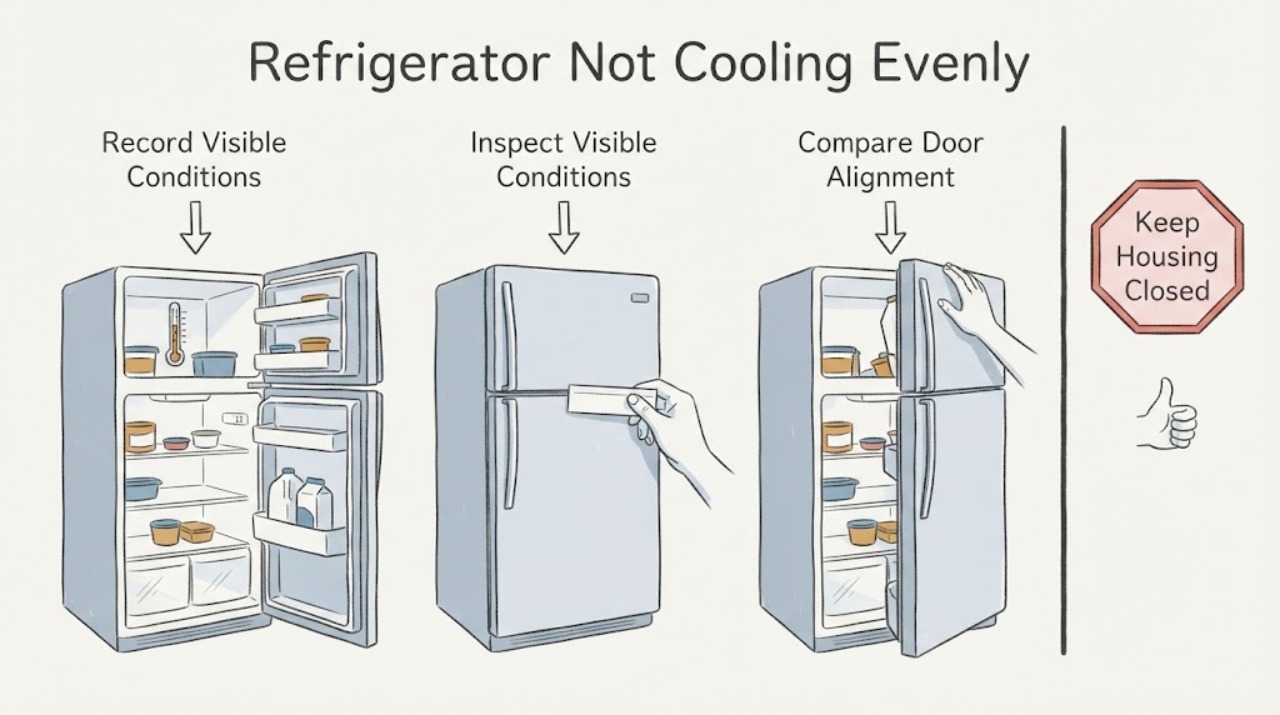
Work through in order
Diagnostic checks
Use only checks that match the exact appliance or system and its official guide.
-
Check 1
Place suitable appliance thermometers in the refrigerator and freezer if available, keep both doors closed as much as practical, and record readings after the appliance has had time to stabilize. If food is already warming, move perishables to a known-safe cold appliance while arranging service.
Expected result: The refrigerator is at or below 40°F (4°C) and the freezer at or below 0°F (-18°C); one or both are warmer; or no reliable measurement is available.
Next step: If either compartment is above its target, minimize door opening, protect the food, and submit the readings with the service request. If no thermometer is available, treat the temperature as unverified and do not rely on appearance or smell to clear perishables.
Why this matters
Why: The readings distinguish a perceived circulation difference from a food-safety risk, but they do not identify an internal component. FoodSafety.gov uses 40°F for the refrigerator and 0°F for the freezer as storage targets.
-
Check 2
With the doors open only briefly, look for food or containers pressed against visible air openings and check that shelves and drawers are not packed so tightly that air cannot circulate. Do not remove the freezer rear cover, poke a hidden drain, or pour hot water into an unseen passage.
Expected result: A visible vent is blocked, the compartments are tightly packed, or no obstruction is visible.
Next step: Move only loose food that is visibly blocking an opening, without changing shelves or dismantling anything, then recheck temperatures. If there is no visible obstruction or readings remain unsafe, request model-matched service.
Why this matters
Why: The opened Crosley family manual treats food too close to an air vent and restricted air space as relevant external checks. A clear visible vent does not rule out an internal airflow, frost, or control problem.
-
Check 3
Inspect the door edges and gaskets from outside for a visibly torn, folded, dirty, or displaced seal, and close each door normally to see whether it stays shut without holding it. Do not adjust hinges, leveling feet, or cabinet position in the apartment without owner or manager approval.
Expected result: A door does not close, a gasket has an obvious gap or damage, frost is concentrated near a door edge, or doors and seals appear visually normal.
Next step: Remove only an obvious loose obstruction and report a damaged gasket, door, or alignment issue to the property manager. If the seal looks normal, continue with temperature documentation rather than attempting hinge or gasket replacement without exact CT15A2 documentation.
Why this matters
Why: The Crosley family troubleshooting material lists a door that does not close and gasket or food-position problems as possible contributors to temperature and frost symptoms. This observation cannot prove a seal is the sole cause.
-
Check 4
Photograph the current temperature-control position and ask the landlord or appliance owner whether a normal user adjustment is permitted. If permission is given and the control is clearly identified, make at most one small colder adjustment and leave the doors closed while observing the trend for up to 24 hours; do not rapidly cycle the control.
Expected result: The setting was changed once and temperatures recover; temperatures do not recover after the observation period; or apartment rules do not permit the adjustment.
Next step: Return to the owner-approved setting if required and report the before/after readings. If either compartment remains above its food-safety target, stop changing settings and arrange qualified service.
Why this matters
Why: An opened Crosley top-freezer family manual says a control change can require 24 hours, and gives that family's warmer/colder scale. Because the exact CT15A2 manual was not located, those family details do not authorize a specific CT15A2 setting or prove a control fault.
-
Check 5
From outside the cabinet, document whether you see a sheet of ice, recurring frost, water under drawers, or unusual temperature differences, along with the model and serial label and the time of each reading. Do not move the refrigerator, remove the rear freezer panel, access wiring, or attempt defrost or drain repair unless the property manager and a qualified servicer authorize a model-specific procedure.
Expected result: Frost or water returns, the pattern is confined to one compartment, the unit would need to be moved for access, or no visible frost or water is present but temperatures remain unsafe.
Next step: Send photos, exact model/serial, temperature log, gasket observations, and permission constraints to the landlord or property manager and request authorized service. Keep the appliance out of service if water is near electrical parts, or there is a damaged cord, smoke, or burning odor.
Why this matters
Why: Frost, water, and compartment-specific readings help a qualified technician choose the next inspection, but do not establish a blocked drain, fan failure, defrost failure, or sealed-system fault. Apartment access is part of the service boundary.
Use your observations
Decision map
Find the observation that best matches what you see, then follow the next safe action.
-
PATH 01Next step
What you see
The refrigerator is above 40°F (4°C), the freezer is above 0°F (-18°C), or food has been in the danger zone for an uncertain time.
Do this next
Move food to a known-safe cold appliance, follow FoodSafety.gov time and temperature guidance, keep the Crosley doors closed, and contact the landlord or qualified appliance service promptly.
Why this path and its safety boundary
Why it matters: This is a food-safety priority regardless of whether the eventual appliance cause is airflow, frost, control, or another internal fault.
-
PATH 02Next step
What you see
A visible vent is blocked, food is packed against an opening, a door does not close, or a gasket has a visible gap or damage.
Do this next
Remove only a loose visible obstruction, preserve the temperature log, and report door or gasket damage to the apartment manager. Do not change hinges, move the cabinet, or order a seal without exact model approval.
Why this path and its safety boundary
Why it matters: A user-visible airflow or door-seal condition is plausible, but it does not prove that the condition explains both compartments or that an internal part is good.
-
PATH 03Next step
What you see
Ice, frost, or water returns, especially around a shelf, drawer, or one compartment, after doors and visible vents appear normal.
Do this next
Photograph the pattern, avoid removing hidden panels or adding heat, and request authorized service through the landlord or property manager.
Why this path and its safety boundary
Why it matters: The pattern warrants model-specific service; it does not by itself prove a drain, fan, defrost heater, or thermostat failure.
-
PATH 04Next step
What you see
The refrigerator must be pulled out, a panel must be removed, or an electrical or water connection must be touched to continue.
Do this next
Stop user troubleshooting and obtain owner or property-manager permission plus qualified service. Keep the unit isolated if there is water near electrical parts, smoke, burning odor, sparking, or a damaged cord.
Why this path and its safety boundary
Why it matters: The next step has crossed the tenant's safe external-check boundary and may affect the property, utility connections, or warranty.
Helpful context
Understand the symptom
The assigned topic identifies a Crosley CT15A2 refrigerator in an apartment, with the freezer above the refrigerator compartment. The exact CT15A2 owner manual was not found among the opened official Crosley documents. The official material used here is limited to general or family-level top-freezer guidance, so it supports external observations and service boundaries rather than a CT15A2-specific diagnosis or part recommendation.
Uneven cooling is a symptom, not proof of a failed fan, defrost heater, damper, thermostat, control board, or sealed system. In an apartment, do not move the refrigerator, remove panels, or alter building connections without landlord or property-manager approval. Record what can be seen and measured, then give those observations to the authorized service path.
When checks do not resolve it
Need a professional?
Request landlord or qualified appliance service when either compartment stays above its food-safety target, frost or water returns, the door or gasket is visibly damaged, the appliance must be moved or opened, or external checks do not restore even cooling. Seek prompt help for smoke, sparking, burning odor, damaged cord, or water near electrical parts.
Safety scope: Do not remove panels, probe live wiring, move the refrigerator, pour hot water into a hidden drain, adjust hinges or leveling feet, open the sealed system, or continue operating with water near electrical parts without owner approval and qualified service.
Have this ready
- Provide the exact CT15A2 model and serial, apartment and access constraints, refrigerator and freezer thermometer readings with times, current control position, photos of frost or water, visible vent and gasket observations, and any owner-approved setting change.
Common questions
FAQ
What temperatures should I use to decide whether the Crosley is keeping food safe?
Use an appliance thermometer rather than the control dial. FoodSafety.gov lists 40°F (4°C) or below for the refrigerator and 0°F (-18°C) or below for the freezer. If food has been too warm for an uncertain period, protect it in a known-safe cold appliance and follow official food-safety time guidance.
Can I turn the Crosley colder to fix the uneven temperatures?
Only make a normal user adjustment if the owner or landlord permits it and the control is clearly identified. An opened Crosley top-freezer family manual says a one-step change may need 24 hours, but the exact CT15A2 manual was not located, so do not transfer its exact scale or assume the control is the cause. Record the setting and temperatures and request service if they remain unsafe.
Should I remove the freezer panel to look for a fan or blocked drain?
No. A frost or water pattern can help a qualified servicer, but it does not prove which internal part is involved. In an apartment, panel removal or moving the appliance also needs owner approval and can expose wiring or sharp parts. Photograph the visible condition and request model-matched service.
What should I send the apartment manager?
Send the model and serial, both compartment temperatures and times, the control position, photos of frost or water, a note about whether vents and gaskets looked clear, and any restriction on moving or opening the refrigerator. That evidence is more useful than naming a fan, drain, thermostat, or defrost part without a model-specific diagnosis.
Read the exact guide
Official sources
- Crosley XTS21 Refrigerator Owner's ManualCrosley · Family-level conditional evidence only; the assigned CT15A2 model is not identified on this opened manual and no exact CT15A2 setting or internal procedure is claimed.
- 4 Steps to Food SafetyFoodSafety.gov · General food-safety guidance used for the stop and food-protection boundary; it does not diagnose the refrigerator.
- Crosley Top-Freezer Refrigerators Owner's Manual and Installation InstructionsCrosley · Family-level conditional evidence only; the manual title limits its model range to XRS/XRE and does not establish exact CT15A2 applicability.
- Cold Food Storage ChartsFoodSafety.gov · General food-safety thresholds used to prioritize the symptom; it does not diagnose the appliance.
Community feedback
Share a repair observation
Share a plain-text repair observation. Accepted observations are published automatically; this page may take a moment to update.