
On this page
Start here
Quick answer
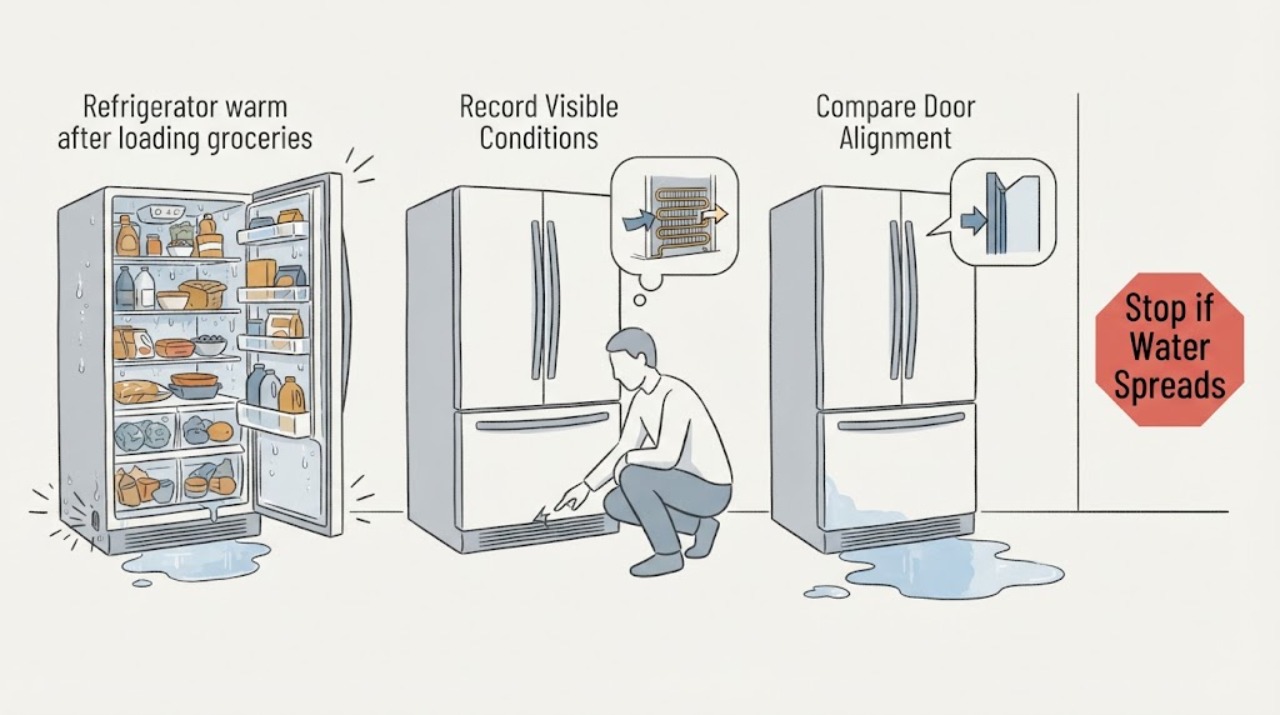
If an LG LFX31925ST refrigerator and freezer become warm just after groceries are loaded, first protect the food and map the water before trying to explain the noise. Move packages away from visible air outlets, check that both doors and drawers close fully, and measure the compartments with an appliance thermometer; a refrigerator should be at or below 40°F and a freezer at or below 0°F. Keep water away from outlets and wiring, and isolate the refrigerator's water supply from a dry, safe location if water is actively flowing. LG notes that a heavily loaded cabinet or frequent door opening can change airflow and produce operating sounds, while ordinary humming, cracking, or refrigerant-flow sounds can be normal; an irregular or continuous sound together with persistent warm temperatures or an active leak needs qualified service rather than a compressor diagnosis.
Work through in order
Diagnostic checks
Use only checks that match the exact appliance or system and its official guide.
-
Check 1
Protect the food and record temperatures without relying on smell or appearance. Put an appliance thermometer in each compartment if available, note the reading and time, and keep the doors closed except for the brief check. FDA's safety targets are 40°F or below for the refrigerator and 0°F or below for the freezer.
Expected result: The refrigerator is above 40°F, the freezer is above 0°F, readings are unknown, or food has already been warm for an uncertain period.
Next step: Move or discard food according to the measured temperature and known time, keep the doors closed, and do not use the refrigerator for perishables until safe temperatures are restored. Record the readings for service.
Stop if: If food safety is uncertain, do not taste questionable food to test it. If water is near electrical parts, stop touching the appliance and isolate power only from a dry, safe location.
Why this matters
Why: A warm reading is a food-safety decision before it is a parts diagnosis. FDA says a refrigerator should be kept at 40°F or below, and perishable food held above 40°F for 4 hours or more should be discarded; odor and appearance cannot reliably establish safety.
-
Check 2
With the refrigerator stationary and the area dry enough for a safe visual check, look at the first wet location: inside under a drawer or shelf, on a door or gasket, behind or beneath the cabinet, or on a nearby sink, hose, or drain. Blot the area and note whether water returns while the refrigerator is idle or only after dispensing, ice use, or loading food.
Expected result: Water returns continuously, starts at a visible supply connection or filter area, appears only after a dispenser/ice event, follows a spill or warm food, or is present at nearby plumbing while the refrigerator's interior is dry.
Next step: For active or recurring water, close the refrigerator water shutoff from a dry accessible position and keep the appliance off; arrange appliance or plumbing service according to the confirmed source. Do not probe a hidden drain or remove a cover.
Stop if: Stop immediately if water reaches an outlet, cord, wiring, or an inaccessible electrical area, or if the source cannot be controlled safely.
Why this matters
Why: Location and timing distinguish an active pressurized leak from condensation, a spill, an event-related dispenser/ice path, or water that traveled from elsewhere. LG specifically notes that open containers, warm food, and incomplete door closure can create interior moisture, and that a floor puddle may come from nearby plumbing rather than the refrigerator.
-
Check 3
After recording the first wet spot, check only accessible loading and sealing points. Move packages, bags, trays, and containers away from visible cold-air outlets; make sure no item holds either door or drawer open; inspect the gasket for a visible gap, tear, dirt, or poor contact; and seal spilled liquids. Do not force the doors or adjust hinges.
Expected result: A grocery package blocks an outlet or door, a door is not fully closed, the gasket has a gap or damage, warm food caused condensation, or the cabinet is clear and seals normally.
Next step: Correct only the accessible obstruction or dirty gasket, close both doors fully, and record whether the leak and temperatures change. If a gasket is torn, a door will not seal, or the compartments stay warm, stop owner testing and request model-specific service.
Stop if: Do not remove interior panels, chip frost, use heat on a drain, or move a heavy refrigerator alone to reach hidden parts.
Why this matters
Why: A newly packed cabinet can restrict circulation, and a blocked or poorly sealed door can let cold air escape and create condensation. If the load and seals are normal, they do not explain persistent warming and the cooling, leak, and sound paths remain unresolved.
-
Check 4
From a safe distance with doors closed, characterize the sound by timing and location rather than touching a fan or running the refrigerator with a panel removed. Note whether it is a brief crack or snap, a hum or rumble during cooling, a gulping sound, a rattling that changes with cabinet contact, or an irregular/continuous scraping or knocking sound. Record whether it began at the same time as the warm temperatures or water.
Expected result: The sound is brief cracking, humming, rumbling, or refrigerant-flow noise and settles; it changes after loading or defrost; it is a repeatable rattle; or it is continuous/irregular and the compartments remain warm.
Next step: If the sound is ordinary and temperatures recover after the load/seal correction, monitor with the doors closed. If it is continuous or irregular, or cooling does not recover, keep the refrigerator off when safe and provide the model, sound timing, temperatures, and leak location to qualified service; do not label the compressor as failed from sound alone.
Stop if: Stop immediately for scraping with burning odor, smoke, arcing, a hot cord, uncontrolled cooling/heating behavior, or water near electrics. Do not touch the fan, compressor, tubing, or wiring.
Why this matters
Why: LG describes thermal expansion, compressor/fan operation, and refrigerant circulation as possible normal sounds, with heavier loading or temperature recovery able to make sounds more noticeable. LG also directs service for irregular or continuous sounds and for a rattle that cannot be resolved by an accessible external check.
-
Check 5
After correcting only a clear loading or door-seal issue and controlling any leak, take one follow-up temperature reading after the refrigerator has had time to operate normally, and compare it with the original reading. Keep a simple timeline: when groceries were loaded, when warming was noticed, when water appeared, the sound pattern, door openings, and both compartment temperatures.
Expected result: Temperatures trend back toward the safe targets and the sound settles with no recurring water, or temperatures stay high, water returns, or the unusual sound continues.
Next step: Use the exact LG support route for LFX31925ST.ASTCNA0 and provide the timeline, thermometer readings, first wet spot, visible seal/load findings, and sound description. Keep perishables elsewhere until safe temperatures are verified.
Stop if: Do not repeatedly power-cycle, force a defrost, enter a service mode, add refrigerant, or replace a compressor, fan, valve, or control based only on this symptom sequence.
Why this matters
Why: Improvement after restoring airflow and closure supports a load/airflow event but does not prove every cooling or water component is healthy. A persistent combination of warm compartments, recurring water, and abnormal sound is an unresolved multi-system symptom requiring service rather than repeated restarts.
Use your observations
Decision map
Find the observation that best matches what you see, then follow the next safe action.
-
PATH 01Next step
What you see
Both compartments became warm immediately after a large grocery load, the visible air outlets or a door were obstructed, and no active water source is found.
Do this next
Rearrange packages away from outlets, restore full door and gasket contact, keep doors closed, and recheck temperatures. Escalate if temperatures do not recover or water/sound symptoms persist.
Why this path and its safety boundary
Why it matters: A loading/airflow or incomplete-closure event is more plausible than a proven compressor failure; LG notes that heavy loading and door conditions can change temperature and operating sounds.
-
PATH 02Next step
What you see
Water grows while the refrigerator is idle, returns at a visible water connection or filter area, or reaches the floor with a wet line; the leak does not depend on dispensing.
Do this next
Close the accessible refrigerator water shutoff from a dry safe position, keep the appliance off, and arrange qualified appliance repair; use plumbing service if the wet source is a nearby sink, hose, or drain.
Why this path and its safety boundary
Why it matters: A continuous water-system or hidden internal leak is more likely than a food spill or door condensation, and continued pressure can increase damage. The location still does not identify a replacement component.
-
PATH 03Next step
What you see
Water appears only after a spill, warm food, humid use, or a door that was held open, while the filter, visible supply path, and nearby plumbing stay dry.
Do this next
Seal containers, cool food before loading, clean and dry the gasket and accessible interior, and monitor one cycle. If water returns or heavy frost accompanies it, stop and request service rather than probing or heating a drain.
Why this path and its safety boundary
Why it matters: Condensation or spilled water is more consistent with the evidence than a pressurized refrigerator leak, but recurring water beneath a drawer or with frost remains an internal-path service issue.
-
PATH 04Next step
What you see
The sound is brief cracking, normal cooling hum/rumble, or refrigerant-flow noise, and it settles as temperatures return toward safe targets with no recurring leak.
Do this next
Continue only with safe loading and door practices, keep a temperature record, and request service if the sound becomes irregular/continuous or cooling fails to recover.
Why this path and its safety boundary
Why it matters: LG documents these sound types as possible normal operating or temperature-recovery sounds; the observation does not justify a compressor diagnosis.
-
PATH 05Next step
What you see
The compartments remain warm, water recurs, or the sound is continuous/irregular after the accessible loading and seal checks, especially with food above safe temperatures.
Do this next
Keep the refrigerator off when safe, isolate water for an active leak, move/discard food according to measured temperature and time, and contact qualified LG appliance service with the exact model and timeline.
Why this path and its safety boundary
Why it matters: The combined symptom pattern is no longer explained by a simple loading event. LG's guidance supports a service boundary for persistent abnormal noise, while the food and leak risks make repeated testing unsafe; the compressor or another part cannot be identified from symptoms alone.
Helpful context
Understand the symptom
The timing matters: filling the cabinet can block cold-air outlets or leave a package holding a door slightly open, but it does not by itself prove that the cooling system or compressor failed. At the same time, a water puddle may be a spill or condensation, a refrigerator water path, or nearby plumbing. Treat the warm compartments, water, and sound as separate observations until their timing and locations line up.
Before inspecting anything, move perishable food to a known-safe cold location if possible. Do not touch a wet outlet, cord, or electrical area. If water is actively accumulating, isolate the refrigerator water supply only from a dry, accessible shutoff; if the area is unsafe, leave the appliance off and arrange qualified help. Do not pull the refrigerator out alone or remove rear or interior panels.
When checks do not resolve it
Need a professional?
Arrange qualified LG appliance service when either compartment cannot return to safe temperature, water is active or recurring, the source is behind a panel or at an inaccessible connection, a door or gasket will not seal, frost and interior water recur, or the sound is irregular or continuous. Stop immediately for water near outlets or wiring, smoke, arcing, burning odor, a hot or damaged cord, uncontrolled operation, or a growing leak; isolate power or water only from a dry safe location. Do not pull out a heavy refrigerator alone, remove panels, touch fans or the compressor, enter service mode, add refrigerant, or choose a compressor, fan, valve, or control part from the symptom sequence.
Common questions
FAQ
Can filling my LG refrigerator with groceries make both sections warm?
It can temporarily restrict cold-air circulation or prevent a door from sealing, especially when packages cover outlets or bins. Rearrange the load, restore full closure, and verify with thermometers; persistent warm readings should not be blamed on loading alone.
Does a strange noise prove the LG compressor is bad?
No. LG describes brief cracking, cooling hums, rumbles, and refrigerant-flow sounds as possible operating sounds. A continuous or irregular sound combined with poor cooling needs service, but the sound alone does not identify the compressor or another part.
What should I do if the refrigerator is leaking while it is warm?
Protect the food, keep water away from electrical areas, record the first wet location, and close the refrigerator water shutoff from a dry safe position if an active water-system leak is present. Keep the appliance off and arrange qualified service for recurring, inaccessible, or uncontrolled water.
Read the exact guide
Official sources
- [LG refrigerator - noise] A strange sound is heardLG USA · Opened LG refrigerator noise guide; applies to sound patterns and loading/temperature context, while exact sound behavior can vary by model.
- [LG Refrigerator] Troubleshooting Water LeaksLG USA · Opened LG leak guide; used for interior condensation/spill and nearby-plumbing distinctions. It does not identify an internal component for this exact multi-symptom case.
- [LG refrigerator - noise] A noise is heard during operation.LG USA · Opened LG operating-noise guide; used to distinguish normal fan/compressor or post-defrost sounds from irregular/continuous sounds requiring service.
- Food and Water Safety During Power Outages and FloodsU.S. Food and Drug Administration · Opened FDA food-safety guidance; used for refrigerator/freezer temperature targets and time-based discard decisions when cooling is impaired.
- LFX31925ST.ASTCNA0: Support, Manuals, Warranty & MoreLG USA · Opened exact LG product support page; used for model identity and the model-specific manual/service route, not as proof of a particular failed component.
Community feedback
Share a repair observation
Share a plain-text repair observation. Accepted observations are published automatically; this page may take a moment to update.