
On this page
Start here
Quick answer
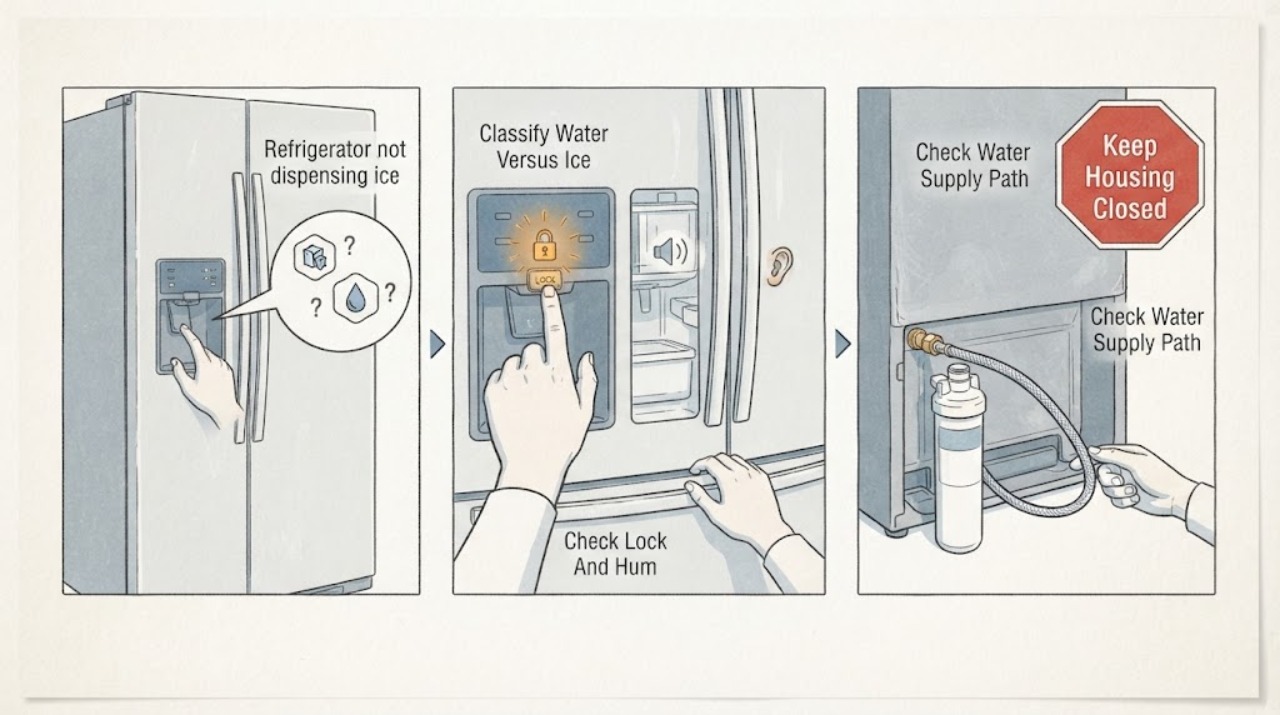
Start by identifying whether water, ice or both fail, then check the LG refrigerator's Control Lock, household water valve, external water line and ice-bin condition. LG says a locked panel, closed valve, kinked hose, clogged filter, frozen tank/line or clumped ice can stop dispensing, while the exact controls and built-in tank arrangement vary by model. If the dispenser hums, use the water-supply or ice-bin branch; if it is silent, check the door switches and model documentation. Stop for a leaking hose or connection, close the water valve, and request service if the external checks do not restore dispensing. Do not remove door panels, probe a live dispenser circuit or force a frozen line.
Work through in order
Diagnostic checks
Use only checks that match the exact appliance or system and its official guide.
-
Check 1
With a cup in place, select Water and then an ice option separately. Record whether water dispenses, ice dispenses, both fail, or one function is weak. Note whether the display shows a lock icon or an error code.
Expected result: Only water fails, only ice fails, both fail, or the panel is locked/displays a code.
Next step: Unlock the panel only with the exact model's documented control, then follow the matching water, ice or service branch. Do not substitute another LG model's button sequence.
Why this matters
Why: A shared lock or supply condition can affect both functions, while a single-function failure narrows the check to that water path or ice path. LG directs error-code cases to its model-specific error-code support.
-
Check 2
If no error code is shown, confirm whether Control Lock is active and, with the correct function selected, listen briefly for a dispenser hum while pressing the lever normally. Do not hold the lever against a stuck or damaged mechanism.
Expected result: The padlock is lit, the unit hums for water or ice, or the unit is silent.
Next step: Unlock using the model's documented control. For a hum, continue with the relevant supply or ice-bin check. For silence, check only the external door-switch indication and then arrange service if it does not resolve.
Why this matters
Why: LG says an engaged Control Lock prevents dispensing. A water hum points toward the supply valve/line; an ice hum calls for checking ice in the bin and clumping. If there is no hum, LG directs attention to door switches and their sensing of a closed door.
-
Check 3
For a plumbed refrigerator with no or weak water, verify that the household valve feeding the refrigerator is open and that the accessible water hose is not kinked, pinched or compressed. If the model has a filter indicator or the filter is past its recommended interval, use the exact model filter instructions.
Expected result: The valve is closed, the hose is bent, the filter is overdue/blocked, or the external water path appears clear.
Next step: Open the valve or straighten the accessible hose by hand. Replace the filter only with a model-compatible filter per LG's instructions. If water is leaking at a connection, close the valve and stop; if flow remains absent, request service.
Why this matters
Why: LG identifies a closed valve, kinked hose and clogged filter as causes of low or absent water flow. A clear external path does not prove a valve, tank or internal line is good.
-
Check 4
For an ice-only failure, verify from the model controls that the ice maker is on and the panel is unlocked. Inspect the ice bin without forcing it; if cubes are visibly clumped, remove the bin according to the manual and gently separate or discard the clump. For a newly installed unit, compare the elapsed time with the model's instructions.
Expected result: The ice maker is off/locked, the bin contains clumped ice, the unit is newly installed, or the bin and settings appear normal.
Next step: Use the exact model's ice-maker control and bin-care instructions. If the bin and settings are normal but ice still will not dispense, stop at external checks and request LG service.
Why this matters
Why: LG says an off ice maker, locked controls, clumped ice or the normal initial production period can prevent ice dispensing. These observations do not diagnose the ice motor or valve.
-
Check 5
If the water path appears supplied but water remains unavailable, check whether the refrigerator temperature is set unusually low and whether food blocks the model's temperature sensor. If the model has a built-in tank, verify it is filled and seated. If the dispenser is silent, confirm that the interior lights respond normally when each door is opened and closed; do not remove hinge covers.
Expected result: The tank/line may be frozen, the tank is empty or misseated, food blocks the sensor, or the lights/door sensing do not respond normally.
Next step: Adjust temperature only as the model manual permits and allow the appliance to stabilize; fill and seat a documented built-in tank. If door sensing or dispensing remains abnormal, request service rather than opening the door wiring.
Why this matters
Why: LG says a low temperature can freeze a tank, filter or water line, while a missing door-switch signal can prevent dispensing. Sensor and tank arrangements vary by model.
Use your observations
Decision map
Find the observation that best matches what you see, then follow the next safe action.
-
PATH 01Next step
What you see
Neither water nor ice dispenses and the control panel is locked or the household water supply is closed.
Do this next
Unlock using the exact model's control and verify the water valve and accessible hose. If a connection leaks, close the valve and stop; otherwise continue only with the model-specific external checks.
Why this path and its safety boundary
Why it matters: A control-lock or shared supply condition is more consistent with both functions failing than an ice-bin-only problem.
-
PATH 02Next step
What you see
Ice dispenses but water does not, and the panel is unlocked.
Do this next
Check the valve, hose, filter indicator and model-specific tank/temperature conditions. Close the valve for any leak and request service if water remains unavailable.
Why this path and its safety boundary
Why it matters: The water supply valve, kinked hose, filter, frozen tank/line or model-specific water-tank setup becomes more relevant than the ice bin.
-
PATH 03Next step
What you see
Water dispenses but ice does not, and the ice maker is off, the panel is locked, the bin is clumped or the unit is newly installed.
Do this next
Unlock and turn on the ice maker according to the model manual, separate/discard clumped ice safely, and allow the documented initial production time. Request service if the bin and settings are normal but dispensing still fails.
Why this path and its safety boundary
Why it matters: LG documents these as user-checkable ice-production or dispensing conditions; they do not confirm a failed ice motor or valve.
-
PATH 04Next step
What you see
The dispenser makes no hum when the panel is unlocked and the selected function is pressed, or the interior-light/door-sensor behavior is abnormal.
Do this next
Perform only the external door-sensor observation described in the model guidance. If the lights/sensors or dispenser remain abnormal, arrange LG service.
Why this path and its safety boundary
Why it matters: LG says the dispenser will not operate if it thinks a door is open and directs users to check door switches; this is not a reason to open hinge wiring at home.
-
PATH 05Next step
What you see
Water leaks from the supply hose/connection, or ice and water remain unavailable after the documented external checks.
Do this next
Close the water valve immediately for a leak, keep the refrigerator out of service as needed, and request qualified LG service. Do not remove panels, probe live circuits or force frozen components.
Why this path and its safety boundary
Why it matters: LG treats a water leak as an electrical/property hazard and directs persistent dispenser problems to repair support.
Helpful context
Understand the symptom
Separate water failure from ice failure first
Select water and ice separately and record which functions fail. LG's dispenser guide uses the presence or absence of a humming sound to separate supply/ice-bin checks from door-switch or connection checks. Do not assume that a water problem proves the ice maker or dispenser motor is defective; a shared valve, filter or control-lock condition can affect both.
Use model-specific controls and water configuration
LG says the lock-button location and temperature-sensor location vary by model, and only some refrigerators have a built-in water tank. Verify the model before using a button sequence, filter bypass or tank instruction. For a plumbed refrigerator, inspect the household valve and supply hose; for a non-plumbed model, verify that the tank is filled with the liquid specified by the model guidance.
Stop at leaks or persistent failure
A leaking water connection is not a normal dispenser symptom. LG says to close the water supply valve immediately because an unattended leak can cause electric shock or property damage. If the hose, valve, filter, tank, ice bin, lock and door-sensor checks do not restore dispensing, use LG support/service rather than removing panels or testing internal parts.
When checks do not resolve it
Need a professional?
Have this ready
- complete LG refrigerator model and region
- whether water, ice or both fail
- whether Control Lock or an error code is displayed
- whether the dispenser hums for water or ice
- water valve, hose, filter and built-in-tank observations
- any leak, door-sensor symptom or visible damage
Common questions
FAQ
Why would an LG refrigerator stop dispensing both ice and water?
Start with Control Lock and the shared water supply. LG also lists a closed valve, kinked hose, clogged filter, frozen tank/line and model-specific tank setup as possible water causes; ice can additionally be off or clumped.
What does a humming dispenser mean?
LG uses the sound as a branch: a water hum leads to checking the home valve and kinked water lines, while an ice hum leads to checking that the bin contains loose ice rather than a clump. It does not prove a motor or valve failure.
Can a clogged filter stop LG refrigerator water dispensing?
Yes. LG says a clogged filter can reduce flow or stop it, and recommends replacement according to the indicator or model's replacement interval. Use only the exact model's filter instructions and compatibility information.
What should I do if water leaks near the refrigerator connection?
Close the water supply valve immediately. LG warns that an unattended leak can cause electric shock or property damage; arrange service rather than continuing dispenser tests.
Read the exact guide
Official sources
- LG Refrigerator - Troubleshooting Water or Ice Continuously DispensingLG USA Support · LG refrigerator dispenser lock, external lever cleaning and service stop guidance
- LG Refrigerator – Water Dispensing SlowlyLG USA Support · LG USA refrigerator water-flow, filter, valve, hose and service guidance
- If Your LG Refrigerator Is Not Dispensing WaterLG USA Support · LG USA refrigerator water-dispenser valve, hose, filter, temperature, tank and leak checks
- LG Refrigerator - Troubleshooting Dispenser IssuesLG USA Support · LG refrigerator dispenser lock, humming, water/ice supply, ice-bin, door-switch and service guidance
- LG Refrigerator Troubleshooting water/ice related issuesLG USA Support · LG refrigerator ice-maker on/off, lock, initial production, water supply and clumped-ice guidance
Community feedback
Share a repair observation
Share a plain-text repair observation. Accepted observations are published automatically; this page may take a moment to update.