
On this page
Start here
Quick answer
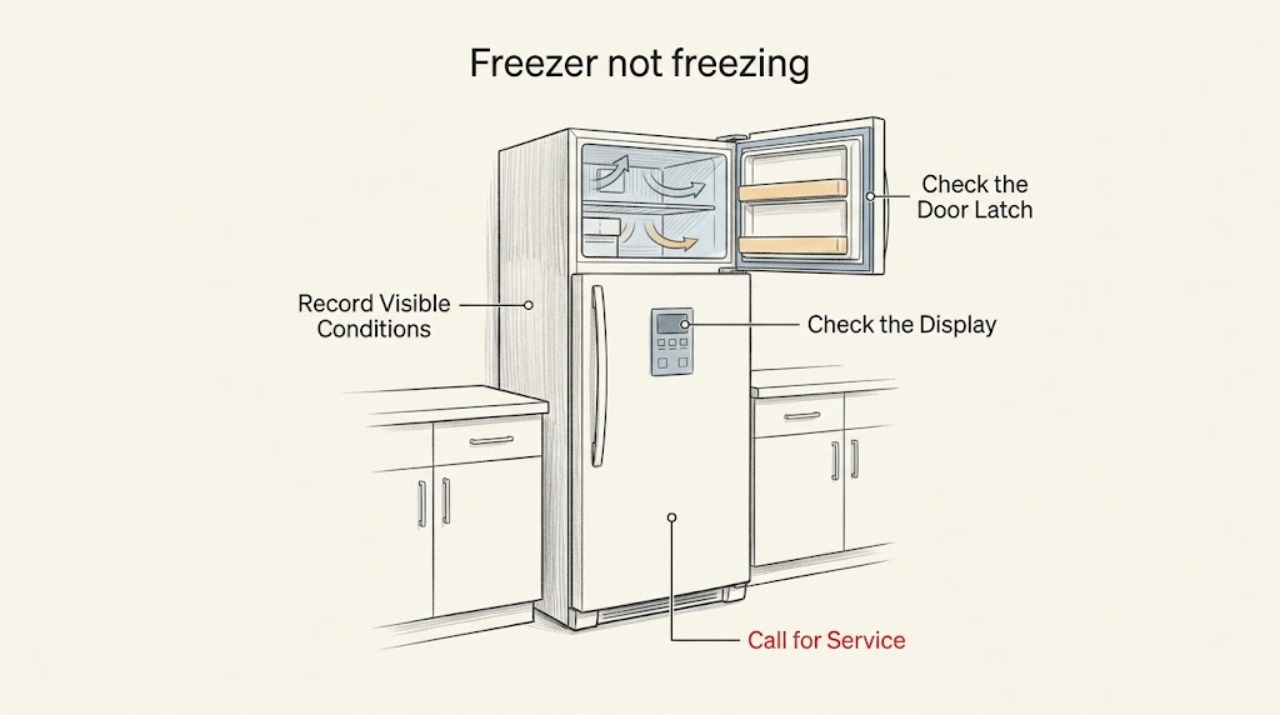
For an LG LSXS26386D freezer that is not freezing, protect thawing food first and verify the freezer temperature with an appliance thermometer rather than judging by touch. LG's guidance says to check the freezer setting, keep food away from the cold-air outlet, close the door completely, allow recovery time after power is restored, and keep the refrigerator in a suitable, ventilated location. FoodSafety.gov lists 0°F (-18°C) or below as the freezer target. If the measured temperature remains above that target, both compartments are warming, or the symptom persists after these outside checks, stop repeated resets and arrange qualified appliance service; do not diagnose a compressor, fan, or sealed-system part from the symptom alone.
Work through in order
Diagnostic checks
Use only checks that match the exact appliance or system and its official guide.
-
Check 1
Keep the freezer door closed as much as practical, move clearly thawing high-risk food to a known-safe freezer or cooler, and place an appliance thermometer between frozen packages. Record the temperature after the compartment has had time to settle rather than relying on how the air feels.
Expected result: The reading is 0°F (-18°C) or below, above 0°F with softening or thawing food, or cannot be measured reliably.
Next step: If the reading is above the target or food is thawing, keep the door closed, protect the food in a known-safe appliance, and continue only the outside checks. Do not taste questionable food or keep reopening the freezer to test it.
Stop if: Stop using the freezer for long-term frozen storage until its temperature is verified at the target or the appliance has been serviced.
Why this matters
Why: A measured result separates a freezer-temperature problem from a misleading touch test. FoodSafety.gov uses 0°F (-18°C) or below as the freezer target; food that is warming needs a food-safety decision before troubleshooting continues.
-
Check 2
Read the freezer setting on the control panel and check whether it was left at the warmest or low setting after a reset, move, or power event. Make only the temperature adjustment allowed by the LSXS26386D user controls, then allow the cabinet to stabilize before judging the change.
Expected result: The control is at a warm/low setting, the setting is appropriate but the thermometer remains high, or the display is blank or behaves abnormally.
Next step: If the setting was warm, leave it at the stable model-approved setting and recheck after the documented recovery period. If the setting is already suitable, the display is abnormal, or the temperature does not recover, stop repeated setting changes and arrange LG or qualified appliance service.
Stop if: Do not enter an unverified service mode, remove controls, or order a sensor, board, compressor, or fan from the temperature symptom alone.
Why this matters
Why: LG's published guidance says a low refrigerator setting can provide insufficient cooling and recommends changing it to medium or high for the applicable control type. A suitable setting with a persistently warm measured freezer, or an abnormal display, is not evidence for a particular part; it points to model-specific service.
-
Check 3
With the appliance operating normally and without removing panels, check the freezer door perimeter and latch, confirm that packages are not caught in the door, and keep food and packaging out of the visible cold-air outlet. Note whether there is a localized frost or ice obstruction, broad frost, or no unusual frost at all.
Expected result: A package holds the door open, the gasket does not close evenly, the outlet is blocked, frost obstructs circulation, or the door and outlet are clear.
Next step: Remove only visible obstructions, close the door fully, and recheck the measured temperature after stabilization. If there is broad or rapidly returning frost, no recovery, water, or a damaged liner, stop trying to clear it with tools and arrange service.
Stop if: Do not scrape ice, use direct high heat, remove an interior or rear panel, or touch refrigerant tubing or wiring.
Why this matters
Why: LG identifies an incompletely closed door, blocked cold-air path, and restricted circulation as conditions that can degrade freezing. A clear door and outlet with a persistently warm thermometer makes a simple loading obstruction less likely but does not identify a fan or sealed-system failure.
-
Check 4
Check the installation environment from outside: note recent power loss or reconnection, direct sun or a nearby heat source, restricted ventilation around the cabinet, and whether the refrigerator side is also warming. Do not pull a built-in or connected appliance out of its installation opening just to inspect hidden parts.
Expected result: The location is unusually hot or poorly ventilated, power was recently restored, only the freezer is warm, both compartments are warm, or the location and power history are normal.
Next step: Correct only an obvious outside condition that can be corrected safely and allow the LG recovery period. If both sections remain above safe temperature, or the location and power are normal but the freezer stays warm, protect food and schedule qualified appliance service.
Stop if: Stop immediately for a hot or damaged cord, burning odor, smoke, liquid near electrics, repeated breaker trips, or exposed wiring; disconnect only from a safe position and obtain qualified electrical or appliance help.
Why this matters
Why: LG says heat sources, poor ventilation, unsuitable ambient temperatures, and the time after power is restored can degrade freezing. If both compartments remain warm in a suitable location, the outside explanations are no longer sufficient; an exact internal cause requires service diagnosis.
Use your observations
Decision map
Find the observation that best matches what you see, then follow the next safe action.
-
PATH 01Next step
What you see
The thermometer is above 0°F (-18°C), food is softening, and the freezer remains warm after the setting, door, outlet, and environment checks.
Do this next
Keep perishable food in a known-safe appliance, keep the LG doors closed, and arrange qualified appliance service with the temperature trend and the checks already completed.
Why this path and its safety boundary
Why it matters: The freezer is not maintaining the food-storage target, and the remaining cause cannot be safely narrowed to a compressor, fan, control, or sealed-system component from these observations.
-
PATH 02Next step
What you see
The freezer recovers after correcting a warm setting, a package blocking the door or cold-air outlet, or a recent power-restoration period, and the measured temperature returns to the target.
Do this next
Keep the stable model-approved setting, preserve door and outlet clearance, and continue monitoring with the appliance thermometer. Arrange service if the temperature rises again without a repeatable outside cause.
Why this path and its safety boundary
Why it matters: The observed change supports an operating, loading, airflow, or recovery-time explanation; it does not prove that any internal part is defective.
-
PATH 03Next step
What you see
Both the refrigerator and freezer are warm in a suitable location, the cold-air path is clear, there is no unusual frost, and a safe reset or cleaning attempt did not restore temperature.
Do this next
Do not keep power-cycling or open the cabinet to hunt for a part. Protect food and have LG or a qualified refrigerator technician evaluate the cooling system using the exact model and serial information.
Why this path and its safety boundary
Why it matters: This pattern is broader than a single blocked shelf or door bin. An exact Reddit report for LSXS26386D described a similar warm-freezer/warm-refrigerator pattern, no frost, little dust, no improvement after a short unplug, and an LG app diagnostic that found nothing; that is a user report, not proof of a component diagnosis.
-
PATH 04Next step
What you see
There is a hot or damaged cord or plug, burning odor, smoke, liquid near electrical parts, repeated breaker operation, exposed wiring, or a damaged liner or refrigerant tube.
Do this next
Stop using the refrigerator, disconnect it only if that can be done without approaching the hazard, keep people away from damaged areas, and contact qualified electrical or appliance service.
Why this path and its safety boundary
Why it matters: An electrical, fire, water, physical, or refrigeration hazard takes priority over temperature troubleshooting.
Helpful context
Understand the symptom
LSXS26386D is an LG side-by-side refrigerator with digital temperature controls, multi-air-flow cooling, and a freezer compartment. Those features identify the product platform, but they do not prove which internal component has failed. Start with the food-temperature and outside-condition checks below; leave sealed-system, electrical, and internal control diagnosis to qualified service.
Do not use a soft package, ice maker result, or a brief blast of cold air as proof that the freezer is safe. Use an appliance thermometer and keep the door closed while you decide what to do. Never taste thawed food to decide whether it is safe.
When checks do not resolve it
Need a professional?
Arrange LG or qualified appliance service when the freezer remains above 0°F (-18°C), food is thawing, both compartments are warm, the display is abnormal, or the temperature does not recover after the outside setting, door, outlet, and environment checks. Stop immediately for a hot or damaged cord or plug, smoke, burning odor, liquid near electrics, repeated breaker trips, exposed wiring, a damaged liner, or an exposed refrigerant tube. Do not remove panels, test live wiring, handle refrigerant, scrape ice with tools, or replace a compressor, fan, sensor, control board, or sealed-system part from this symptom alone.
Common questions
FAQ
Is the LSXS26386D freezer safe if food still feels cold but is not hard-frozen?
Verify it with an appliance thermometer. FoodSafety.gov lists 0°F (-18°C) or below for a freezer; move thawing high-risk food to a known-safe appliance and do not taste food to judge safety. A brief blast of cold air or a cold-feeling package is not a substitute for a temperature reading.
Can a normal LG app or display diagnostic rule out a freezer cooling problem?
No. An exact-model Reddit report describes a warm LSXS26386D, no frost, and an LG app diagnostic that found nothing, followed by the owner moving food elsewhere. That is community experience rather than a diagnosis, but it supports using the measured temperature and symptom trend—not a normal app result alone—to decide whether service is needed.
Read the exact guide
Official sources
- REFRIGERATIONLG Electronics U.S.A., Inc. · The official specification sheet describes the LSXS26386 side-by-side platform, including multi-air flow, digital temperature controls, three freezer shelves, and the LSXS26386D black-stainless model code.
- Cold Food Storage ChartFoodSafety.gov · The official FoodSafety.gov chart states that freezer storage should be 0°F (-18°C) or below and explains that continuously frozen food at that temperature can be kept indefinitely for quality purposes.
- LG side by side freezer not freezingReddit r/Appliances · An exact-model community report for LG LSXS26386D; it is used only as a lived symptom report, not as manufacturer confirmation or a component diagnosis.
- [LG refrigerator freezing] Food in the freezer is not frozen. Food has slightly thawed. The freezer’s function is degraded.LG USA Support · LG's official help page discusses a freezer that is not keeping food frozen, including cold-air outlet clearance, complete door closure, ventilation, ambient temperature, recovery after power is restored, and changing a low setting to medium or high; LG notes the guide is for all models and images may differ.
- LSXS26386D.ASBCNA0LG USA · The page identifies LSXS26386D.ASBCNA0 as a 26 cu. ft. Door-in-Door refrigerator, lists its owner manual and specification documents, and provides the model's warranty and support paths.
Community feedback
Share a repair observation
Share a plain-text repair observation. Accepted observations are published automatically; this page may take a moment to update.