
On this page
Start here
Quick answer
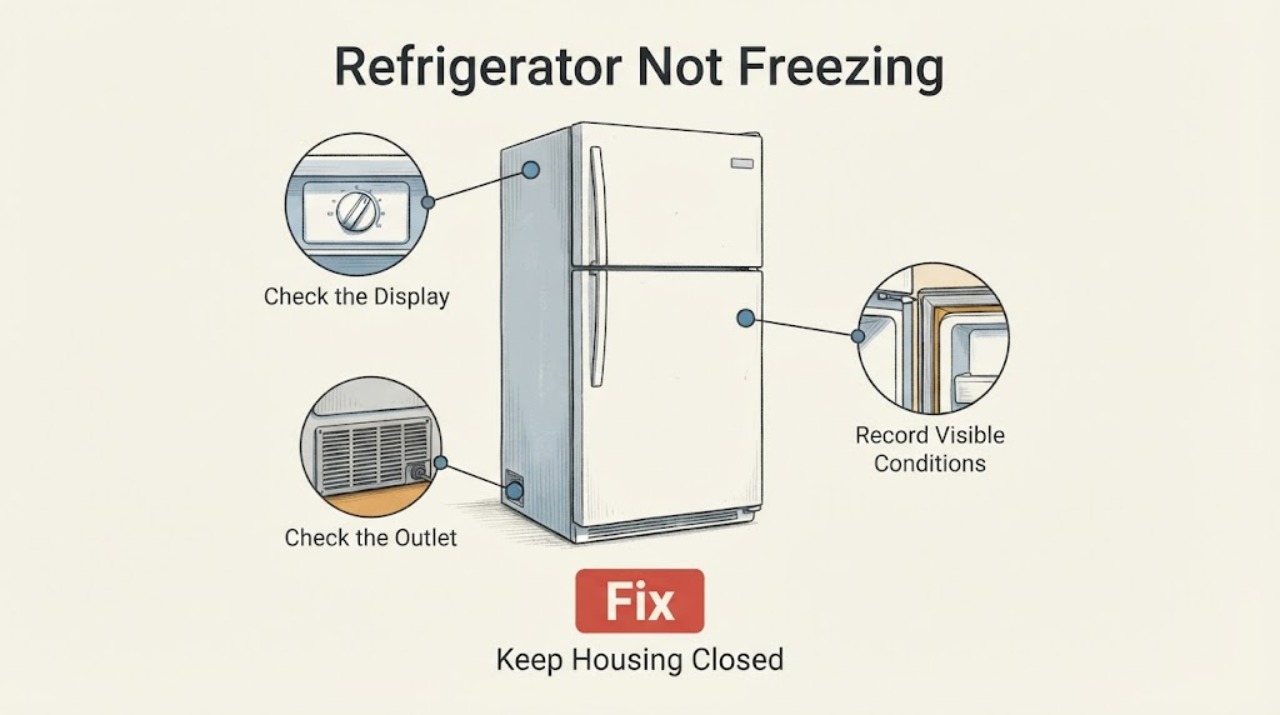
Start by confirming that the freezer compartment is actually warm rather than judging it by ice production alone. Record the model and market, check that the appliance has power, use the exact manual's temperature control, and allow the documented stabilization time after a new installation or a large load of warm food. Then check that doors close against the gasket, no package blocks an air outlet, and the cabinet has the model-required ventilation clearance. Hisense's cooling guidance says to check the thermostat, door seal, warm food and compressor behavior; an opened Hisense manual also lists defrost, blocked airflow, insufficient clearance and frequent door openings as possible temperature causes. If the freezer remains warm after these visible checks, food is thawing, the compressor repeatedly starts and stops, or the cord, outlet or cabinet is damaged, protect the food, stop using the appliance if it is unsafe, and arrange model-specific Hisense or qualified refrigeration service. Do not open the sealed system, test live wiring, or infer a refrigerant, compressor, fan or control-board failure from the symptom alone.
Work through in order
Diagnostic checks
Use only checks that match the exact appliance or system and its official guide.
-
Check 1
Record the complete Hisense model/product ID, market, freezer temperature and food condition before changing settings or ordering anything.
Expected result: The freezer is measured warm, frozen food is soft or thawing, the refrigerator compartment is also warm, or only the ice maker output is reduced.
Next step: Use the exact model manual for the temperature display, modes and stabilization time. If only ice production is affected, keep that separate from a not-freezing diagnosis and follow the model's ice-maker support.
Why this matters
Why: A warm freezer is a broader cooling symptom, while reduced ice output alone does not prove that the freezer is not reaching temperature. Hisense directs owners to the product ID/manual path because controls and supported checks are model-specific.
-
Check 2
Check power and the visible operating state without opening the cabinet: confirm the interior light or display works, the plug and outlet are secure and dry, and no breaker or fuse has interrupted power.
Expected result: The appliance has no light/display, the outlet or breaker is abnormal, or the refrigerator powers normally and the compressor/fan can be heard.
Next step: If the plug, outlet, cord or cabinet is wet or damaged, stop and obtain qualified electrical help. If power is normal, continue with the temperature, door and airflow checks; do not perform live electrical measurements.
Why this matters
Why: No power can explain a warm freezer; normal power does not prove that the sealed cooling system is healthy. Hisense's support and manual separate power faults from compressor, fan, defrost and airflow conditions.
-
Check 3
Verify the freezer setting and recent operating history: check the exact control panel for a warmer setting, standby/vacation mode or a documented defrost interval, and note whether the unit was recently installed, unplugged or loaded with warm food.
Expected result: The setting is warmer than intended, the appliance is in a documented defrost or startup period, or the freezer remains warm after the model's stated recovery period.
Next step: Correct only the setting or mode identified by the exact manual, keep the doors closed and allow the documented recovery time. If it remains warm, protect the food and arrange service rather than repeatedly cycling the controls.
Why this matters
Why: Hisense support says to adjust the thermostat, and the opened manual lists defrost, recent startup, warm food and frequent door opening as conditions that can temporarily change cooling behavior. Persistent warmth after the applicable period is a service symptom, not proof of a particular part failure.
-
Check 4
Inspect the closed-door seal and accessible airflow path: remove only loose packages preventing closure, look for a visible gasket gap, keep food away from freezer air outlets, and check the cabinet's accessible clearance against the exact installation instructions.
Expected result: A door does not close or seal continuously, food blocks an outlet, frost blocks an outlet, or the cabinet is installed too close to a wall or heat source.
Next step: Restore only the documented external clearance and remove loose obstructions. If the gasket is damaged, frost returns, or the appliance needs panel removal or a forced defrost, stop and use the exact manual or qualified service; do not scrape, heat or dismantle the cooling system.
Why this matters
Why: Warm-air leakage and blocked circulation can keep a freezer from reaching temperature. The observation does not distinguish a fan, defrost, sensor, compressor or refrigerant fault.
-
Check 5
Listen once during normal operation and record the pattern without repeatedly restarting the refrigerator: note steady compressor/fan operation, no sound, or continuous clicking and starting/stopping.
Expected result: The freezer remains warm while the compressor appears to run continuously, the motor is silent, or it repeatedly clicks and restarts.
Next step: Keep the doors closed and protect food. If the pattern is repeated clicking, there is an abnormal smell/noise, or cooling does not recover after the visible checks, stop using the appliance when safe and arrange model-specific service.
Why this matters
Why: Hisense identifies compressor and fan sounds as normal possibilities and separately tells owners to listen for a compressor that starts and stops continuously. These patterns help a technician but do not diagnose a compressor, relay, fan, control or sealed-system part.
Use your observations
Decision map
Find the observation that best matches what you see, then follow the next safe action.
-
PATH 01Next step
What you see
The light/display is off, the outlet or breaker is abnormal, or the cord/plug is wet or damaged.
Do this next
Do not touch a wet plug or perform live testing. Isolate power only when safe and use qualified electrical or appliance service.
Why this path and its safety boundary
Why it matters: The refrigerator may not be receiving safe power; this is not a refrigeration-part diagnosis.
-
PATH 02Next step
What you see
The appliance was recently installed, defrosting, loaded with warm food, left open, or set warmer than intended, and the model's recovery period has not elapsed.
Do this next
Use only the exact manual's control and waiting guidance, keep the doors closed and protect perishable food. If the freezer remains warm afterward, escalate to model-specific service.
Why this path and its safety boundary
Why it matters: The opened Hisense support and manual describe these as conditions that can temporarily reduce or interrupt cooling.
-
PATH 03Next step
What you see
The door has a visible gap, food or frost blocks an air outlet, or the cabinet lacks the exact manual's accessible ventilation clearance.
Do this next
Remove only loose external obstructions and restore documented clearance. If the gasket or frost problem persists, use the model manual or qualified service rather than removing panels or forcing a defrost.
Why this path and its safety boundary
Why it matters: Air leakage or restricted circulation can explain a warm freezer, but it does not identify which internal component, if any, has failed.
-
PATH 04Next step
What you see
The freezer remains warm after the model-matched external checks, frozen food is thawing, or the compressor repeatedly clicks/starts and stops.
Do this next
Protect food, stop repeated tests, and arrange Hisense or qualified refrigeration service. Do not open the sealed system, damage refrigerant tubing, test live wiring, or replace a compressor, fan, sensor or control board based on the symptom alone.
Why this path and its safety boundary
Why it matters: The symptom is outside the supported visible-check result, and the opened Hisense material does not identify a safe user repair or a universal failed part.
Helpful context
Understand the symptom
Confirm that the freezer is warm, not merely that an ice maker is slow
Record the freezer temperature with a suitable thermometer if available, the condition of frozen food, and whether the refrigerator compartment is also warm. Ice production can have its own water, ice-maker or cycle conditions, while a warm freezer points to a broader cooling symptom. Photograph the rating label before using a manual: Hisense's official cooling support says the product ID is used to find the applicable manual and identifies the serial label inside the refrigerator or on the back.
Use the exact controls and give the appliance time to respond
Check the freezer and refrigerator temperature settings, including any vacation, quick-freeze or standby mode shown on the actual control panel. Hisense's general cooling support directs owners to adjust the thermostat and listen for compressor behavior. A model-specific Hisense manual should control the waiting period after a new installation, defrost cycle or large amount of warm food; do not transfer a button sequence or temperature value from another model.
Keep the cold-air path and door seal clear
With the appliance operating normally and without removing panels, check that packages are not pressed against the freezer air outlet, the doors close fully, and the gasket makes continuous contact. Check only the accessible space around the cabinet against the exact installation manual. The opened Hisense manual lists blocked air outlets, an obstructed door, insufficient side/back/top clearance and a freezer door left open as separate causes of a warm compartment.
When checks do not resolve it
Need a professional?
Arrange Hisense or qualified refrigeration service when the freezer remains warm after the exact model's temperature, door, airflow and clearance checks, or when the compressor repeatedly clicks and restarts., Stop using the appliance and obtain qualified help for a damaged cord or plug, water near electrical parts, smoke, burning odor, refrigerant-circuit damage or an abnormal overheating condition., Do not open panels, test live wiring, pierce tubing, add refrigerant, use a heat source to defrost, or select a replacement part without the exact model and qualified diagnosis.
Have this ready
- complete Hisense model/product ID and serial information
- country or market and refrigerator/freezer configuration
- measured freezer and refrigerator temperatures and food condition
- temperature setting, recent installation or defrost history and door/airflow observations
- whether the compressor/fan is silent, steady, or repeatedly clicking
Common questions
FAQ
Why is my Hisense freezer not freezing even though the light is on?
A working light confirms some power but does not establish normal cooling. Record the freezer temperature, verify the model-specific setting, check the door seal, air outlets and accessible ventilation, and listen for the compressor pattern. Persistent warmth after those checks needs model-specific service rather than a guessed compressor or refrigerant diagnosis.
Can a Hisense refrigerator be warm during defrost or after startup?
Yes, Hisense documentation for refrigerator families describes defrost and recent startup as conditions that can temporarily affect cooling. Use the exact model manual for the recovery period, keep the doors closed and protect food. If the freezer remains warm afterward, arrange service.
Should I add refrigerant or replace the compressor when a Hisense freezer is not freezing?
No. The symptom alone does not identify a refrigerant leak, compressor, fan or control failure. Hisense warns against damaging the refrigerant circuit and directs qualified or authorized personnel to perform electrical and sealed-system work. Provide the exact model and measured temperatures to service.
Read the exact guide
Official sources
- USER’S OPERATION MANUALHisense · Opened the Hisense-hosted manual and verified the HRFD635SW model on its cover. It is used for documented manufacturer safety and troubleshooting patterns, not as proof that the task refrigerator has this model's controls, dimensions or exact recovery time.
- Support CoolingHisense UK · Opened official Hisense UK cooling support. It provides general external cooling checks and explicitly routes owners to the product ID/manual path; regional and model-specific controls remain unresolved for the task appliance.
Community feedback
Share a repair observation
Share a plain-text repair observation. Accepted observations are published automatically; this page may take a moment to update.