
On this page
Start here
Quick answer
This page is for food freezing in the fresh-food refrigerator compartment, not ordinary freezer operation or freezer frost. Hisense's opened HQD20 manual gives two direct checks for this symptom: move food away from the refrigerator air vent and adjust the temperature control to a less-cold setting. Start there, then check that containers or shelves are not blocking airflow, the door closes fully, and the refrigerator is not in a special cooling mode. Hisense product lines use different controls and layouts, so do not copy a button sequence or temperature value from another model. After a setting change, allow the exact manual's stabilization period before judging the result. If food still freezes with correct placement and settings, or if temperatures swing widely, the door will not seal, heavy frost returns, water leaks, the fan or compressor behaves abnormally, or an electrical odor appears, protect the food and arrange qualified service. Do not remove panels, bypass a sensor, or test live wiring.
Before you begin
Safety first
- The owner may identify the model and symptom location, move food away from visible vents, correct accessible loading and closure obstructions, clean and dry the gasket, check documented controls and modes, and perform only a model-approved thaw with power disconnected. Qualified personnel must handle panels, sensors, dampers, fans, defrost parts, controls, wiring, compressors, refrigerant, and live diagnosis.
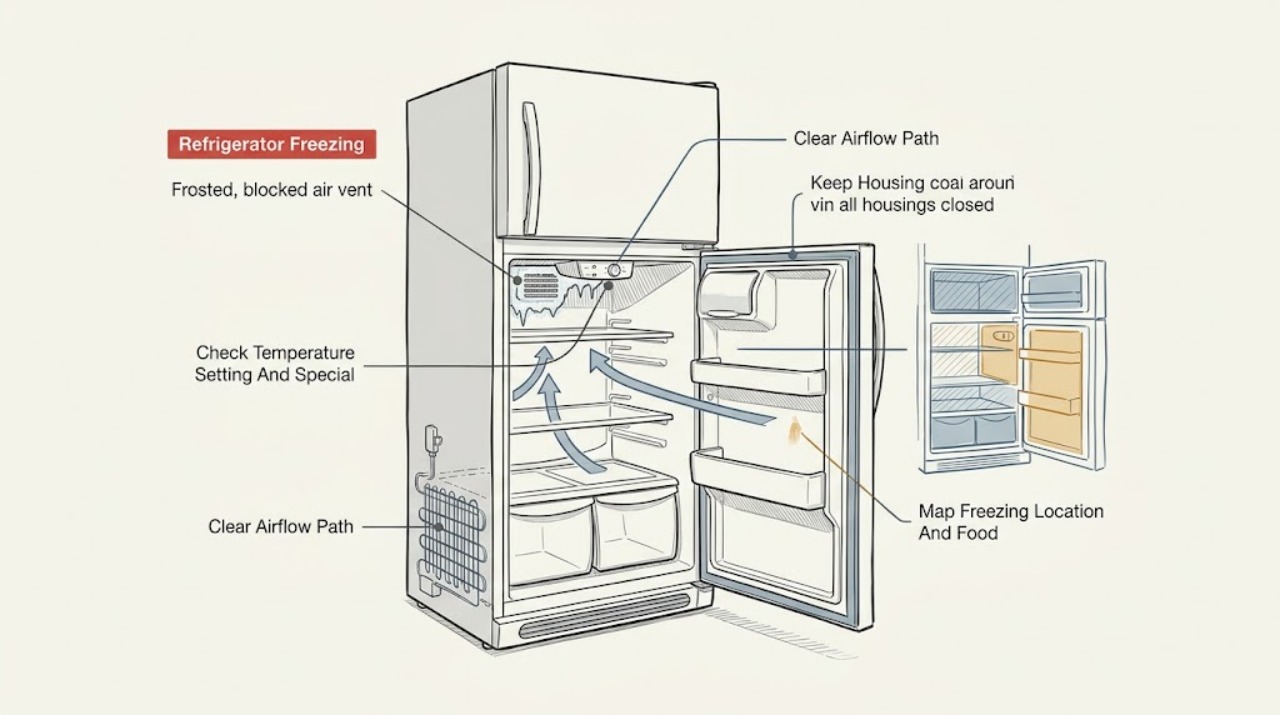
Work through in order
Diagnostic checks
Use only checks that match the exact appliance or system and its official guide.
-
Check 1
Record the model and serial information and map which fresh-food items are freezing: only packages touching the rear or top outlet, one shelf or drawer, the door bins, or the whole refrigerator compartment. Note whether the freezer remains normal and whether a recent power interruption, warm load, or control change preceded the symptom.
Expected result: Only food near an outlet is frozen; one zone is affected; the entire fresh-food compartment is too cold; or the freezer and refrigerator are both abnormal.
Next step: Continue with the vent and setting checks for fresh-food-only freezing. Use the exact model manual and service branch if the pattern is whole-compartment, rapidly changing, or accompanied by warming elsewhere.
Stop if: Stop for smoke, sparks, burning odor, water near electrical parts, a hot cord or outlet, or food that cannot be kept at a safe temperature.
Why this matters
Why: A localized pattern makes vent placement or a local airflow stream more likely. Whole-compartment freezing makes the temperature setting, special mode, sensor, or cooling control more likely; abnormalities in both compartments require a broader model-specific diagnosis.
-
Check 2
Move food, containers, and shelves only as the exact manual permits. Keep packages away from the rear wall, top outlet, and visible air returns; do not overpack the compartment or cover a vent with a container. Check whether the freezing stops in that location after the compartment has had time to stabilize.
Expected result: Frozen food was directly beside or in front of a vent; the outlet or return path was blocked; the compartment was overpacked; or the airflow path was already clear.
Next step: Keep the documented spacing and monitor the same shelf. If an outlet is hidden behind ice or a duct cannot be cleared without removing a panel, stop and use the model-specific service branch.
Stop if: Do not pry ice from a vent, remove an air duct, reach behind a fan cover, or use a sharp object inside the compartment.
Why this matters
Why: Hisense directly links fresh-food freezing to food too close to the air vent. A local improvement after repositioning supports an airflow-placement cause; a clear path with whole-compartment freezing points toward controls or sensing.
-
Check 3
Check the temperature display or dial and look for a special rapid-cooling mode, vacation setting, or other model-specific indicator. Adjust to the next less-cold setting only as the exact Hisense manual directs; do not change several settings at once. Record the before and after setting and the time of the change.
Expected result: The control is at its coldest position; a Super Cool or similar rapid-cooling mode is active; the setting appears ordinary but the compartment is still freezing; or the panel does not match the manual.
Next step: Cancel or adjust only the documented mode and allow the model's stated stabilization period. The HQD20 manual uses 24 hours for a temperature adjustment, but do not apply that exact period to another model without its manual.
Stop if: Do not open the control panel, bypass a temperature sensor, or repeatedly change settings before the stabilization period has elapsed.
Why this matters
Why: A cold setting or active rapid-cooling mode can explain a whole-compartment freeze, while an ordinary setting with the same symptom makes a control, sensor, airflow, or cooling fault more likely. A panel mismatch means the model procedure is not established.
-
Check 4
Inspect the closed-door perimeter and gasket without removing it. Move any shelf, drawer, or package that prevents closure; wipe visible dirt from the gasket with a mild method approved by the manual and dry it. Note whether warm humid air, uncovered liquids, frequent opening, or a cold garage location is contributing to temperature swings.
Expected result: A door or drawer is not closing fully; the gasket has a gap, dirt, fold, or damage; moisture or frost is present near the seal; or closure and gasket contact are uniform.
Next step: Correct only an accessible obstruction or cleaning issue and monitor the temperature. If the gasket, hinge, liner, or door alignment needs adjustment or replacement, arrange model-specific service.
Stop if: Do not heat, glue, stretch, or remove the gasket; stop if the door, liner, hinge, cord, or outlet is damaged or wet.
Why this matters
Why: A poor seal usually admits humid air and creates frost or uneven cooling, but an obstructed door can also disturb the intended airflow and temperature pattern. A sound seal makes the gasket a less likely explanation for persistent whole-compartment freezing.
-
Check 5
After placement, setting, mode, and closure checks, observe the refrigerator through the exact manual's stabilization period. Record whether the same foods freeze, whether temperatures swing, whether frost blocks an outlet, and whether the fan, compressor, drain, or display behaves abnormally. Do not remove panels or recreate an intermittent fault.
Expected result: Freezing stops after repositioning or a less-cold setting; freezing continues across the compartment; the refrigerator cycles abnormally or produces heavy frost; or a leak, code, hot electrical part, smoke, or odor appears.
Next step: Protect food and arrange qualified Hisense service for persistent or hazardous symptoms. Provide the model, temperature setting, mode, shelf pattern, door observations, stabilization time, and any frost or display information.
Stop if: Do not keep operating a refrigerator with smoke, sparks, burning odor, water near electrical parts, a hot cord or outlet, repeated protective-device trips, or unsafe food temperatures.
Why this matters
Why: A stable improvement supports vent placement or setting. Persistent whole-compartment freezing, heavy frost, abnormal cycling, or a hazard makes a sensor, control, defrost, airflow, or sealed cooling fault more likely and cannot identify a part by itself.
Use your observations
Decision map
Find the observation that best matches what you see, then follow the next safe action.
-
PATH 01Safety boundary
What you see
Only food beside the rear or top air outlet freezes, the rest of the fresh-food compartment is normal, and the pattern improves after food is moved away from the outlet.
Do this next
Keep food within the shelf trim and away from the documented outlet and return path. Monitor the same shelf after the model's stabilization period.
Why this path and its safety boundary
Why it matters: Local airflow placement is more likely than a whole-refrigerator control fault.
Safety stop: Arrange service if the outlet is ice-blocked, food freezes despite clear spacing, or the fan or air duct cannot be checked without a cover.
-
PATH 02Safety boundary
What you see
Food across the fresh-food compartment freezes, the temperature control is at a very cold setting, or a documented rapid-cooling mode is active, and the symptom improves after a model-approved adjustment.
Do this next
Leave the control at the exact manual's recommended setting and allow the stated stabilization time. Do not repeatedly toggle modes or assume another model's buttons work the same way.
Why this path and its safety boundary
Why it matters: The setting or special mode is more likely than a localized vent obstruction.
Safety stop: Use service if a normal setting still freezes all shelves, the display does not respond correctly, or temperature swings persist.
-
PATH 03Safety boundary
What you see
Freezing is accompanied by a door or drawer gap, frost or moisture around the gasket, a package preventing closure, or frequent prolonged openings.
Do this next
Remove the obstruction, clean and dry the gasket, reduce door-open time, and monitor. Arrange model-specific service if the gasket or alignment remains defective.
Why this path and its safety boundary
Why it matters: An imperfect closure or moisture load is contributing to an abnormal temperature and frost pattern, although it does not by itself prove a failed part.
Safety stop: Do not remove or reshape the gasket, and stop if the liner, hinge, or door is damaged.
-
PATH 04Safety boundary
What you see
Food still freezes across the fresh-food compartment after vent clearance, a normal documented setting, no special cooling mode, full door closure, and the manual's stabilization period.
Do this next
Protect food and arrange qualified Hisense appliance service. Provide temperature observations, shelf locations, setting and mode history, frost pattern, and the exact model rather than ordering a part from the symptom alone.
Why this path and its safety boundary
Why it matters: A temperature sensor, control, damper, fan, defrost, or sealed cooling fault becomes more likely; the symptom does not identify which component is defective.
Safety stop: Do not open panels, bypass a sensor or damper, make live tests, or keep resetting controls to force a different temperature.
-
PATH 05Safety boundary
What you see
Freezing is accompanied by warming in another compartment, severe frost, water leakage, repeated protective-device trips, smoke, sparks, burning odor, a hot cord or outlet, or unsafe food temperatures.
Do this next
Disconnect power only when safe, relocate or protect food, and arrange qualified appliance or electrical service. Do not continue operation to observe another cycle.
Why this path and its safety boundary
Why it matters: The condition exceeds a user adjustment and may involve a cooling, defrost, water, electrical, or control fault.
Safety stop: Do not reconnect a wet or damaged unit, touch wiring, remove covers, or use sharp tools or concentrated heat on frost.
Helpful context
Understand the symptom
Keep the symptom in the fresh-food compartment
Food freezing in the refrigerator compartment is different from ice crystals on food in the freezer or frost on a freezer wall. The useful first question is whether only items near the rear or top air outlet freeze, or whether food across the compartment freezes. Hisense's HQD20 manual specifically separates the fresh-food symptom and points to air-vent placement and an overly cold temperature setting.
A cold air outlet can freeze nearby food without a whole-refrigerator fault
Do not press cartons, produce, or containers against the back wall or directly in front of a vent. If only the rear or top row is frozen and other shelves are normal, relocate the food within the shelf trim and leave the documented airflow space. If every shelf is freezing, the setting, special mode, ambient condition, sensor, or cooling control deserves more attention than one misplaced package.
Check modes and wait for a stable result
Some Hisense refrigerators expose Super Cool or Super Freeze functions; the opened HRF266N6CSE1 product page describes both as separate controls. A mode intended to rapidly lower temperature can make an ordinary fresh-food compartment seem too cold if it is left enabled, but the exact behavior and cancellation method are model-specific. Correct the setting only as the matching manual describes, then wait its stated stabilization time before changing it again.
Thaw or repair only within the safe boundary
If ice is blocking an outlet or shelf, use the exact manual's defrost instructions. An opened Hisense manual instructs the owner to unplug before defrosting and says never to use sharp objects to remove frost; it also says repairs beyond the listed checks should be done by qualified service. Do not remove a cover, bypass a sensor, or make a live measurement to find out why fresh food is freezing.
Safety boundary
Stop conditions
- Stop and disconnect power only when safe for smoke, sparks, burning odor, a hot or damaged cord or outlet, water near electrical parts, or repeated protective-device trips.
- Do not use a knife, screwdriver, razor, or other sharp object to remove frost, and do not apply concentrated heat to the liner, vent, wiring, or tubing.
- Do not remove panels, bypass a sensor, damper, or defrost control, perform live electrical tests, or work on the compressor or sealed cooling system.
- Protect or relocate food when the fresh-food compartment or freezer temperature is unsafe, unstable, or outside the exact manual's guidance.
- Do not apply another Hisense model's button sequence, temperature limit, stabilization time, or part fit to this unidentified model.
When checks do not resolve it
Need a professional?
Arrange qualified Hisense refrigerator service when fresh-food compartment freezing persists after the exact model's vent, placement, setting, special-mode, closure, and stabilization checks; when heavy frost blocks an outlet; when the door or gasket cannot seal; or when temperatures swing or another compartment becomes abnormal. Stop immediately for smoke, sparks, burning odor, water near electrical parts, a hot or damaged cord or outlet, repeated protective-device trips, or unsafe food temperatures. The owner may identify the model, move food away from visible vents, correct accessible closure obstructions, clean and dry the gasket, check documented controls, and use only a model-approved thaw. Internal sensors, dampers, fans, defrost components, controls, compressors, wiring, and sealed-system work requires qualified service.
Safety scope: The owner may identify the model and symptom location, move food away from visible vents, correct accessible loading and closure obstructions, clean and dry the gasket, check documented controls and modes, and perform only a model-approved thaw with power disconnected. Qualified personnel must handle panels, sensors, dampers, fans, defrost parts, controls, wiring, compressors, refrigerant, and live diagnosis.
Common questions
FAQ
Why is food freezing in only one area of my Hisense refrigerator?
Hisense's HQD20 manual specifically points to food placed too close to an air vent. Move items away from the rear and top outlet and keep the return-air path open. If the whole fresh-food compartment freezes, check the temperature setting and any model-specific rapid-cooling mode instead.
Which setting should I use when a Hisense refrigerator is too cold?
Use the exact model manual and move the temperature to a less-cold setting as it directs. The opened HQD20 manual uses a 24-hour stabilization period, but that timing is model-specific. Some Hisense models also have Super Cool or Super Freeze functions, so confirm that a rapid-cooling mode is not active.
Can a bad door seal make the refrigerator freeze food?
A closure problem can disturb humidity and airflow and may create frost or uneven temperatures, but a door seal is not proven to be the cause by freezing alone. Check for packages blocking closure, a dirty or damaged gasket, and frost near the seal. If the gasket contacts the cabinet and the whole compartment still freezes, use the setting and service branches.
Can I use a knife or hair dryer to clear ice near the refrigerator vent?
Do not use a knife, screwdriver, razor, or other sharp object. Disconnect power and follow only the exact model's defrost instructions; an opened Hisense manual specifically warns against sharp objects and sets a qualified-service boundary for repairs beyond its listed checks.
Read the exact guide
Official sources
- 北美120使用说明书-封面Hisense Company Ltd. · Opened Hisense manual for model RS44G1; used for the documented safe-defrost and sharp-object warnings, not as a control or temperature specification for an unidentified model.
- Hisense Support - For All Your Appliance Needs - Hisense USAHisense USA · Official Hisense support hub; it directs refrigerator owners to choose a category and locate model-specific documentation and support.
- Hisense HQD20 UM ENv10.inddHisense USA · Opened Hisense manual for the HQD20 model family; its direct fresh-food freezing checks and 24-hour stabilization instruction are model-specific and are not asserted for every Hisense refrigerator.
- Hisense 26.6 cu. ft. French Door RefrigeratorHisense USA · Official product page for one Hisense French Door model; its special-mode features are an example of model variation, not a universal control claim.
Community feedback
Share a repair observation
Share a plain-text repair observation. Accepted observations are published automatically; this page may take a moment to update.