
On this page
Start here
Quick answer
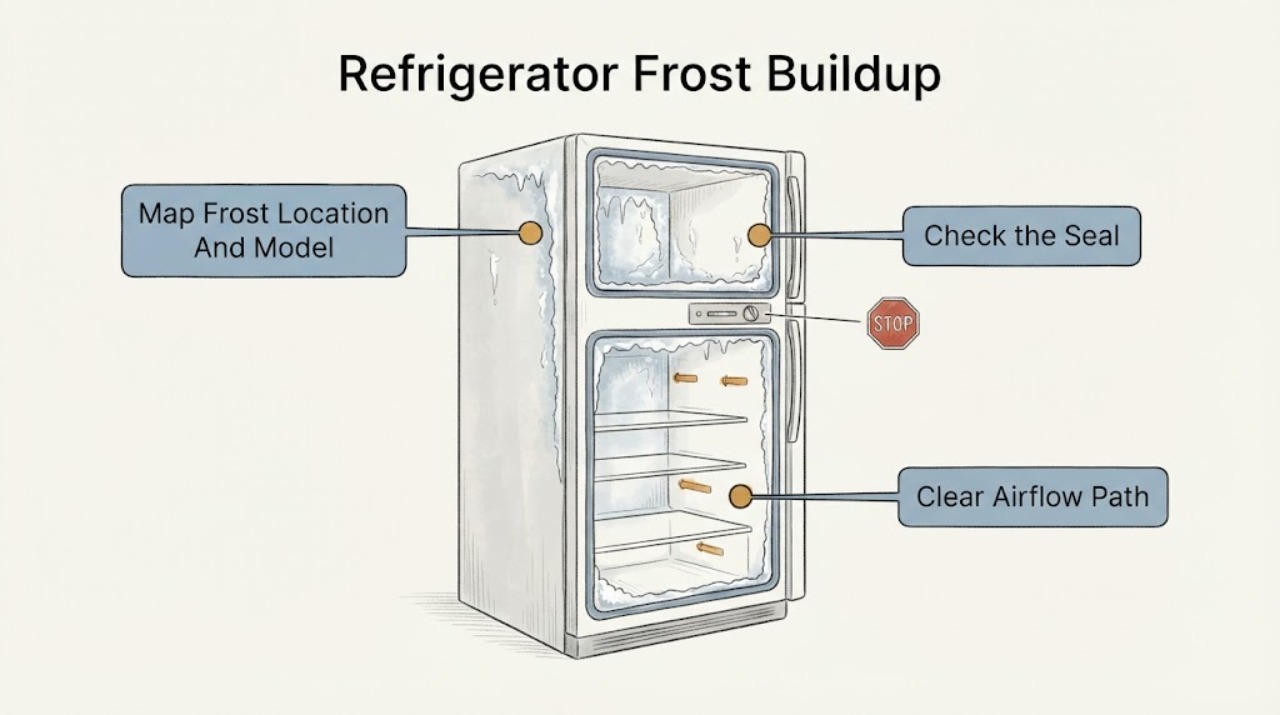
First photograph where the frost is forming and record the exact Hisense model. A little frost in a freezer can follow frequent or prolonged door opening, a door that does not seal, blocked airflow, or a manual-defrost design; it is not enough to diagnose a failed part. Check that containers are not blocking air outlets, the door closes without interference, the gasket is clean and continuous, and the temperature control is not set colder than the model requires. Hisense support says a small amount of freezer-wall ice may disappear during the defrost cycle, while an official Hisense No Frost manual says recurring wall frost can still result from frequent door opening or a poor door seal. If the exact manual permits user defrosting, disconnect power, let the ice melt naturally, collect water, and never chip frost with a knife or other sharp object. Do not remove evaporator or rear panels, test a heater or fan live, or use a heat gun. Frost that returns quickly after a complete safe defrost, covers a fan or air channel, appears with poor cooling or water, or is accompanied by smoke, burning odor, sparking, or a hot cord needs qualified Hisense or appliance service.
Before you begin
Safety first
- This article covers model identification, frost-location observation, accessible door and gasket checks, visible airflow and setting checks, and model-permitted safe defrosting. Evaporator, fan, heater, drain, sensor, control, wiring, compressor, and refrigerant work requires qualified service.
Work through in order
Diagnostic checks
Use only checks that match the exact appliance or system and its official guide.
-
Check 1
Record the complete Hisense model and photograph the frost before clearing it. Identify whether it is on the freezer wall, fresh-food rear wall, door gasket or frame, around an air outlet, on a drawer, or visible only behind a panel; note whether the unit is manual-defrost or labeled No Frost/frost-free.
Expected result: Frost is a thin even layer, a thick sheet, concentrated around the door, localized at an air opening, present in the refrigerator compartment, or visible only behind a cover; cooling may be normal or weak.
Next step: Use the matching door, airflow, temperature, defrost, or service branch below and the exact Hisense manual. Do not begin with a generic button sequence or a part replacement.
Stop if: Stop for smoke, burning odor, sparking, a hot or damaged cord, water near electricity, refrigerant or oil evidence, or a rapidly worsening temperature problem.
Why this matters
Why: Location and model determine whether moisture entry, blocked airflow, a manual-defrost interval, or a hidden defrost/fan problem is more likely. Frost behind a panel cannot be safely identified by an owner without opening the appliance.
-
Check 2
Check that no container, drawer, shelf, or package holds the door open. Inspect the gasket for dirt, folds, gaps, tears, or sections pulled out of the channel; wipe it with a soft damp cloth and dry it, without removing the gasket or adjusting hinges.
Expected result: The door is obstructed, the gasket is dirty or deformed, a section does not contact the cabinet, the door closes evenly, or frost is concentrated along one edge despite a clean seal.
Next step: Remove only the obvious obstruction and clean or reseat a gasket edge that the manual says is owner-accessible. Close the door and monitor; arrange service if it cannot seal or frost returns at the same edge.
Stop if: Do not force the door, stretch or glue the gasket, adjust hinges under load, or continue if the cabinet is damaged or water is near electrical parts.
Why this matters
Why: Hisense identifies an obstructed or poorly sealing door as a moisture and frost cause. A clean, continuous seal with edge frost that returns suggests alignment, hinge, cabinet, or another model-specific issue.
-
Check 3
Check that food and containers do not cover the model's interior air outlets or rear openings, that stored items are not pressed against the wall, and that the temperature setting matches the exact manual. Note whether warm food, frequent door openings, or a warm room preceded the frost.
Expected result: An outlet is blocked, food touches the rear wall, the temperature is set unusually low, warm food or frequent openings preceded the frost, or airflow and settings are normal but frost is localized or heavy.
Next step: Rearrange only visibly obstructing items, correct a clearly identified setting, and allow the appliance to stabilize. If the frost remains or returns, use the defrost-type and service branches rather than lowering the setting further.
Stop if: Do not scrape frost, remove an air duct, cover an outlet, or use a sharp, heated, or mechanical tool to clear ice.
Why this matters
Why: Hisense links blocked airflow, low settings, warm food, and frequent door opening with poor temperature distribution or frost. A clear airflow path with recurring heavy frost makes a hidden defrost, fan, sensor, drain, or seal problem more likely.
-
Check 4
Use the exact model manual to determine whether the unit is manual-defrost or frost-free and whether it provides an owner defrost function. If manual defrost is permitted, remove food, disconnect power as directed, let the frost melt naturally, place towels for water, clean and dry the interior, and reconnect only when it is dry and the manual permits.
Expected result: The model is manual-defrost, the manual permits a specific defrost function, a small frost layer clears during automatic defrost, or heavy frost returns after a complete safe thaw.
Next step: Follow only the exact manual's defrost interval or function. If frost rapidly returns, blocks airflow, or cooling is poor, keep the appliance off as needed for food safety and arrange qualified service.
Stop if: Never use a knife, screwdriver, sharp object, heat gun, open flame, or mechanical defrost device; do not puncture refrigerant tubing or energize the appliance while wet.
Why this matters
Why: Hisense support gives manual-defrost guidance for applicable products, while its No Frost manual says occasional frost may disappear automatically but recurring wall frost can reflect door-use or seal conditions. A return after a full thaw is evidence for an unresolved cause, not a reason to repeat unsafe scraping.
-
Check 5
After the safe external checks, observe whether the refrigerator and freezer still reach their normal temperatures, whether the fan noise or airflow has changed, and whether condensation or water accompanies the frost. Check only visible door, shelf, floor, and accessible drain-area conditions described by the model manual.
Expected result: Cooling is normal and frost is slight, one compartment is warm, a fan is rubbing or airflow is weak, water is pooling, frost covers a rear panel, or food has thawed.
Next step: Protect perishable food and stop using the appliance if temperatures are unsafe or a leak is present. Arrange model-specific service instead of opening the rear panel or forcing the fan.
Stop if: Do not touch a fan, remove an evaporator cover, clear a hidden drain with wire, perform live tests, or continue operation with smoke, burning odor, sparking, or water near electricity.
Why this matters
Why: Slight moisture-related frost can be a use or sealing issue, but frost paired with weak airflow, warming, water, or a hidden panel pattern can involve the evaporator, fan, drain, defrost heater, sensor, or control.
-
Check 6
Document whether the frost returns after the model-approved complete defrost, remains in one location, covers a fan or air channel, or is accompanied by a temperature alarm, water, unusual noise, or display warning. Provide the model, photos, settings, and timing to Hisense support or a qualified appliance technician.
Expected result: The frost stays gone after an external correction, returns quickly, reappears behind a panel, or the appliance has poor cooling, a fan/compressor symptom, water, an alarm, or electrical damage.
Next step: Arrange qualified Hisense or appliance service; use electrical service for supply hazards and protect food from unsafe temperatures. Keep the appliance off when the safety boundary is reached.
Stop if: Do not replace a heater, sensor, fan, gasket, or control by guesswork, remove panels, bypass a defrost control, test live wiring, or work on refrigerant.
Why this matters
Why: Rapid recurrence or hidden frost is not safely distinguished by a generic reset. A door, defrost, drain, fan, sensor, control, or sealed-system issue may need model-specific access and testing.
Use your observations
Decision map
Find the observation that best matches what you see, then follow the next safe action.
-
PATH 01Safety boundary
What you see
Frost is light or localized near a door or air opening, the door was opened frequently or held open, a package obstructs closure, or an outlet is blocked, while cooling remains normal.
Do this next
Clear the obstruction, clean or safely reseat the accessible gasket edge, and restore clear airflow. Monitor after the appliance stabilizes; arrange service if the seal cannot close or frost returns at the same location.
Why this path and its safety boundary
Why it matters: Moisture entry and restricted air circulation are more likely than an internal defrost failure.
Safety stop: Do not stretch the gasket, force the door, scrape ice, or remove an air duct.
-
PATH 02Safety boundary
What you see
The exact Hisense model is manual-defrost and has a normal, gradually increasing frost layer without a smoke, water-near-electricity, or cooling emergency.
Do this next
Follow the model manual: disconnect power, thaw naturally, collect water, dry thoroughly, and reconnect only as directed. Do not infer the interval or control sequence from another model.
Why this path and its safety boundary
Why it matters: Frost accumulation may be expected to a model-specific point and may require a safe manual defrost rather than a parts diagnosis.
Safety stop: Never chip, stab, heat, or mechanically force frost, and do not reconnect while water remains around electrical parts.
-
PATH 03Safety boundary
What you see
A labeled No Frost or frost-free Hisense appliance develops thick or recurring frost, especially after a complete model-approved thaw, or frost blocks a fan or air channel.
Do this next
Check the external door and airflow conditions once. If frost returns or cooling changes, leave internal diagnosis to qualified service and provide photos and timing.
Why this path and its safety boundary
Why it matters: Frequent door opening or a poor seal can still cause frost, but rapid recurrence or hidden ice makes a defrost, fan, sensor, drain, control, or airflow fault more likely.
Safety stop: Do not remove the evaporator panel, bypass a defrost sensor, touch a fan, or perform live tests.
-
PATH 04Safety boundary
What you see
Frost is accompanied by a warm compartment, weak airflow, food thawing, condensation, standing water, an alarm, or an unusual fan/compressor sound.
Do this next
Protect food and arrange qualified appliance service. Isolate power or water only from a dry, safe position and follow the exact manual for any emergency leak instruction.
Why this path and its safety boundary
Why it matters: The frost may be restricting airflow or may be a symptom of a seal, drain, fan, defrost, sensor, control, or cooling-system problem rather than a cosmetic issue.
Safety stop: Do not continue operation if food safety or electrical safety is compromised, and do not open the sealed or electrical system.
-
PATH 05Safety boundary
What you see
Frost rapidly returns after the correct external and model-approved defrost checks, appears behind a panel, or there is smoke, burning odor, sparking, a hot cord, refrigerant evidence, water near electricity, or repeated breaker trips.
Do this next
Stop using the refrigerator and arrange qualified Hisense or appliance service; use qualified electrical help for supply hazards. Keep doors closed as practical and move food only when safe.
Why this path and its safety boundary
Why it matters: An unresolved internal or safety fault is possible and further owner intervention could damage the refrigerant circuit or expose live parts.
Safety stop: Do not chip ice, remove panels, bypass controls, test live wiring, puncture tubing, or restart repeatedly.
Helpful context
Understand the symptom
Frost location is the first useful clue
A light layer on a freezer wall, frost around a door edge, a blocked rear air opening, and ice hidden behind an evaporator cover are different observations. Hisense documents both manual-defrost and No Frost products, so a procedure for one model may be wrong for another. Note whether the fresh-food compartment, freezer, door frame, or one small area is affected and whether cooling has changed.
Door sealing and airflow are safe external checks
Hisense support says to make sure the door seals properly, and its manuals warn not to block air circulation openings with stored food. A package holding the door open or a gasket that is dirty, folded, or detached allows warm moist air in; a blocked outlet can create a local frost or temperature pattern. Clean and reposition only what is plainly accessible, then observe whether the door closes all around its perimeter.
Defrost type changes the safe next step
A manual-defrost appliance may require power disconnection and natural thawing at the interval specified by its manual. A frost-free appliance normally defrosts automatically; recurring heavy frost or ice in an air channel points toward a seal, airflow, defrost, sensor, fan, drain, or control issue. Use a model-specific defrost function only when the exact manual identifies it, and never puncture tubing or remove a panel to reach hidden ice.
Safety boundary
Stop conditions
- Stop using the refrigerator for smoke, burning odor, sparking, a hot or damaged cord or plug, water near electricity, refrigerant or oil evidence, repeated breaker trips, or rapidly worsening temperatures.
- Do not use knives, screwdrivers, sharp objects, heat guns, open flames, or mechanical tools to remove frost; do not puncture refrigerant tubing.
- Do not remove evaporator, rear, electrical, or control panels, bypass defrost or temperature controls, touch fans, or perform live electrical tests.
- Disconnect power before model-permitted cleaning or manual defrosting, keep water away from electrical parts, and reconnect only when surfaces are dry and the exact manual permits.
- Do not replace a gasket, heater, fan, sensor, drain component, or control by guesswork; confirm the exact model and use qualified diagnosis for recurrent or hidden frost.
When checks do not resolve it
Need a professional?
Arrange qualified Hisense or appliance service when frost returns quickly after a model-approved complete defrost, is hidden behind a panel, blocks a fan or air channel, or is accompanied by poor cooling, food thawing, water, alarms, or unusual mechanical noise. Stop immediately for smoke, burning odor, sparking, a hot or damaged cord, water near electricity, refrigerant evidence, or repeated breaker trips.
Safety scope: This article covers model identification, frost-location observation, accessible door and gasket checks, visible airflow and setting checks, and model-permitted safe defrosting. Evaporator, fan, heater, drain, sensor, control, wiring, compressor, and refrigerant work requires qualified service.
Common questions
FAQ
Is a small amount of frost normal in a Hisense freezer?
It can be, depending on the model and use. Hisense support says a small amount may disappear during the defrost cycle, and an official No Frost manual says occasional frost can follow frequent or prolonged door opening or a poor seal. Heavy, fast-returning, or performance-related frost needs diagnosis.
Can a blocked vent cause frost buildup in a Hisense refrigerator?
Yes. Hisense manuals and support material warn that stored food should not block air outlets or rear openings. Reposition only items that visibly obstruct airflow, then monitor. Do not remove ducts or panels to clear hidden ice.
How should I defrost a Hisense refrigerator?
First check the exact model manual. If manual defrost is permitted, disconnect power, let frost melt naturally, collect water with towels, clean and dry the appliance, and reconnect only as directed. Never chip ice with a sharp object, use a heat gun or flame, or puncture refrigerant tubing.
Why does frost form around the Hisense refrigerator door?
An obstructed door, dirty or damaged gasket, uneven contact, or frequent or prolonged opening can let warm moist air enter. Check the accessible gasket and closure without forcing the door. Frost that returns along one edge after cleaning may need alignment or seal service.
Why does frost come back after I defrost my Hisense refrigerator?
If the door seal and airflow are correct, rapid recurrence can indicate a hidden defrost, fan, drain, sensor, control, or cooling-system problem. A No Frost appliance should not require repeated scraping. Do not remove the evaporator cover; arrange model-specific service.
When is frost buildup a reason to stop using the refrigerator?
Stop for smoke, burning odor, sparking, a hot or damaged cord, water near electricity, refrigerant or oil evidence, repeated breaker trips, or unsafe food temperatures. Do not open panels, perform live tests, bypass defrost controls, or keep restarting a hazardous appliance.
Read the exact guide
Official sources
- Support CoolingHisense UK · Official Hisense UK cooling FAQ; advice is general and the exact defrost method and temperature settings remain model-specific.
- Hisense HQD20 UM ENv10.inddHisense USA · Official HQD20 owner manual; its air-opening, gasket, automatic-defrost, and cleaning directions are examples for that model family and not a universal Hisense procedure.
- Hisense Product & Support CentreHisense Australia · Official Hisense support center; manual-defrost instructions apply only to models for which the support or owner's manual identifies manual defrost.
- 818898en.inddHisense · Official Hisense owner manual for the documented No Frost refrigerator/freezer family; the listed buttons and settings are not universal to unidentified Hisense models.
Community feedback
Share a repair observation
Share a plain-text repair observation. Accepted observations are published automatically; this page may take a moment to update.