
On this page
Start here
Quick answer
When refrigerators in two houses show the same not-refrigerating symptom, first compare the conditions that repeat instead of assuming all three appliances have the same failed part. Confirm the full model and market for each unit, then measure the refrigerator and freezer compartments with an appliance thermometer, verify that each installation is dry, ventilated, and between 55°F and 110°F, and check the clearance and door or vent conditions. For the LG LFXS28968S/00, LG lists a French-door refrigerator with electronic controls, Multi-Air Flow, Smart Cooling, and a Linear Compressor, but those features do not identify a failed component. Set the refrigerator near LG's recommended 37°F and the freezer near 0°F only through the exact model instructions, then allow the documented stabilization period; LG says a recently installed or repaired refrigerator may need two to three days. Protect perishable food while temperatures are unsafe. If the exact model remains warm after these external checks and the full wait, request LG service with the readings and installation comparison, and check the model-specific warranty before authorizing sealed-system work.
Before you begin
Safety first
- Do not open the sealed refrigeration system, remove electrical covers, perform live voltage or refrigerant tests, bypass controls, alter wiring, or order a compressor, fan, sensor, or control board solely from a not-refrigerating symptom. Stop immediately for smoke, burning odor, sparks, damaged wiring, water near electrical parts, severe overheating, or unsafe food.
Work through in order
Diagnostic checks
Use only checks that match the exact appliance or system and its official guide.
-
Check 1
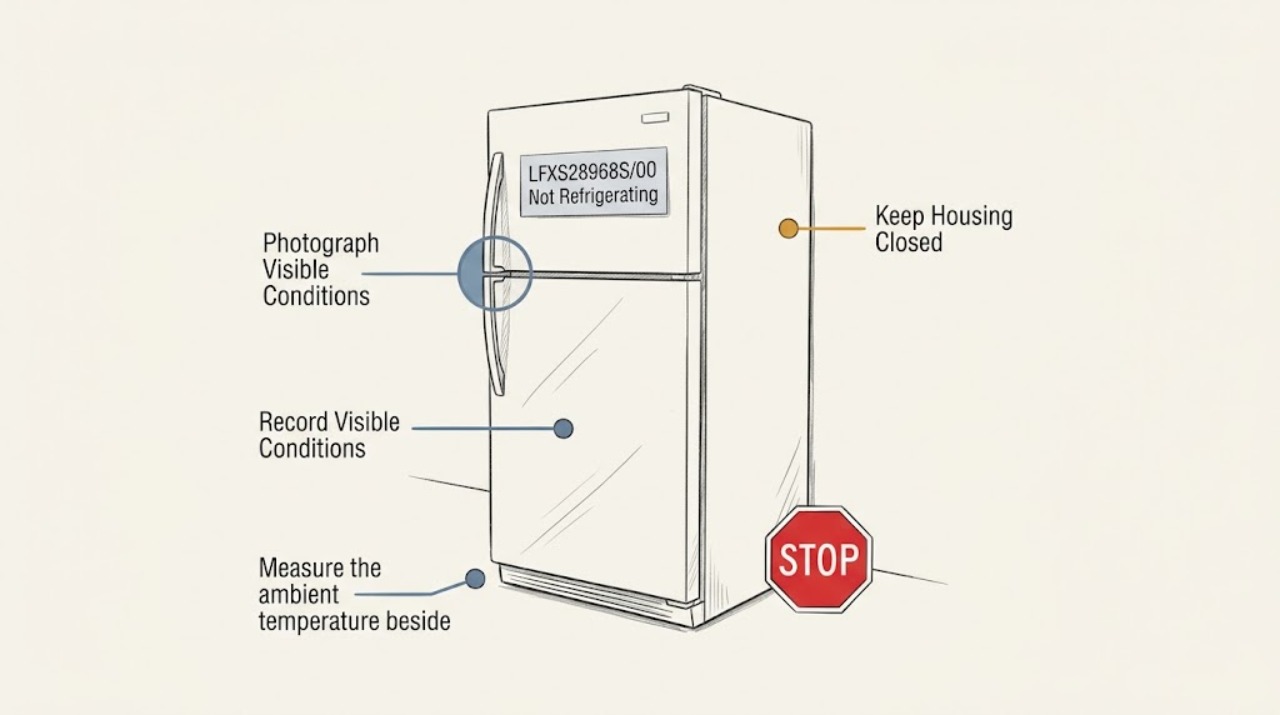
For each of the three refrigerators, photograph the rating label and record the complete model suffix, serial number, market, installation address, room, installation or repair date, and the exact symptom. Confirm whether the affected unit is LG LFXS28968S/00 rather than a visually similar LFXS28968 variant.
Expected result: All three units have the same exact model and suffix, the units are different models, one unit's identity is uncertain, or the symptom only follows one physical appliance.
Next step: Use the exact LFXS28968S/00 literature for that unit and keep the other refrigerators as separate comparisons. If the rating label cannot be read safely, stop model-specific troubleshooting and provide the label photo to LG service.
Stop if: Do not remove panels, move a refrigerator to read a rear label, or order a part from the family name alone.
Why this matters
Why: An exact model match permits use of the LFXS28968S support and literature path. Different models or an uncertain suffix make the cross-house pattern a comparison clue, not permission to share settings, codes, or parts. A symptom that follows one appliance is more appliance-specific than a symptom that appears only at one location.
-
Check 2
With each door opened only briefly, place an appliance thermometer in the center of the refrigerator compartment and the freezer, away from walls, doors, and air outlets. Record the time, displayed settings, measured temperatures, and whether the compressor or fans appear to be operating normally from outside.
Expected result: The refrigerator is above the recommended 37°F range, the freezer is above the recommended 0°F range, the display and measurements disagree, or the readings are normal after a recent door opening or loading event.
Next step: Protect temperature-sensitive food and repeat the measurement under normal closed-door use. Use the documented readings to compare the three locations; do not diagnose a compressor or refrigerant problem from temperature alone.
Stop if: Do not insert a probe through a gasket, remove a sensor, open a service panel, or perform live electrical measurements.
Why this matters
Why: Separate compartment measurements distinguish a genuine cooling problem from a display or perception issue. LG says room temperature, loading, blocked vents, and door closure affect cooling, and gives 37°F and 0°F as recommended starting temperatures; a single warm reading after a door opening is not enough to identify a failed part.
-
Check 3
Measure the ambient temperature beside each refrigerator and inspect the installation from the front and sides without moving the cabinet. Check that the area is dry and ventilated, that the cabinet is not pressed tightly against surrounding surfaces, and that the model manual's clearance requirements are met.
Expected result: The room is below 55°F or above 110°F, the space is humid or poorly ventilated, the rear or sides lack the required clearance, or all locations meet the documented environmental conditions.
Next step: Correct only an accessible environmental or clearance problem in accordance with the exact manual, then repeat the compartment measurements. If the room cannot be brought into range or the appliance would need to be moved, use qualified installation or appliance help.
Stop if: Do not move a heavy refrigerator alone, place it in a damp location, improvise ventilation openings, or use a heater near the appliance.
Why this matters
Why: LG says temperatures outside 55°F–110°F can cause excessive cooling or no cooling, and insufficient clearance can prevent heat from the rear cooling motor from dissipating. A repeated environmental or clearance issue can explain a cross-house pattern without proving that every refrigerator has the same internal defect.
-
Check 4
Check the accessible control display for an off, locked, or unintended setting, then use only the LFXS28968S/00 manual's normal control procedure. LG's general guidance recommends 37°F for the refrigerator and 0°F for the freezer; make one small documented adjustment rather than changing several settings at once.
Expected result: The display is off or locked, a setting is warmer than the recommended starting point, the controls are correct, or the setting cannot be changed using the normal user interface.
Next step: Record the original and new setting, then wait through the applicable recovery period before changing anything else. If the controls cannot be changed normally, retrieve the exact manual from the LFXS28968S support page and request service if the interface remains unresponsive.
Stop if: Do not enter a hidden diagnostic mode, repeatedly cycle power, bypass a lock, or use another LG model's button sequence.
Why this matters
Why: A locked or incorrect setting can imitate a cooling failure. LG notes that display appearance and settings vary by model, and that the freezer and refrigerator settings interact on standard designs. A correct setting with persistent warm measurements points back to environment, airflow, door sealing, recovery time, or service—not automatically to a particular component.
-
Check 5
Inspect shelves, drawer fronts, door bins, and visible air vents without removing panels. Ensure food is not blocking the rear vents, the refrigerator is not packed beyond the manufacturer's airflow guidance, and every door closes fully without a package or shelf pushing it open.
Expected result: A vent is blocked, the refrigerator is overfilled, a shelf or package prevents full closure, a gasket has a visible gap, or loading and door closure are normal.
Next step: Rearrange only loose packages, reinstall an obviously misplaced shelf as the manual allows, and close the doors normally. Repeat the temperature check after stabilization; arrange service for a torn gasket, misalignment, or persistent warm readings.
Stop if: Do not pull out the gasket, adjust hinges, remove air covers, chip ice, reach into a fan, or apply direct heat.
Why this matters
Why: LG states that blocked vents interrupt cold-air circulation and that an item preventing full closure lets warm air enter and reduces cooling. If the same loading or closure problem is present at several houses, it is a shared accessible condition; if it is present only on LFXS28968S/00, it is a unit-specific clue but still not a part identification.
-
Check 6
After the external conditions and one control setting are documented, leave each refrigerator closed and normally loaded while recording temperatures over the recovery period. LG says a recently installed or repaired refrigerator may take two to three days to reach normal operating temperature; use the exact manual if it specifies a different period.
Expected result: Temperatures return to the recommended range, only refrigerators at one type of location remain warm, the exact LFXS28968S/00 remains warm in an in-range installation, or a safety hazard appears.
Next step: For persistent warm temperatures, provide LG service the model, serial, measurements, settings, installation comparison, and recovery timeline. Protect or relocate food according to applicable food-safety guidance.
Stop if: Stop using an appliance with smoke, burning odor, sparking, damaged wiring, water near electrical parts, severe overheating, or unsafe food temperatures; do not open the sealed system or electrical panels.
Why this matters
Why: Recovery after installation, loading, or a shared environment points toward an operating condition rather than a confirmed failed part. Persistence in one exact unit after a suitable wait supports a model-specific service decision. Smoke, burning odor, sparks, damaged wiring, water near electrical parts, or unsafe food overrides all further checks.
Use your observations
Decision map
Find the observation that best matches what you see, then follow the next safe action.
-
PATH 01Safety boundary
What you see
The same warm-temperature symptom appears only in rooms outside 55°F–110°F, with poor ventilation or inadequate clearance, while a refrigerator in a suitable location cools normally.
Do this next
Correct the accessible environmental or clearance condition using each exact manual, then repeat compartment measurements after recovery. Use qualified help if the refrigerator must be moved or the space cannot be corrected.
Why this path and its safety boundary
Why it matters: The installation environment is the leading shared variable. LG warns that an unsuitable location can cause no cooling and that insufficient clearance can reduce cooling performance; this pattern does not establish three failed compressors.
Safety stop: Do not continue operating in a damp, overheated, freezing, or tightly enclosed location.
-
PATH 02Safety boundary
What you see
The display and lights operate, the room and clearance are suitable, doors and vents are normal, but the confirmed LFXS28968S/00 remains warm after the model's recovery period.
Do this next
Arrange LG appliance service with the exact suffix, serial number, temperature log, control settings, installation conditions, and the two-house comparison. Check the model-specific warranty before authorizing sealed-system work.
Why this path and its safety boundary
Why it matters: The external comparison checks have removed common operating explanations. Cooling regulation, airflow, sealed-system, or another internal fault is possible, but these observations cannot select a compressor, sensor, fan, or refrigerant repair.
Safety stop: Do not remove panels, test energized circuits, open refrigerant lines, or order a replacement component from the symptom alone.
-
PATH 03Safety boundary
What you see
The refrigerator is warm only when a shelf, door bin, or package blocks a vent or keeps a door from closing, and the temperature improves after the accessible obstruction is removed.
Do this next
Keep vents clear, maintain ordinary loading, close doors fully, and monitor measured temperatures during normal use. Request service for a persistent gasket gap, misalignment, or recurrence without a new obstruction.
Why this path and its safety boundary
Why it matters: Restricted circulation or warm air entering at the door is more likely than a primary internal fault. The improvement supports the accessible condition, not a blanket conclusion about every refrigerator in the two houses.
Safety stop: Do not reshape seals, adjust hinges, remove panels, or apply direct heat.
-
PATH 04Safety boundary
What you see
The display is off, the controls cannot be changed normally, or the refrigerator shows no normal cooling response while the outlet and cord appear externally intact.
Do this next
Stop at safe external observations, check the household electrical panel only if there is no hazard and you know the correct circuit, and obtain an electrician or LG service visit if power or the control interface remains uncertain.
Why this path and its safety boundary
Why it matters: This is an external power or control-state branch, not evidence of a refrigeration part. Repeated failures across houses still require comparing whether the same circuit, outlet practice, or control state is involved, without live testing.
Safety stop: Do not use extension cords or adapters as a workaround, open the electrical compartment, bypass a safety device, or repeatedly reset a tripping circuit.
-
PATH 05Safety boundary
What you see
All three refrigerators have suitable rooms, clearances, settings, loading, and door closure, but measured temperatures remain unsafe or the symptom recurs after the full recovery period.
Do this next
Protect food and schedule qualified refrigerator service for each appliance, supplying separate model, serial, temperature, location, and timeline records. Ask the technician to document the measured fault before recommending repair or replacement.
Why this path and its safety boundary
Why it matters: The repeated pattern is no longer explained by the simple accessible checks. If the same exact LFXS28968S/00 is affected, use its model-specific service and warranty path; if different models are affected, keep their diagnoses separate rather than inferring one universal part.
Safety stop: Stop using any unit with smoke, burning odor, sparks, damaged wiring, water near electrical parts, severe overheating, or food-safety risk.
Helpful context
Understand the symptom
Why three refrigerators in two houses need a comparison before a parts diagnosis
A repeated symptom across two houses is useful evidence, but it is not proof that three different units share one internal failure. Compare what actually repeats: the room temperature, clearances, ventilation, outlet and display behavior, door loading, temperature settings, and the delay between installation or service and the first measurement. LG's opened LFXS28968S support page confirms that the supplied model has model-specific manuals and repair routing, while the product page identifies its French-door, electronically controlled cooling platform. Keep this article scoped to that platform and do not transfer a diagnosis from another LG model or from a different refrigerator in the same house.
Use measurements and installation conditions as the shared evidence
LG recommends approximately 37°F for the refrigerator and 0°F for the freezer, but a display or a hand on a shelf is not a substitute for a compartment measurement. LG also says refrigerators should be in a dry, shaded, well-ventilated location between 55°F and 110°F, with adequate space for heat to dissipate. If all three cases occur in locations with the same environmental or clearance problem, correct only the accessible condition and retest. If one confirmed LFXS28968S/00 remains warm in a suitable installation after the normal recovery period, the comparison has done its job: move to model-specific service rather than guessing a compressor, sensor, or control part.
When checks do not resolve it
Need a professional?
Call LG service after the exact LFXS28968S/00 identity is confirmed and the measured temperature remains high in a dry, ventilated installation with suitable clearance, normal settings, clear vents, closed doors, and the applicable recovery period. If several appliances are affected, provide separate records so the technician can distinguish a shared installation condition from an appliance fault.
Safety scope: Do not open the sealed refrigeration system, remove electrical covers, perform live voltage or refrigerant tests, bypass controls, alter wiring, or order a compressor, fan, sensor, or control board solely from a not-refrigerating symptom. Stop immediately for smoke, burning odor, sparks, damaged wiring, water near electrical parts, severe overheating, or unsafe food.
Have this ready
- Provide each appliance's complete model and serial details, market, address and room, installation or repair date, room temperature, clearance and ventilation observations, refrigerator and freezer measurements, displayed settings, door and vent results, power-display behavior, food-safety concern, and whether the symptom follows the appliance or the location.
Common questions
FAQ
Why would refrigerators in two houses have the same not-refrigerating problem?
The repeated symptom may share an installation or use condition, but it does not prove that all appliances have the same failed part. Compare each room's temperature, clearance, ventilation, settings, door loading, visible airflow, and measured compartment temperatures, and keep different models separate.
What model details matter for an LG LFXS28968S/00 cooling complaint?
Record the complete rating-label model and suffix, serial number, market, and the exact appliance location. LG's support page provides model-specific manuals, troubleshooting, repair, and warranty routes, so do not use a different LFXS28968 variant as if it were identical.
What temperatures should I use as a starting point?
LG's general guidance recommends 37°F for the refrigerator and 0°F for the freezer. Verify actual temperatures with an appliance thermometer and use the exact LFXS28968S/00 instructions for the control procedure.
How long should an LG refrigerator take to cool after installation or repair?
LG says a recently installed or repaired refrigerator may take two to three days to reach normal operating temperature, depending in part on the amount of food inside. Keep doors closed as normally used, record the readings, and use the exact manual if it gives a different recovery instruction.
Should I replace the compressor because the LFXS28968S/00 is not refrigerating?
Not from the symptom alone. First document the environment, clearance, settings, door and vent conditions, and measured temperatures. If the problem persists in a suitable installation after the recovery period, have LG service diagnose the cooling path and check model-specific warranty coverage before any part decision.
Read the exact guide
Official sources
- If Your LG Refrigerator Is Not Cold EnoughLG · Official LG USA refrigerator support guidance opened for the not-refrigerating symptom; it is based on standard models and directs owners to account for model-specific settings.
- LG Refrigerator - How Much Space Is Needed Between the Wall and My Refrigerator?LG · Official LG USA clearance guidance opened for the repeated-location comparison; it states a general minimum and directs owners to the specific model manual for differing requirements.
- LFXS28968S.ASTCNA0 — Support, Manuals, Warranty & More | LG USA Product Support PageLG · Official LG USA support page opened for the LFXS28968S family; the page exposes the exact model support route and documentation while model suffix and market remain important.
- LG Refrigerator - Can I Install My Refrigerator on a Balcony or in a Storage Room?LG · Official LG USA installation guidance opened for comparing refrigerator locations across houses; it applies as general installation guidance and does not replace the exact LFXS28968S/00 manual.
- LG LFXS28968S: 28 cu.ft. Smart wi-fi Enabled French Door Refrigerator | LG USA BusinessLG · Official LG product page opened for the supplied LFXS28968S model; used to identify its French-door configuration, electronic controls, Multi-Air Flow, Smart Cooling, Linear Compressor, and temperature sensors without treating a listed feature as proof of failure.
- How to adjust the temperature for LG refrigeratorsLG · Official LG USA temperature-control guidance opened for the LFXS28968S/00 symptom; it gives general recommended temperatures and warns that display appearance and available settings vary by model.
Community feedback
Share a repair observation
Share a plain-text repair observation. Accepted observations are published automatically; this page may take a moment to update.