
On this page
Start here
Quick answer
When a Liebherr freezer is not working, first decide whether the appliance is completely dead, powered but not cooling, or showing a fault message. Check the external power connection, the accessible breaker or fuse, and whether the freezer compartment was switched off or placed in a special mode; then use the exact model instructions for the controls. Liebherr says the model and service or serial number are on the type plate and are needed to retrieve the correct operating instructions. A dark display with no stable power, a recurring fault code, an emergency-mode indicator, smoke, burning odor, sparking, a hot cord, water near electricity, or a damaged refrigerant circuit is a stop-and-service condition. Do not open panels, bypass a door or control safety, repeatedly reset a tripping supply, or attempt electrical or sealed-system work.
Work through in order
Diagnostic checks
Use only checks that match the exact appliance or system and its official guide.
-
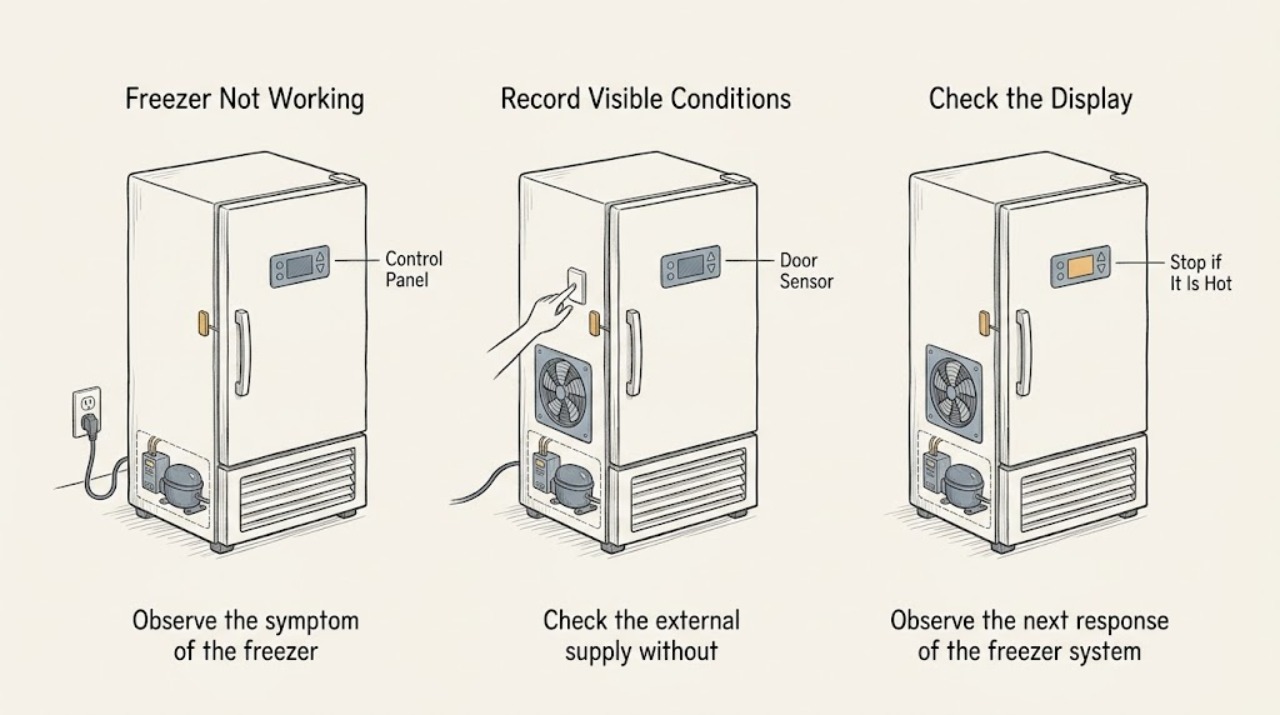
Record the symptom and protect the frozen food
Keep the door closed as much as practical while you note whether the display, status light, and interior light are on; whether the food is still hard frozen; whether an alarm, power-cut symbol, or fault code is visible; and when the freezer was last known to work. Take a photo of the display and type plate without removing any cover.
Expected result: The freezer is completely dark; the display is active but the cabinet is warming; a temperature or power-failure alarm is present; a fault code is shown; or the display is active with no alarm but the freezer does not respond to controls.
Next step: For a dark appliance, continue to the external power check. For an active display, retrieve the exact manual and check the freezer control and mode. For any fault or persistent alarm, preserve the code and prepare for service rather than repeatedly resetting it.
Stop if: Stop immediately for smoke, burning odor, sparks, a hot or damaged cord, water near electrical parts, a refrigerant/oil leak, or food that may have spoiled.
Why this matters
Why: A dark appliance points first to power, switch, or control state. A power-cut or temperature alarm can explain a recent rise, while a recurring fault code or active controls with no response points toward a model-specific control or appliance fault. Food condition is a separate safety decision.
-
Check the external supply without moving the freezer
Without pulling out a built-in appliance, confirm that the plug is seated in the intended accessible outlet and inspect the household breaker or fuse for an open condition. Check whether the freezer compartment has been switched off at its model-specific control. Restore a normal external power condition once only if it is safe, and do not use an extension lead or repeatedly reset a breaker.
Expected result: The plug was loose, the breaker or fuse is open, the freezer compartment was switched off, the outlet will not hold power, or the supply and freezer control are normal but the appliance remains dead.
Next step: Correct only the external condition, then allow the appliance to start under the exact model instructions. If power will not hold, the display stays dark, or the cord or outlet is damaged, stop and arrange qualified electrical or Liebherr service.
Stop if: Do not open an outlet, remove appliance panels, measure live voltage, use an extension lead as a workaround, or keep resetting a breaker that trips again.
Why this matters
Why: A loose connection, open fuse, or switched-off compartment can make the freezer appear not to work. A breaker that opens again or a normal supply with no display shifts the problem to the appliance's cord, input, control, or internal electrical system.
-
Check the freezer control, lock, and operating mode
Using the exact model manual, confirm that the freezer compartment is switched on, the set temperature is present, and a child lock, SabbathMode, holiday setting, or other special mode is not changing the expected display or controls. Touch only the documented control icons; do not press random keys or hold controls while the appliance is unresponsive.
Expected result: The freezer compartment was switched off; a child lock or special mode is active; the display responds and shows a normal setpoint; or controls do not respond and the display shows a fault or unusual indicator.
Next step: Restore only the documented normal setting or exit the documented lock/mode once, then close the door and observe. If the control remains unresponsive, the fault code returns, or the freezer does not start, stop and contact service with the model and code.
Stop if: Do not bypass a child lock or safety control, remove the control panel, or keep cycling modes to force a response.
Why this matters
Why: Liebherr models can operate refrigerator and freezer sections separately, and child-lock or special modes can change which controls, lights, and alarms appear. A responsive control that restores operation supports a setting issue; a recurring fault or unresponsive panel needs model-specific diagnosis.
-
Check door closure, ventilation, and visible conditions
Inspect the closed door from outside for a drawer, package, or gasket edge preventing a full seal. Look for blocked accessible ventilation grilles or fan slits, a nearby heat source, and ambient conditions outside the climate class on the type plate. Do not pull out a built-in unit, remove the gasket, chip ice, or open a cover to inspect a fan.
Expected result: The door does not close evenly; a package or gasket gap is visible; ventilation is blocked; the freezer is beside a heat source or outside its specified ambient range; or the external conditions are normal.
Next step: Remove only a visible obstruction or accessible ventilation blockage allowed by the manual, close the door, and observe without frequent opening. If the gasket or door is damaged or operation does not recover, arrange service.
Stop if: Stop if the appliance must be moved, the gasket or frame is damaged, ice needs force or a sharp tool, or the cabinet, cord, or outlet is wet or hot.
Why this matters
Why: Liebherr identifies door closure, ventilation and air extraction, climate class, and nearby heat as factors that can make a freezer too warm or trigger an alarm. If these conditions are normal but the freezer is still inactive or warming, an internal fan, sensor, control, compressor, or sealed-system fault becomes more likely.
-
Handle alarms and fault codes as a service handoff
For a power-cut or temperature alarm, note the warmest displayed temperature or alarm state, keep the door closed, and assess the food without tasting questionable items. For an appliance-fault message, write down the exact code and use the manual's documented acknowledgement only; do not erase evidence by repeated power cycling.
Expected result: The alarm clears after normal power and door conditions return; the temperature or alarm remains abnormal; a fault code reappears; or the display shows an emergency or defective operating indication.
Next step: If the freezer does not return to normal operation after the model-approved external checks, stop using it and contact Liebherr service. Provide the model, service and serial number, code, power history, food condition, and observations from each check.
Stop if: Stop immediately for smoke, burning odor, sparking, a hot connection, water near electricity, refrigerant-circuit damage, or any need to open a panel or alter wiring.
Why this matters
Why: Liebherr manuals distinguish a temporary power or door event from a component fault. A fault code or abnormal operating indicator that persists points to internal diagnosis, while food that thawed during the event requires a separate safety decision.
Use your observations
Decision map
Find the observation that best matches what you see, then follow the next safe action.
-
PATH 01Safety boundary
What you see
The display and interior light are both dark, or the freezer was switched off.
Do this next
Check the accessible plug, outlet supply, breaker or fuse, and model-specific freezer On/Off control once without moving the appliance. If the supply will not hold or the display stays dark, arrange qualified service.
Why this path and its safety boundary
Safety stop: Continue with the control/mode, door/ventilation, or alarm/fault-code branch.
-
PATH 02Safety boundary
What you see
The display responds, but a lock, special mode, incorrect setting, door obstruction, or ventilation issue is visible.
Do this next
Correct only the documented external setting or visible obstruction, close the door, and observe one normal recovery attempt with minimal opening.
Why this path and its safety boundary
Safety stop: Do not infer a failed compressor from a responsive display; continue to the alarm or fault-code handoff after confirming the exact model instructions.
-
PATH 03Safety boundary
What you see
A power-cut or temperature alarm is present and the freezer recently lost power or had its door open.
Do this next
Record the alarm state, keep the door closed, check food quality, and allow only the model-approved recovery path; do not consume spoiled or unsafe food or refreeze food that has fully defrosted.
Why this path and its safety boundary
Safety stop: Treat persistent warming or no operation as an unresolved appliance problem rather than a harmless alarm.
-
PATH 04Safety boundary
What you see
A fault code, emergency-mode indication, or unusual status remains after the documented external checks.
Do this next
Stop using the freezer and contact Liebherr service with the exact code, model, service number, serial number, and check results.
Why this path and its safety boundary
Safety stop: True
-
PATH 05Safety boundary
What you see
There is smoke, burning odor, sparking, a hot cord or outlet, water near electricity, or evidence of refrigerant-circuit damage.
Do this next
Stop operation, disconnect power only if it can be done without contact with the hazard, ventilate and avoid ignition sources if a refrigerant leak is suspected, and obtain qualified help.
Why this path and its safety boundary
Safety stop: True
Helpful context
Understand the symptom
Define what not working means before resetting anything
A freezer can be completely unpowered, powered with a dark or locked control, running but too warm, or stopped by a fault condition. Record whether the interior light or display is on, whether a fan or compressor sound can be heard without touching the appliance, and whether the food is softening. Photograph any symbol, alarm, or fault code before clearing it. This separates a supply problem from a cooling or control problem and gives service useful evidence.
Use the exact model's control and installation guidance
Liebherr models differ in display layout, freezer On/Off controls, child lock, ventilation, and message handling. Retrieve the manual with the nine-digit service number or serial number and use it to identify the freezer compartment control, special operating mode, required air path, and any model-specific fault response. Do not assume that a dark display means a failed compressor or that a silent appliance is safe to disassemble.
Protect food and stop at electrical or refrigerant hazards
Keep the door closed while deciding whether food must be moved to another known-safe freezer. A power-cut or temperature alarm does not prove that food is safe; check its condition and follow local food-safety guidance. If there is smoke, burning odor, sparking, a hot connection, water near electricity, or evidence that the refrigerant circuit was damaged, stop using the appliance and obtain qualified help without opening panels or creating an ignition source.
Safety boundary
Stop conditions
- Stop for smoke, burning odor, sparks, a hot or damaged cord, water near electrical connections, or suspected refrigerant-circuit damage.
- Do not keep resetting a breaker that trips again or repeatedly power-cycle a recurring fault code.
- Do not remove panels, measure live voltage, alter wiring, bypass a lock, or work on the compressor or sealed cooling circuit.
- Do not chip ice, apply improvised heat, move a built-in appliance, or force a door, gasket, grille, or control.
- Keep potentially spoiled or fully defrosted food out of use and follow appropriate food-safety guidance.
Only after diagnosis
Potential parts
- freezer door gasket or door-sensing component
Consider this class only if a visible sealing or door-sensing fault is confirmed after correct closure and obstruction checks and qualified diagnosis identifies the component.
Confirm the complete Liebherr model and manufacturer fit information; do not remove the gasket or adjust a built-in door as a guess. - freezer fan assembly
Consider a fan assembly only after persistent non-operation or warming with normal power, controls, door, ventilation, and frost conditions and a qualified diagnosis of abnormal fan behavior.
Fan access and fitment vary by model; do not remove covers or reach into a powered appliance. - temperature sensor or defrost component
Consider a sensor or defrost component only when a recurring fault, alarm, frost pattern, or control behavior is linked to it by qualified diagnosis.
Verify the complete model and service information; do not bypass a sensor, thermal device, or defrost safety. - compressor or sealed-system component
Consider sealed-system work only after qualified diagnosis confirms persistent non-operation or warming with correct external power, settings, door, ventilation, and food-load conditions.
Refrigerant and compressor work requires qualified service and model-specific equipment; do not select a part from a symptom alone.
When checks do not resolve it
Need a professional?
Arrange Liebherr or qualified appliance service when the display remains dark with a confirmed supply, the freezer control is unresponsive, a fault or emergency-mode indication persists, an alarm returns, the freezer stays warm after correct power, setting, door, ventilation, and model-approved checks, or the door, cord, frame, fan, compressor, sensor, control, or sealed system may be faulty. Stop immediately for smoke, burning odor, sparking, a hot connection, water near electricity, refrigerant-circuit damage, or food that may have spoiled. Provide the exact model and service or serial number and do not open panels or work on live electrical or sealed-system parts.
Common questions
FAQ
Why is my Liebherr freezer not working at all?
Check whether the display and interior light are on, then verify the accessible plug, breaker or fuse, and model-specific freezer On/Off control. If the supply is normal but the appliance stays dark or unresponsive, arrange service rather than opening the cabinet.
How do I find the correct manual for a Liebherr freezer?
Use the nine-digit service number or serial number on the appliance serial tag in Liebherr's operating-instructions lookup. The exact manual determines the controls, modes, alarm behavior, and safe user checks.
What does a Liebherr freezer fault message mean?
It indicates that the appliance has detected a component fault. Record the exact code and use the model manual's documented response; if the message persists or returns, contact Liebherr service with the code and model information.
Can a Liebherr freezer look like it is not working because of a mode or lock?
Yes. Liebherr models can switch the freezer compartment separately, and child-lock or special modes can change the controls, display, lights, or alarms. Confirm the exact model's setting before assuming an internal failure.
When should I stop troubleshooting a Liebherr freezer?
Stop for a persistent fault or emergency-mode indication, a dark appliance with confirmed power, repeated breaker trips, smoke, burning odor, sparks, a hot cord, water near electricity, suspected refrigerant damage, or food that may have spoiled. Do not open panels or work on live electrical or sealed-system parts.
Read the exact guide
Official sources
- FAQs – frequently asked questions about Liebherr refrigerators & freezersLiebherr · Liebherr FAQ identifies serial-tag information, temperature and setting checks, door closure, ventilation, climate conditions, power-related indicators, and service escalation.
- MessagesLiebherr · Liebherr manual guidance covers power-cut messages, food checks, appliance fault symbols, recording the displayed fault code, and contacting service.
- Operating instructions of your Liebherr fridge or freezerLiebherr · Liebherr directs owners to enter the nine-digit service or serial number from the serial tag to retrieve the exact manual.
- Audible warning signalLiebherr · The opened Liebherr operating manual covers switching the appliance on and off, freezer controls, power-failure and temperature alarms, appliance malfunction checks, ventilation, and service handoff.
Community feedback
Share a repair observation
Share a plain-text repair observation. Accepted observations are published automatically; this page may take a moment to update.