
On this page
Start here
Quick answer
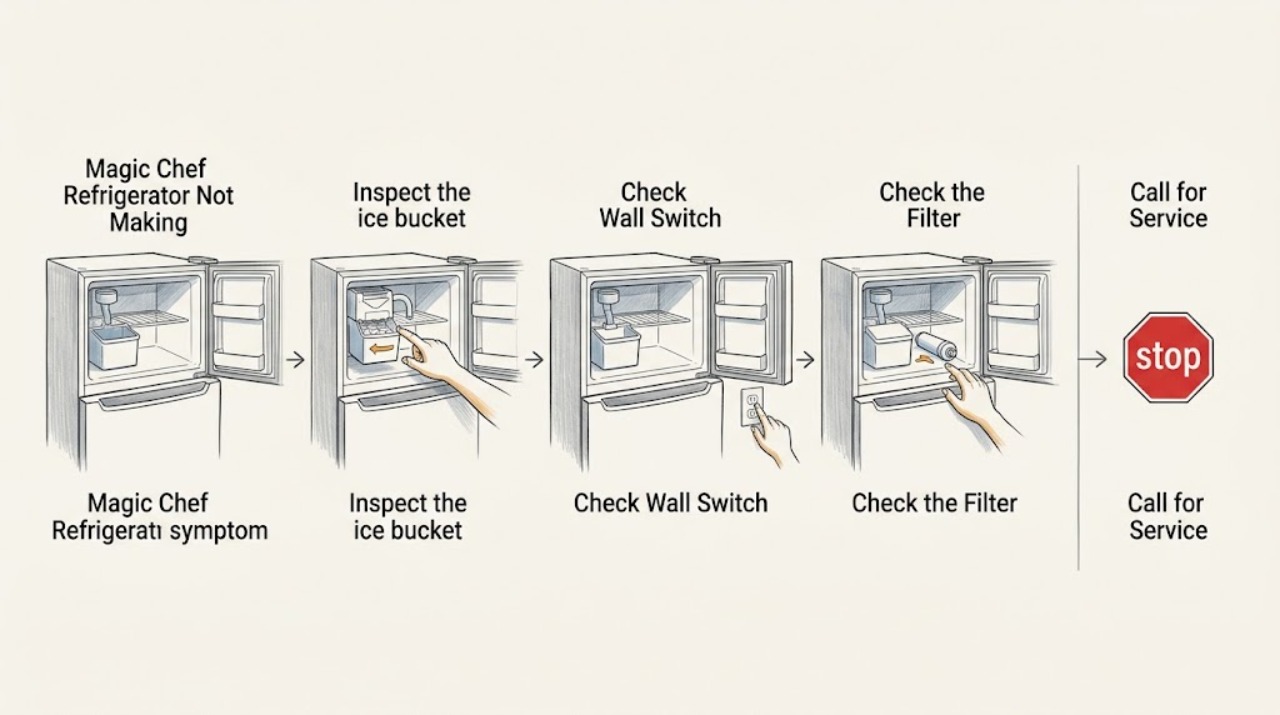
When a Magic Chef refrigerator stops making ice, first confirm that the model is equipped for automatic ice production and that the freezer is cold enough for its ice cycle. Then check the ice maker's on/off condition, the bucket, the accessible water supply, and any filter. If the mold never fills after those checks, do not force the mechanism or test live voltage; arrange model-specific service.
Work through in order
Diagnostic checks
Use only checks that match the exact appliance or system and its official guide.
-
Check 1
Inspect the ice bucket and mold without removing covers; note whether there are fresh cubes, a bridged mass, an empty dry mold, or an ice bucket that is full but not delivering.
Expected result: The bucket is full, cubes are clumped, or the mold is empty.
Next step: Record the pattern and continue with the checks that match it; do not chip ice with a sharp object.
Stop if: If there is no ice-making hardware, this topic does not apply to the configuration.
Why this matters
Why: The symptom may be delivery blockage, an ice-cycle problem, or lack of water rather than a single confirmed failed part.
-
Check 2
Verify the ice maker is switched on, the bucket is fully seated, and the freezer door closes against its gasket without an obstruction.
Expected result: The ice maker is off, the bucket is mis-seated, or the door does not seal.
Next step: Correct only the accessible condition according to the model instructions and allow a normal cycle to run.
Stop if: Continue to the freezer-temperature and water-path checks.
Why this matters
Why: A control or interlock condition can prevent a cycle from starting or stop ice delivery.
-
Check 3
Check for normal freezer coldness and inspect any accessible water filter, supply line, and shutoff for a kink, closed valve, or incorrect seating; do not disconnect pressurized tubing.
Expected result: The freezer is warm, the line is kinked or shut off, or the filter is not seated.
Next step: Restore the safe accessible condition and reassess; follow the manual for any filter replacement.
Stop if: A dry mold after normal conditions points beyond basic user checks.
Why this matters
Why: The ice maker may not reach its operating condition or may not receive water.
-
Check 4
Observe one requested cycle without inserting tools into the ice maker and listen for a fill or motor response only from a safe position.
Expected result: The mold stays dry after the refrigerator is cold and the basic controls and water path are correct.
Next step: Stop DIY testing and arrange qualified appliance service.
Stop if: Do not repeatedly force the ejector or bypass a safety control.
Why this matters
Why: A valve, ice-maker mechanism, sensor, or control fault is possible and needs model-specific diagnosis.
Use your observations
Decision map
Find the observation that best matches what you see, then follow the next safe action.
-
PATH 01Next step
What you see
The bucket is full but cubes will not leave the dispenser
Do this next
Check the seated bucket and accessible chute without forcing frozen parts.
-
PATH 02Next step
What you see
The mold is dry and the freezer is warm or the water path is restricted
Do this next
Correct the safe setting, seal, filter, or supply condition and allow a normal cycle.
-
PATH 03Next step
What you see
The freezer is operating normally and the mold stays dry
Do this next
Arrange qualified model-specific service rather than applying live electrical tests.
Helpful context
Understand the symptom
Confirm the kind of ice failure
No new cubes, a full bucket that will not dispense, and a mold that is frozen together are different symptoms. Start by looking for evidence of a completed ice cycle before considering a component.
When checks do not resolve it
Need a professional?
Use qualified service for persistent ice-production failure or internal testing.
Common questions
FAQ
How can I tell whether the ice maker or dispenser is the problem?
Look for new cubes in the bucket. A full bucket with no delivery points to the delivery path; an empty dry mold after normal freezer conditions points to the ice-making or fill path.
Can I pry frozen cubes loose with a knife?
No. Do not use a sharp tool in the ice maker or freezer. Follow the model instructions or request service.
Read the exact guide
Official sources
- 4.5 CU.FT. REFRIGERATOR INSTRUCTION MANUALMC Appliance / Magic Chef · Magic Chef refrigerator freezer operation, temperature control, maintenance, and safety
- 17.6 cu. ft. Top-Mount Refrigerator in BlackMagic Chef · Magic Chef refrigerator compartment and model-dependent ice/freezer features
Community feedback
Share a repair observation
Share a plain-text repair observation. Accepted observations are published automatically; this page may take a moment to update.