
On this page
Start here
Quick answer
Turn the dishwasher off before inspecting the spray arms. Maytag says to spin the middle spray arm by hand before a cycle and rearrange dishes if it meets resistance; it also says that blocked arms, food residue, hard-water deposits, loading, and the selected cycle can affect cleaning. Remove visible food from the accessible arm holes only as the exact model manual allows, clean the removable filter system with water and a soft brush, and reinstall every filter securely. Do not run the dishwasher without its filters, poke deep into the pump, or assume recurring food in the arms proves a failed pump or chopper. If clean arms and filters clog again quickly, the arms do not rotate with a clear load, or water circulation remains weak, stop disassembling and arrange model-specific service.
Before you begin
Safety first
- Do not run the dishwasher without filters, open the pump, bypass a screen, perform live electrical tests, or use metal tools to enlarge spray holes. Keep hands clear of broken glass and stop for leaks or exposed electrical parts.
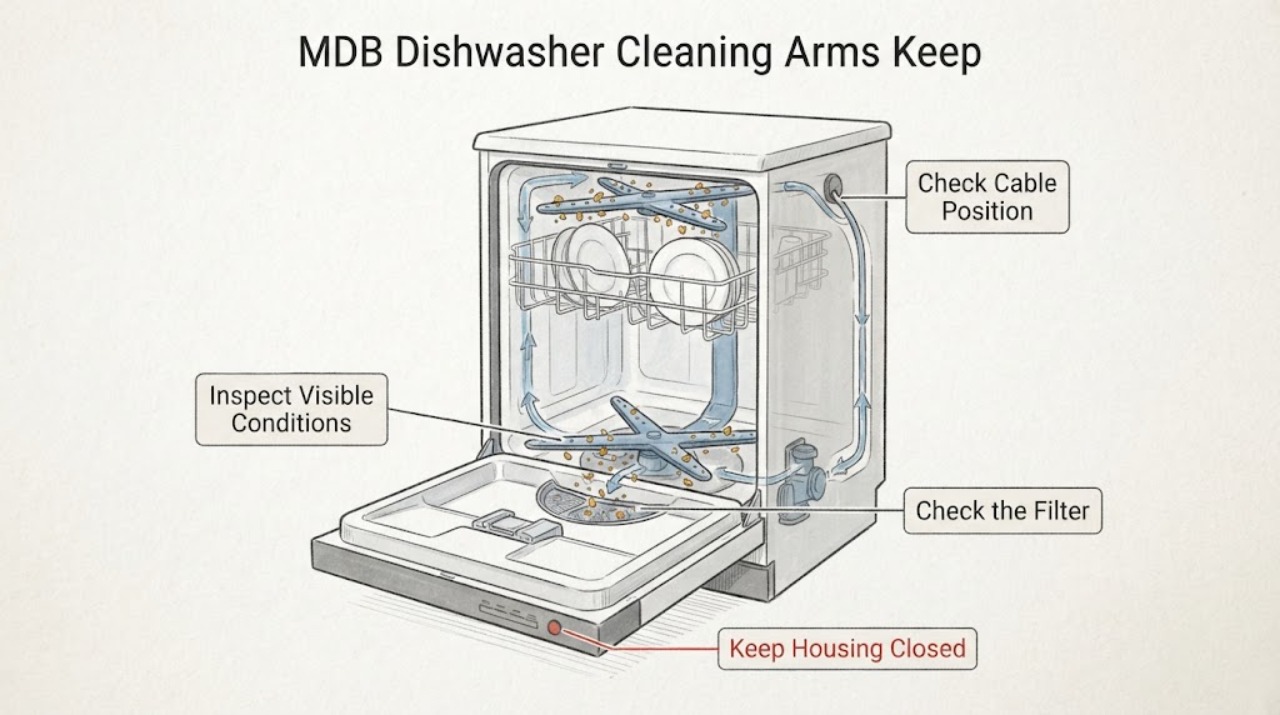
Work through in order
Diagnostic checks
Use only checks that match the exact appliance or system and its official guide.
-
Check 1
Cancel the cycle, let hot water and parts cool, and remove the racks only as needed to look at the middle and lower spray arms. With the dishwasher stopped, rotate the middle arm by hand and note which arm has blocked holes or resistance. Keep fingers away from sharp debris and do not run a cycle with a loose part.
Expected result: The arm meets a dish or rack, the arm itself resists with a clear load, or the arm turns freely but has visible food or mineral deposits.
Next step: Rearrange the load for a simple obstruction. If the arm is visibly clogged, continue with the model-specific cleaning check; if it resists with a clear load, stop and arrange service rather than forcing it.
Why this matters
Why: Maytag says resistance before a cycle can come from dishes blocking the arm, while a free arm with clogged holes is a separate cleaning issue. Neither observation identifies a failed pump.
-
Check 2
With power off and the dishwasher cool, remove only an arm that the exact MDB manual identifies as user-removable. Rinse the arm and inspect the holes for food or mineral material; use water and a soft, non-metal brush where the manual permits. Do not use a drill, wire, knife, or deep pick to enlarge or force a nozzle.
Expected result: Debris rinses out, hard deposits remain, the arm cannot be removed as the manual describes, or the arm is cracked, loose, or distorted.
Next step: Reinstall a clean, intact arm exactly as the manual shows and confirm that it spins freely. Stop if removal requires force or the part is damaged, and provide the model to Maytag service.
Why this matters
Why: Rinsable debris or deposits support a cleaning and water-quality branch. A cracked, distorted, or non-removable assembly needs model-specific parts/service information; it does not justify a generic arm or pump replacement.
-
Check 3
Inspect the bottom filter or foreign-object area after removing the lower rack. Carefully remove only visible loose food, labels, toothpicks, or other objects from the accessible area, then rinse the filter under running water and use a soft brush for residue. Do not reach into a hidden pump opening or handle broken glass with bare fingers.
Expected result: The filter or foreign-object cup contains food, the mesh is coated, the filter is missing or not seated, or the filter area is clear and correctly locked.
Next step: Replace and lock every filter before operating the dishwasher. If the filter is damaged, missing, or repeatedly fills with large debris, stop and arrange model-specific service; do not run without the filters.
Why this matters
Why: Maytag says food and foreign objects around the filter area can cause further issues and that regular filter cleaning helps prevent food particles from recirculating. A clean, correctly installed filter does not rule out a circulation fault.
-
Check 4
Review loading and cycle choices: keep dishes from touching the spray arms, avoid blocking the arm path, face soiled surfaces downward and inward, and confirm that a top-rack-only cycle was not selected when the lower rack needs washing. Do not overload the racks.
Expected result: A dish blocks an arm, the lower arm is inactive because of the selected cycle, the rack is overloaded, or the load leaves clear arm paths.
Next step: Correct the loading or cycle selection and observe one normal run with clean, securely installed filters. If the arms clog again despite clear paths, move to the water and service checks.
Why this matters
Why: Maytag states that loading can restrict water circulation and that Top Rack Only does not engage the lower spray arms. These conditions can mimic a spray-arm failure without explaining recurring food inside a clear arm.
-
Check 5
Check the external water supply is open and note whether the dishwasher fills, sprays, drains, and leaves unusual standing water. Do not remove hoses, open the circulation pump, or perform a live pressure measurement as a first response to clogged arm holes.
Expected result: The water supply is restricted, the dishwasher has weak or absent circulation, standing water remains, or fill, spray, and drain behavior appear normal.
Next step: Correct only an accessible supply condition. For weak circulation, repeated standing water, or a recurring clog with a clean filter, stop internal disassembly and arrange model-specific service.
Why this matters
Why: Maytag identifies water supply, pressure, temperature, and drainage as separate cleaning factors. Weak circulation or standing water with clean arms and filters broadens the problem beyond arm cleaning, but does not identify a pump or chopper failure.
-
Check 6
Record how soon the holes clog again, which food particles appear, the exact MDB model and serial information, whether the filter was intact, and whether cleaning performance or arm rotation changed after cleaning. Keep photos of the arm holes and filter area for service.
Expected result: Clogging returns after one or two cycles, returns gradually with mineral film, or stops after a clean arm, filter, and corrected load.
Next step: Use the exact model details to request service when recurrence is rapid or cleaning performance remains poor. Do not order a pump, chopper, filter housing, or spray arm without a model-specific diagnosis.
Why this matters
Why: Rapid recurrence with large debris suggests a continuing debris-path or circulation issue that cannot be diagnosed from the visible arm alone. Gradual deposits fit a cleaning or hard-water branch, while durable improvement supports maintenance rather than a confirmed part failure.
Use your observations
Decision map
Find the observation that best matches what you see, then follow the next safe action.
-
PATH 01Next step
What you see
The middle or lower spray arm contacts a dish or rack, and it spins freely after the load is rearranged.
Do this next
Run a correctly loaded cycle with secure filters and monitor whether debris returns; do not replace a component based on the original obstruction.
Why this path and its safety boundary
Why it matters: Maytag's documented obstruction condition is more likely than a failed wash pump for that cycle.
-
PATH 02Next step
What you see
Food or mineral residue is visible in the arm holes or filter, and the arm turns normally once cleaned and reinstalled.
Do this next
Maintain the filter and arm using the exact model instructions. If the same particles return quickly, arrange service instead of repeatedly picking at the nozzles.
Why this path and its safety boundary
Why it matters: A maintenance or debris-recirculation issue is supported, but the source of unusually large or rapidly recurring food remains unresolved.
-
PATH 03Next step
What you see
The lower rack was washed with Top Rack Only selected, the racks were overloaded, or dishes blocked the spray path.
Do this next
Correct the cycle and loading, then observe one normal run. Escalate only if clean arms and filters still clog or circulation remains weak.
Why this path and its safety boundary
Why it matters: The cycle or loading can explain poor coverage and residue without proving arm or pump failure.
-
PATH 04Next step
What you see
Large food particles return to multiple spray arms after the filter is clean and locked, or the arms resist or fail to rotate with a clear load.
Do this next
Stop internal disassembly, preserve the debris and model details, and arrange qualified Maytag dishwasher service. Do not run without filters or bypass a protective screen.
Why this path and its safety boundary
Why it matters: The problem may involve a deeper debris path, circulation, or model-specific assembly, but the visible symptom does not identify a pump, chopper, motor, or other part.
Helpful context
Understand the symptom
Repeated food in the spray-arm holes is a real cleaning-system symptom, but it is not a pump diagnosis. Maytag's public guidance separates a blocked or obstructed arm from filter maintenance, loading, water supply, cycle selection, detergent, and hard-water residue. Start by documenting which arm is affected and whether it turns freely with the dishwasher stopped.
The task does not provide an exact MDB model. Arm removal, filter style, and access to the lower wash area vary, so use the matching manual for any removable-arm step. The safe family-level boundary is external inspection, hand rotation with power off, correct loading, and filter cleaning without opening the pump or guessing at an internal part.
When checks do not resolve it
Need a professional?
Call qualified service for recurring food in multiple spray arms, weak circulation after safe cleaning, an arm that cannot rotate with a clear load, a damaged arm or filter, standing water, or any suspected pump or chopper issue.
Safety scope: Do not run the dishwasher without filters, open the pump, bypass a screen, perform live electrical tests, or use metal tools to enlarge spray holes. Keep hands clear of broken glass and stop for leaks or exposed electrical parts.
Have this ready
- Provide the full MDB model and serial information, affected arm, particle type, recurrence interval, filter condition, cycle used, loading pattern, standing-water observation, and photos of the arm and filter area.
Common questions
FAQ
Do repeatedly clogged Maytag dishwasher arms prove that the pump or chopper is bad?
No. Maytag's guidance first separates arm obstruction, cleaning, loading, selected cycle, water supply, filter, and hard-water residue. Recurring debris after those checks needs model-specific diagnosis; it does not identify a pump or chopper by itself.
Can I run the Maytag dishwasher with the filter removed to see where food is going?
No. Maytag says to reinstall and lock the filters before operation. Running without the filters can allow objects into protected areas and create further problems.
Should I use a pin or wire to open every clogged spray-arm hole?
Do not enlarge or force the nozzles with metal tools. Use the exact model instructions for a removable arm and safe cleaning method. If debris will not rinse out or returns rapidly, stop and arrange service.
Read the exact guide
Official sources
- Cleaning the Removable Filtration System - Dishwasher - Product HelpMaytag Product Help · Maytag dishwasher removable-filter and foreign-object cleaning guidance at family scope
- Spray Arm Not Working - Dishwasher - Product HelpMaytag Product Help · Maytag dishwasher spray-arm obstruction, cleaning, cycle, and service guidance at family scope
- Food Residue Remains on Dishes - Product HelpMaytag Product Help · Maytag dishwasher food-residue and wash-performance troubleshooting at family scope
- Maytag Dishwasher Owner's ManualMaytag · Maytag dishwasher owner guidance in the opened manual family; used for general food-scrape, loading, spray-arm clearance, and safety boundaries, not exact MDB variant fitment
Community feedback
Share a repair observation
Share a plain-text repair observation. Accepted observations are published automatically; this page may take a moment to update.