
On this page
Start here
Quick answer
If a Maytag dishwasher leaves more than a small amount of water in the filter area after a completed cycle, stop repeated cycles and first note whether the cycle was interrupted, the water is dirty, or the water returns from the sink or air gap. From a dry, safe location, turn off power and close the under-sink water valve before handling standing water; do not touch wet electrical parts. Remove only loose water and clean a filter that the exact manual identifies as user-accessible. Then inspect the visible drain hose for a kink, a low route, a blocked air gap, or a garbage-disposal connection problem. A steady hum with no flow, grinding, no pump sound, a repeated drain code, a damaged hose, or water that remains after these checks is a service boundary. Never use drain-opening chemicals in the dishwasher.
Before you begin
Safety first
- This article covers stopping the appliance, safe standing-water removal, a manual-documented filter check, visible hose and sink observations, and one controlled confirmation after an obvious correction. It does not authorize touching wet electrical equipment, opening panels, disconnecting pressurized or water-filled lines, bypassing a latch, moving a built-in unit alone, testing live parts, or replacing internal components.
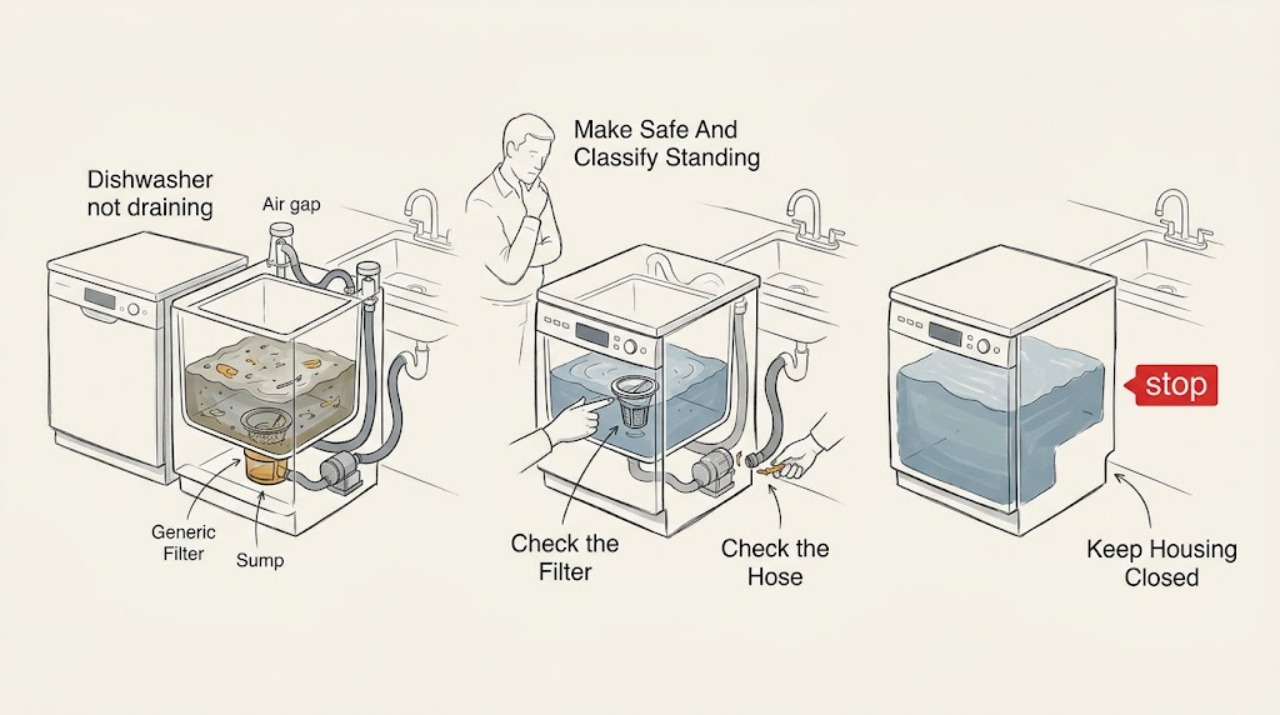
Work through in order
Diagnostic checks
Use only checks that match the exact appliance or system and its official guide.
-
Check 1
Stop the dishwasher and note whether the cycle completed, whether water is only in the filter recess or covers the tub floor, and whether water returns when the sink or disposal drains. From a dry safe location, turn off dishwasher power and close the water valve before handling water; keep hands out of water near electrical parts.
Expected result: Only a small amount of water is in the filter area, the tub floor is covered after a completed cycle, the cycle was interrupted, dirty water returns from the sink, or water is near an outlet, cord, or control.
Next step: If the situation is unsafe, keep power and water off and arrange service. Otherwise remove only loose water with towels or a cup if safe, then continue to the model-specific filter check.
Stop if: Stop for smoke, sparks, burning odor, damaged wiring, uncontrolled water, or water touching electrical parts.
Why this matters
Why: A small filter-area amount or interrupted cycle may not indicate a failed drain. Excess water after a completed cycle suggests a drain restriction, pump, or control issue; sink-related return suggests the outlet path or household plumbing. Water near electrical parts is an immediate safety boundary.
-
Check 2
With power off and the water cool, remove the lower rack and inspect the filter only if the Maytag manual identifies it as user-accessible. Rinse removable filter parts with warm water and a soft brush, and look at the visible sump for loose food, paper, seeds, toothpicks, or glass without reaching into the pump.
Expected result: The filter mesh is coated, the sump has loose debris, the filter is clear, the filter is damaged or will not seat, or the model has no documented removable filter.
Next step: Rinse and refit the filter exactly as the manual shows. If it is damaged, absent, or cannot seat, leave the dishwasher off and arrange service rather than improvising a cover or running without it.
Stop if: Do not force the filter, use abrasive or sharp tools, reach into an impeller, remove a sealed cover, or continue if water is hot or near electrical parts.
Why this matters
Why: Food or label debris can restrict flow before it reaches the pump. A clear filter, an absent filter access procedure, or a filter that cannot lock correctly makes a hose, air gap, pump, or control issue more likely.
-
Check 3
Under the sink, inspect the visible drain hose for kinks, crushing, sagging, or a flat route. Check whether the model installation calls for a secured high loop or air gap, and look for residue at the air-gap cap or hose connection without disconnecting a water-filled line.
Expected result: The hose is kinked or low, the air gap is blocked, the hose connection is wet, the route looks correct, or the hose cannot be inspected without moving the dishwasher.
Next step: Correct only an obvious accessible hose position according to the Maytag installation instructions. If the air gap or plumbing needs disassembly, or the hose is behind the unit, leave the appliance off and arrange service or plumbing help.
Stop if: Do not detach a hose full of water, force a clamp, push sharp tools through the hose, pull the dishwasher, or work where water can reach electrical parts.
Why this matters
Why: A restricted or low hose and a blocked air gap can prevent discharge or allow sink wastewater to flow back. A wet connection can leak or admit air. A clear route makes a filter, sump, pump, or control problem more likely.
-
Check 4
If the dishwasher drains through a garbage disposal, check from the sink side whether the disposal or its dishwasher inlet is blocked and whether this is a new installation with a knockout plug issue. Run water in the sink and observe whether the sink, air gap, or tailpiece backs up; do not reach into powered equipment.
Expected result: The sink or disposal backs up, water spills from the air gap, the dishwasher connection is newly installed, the disposal inlet appears blocked, or the household drain flows freely.
Next step: Use ordinary sink or disposal maintenance only when safe and permitted; arrange plumbing help for a persistent backup. If the installation connection cannot be verified without hose removal, provide the model and installation details to a technician.
Stop if: Do not put hands or tools into a disposal, use chemical drain cleaner in the dishwasher, or disconnect a hose without power, water isolation, and safe containment.
Why this matters
Why: A downstream sink or disposal restriction can prevent the dishwasher from draining. A retained knockout plug can block a newly installed connection. Free household flow makes a dishwasher-side filter, hose, pump, or control fault more likely.
-
Check 5
After a documented filter or external-route correction, make at most one model-approved drain or short rinse observation from a dry safe position. Note whether water flows steadily, flows slowly, the pump hums without movement, grinding occurs, the pump is silent, or a drain-related code returns.
Expected result: The tub empties, flow is weak, a hum occurs with no flow, grinding occurs, there is no pump sound, or an error code returns.
Next step: Stop testing when the result is unchanged or abnormal. Record the sound, water level, timing, code, and checks already completed for appliance service.
Stop if: Do not measure live voltage, bypass a door latch, open panels, probe the pump, or repeat cycles with standing water, abnormal noise, odor, heat, or leakage.
Why this matters
Why: Normal flow after a correction supports a filter, hose, air-gap, disposer, or household-drain restriction that was resolved. Weak flow or a hum can indicate an obstruction or pump problem; grinding can indicate hard debris. Silence or a recurring code can involve the pump, door latch, wiring, or control.
-
Check 6
Compare the result with the original symptom: determine whether the cycle was interrupted, whether the tub drains after the safe correction, and whether water returns only after sink use. Do not keep running full cycles to prove a fault.
Expected result: The tub now drains, water remains after a complete cycle, water returns from the sink, or the pump is silent or noisy despite a clear visible drain path.
Next step: Keep the dishwasher off when water remains or a fault recurs. Arrange appliance service for a dishwasher-side failure and plumbing service for a household drain backup; give the technician the exact model and timing.
Stop if: Stop for water near electrical parts, smoke, sparks, burning odor, a damaged cord or hose, uncontrolled water, or a recurring fault.
Why this matters
Why: Recovery after one correction supports the corresponding filter, hose, air-gap, disposer, or household-drain cause. Persistent water after a completed cycle with a clear outlet makes a pump, sump, internal hose, door latch, wiring, or control issue more likely.
Use your observations
Decision map
Find the observation that best matches what you see, then follow the next safe action.
-
PATH 01Safety boundary
What you see
Only a small amount of water remains in the filter recess, or the cycle was interrupted, and a documented drain or rinse completes normally.
Do this next
Use the owner's manual to confirm the expected residual level and monitor the next completed cycle. Escalate if water covers the tub floor, becomes dirty, or returns after sink use.
Why this path and its safety boundary
Why it matters: This pattern can be normal for the model or caused by the interrupted cycle rather than a failed drain system.
Safety stop: Do not treat rising water, repeated standing water, or a leak as normal residual water.
-
PATH 02Safety boundary
What you see
The filter or visible sump contains debris, the hose is kinked or low, the air gap or disposal inlet is blocked, or sink drainage backs up, and the dishwasher does not empty.
Do this next
Correct only a documented, accessible filter or hose-route issue. Use plumbing help for a sink or disposal backup, and arrange service when access requires disconnecting a hose or moving the dishwasher.
Why this path and its safety boundary
Why it matters: A restriction in the filter, sump, hose, air gap, disposer, or household drain is more likely than a failed control.
Safety stop: Do not use chemical drain cleaner, detach a water-filled hose, or probe a blockage with a sharp tool.
-
PATH 03Safety boundary
What you see
The visible filter and outlet path are clear, but the tub remains full; the pump hums without flow, grinds, stays silent, or a drain code returns.
Do this next
Leave the dishwasher off and arrange qualified appliance service. Provide the sound, flow pattern, water level, error code, model, and external checks completed.
Why this path and its safety boundary
Why it matters: A drain pump or impeller, internal obstruction, door-latch authorization, wiring, or control issue is more likely. These cannot be distinguished safely by repeated cycles or live tests.
Safety stop: Do not open panels, reach into the pump, bypass a latch, measure live circuits, or order a pump before diagnosis.
-
PATH 04Safety boundary
What you see
Water reaches electrical parts, a cord or hose is damaged, smoke or sparks occur, water is uncontrolled, the source is behind the unit, or the fault persists after the safe checks.
Do this next
From a dry safe location, keep power off and close the water valve if that can be done without touching wet equipment. Arrange prompt qualified appliance service; use plumbing help for a household backup.
Why this path and its safety boundary
Why it matters: The symptom has crossed the owner-check boundary and continued operation could spread water or expose electrical and internal components.
Safety stop: Do not touch wet electrical equipment, restart the dishwasher, pull it from the cabinet, or attempt internal repair.
Helpful context
Understand the symptom
Separate normal filter-area water from a failed drain
A small amount of water in the recessed filter area can protect seals on some Maytag models, and an interrupted cycle may leave water behind. Water covering the tub floor after a complete cycle, dirty water returning from the sink, or a level that rises from cycle to cycle is more consistent with a restricted drain path. Record the amount and whether the cycle reached its drain stage before taking anything apart.
The drain path includes the sink connection
The drain pump sends water through the hose to a sink tailpiece, garbage disposal, or air gap. A kink, crushed hose, low route, blocked air gap, blocked disposer inlet, or retained disposer knockout plug can stop discharge or let wastewater return. Installation details vary, so compare the hose route with the Maytag installation instructions for the exact model instead of applying one universal height.
Pump sounds change the next decision
A steady hum without water movement can point to an obstruction near the pump, while grinding can indicate hard debris in the pump area. No pump sound during the drain stage can point to a pump, wiring, door latch, or control issue. These observations help a technician, but they do not justify probing the pump or testing live circuits at home.
Safety boundary
Stop conditions
- Stop and keep the dishwasher off if water reaches an outlet, plug, cord, controls, or other electrical parts; do not touch wet electrical equipment.
- Do not open cabinet, pump, sump, control, or sealed panels, bypass a door latch, test live circuits, or reach into a disposal or pump.
- Stop for smoke, burning odor, sparks, abnormal grinding, hot water that cannot be contained, a damaged cord or hose, uncontrolled water, or a repeated drain fault.
- Do not use drain-opening chemicals, hand dish soap, improvised treatments, or repeated cycles to force a blocked dishwasher to drain.
- Do not disconnect a water-filled or pressurized line, pull a built-in dishwasher, or move it alone for access.
- Do not order a filter, hose, air-gap part, drain pump, latch, or control until the exact model and qualified diagnosis identify the failed part and fit.
Only after diagnosis
Potential parts
- dishwasher filter or filter cover
Consider this category only when the exact model documents the filter, inspection confirms damage or inability to seat, and cleaning or correct refitting does not resolve the drain symptom.
Confirm the exact Maytag model, filter design, locking interface, and manufacturer fit information before ordering. - dishwasher drain hose or air-gap component
Consider this category only when the confirmed drain path has a split, crushed, blocked, or damaged hose or air-gap component after routing and household plumbing are checked.
Confirm the exact Maytag model, hose type, connection points, routing requirements, and manufacturer fit information before ordering. - dishwasher drain pump or control
Consider this category only when qualified diagnosis finds no external restriction and links a silent pump, hum without flow, recurring drain code, wiring, or control symptom to the failed assembly.
Confirm the exact Maytag model, pump or control revision, connectors, and technician diagnosis before ordering; do not choose by appearance alone.
When checks do not resolve it
Need a professional?
Arrange appliance service when standing water remains after the exact manual's filter and safe drain-path checks; when the pump hums without flow, grinds, stays silent, or a drain code returns; when the hose or pump requires internal access; or when water leaks inside the cabinet. Arrange plumbing help when the sink, disposal, air gap, or household drain backs up after the visible hose route is correct. Seek prompt help for smoke, sparks, burning odor, uncontrolled water, damaged wiring, or water near electrical parts.
Safety scope: This article covers stopping the appliance, safe standing-water removal, a manual-documented filter check, visible hose and sink observations, and one controlled confirmation after an obvious correction. It does not authorize touching wet electrical equipment, opening panels, disconnecting pressurized or water-filled lines, bypassing a latch, moving a built-in unit alone, testing live parts, or replacing internal components.
Common questions
FAQ
Is a small amount of water in a Maytag dishwasher normal?
A small amount in the recessed filter area can be normal on some models, and an interrupted cycle can leave water behind. Water covering the tub floor after a completed cycle or rising after sink use is more suggestive of a drain-path problem.
What should I check first when my Maytag dishwasher will not drain?
Turn off power from a dry safe location, note the water level, and inspect the documented filter and visible sump for debris. Then check the visible drain hose, high loop or air gap, disposer connection, and sink backup without disconnecting a water-filled line.
Can a garbage disposal stop a Maytag dishwasher from draining?
Yes. Food buildup, a blocked dishwasher inlet, a retained knockout plug on a new installation, or a sink-side blockage can stop discharge. If the sink or disposal backs up, arrange plumbing help rather than replacing a dishwasher pump by guesswork.
What does a humming Maytag dishwasher mean if no water moves?
Maytag's guidance treats a steady hum without water movement as a possible pump obstruction or jammed impeller. Keep power off, do not probe the pump, and arrange service if the visible filter and drain route are clear.
When should I stop using a Maytag dishwasher that will not drain?
Stop for water near electrical parts, smoke, sparks, burning odor, abnormal grinding, uncontrolled water, a damaged cord or hose, or a drain fault that returns. Keep it off and arrange qualified appliance service; use plumbing help for a sink or household-drain backup.
Read the exact guide
Official sources
- Dishwasher Not DrainingMaytag · Official Maytag troubleshooting page used for the main drain decision tree; exact access and cycle behavior vary by model.
- How to Unclog a Dishwasher That Won’t DrainMaytag · Official Maytag educational article used for the filter, standing-water, sink-side, and service branches; the owner's manual governs model-specific access.
- Dishwasher Error Codes - ReadingMaytag · Official Maytag error-code page used for code-recording and drain-fault branches; exact codes and meanings vary by model.
- Not Draining - Newly Installed - Dishwasher - Product HelpMaytag · Official Maytag installation troubleshooting used for hose-route and disposer branches; installation requirements must be confirmed for the exact model.
Community feedback
Share a repair observation
Share a plain-text repair observation. Accepted observations are published automatically; this page may take a moment to update.