
On this page
Start here
Quick answer
A Maytag dishwasher odor usually starts with trapped food soil, a filter or foreign-object cup that needs attention, residue on the tub or door gasket, or water that is not leaving through the drain path. First empty the dishwasher and identify whether the odor is musty, sour, sewage-like, chemical, or burning; stop using it for smoke, melting, a strong electrical or burning smell, or a leak near electrical parts. With power off and the exact manual in hand, clean the applicable filter or foreign-object cup and reinstall it securely, wipe the gasket and accessible tub surfaces, and check for standing water or a recurring drain problem. A small amount of water in some Maytag filter areas can be normal, but persistent odor, dirty dishes, standing water beyond the model's normal level, a blocked drain, or a damaged seal needs qualified dishwasher or plumbing service.
Before you begin
Safety first
- This article supports emptying the dishwasher, cool visual checks, model-approved filter or foreign-object-cup cleaning, accessible gasket care, and visible drain observations only. Pump, sump, heater, circulation, wiring, plumbing disconnection, and cabinet work belong to qualified service.
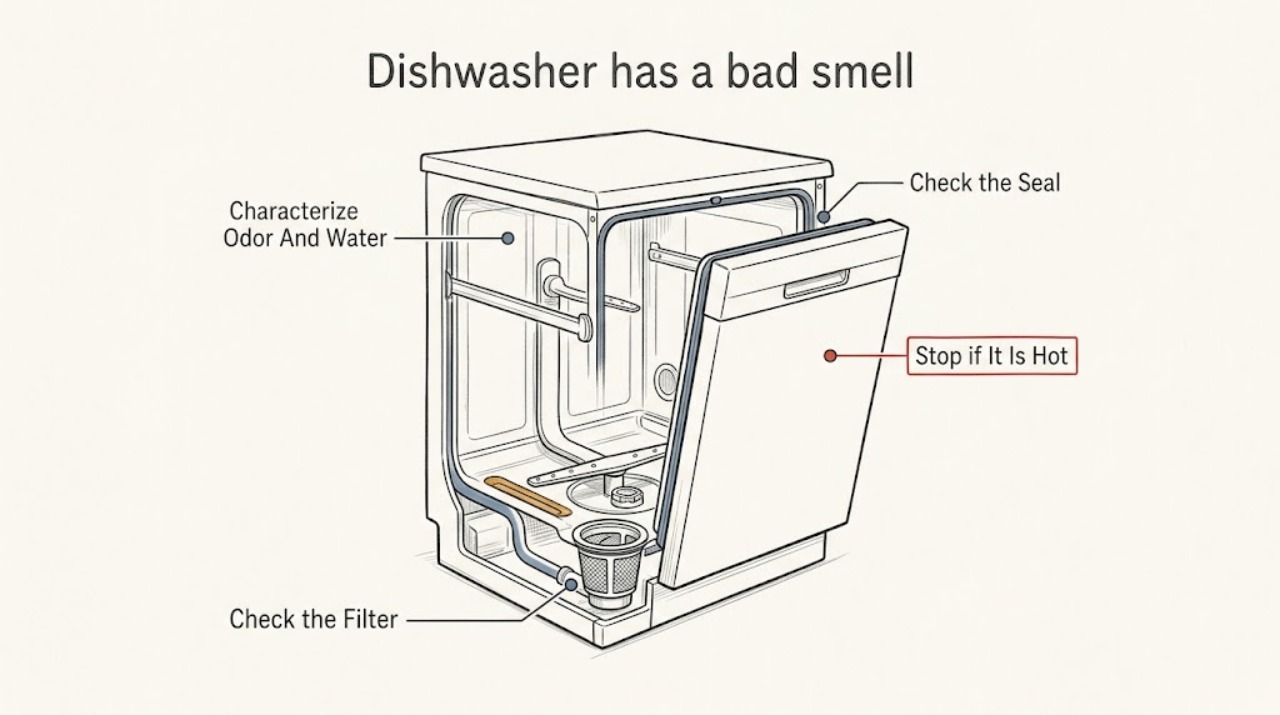
Work through in order
Diagnostic checks
Use only checks that match the exact appliance or system and its official guide.
-
Check 1
Empty the dishwasher and, without touching hot surfaces or standing water, note where the smell is strongest, whether it is musty, sour, sewage-like, chemical, or burning, whether dishes are gritty or dirty, and whether water remains in the tub or only in the filter area.
Expected result: The odor is food-like or musty, the filter area has a small amount of water, the tub floor has more water than expected, dishes are dirty, the smell is sewage-like, or there is smoke, melting, or a burning electrical odor.
Next step: Continue only with a cool, dry appliance and the exact model instructions. For persistent excess water or a sewage-like odor, inspect only visible drain connections and arrange service if the path is not clearly accessible; leave the machine off for a burning, smoke, melting, or electrical smell.
Stop if: Do not run the dishwasher for smoke, melting, sparking, a strong electrical or burning smell, a leak near electrical parts, or water that is unsafe to contain.
Why this matters
Why: Food soil, gasket buildup, and filter condition become more likely with a food-like or musty odor. Maytag says a small amount of filter-area water can be normal, while excess water, poor cleaning, or odor supports a filter or drain-path check. Burning or chemical symptoms are not a cleaning problem.
-
Check 2
Turn the dishwasher off, remove the lower rack only when the interior is safe, and use the exact Maytag model manual to identify the filtration style; clean a removable filter with running water and a soft brush, or empty the documented foreign-object cup without forcing parts.
Expected result: The removable filter has food soil or mineral deposits, the foreign-object cup contains particles or a hard object, the filter area is clear, the filter does not match the manual, or the part will not release safely.
Next step: Rinse and gently brush only as the manual allows, then reinstall every filter or cup so it is seated and locked. Do not operate without the required filtration parts. If a hard object is lodged below the filter or access is uncertain, stop and arrange service.
Stop if: Do not use a wire brush or abrasive pad, reach into a pump opening, force a filter, or run the dishwasher with a loose or missing filter.
Why this matters
Why: Maytag links filter cleaning with stronger water flow, fewer recirculated food particles, and odor prevention. A clear filter makes the gasket, tub, drain path, or internal circulation path more likely; a stuck or unfamiliar part is a model-specific service boundary.
-
Check 3
With the dishwasher empty and cool, wipe accessible tub surfaces, the door edge, and the gasket crevices using the cleaning method in the Maytag manual; remove visible food residue without pulling or deforming the seal, then wipe the area dry.
Expected result: Residue or dark buildup is present on the tub or gasket, the gasket is torn or no longer seats, the interior is clean but the smell remains, or the odor returns after one normal cleaning cycle.
Next step: If the seal is intact, keep the door and gasket clean and dry between loads and use only the model-approved cleaning procedure. If the gasket is damaged, the door does not close evenly, or odor persists, arrange appliance service rather than applying adhesive or fragrance.
Stop if: Do not use bleach, solvents, abrasive tools, or mixed cleaners unless the exact Maytag manual explicitly permits them; stop for a leak that reaches electrical components.
Why this matters
Why: Residue and gasket buildup can produce food-like or musty odor even when the filter is clean. A torn or distorted gasket can leak and needs replacement diagnosis; odor that remains with a clean interior makes drain or internal circulation causes more likely.
-
Check 4
After the filter and gasket check, inspect only the visible drain hose, sink connection, air gap or disposal connection if present, and the tub's remaining water; compare the water level with the exact Maytag manual and do not disconnect a wet hose without safe containment.
Expected result: Water covers the tub floor, the sink or air gap backs up, the visible hose is kinked or damaged, the drain connection is blocked, or only the small normal filter-area water remains.
Next step: Correct only a plainly visible installation issue according to the model instructions. If the household drain backs up, the hose is damaged, or water remains above the normal level after a cycle, leave the dishwasher off and arrange qualified plumbing or appliance service.
Stop if: Do not pull out a built-in dishwasher, open the pump housing, snake a hose through the appliance, or work on a wet connection near electrical wiring.
Why this matters
Why: Persistent excess water or backup points toward a drain-path restriction rather than odor alone. A small amount in the filter area can be normal according to Maytag. A damaged or inaccessible hose connection needs plumbing or appliance service.
-
Check 5
When the filter or cup is securely installed, the gasket is intact, the tub is at its normal starting condition, and no hazard is present, run one empty cleaning or normal cycle using only the detergent and cleaning method allowed by the exact Maytag instructions; observe drain completion, odor, leaks, and dish-cleaning performance afterward.
Expected result: The odor is gone, the smell returns immediately, water remains above the normal level, dishes remain gritty or dirty, a leak appears, or a new burning or electrical smell develops.
Next step: Use the dishwasher only while it completes normally and remains dry. For recurring odor, excess water, poor cleaning, or any abnormal smell, leave it off and give service the filter findings, water level, drain observations, and cycle result.
Stop if: Stop immediately for smoke, sparking, melting, burning electrical odor, a leak near electrical components, overflow, or a cycle that cannot drain.
Why this matters
Why: A successful cycle supports removable residue or filter soil as the likely cause, but recurrence indicates unresolved drain, gasket, filter, or internal circulation contamination. Dirty dishes or abnormal water after cleaning are performance clues, not proof of a particular pump or motor failure.
Use your observations
Decision map
Find the observation that best matches what you see, then follow the next safe action.
-
PATH 01Safety boundary
What you see
The smell is food-like or musty, visible soil is on a removable filter or foreign-object cup, and the odor improves after the applicable part is cleaned and securely reinstalled.
Do this next
Monitor the next normal load, keep large food particles out of the filter area, and repeat the model-approved maintenance interval. If the odor returns quickly or water remains, inspect the drain branch and arrange service.
Why this path and its safety boundary
Why it matters: Trapped food residue or filter-area buildup is more likely than a failed pump or control.
Safety stop: Do not run without the filter or cup locked in place, and do not reach into the pump opening to remove an object.
-
PATH 02Safety boundary
What you see
The filter is clear but residue or dark buildup is found in gasket crevices or on accessible tub surfaces, and the smell improves after cleaning.
Do this next
Keep the gasket and door edge clean and dry and follow the model's cleaning guidance. If the gasket is torn, the door does not seal, or the odor returns, request appliance service.
Why this path and its safety boundary
Why it matters: Door-seal or interior residue is more likely than a drain restriction for this episode.
Safety stop: Do not glue a gasket, use abrasive tools, mix cleaning chemicals, or operate if the seal leaks toward electrical components.
-
PATH 03Safety boundary
What you see
Only a small amount of water remains in the filter area, the tub otherwise drains normally, and there is no excess water, poor cleaning, or recurring odor.
Do this next
Do not remove water by force. Continue normal use and routine filter or interior maintenance according to the exact model instructions; investigate if the amount increases or odor appears.
Why this path and its safety boundary
Why it matters: Maytag identifies this limited filter-area water as normal in applicable designs because it helps keep seals from drying.
Safety stop: Stop if water covers the tub floor, the dishwasher backs up, leaks, or cannot complete its drain.
-
PATH 04Safety boundary
What you see
The odor persists with a clean filter and gasket, water remains above the normal filter-area level, the sink or air gap backs up, or the dishwasher does not drain completely.
Do this next
Check only visible connections and model-approved installation points. Leave the dishwasher off and arrange plumbing or appliance service when the path is blocked, damaged, inaccessible, or still retains water.
Why this path and its safety boundary
Why it matters: A blocked or incorrectly installed drain path, drain hose, or internal drain system is more likely than surface residue alone.
Safety stop: Do not pull out a built-in appliance, open the pump, or disconnect a wet hose without safe containment and power isolation.
-
PATH 05Safety boundary
What you see
The filter is clean and water drains, but dishes remain gritty or dirty, spray performance is abnormal, and odor returns after the permitted cleaning cycle.
Do this next
Verify only the model-approved loading, detergent, and spray-arm clearance checks. If poor cleaning and odor persist, arrange appliance service for circulation and drain diagnosis.
Why this path and its safety boundary
Why it matters: A recirculation, spray-arm, water-temperature, detergent, or internal soil issue may be contributing; odor alone cannot identify the failed component.
Safety stop: Do not remove the sump, circulation pump, heater, or wiring as a cleaning experiment.
-
PATH 06Safety boundary
What you see
The smell is burning, electrical, or chemical, or the dishwasher leaks, smokes, sparks, melts, overflows, or has a damaged gasket or glass component.
Do this next
Stop the dishwasher, keep people away from the hazard, and arrange qualified appliance or electrical service; follow local emergency guidance for smoke or fire.
Why this path and its safety boundary
Why it matters: This is an active fire, shock, chemical, or water-damage hazard, not routine dishwasher deodorizing.
Safety stop: Do not restart the dishwasher, touch wet electrical parts, add chemicals to mask the smell, or dismantle the appliance.
Helpful context
Understand the symptom
Find the odor source before replacing anything
A bad smell does not identify one failed part. Food particles can collect in a filter or foreign-object cup, residue can remain on tub surfaces, and buildup in the door gasket can smell musty. A drain restriction can leave odor-causing water or soil behind. Note whether the smell is strongest at the open door, filter area, drain connection, or outside the machine, and whether dishes are gritty, dirty, or left wet.
Maytag filter designs are not all the same
Maytag's own guidance describes a removable filter style and a maintenance-free filter system with a foreign-object cup. Do not twist a part that your model does not identify as removable. If your manual shows a filter, rinse it and use a soft brush for stuck soil; if it shows a cup, remove only the cup and reinstall it so it locks. Do not run the dishwasher with a loose or missing filter.
A little water may be normal; odor and excess water are different
Maytag notes that a small amount of water in the filter area can protect seals and should drain when the next cycle starts. That is different from water covering the tub floor, recurring drain failure, dirty dishes, or an odor that returns immediately after cleaning. Use the model's normal water level as the comparison and stop before disassembling the pump or drain hose.
Safety boundary
Stop conditions
- Leave the dishwasher off for burning or electrical odor, smoke, sparking, melting, overflow, or a leak near electrical parts.
- Do not reach into a pump or sump opening, pull out a built-in dishwasher, disconnect wet plumbing, or remove panels as an ordinary odor check.
- Do not operate with a loose or missing filter, foreign-object cup, damaged gasket, or an uncertain reinstallation.
- Stop after the model-approved filter, gasket, visible drain, and one controlled cleaning-cycle check if odor or excess water returns.
- Do not replace a pump, motor, drain hose, filter, gasket, or control based only on odor; confirm the exact model-specific diagnosis first.
Only after diagnosis
Potential parts
- Maytag dishwasher filter assembly or foreign-object cup
Consider this part class only when the exact model uses it and the filter or cup is cracked, distorted, missing, or unable to lock after cleaning, or qualified diagnosis finds it contributes to recurring soil or odor.
Confirm the exact Maytag model, filtration style, locking features, and manufacturer fit information before ordering. - Maytag dishwasher door gasket
Consider this part class only when the gasket is torn, hardened, distorted, or confirmed by diagnosis as a source of leakage or odor retention after cleaning.
Confirm the exact Maytag model, gasket profile, installation direction, and manufacturer fit information before ordering. - Maytag dishwasher drain hose
Consider this part class only when the visible drain hose is damaged or qualified diagnosis confirms an internal hose restriction that cannot be corrected by safe routing.
Confirm the exact Maytag model, connection ends, routing requirements, and manufacturer fit information; built-in plumbing work may require qualified service. - Maytag dishwasher drain or circulation pump assembly
Consider this part class only after qualified diagnosis finds a pump or sump problem when the filter, gasket, visible drain path, and cleaning checks do not resolve odor or drainage symptoms.
Confirm the exact Maytag model and diagnostic result; do not infer pump failure from odor alone or attempt internal replacement as a routine cleaning step.
When checks do not resolve it
Need a professional?
Arrange qualified dishwasher or plumbing service when odor persists after the applicable filter and interior cleaning, returns immediately, accompanies excess water or poor draining, or comes with dirty or gritty dishes despite correct loading and detergent. Seek prompt help for burning or electrical smell, smoke, sparking, melting, overflow, a leak near electrical components, a damaged seal, or a dishwasher that cannot safely complete a cycle.
Safety scope: This article supports emptying the dishwasher, cool visual checks, model-approved filter or foreign-object-cup cleaning, accessible gasket care, and visible drain observations only. Pump, sump, heater, circulation, wiring, plumbing disconnection, and cabinet work belong to qualified service.
Common questions
FAQ
Why does my Maytag dishwasher smell bad?
Common paths include food soil in the filter or foreign-object cup, residue on the tub, buildup in the door gasket, or a drain restriction. Empty the machine, identify the odor and water level, and follow the exact Maytag filtration and cleaning instructions before considering a part.
Is water in the bottom of a Maytag dishwasher always a problem?
No. Maytag says a small amount in some filter areas can protect seals and may be drained when the next cycle starts. Water covering the tub floor, recurring odor, poor cleaning, backup, or incomplete draining is a different symptom that needs investigation.
Does every Maytag dishwasher have a removable filter?
No. Maytag describes both removable filter designs and a maintenance-free system with a foreign-object cup. Use the exact model manual to identify yours, do not force a part, and never run the dishwasher with a required filter or cup loose or missing.
How can I clean a Maytag dishwasher gasket that smells musty?
With the appliance empty, cool, and off, wipe accessible gasket crevices and the door edge using the exact Maytag cleaning method, then dry them. Do not deform, glue, or replace the seal without confirming the model; a torn gasket or persistent odor needs service.
When should I stop trying to remove a dishwasher odor myself?
Stop for burning or electrical odor, smoke, sparking, melting, overflow, a leak near electrical components, a damaged seal, or water that will not drain safely. Also stop when odor or excess water returns after the model-approved filter, gasket, visible drain, and one controlled cycle checks.
Read the exact guide
Official sources
- How to Clean the Dishwasher FiltersWhirlpool · Official Whirlpool manufacturer filter guidance used as cross-brand context; the exact Maytag filtration design and manual take precedence.
- How to get rid of dishwasher smells in 5 stepsWhirlpool · Official Whirlpool manufacturer guidance used for general odor mechanisms shared across compatible dishwasher designs; Maytag model instructions take precedence for the assigned appliance.
- Water Remains In Filter Area - Dishwasher - Product Help | MaytagMaytag · Official Maytag dishwasher troubleshooting page; its normal-water guidance applies only to the filter-area condition described for matching models.
- QUICK START GUIDE MAYTAG® DISHWASHERMaytag · Official Maytag quick-start guide hosted on the Whirlpool document domain; it applies to the named guide's design only, so the exact model manual controls.
- Cleaning the Filter - Dishwasher - Product Help | MaytagMaytag · Official Maytag dishwasher product-help page; filtration style and access vary by model, so the exact manual controls.
Community feedback
Share a repair observation
Share a plain-text repair observation. Accepted observations are published automatically; this page may take a moment to update.