
On this page
Start here
Quick answer
Start by describing the result: food remains on every dish, only one rack is dirty, white film or grit is left, or the dishwasher fills but does not spray well. Check that the water supply is open, select a cycle suited to the soil, and load dishes so spray arms and the detergent dispenser are not blocked. With the dishwasher off, spin the accessible spray arm by hand and inspect the model-appropriate filter; clean and reinstall a removable filter exactly as Maytag directs. Use fresh automatic-dishwasher detergent in the correct dispenser and amount, and use rinse aid if the model calls for it. If the wash remains poor after these checks, the spray system, water fill, circulation pump, heater, filter design, or control may need diagnosis. Do not open panels, reach into the pump, use drain chemicals, or keep testing if there is a burning smell, leak, damaged wiring, or a breaker that trips.
Before you begin
Safety first
- This article covers loading, detergent, visible spray-arm and filter checks, water-supply observation, and model-approved cleaning only. Pump access, internal circulation or heating checks, panel removal, wiring, live measurements, and leak repair belong to qualified professionals.
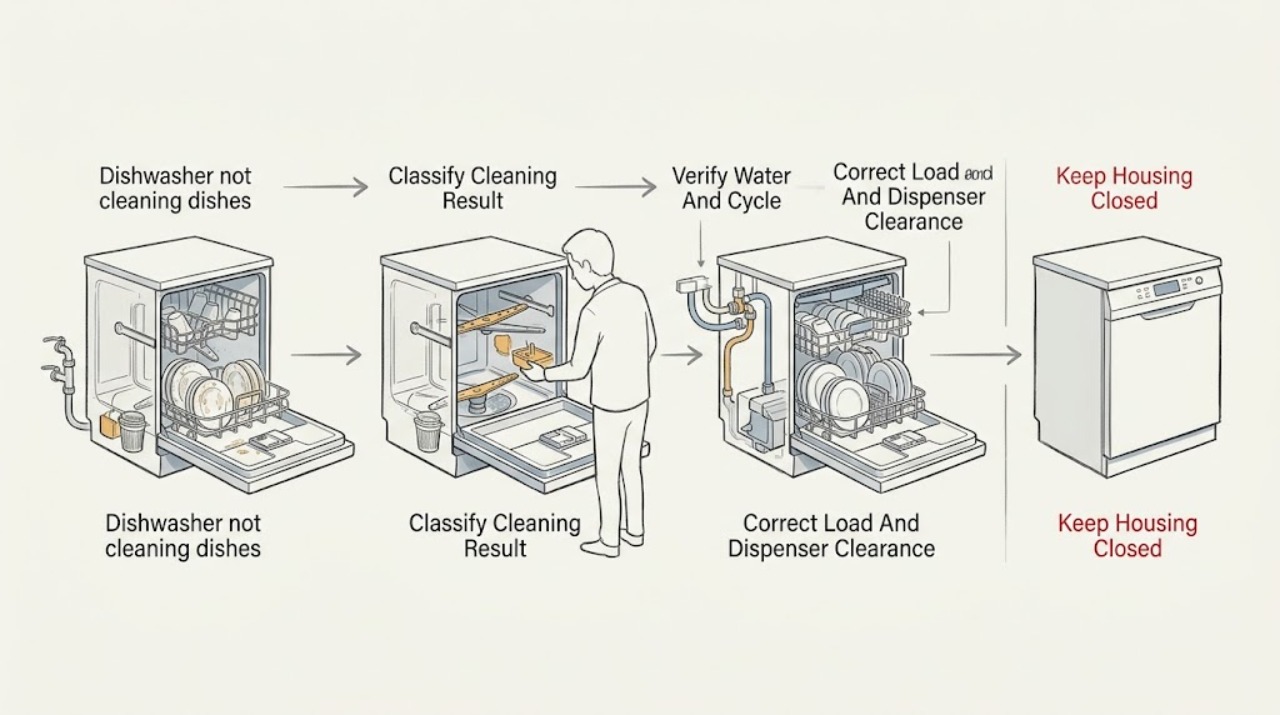
Work through in order
Diagnostic checks
Use only checks that match the exact appliance or system and its official guide.
-
Check 1
Inspect the clean load and record whether food remains on every rack, only the upper or lower rack, or mainly as white film, grit, or water spots. Note whether the dispenser opened and whether the dishwasher completed the cycle without a leak, unusual heat, burning odor, or electrical warning.
Expected result: All racks are dirty, one rack is dirty, the dispenser stayed closed, white film or grit remains, or the cycle ended with a leak or warning.
Next step: Stop use for a leak, burning odor, smoke, hot wiring, shock, or repeated breaker trip. Otherwise continue with water, loading, spray, filter, and detergent checks in that order.
Stop if: Do not run additional cycles to mask a safety symptom or open the dishwasher to inspect energized parts.
Why this matters
Why: The pattern separates shared wash or supply problems from a rack-specific spray or loading problem and separates soil from mineral or detergent residue. A leak, burning smell, or electrical warning is not a cleaning adjustment.
-
Check 2
Confirm from the normal under-sink access that the dishwasher water shutoff is open, then check the exact manual for the selected cycle and any high-temperature or heavy-soil option appropriate to the load. Do not alter plumbing or use a cycle outside the model instructions.
Expected result: The supply valve is closed or partly closed, the cycle is Top Rack Only or otherwise mismatched to the dirty rack, the load is heavily soiled, or the supply and cycle are appropriate.
Next step: Open only a plainly accessible supply valve if safe and permitted, select a model-appropriate cycle, and continue. If fill behavior is abnormal or the valve or connection leaks, stop and arrange plumbing or appliance service.
Stop if: Do not disconnect hoses, work on a leaking valve, or continue if water is reaching the floor.
Why this matters
Why: Insufficient fill or a cycle that intentionally omits a rack can leave dishes dirty without a failed part. A correct supply and cycle keep loading, spray, filter, detergent, and service causes in scope.
-
Check 3
Empty and reload the racks according to the Maytag manual: leave space between dishes, angle soiled surfaces toward the spray arms, keep tall items from blocking an arm, and make sure no item touches the detergent dispenser door. Do not pre-rinse away all soil unless the manual calls for it.
Expected result: A dish or pan blocks a spray arm or dispenser, the racks are overloaded, soiled surfaces face away from spray, or the load is correctly spaced and positioned.
Next step: Rearrange the load and run one appropriate supervised cycle if there is no hazard. If the same rack remains dirty, record it and continue to the spray-arm and filter checks.
Stop if: Do not force racks, load items that are unsafe for the model, or continue with a leak or damaged rack or spray arm.
Why this matters
Why: Blocked spray or detergent release can leave localized residue even when the dishwasher itself is working. A correct load with the same pattern shifts attention to spray movement, filter, detergent, water, or circulation.
-
Check 4
With the dishwasher off, inspect accessible spray-arm openings for food, mineral, or detergent residue and spin the middle arm by hand to check for free movement. Confirm that Top Rack Only was not selected when the lower rack needs cleaning; do not reach into the pump.
Expected result: An arm is blocked or resists movement, a side opening is split, Top Rack Only was selected, or the spray path is clear and the proper cycle was used.
Next step: Remove only loose accessible residue and correct the cycle or loading. If an arm is damaged, remains blocked, or the dishes stay dirty with free-moving arms, arrange qualified service rather than removing internal components.
Stop if: Do not use sharp tools in the arm, force it, or operate with a cracked spray arm or active leak.
Why this matters
Why: Maytag says a blocked arm can delay detergent release and soil removal, and Top Rack Only intentionally leaves the lower rack without lower-arm washing. A clear path with persistent poor cleaning points toward water flow or a component fault.
-
Check 5
Use the exact Maytag manual to identify whether the dishwasher has a removable filter or maintenance-free design. If removable, remove the lower rack, rinse and gently clean the filter as directed, then lock it fully back into place; inspect for visible food or mineral buildup without reaching into the pump.
Expected result: The filter is coated or clogged, the filter is damaged or will not lock, the model has a maintenance-free design, or the filter is clean and secure but dishes remain dirty.
Next step: Run one model-appropriate rinse or wash cycle after a removable filter is correctly reinstalled. If cleaning performance does not improve, stop repeated filter cleaning and arrange model-specific service.
Stop if: Do not run without required filters, use a wire brush or scouring pad, remove a maintenance-free filter, or reach into sharp debris or the pump.
Why this matters
Why: Maytag links dirty filters with food recirculation, reduced water flow, and poor cleaning. A clean, secure filter or a maintenance-free design makes detergent, water supply, spray, circulation, or heating more likely.
-
Check 6
Check that fresh automatic-dishwasher detergent is stored dry, placed in the main dispenser, and used according to the package and Maytag manual. Note whether rinse aid is empty, white film or grit persists, or the dispenser fails to open; give the model number and the full diagnostic pattern to a qualified technician if the next cycle still cleans poorly.
Expected result: Detergent is stale, mismeasured, or blocked; rinse aid is absent; hard-water film is visible; the dispenser opens normally; or correct detergent and loading do not improve cleaning.
Next step: Correct only the detergent, dispenser clearance, or rinse-aid condition allowed by the manual and monitor one cycle. If dishes remain dirty, stop repeated testing and arrange qualified Maytag dishwasher service.
Stop if: Do not use hand dish soap, mix cleaners, take live measurements, open panels, or choose a pump, heater, or control part from dirty dishes alone.
Why this matters
Why: Detergent amount, dispenser release, rinse aid, and mineral deposits can affect soil removal and film. Persistent poor cleaning with correct settings and free spray arms suggests fill, circulation, heating, filter, or control diagnosis rather than another detergent change.
Use your observations
Decision map
Find the observation that best matches what you see, then follow the next safe action.
-
PATH 01Safety boundary
What you see
Only one rack or a small group of dishes is dirty, and a dish, pan, rack position, spray arm, or dispenser is blocked.
Do this next
Rearrange the load, confirm the appropriate cycle, and clear only accessible spray-arm residue. If the same rack remains dirty with a clear path, arrange service.
Why this path and its safety boundary
Why it matters: A water-access or loading path is more likely than a whole-machine wash failure.
Safety stop: Do not force racks or spray arms or run with a damaged arm or leak.
-
PATH 02Safety boundary
What you see
Food particles, grease, grit, or white film are visible on a removable filter, in the tub, or on dishes, while the dishwasher fills and drains normally.
Do this next
Clean and lock the applicable filter, use fresh model-approved detergent, and run one appropriate cleaning cycle. Arrange service if the residue or poor cleaning returns.
Why this path and its safety boundary
Why it matters: Filter recirculation, detergent, hard-water, or interior residue is more likely.
Safety stop: Do not run without the filter, use abrasive tools, or mix cleaning products.
-
PATH 03Safety boundary
What you see
The dispenser is blocked or remains closed, detergent is stale or incorrect, the water shutoff is not fully open, or the cycle is mismatched to the soil or rack.
Do this next
Correct only the plainly visible loading, dispenser, supply, or cycle issue allowed by the exact manual, then monitor one cycle. Call service if fill or dispenser behavior remains abnormal.
Why this path and its safety boundary
Why it matters: Detergent delivery, fill, or user-selected cycle can explain the poor cleaning without proving a failed wash component.
Safety stop: Do not disconnect a water line, use hand soap, or continue if a valve or hose leaks.
-
PATH 04Safety boundary
What you see
Dishes are mostly free of food but have white film, grit, spots, or mineral residue, and the filter and spray path are clear.
Do this next
Follow the Maytag detergent, rinse-aid, and model-approved interior-cleaning guidance. If film persists with correct products and cleaning, arrange service for water and wash-system assessment.
Why this path and its safety boundary
Why it matters: Detergent, rinse-aid, water-quality, or interior mineral buildup is more likely than a blocked spray arm.
Safety stop: Do not use unapproved acids, mix cleaners, or infer a heater failure from film alone.
-
PATH 05Safety boundary
What you see
All racks remain dirty after correct loading, water supply, detergent, spray-arm, and filter checks, or the dishwasher has abnormal fill, circulation, heating, drain, leak, or electrical behavior.
Do this next
Stop repeated cycles and arrange qualified Maytag dishwasher service with the model number and observations. Use electrical or plumbing help when the evidence points to those boundaries.
Why this path and its safety boundary
Why it matters: A wash-system component or control condition is more likely, but dirty dishes do not identify a specific replacement part.
Safety stop: Do not open panels, reach into the pump, take live measurements, bypass protection, or order a component from the symptom alone.
Helpful context
Understand the symptom
Use the dirty-dish pattern to choose the first check
Food on all racks points toward supply, detergent, filter, spray, temperature, or circulation. Food on one rack focuses attention on that rack's spray path, loading, or a cycle that does not engage every arm. White film or grit makes detergent, rinse aid, hard-water deposits, and filter cleaning more relevant. Record the pattern before changing several settings at once.
Loading controls where water can reach
Maytag recommends spacing dishes, angling soiled surfaces toward the spray arms, and avoiding tall items that block an arm or the dispenser. A Top Rack Only cycle is intentional: it does not engage the lower spray arms. Correct loading is a diagnostic change because the same machine can clean one arrangement and leave another dirty.
Treat detergent and hard water separately
Use only automatic-dishwasher detergent, keep it fresh and dry, place it in the correct dispenser, and follow the exact model and package directions. Too little detergent can leave soils; too much can leave residue or foam. Rinse aid and hard-water buildup affect film and spotting, but they do not prove that the spray or circulation system is working.
Know when cleaning has reached its limit
A cleaned filter and spray arm can restore circulation when debris was the cause. If dishes stay dirty with correct loading, detergent, water supply, and a clear spray path, the remaining possibilities include fill, circulation, heating, or control faults that require model-specific service. Do not disassemble the pump to prove the point.
Safety boundary
Stop conditions
- Stop immediately for smoke, burning odor, hot or damaged wiring, shock, a leak reaching the floor, uncontrolled water, or a breaker that trips again; keep clear and arrange urgent qualified help.
- Do not open access or electrical panels, reach into the pump, disconnect internal hoses, take live measurements, or bypass a safety or flood device.
- Do not run without required filters, use a wire brush or scouring pad, force spray arms or racks, or operate with a cracked arm, damaged gasket, or active leak.
- Do not use hand dish soap, mix cleaners, add unapproved chemicals, or infer a pump, heater, or control-board failure from dirty dishes alone.
- Stop repeated test cycles when correct loading, detergent, filter, spray path, water supply, and model cycle do not restore cleaning; arrange qualified service.
Only after diagnosis
Potential parts
- dishwasher filter assembly
Consider this category only if the exact Maytag model has a removable filter and the filter is damaged, missing, or cannot lock after qualified diagnosis.
Confirm the complete Maytag model and filter style before ordering; some models use maintenance-free filtration. - dishwasher spray arm
Consider this category only if a spray arm is visibly cracked, split, blocked beyond safe cleaning, or confirmed by model-specific diagnosis to be defective.
Confirm the exact Maytag model and spray-arm position before ordering; do not infer fit from appearance alone. - dishwasher circulation pump or wash motor
Consider this category only when a qualified technician confirms inadequate circulation after loading, filter, spray, detergent, and water-supply causes are excluded.
Confirm the complete model and approved diagnostic result with the technician before ordering or installing. - dishwasher heating or water-inlet component
Consider this category only if model-specific diagnosis confirms a fill or heating fault that explains the cleaning result.
Confirm model, electrical and water requirements, and professional installation boundaries before ordering.
When checks do not resolve it
Need a professional?
Arrange qualified Maytag dishwasher service when all racks remain dirty after correct loading, detergent, water-supply, spray-arm, and filter checks; when the dispenser, fill, circulation, heating, drain, or control behavior is abnormal; or when the model's filter or wash design is unclear. Use plumbing service for an external supply or drain connection and electrical service for a recurring breaker, wiring, or supply fault. For smoke, burning odor, floor water, hot wiring, shock, or uncontrolled water, stop using the dishwasher and obtain urgent help from a safe location.
Safety scope: This article covers loading, detergent, visible spray-arm and filter checks, water-supply observation, and model-approved cleaning only. Pump access, internal circulation or heating checks, panel removal, wiring, live measurements, and leak repair belong to qualified professionals.
Common questions
FAQ
Why is my Maytag dishwasher not cleaning the dishes?
Check water supply, cycle selection, loading, spray-arm movement, filter condition, detergent and dispenser release, rinse aid, and hard-water residue. If every rack remains dirty after those model-approved checks, arrange qualified service for the wash system.
Why is only one rack of my Maytag dishwasher dirty?
A blocked spray arm, tall item, overloaded rack, incorrect rack position, or Top Rack Only cycle can leave one rack dirty. Rearrange the load and confirm the spray path and cycle; persistent rack-specific failure needs service.
Can a dirty filter make a Maytag dishwasher clean poorly?
Yes. Maytag says filter debris can contribute to food recirculation and reduced water flow. Check whether your model has a removable filter, clean it as directed, lock it back in place, and do not operate without required filters.
What causes white film or grit on dishes from a Maytag dishwasher?
Detergent choice or amount, missing rinse aid, hard-water deposits, and residue on the interior or spray arms can contribute. Follow Maytag's model and product guidance; do not infer a failed heater from film alone.
When should I call service for a Maytag dishwasher that is not cleaning?
Arrange service when correct loading, water supply, detergent, spray-arm, and filter checks do not improve every rack, or when fill, circulation, heating, drain, leak, or control behavior is abnormal. Stop immediately for smoke, burning odor, hot wiring, shock, floor water, or a repeated breaker trip.
Read the exact guide
Official sources
- Properly Loading a DishwasherMaytag Product Help · Maytag loading guidance; rack layout and safe materials remain model-specific.
- Dishes are not CleanMaytag Product Help · Maytag's official dirty-dish troubleshooting guidance; exact model manual and cycle features govern.
- Dishwasher Not DrainingMaytag Product Help · Maytag drain guidance used to distinguish a filter or drain restriction from persistent wash performance; internal pump access is professional work.
- Cleaning the Filter - DishwasherMaytag Product Help · Maytag filter guidance for manual-clean and maintenance-free designs; the exact owner manual determines the applicable procedure.
- Detergent Usage GuidelinesMaytag Product Help · Maytag detergent guidance for automatic-dishwasher products and dispenser use; follow exact model and product instructions.
- Cleaning the Interior - DishwasherMaytag Product Help · Maytag interior-cleaning guidance for white residue and maintenance; use the exact model and cleaner instructions.
- Spray Arm Not Working - DishwasherMaytag Product Help · Maytag spray-arm guidance for blocked arms, hard-water residue, and Top Rack Only behavior; exact model design controls.
Community feedback
Share a repair observation
Share a plain-text repair observation. Accepted observations are published automatically; this page may take a moment to update.