
On this page
Start here
Quick answer
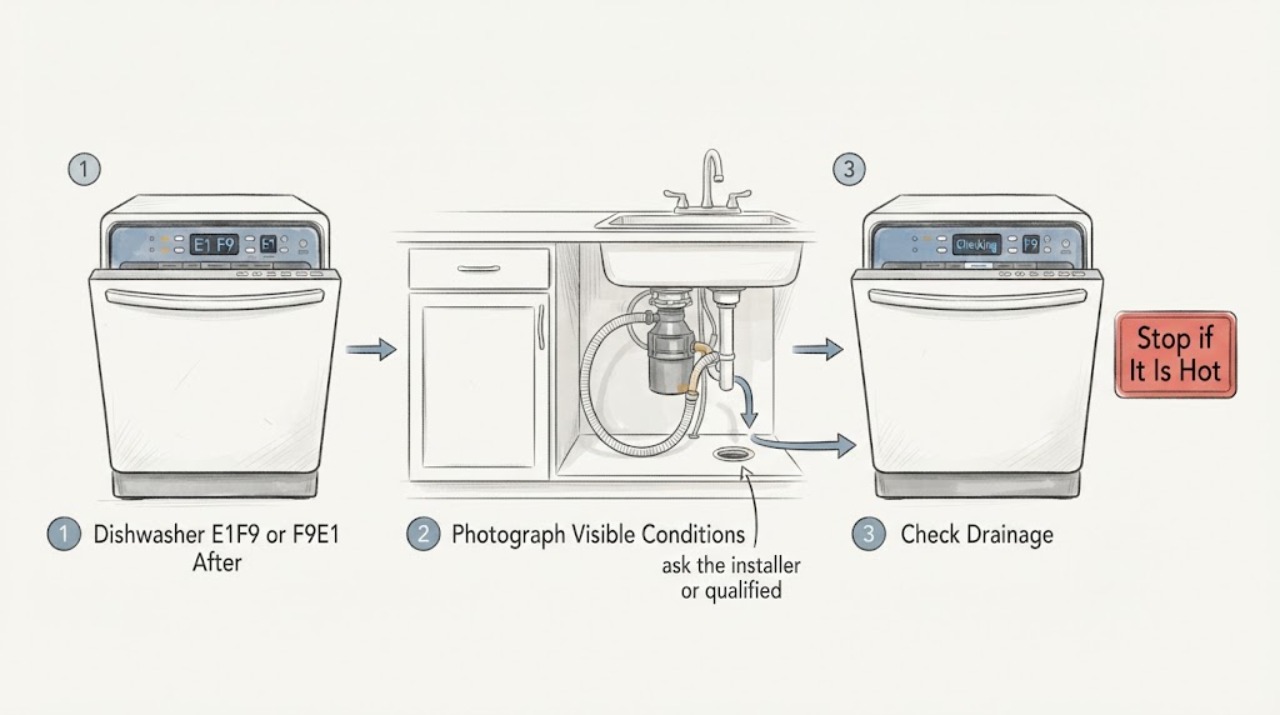
Maytag's opened dishwasher guidance identifies F9E1 as a long-drain or not-draining condition. Maytag's dishwasher code guide says digital models commonly show an F#E# order and flashing-light models use the first flash group as F and the second as E, so a display remembered as E1F9 must be photographed and checked against the exact model manual rather than silently treated as F9E1. Because the problem began after a new garbage disposal was installed, first have the installer or a qualified plumber verify that the dishwasher drain is attached to the disposer inlet or approved drain path, that the new disposer inlet's dishwasher knockout plug was removed, and that the visible hose or air-gap route is not kinked or blocked. The knockout plug is a drain-port plug, not the dishwasher's electrical plug; do not dismantle the disposer or disconnect a wet or pressurized connection just to inspect it. If water is leaking, standing near electrical equipment, or the code returns after one safe, documented power cycle, stop using the dishwasher and arrange service.
Before you begin
Safety first
- Owner-level checks are limited to recording the full code or flash sequence, photographing the model, observing the dry visible hose and air-gap route, and having the installer verify the new disposer drain-port connection. Do not confuse the knockout drain plug with a power plug, dismantle the disposer, disconnect a pressurized or wet hose, tilt the dishwasher, remove the pump, enter service diagnostics, or perform live electrical testing.
Work through in order
Diagnostic checks
Use only checks that match the exact appliance or system and its official guide.
-
Check 1
Photograph the complete display or the full repeating clean-light pattern before pressing Cancel. Record whether the panel actually shows F9E1, E1F9, another code, or only a partial message; count the first and second flash groups if there is no digital display; and note whether water remains in the tub.
Expected result: The panel clearly shows F9E1, shows E1F9 in that order, shows a different code, or the code can only be reconstructed from flashing lights.
Next step: Keep the photo and the exact model number from the rating label for the installer or service provider. Continue with the installation-timeline check only if the issue is a confirmed dishwasher drain symptom and the floor and connections are dry.
Stop if: Stop if water is near electrical equipment, the unit is leaking, the display is accompanied by smoke or a burning odor, or a code cannot be safely observed without opening the appliance.
Why this matters
Why: Maytag's reading guide describes F#E# as the common digital order and the first/second flash groups as F then E, but exact codes vary by model. The display order is an identity check, not permission to translate an unfamiliar code by swapping characters.
-
Check 2
With the dishwasher off and the sink area dry, ask the installer or qualified plumber to verify the new garbage disposal's dishwasher drain inlet is the intended connection and that its knockout drain plug was removed during installation. Do not remove the disposer, strike it, reach inside it, or confuse this drain plug with an electrical plug.
Expected result: The disposer is new and its dishwasher inlet plug was not verified, the drain hose is connected to the wrong port, the connection leaks, or the installer confirms the inlet is open and correctly connected.
Next step: Have the installer correct only the documented drain-port connection if it is wrong. If the plug status or connection cannot be safely verified externally, leave the dishwasher off and arrange qualified installation or appliance service.
Stop if: Do not use a hammer, pliers, cutting tool, or force on the disposer as a dishwasher repair; do not work on a wet, energized, or pressurized connection.
Why this matters
Why: Maytag specifically lists an unremoved disposer knockout plug as a new-installation cause of a dishwasher long-drain code. A confirmed open inlet makes that installation cause less likely but does not prove the dishwasher pump or another internal component is faulty.
-
Check 3
Inspect only the visible dishwasher drain route under the sink for a sharp kink, pinch, crushed section, loose connection, or an air-gap cap that is visibly obstructed. Do not pull the built-in dishwasher out, disconnect the hose, or open the air gap unless the exact installation instructions authorize that owner check.
Expected result: The visible hose is kinked or leaking, the air-gap route is visibly blocked, the household sink/disposer backs up, or the visible route looks clear and dry.
Next step: Correct only a clearly visible routing problem without disconnecting the line, or have the installer/plumber clear the air-gap or household drain. If the route is clear, water remains, or the connection leaks, stop and arrange service.
Stop if: Do not run the disposer to force a blockage through the dishwasher line, detach a hose, use drain chemicals, or continue if water approaches electrical parts.
Why this matters
Why: Maytag lists a kinked, pinched, clogged, or incorrectly installed drain hose and an obstructed air gap as possible long-drain causes. A clear visible route only narrows the external branch; it does not identify a pump, control, or internal hose failure.
-
Check 4
After the drain connection and visible route are verified dry and safe, compare the actual water result with the code: note whether the tub is empty, partly full, or has a normal small amount of residual water in the filter area, and whether a new cycle stopped while draining. Do not add water or repeat cycles to manufacture a fault.
Expected result: Water is standing in the tub, the sink or disposer backs up, the dishwasher drains but the code returns, or the tub is empty and the code is only a remembered display.
Next step: Preserve the code photo and installation observations. If water remains or the route cannot be restored externally, keep the dishwasher off and arrange appliance or plumbing service.
Stop if: Do not tilt the dishwasher, remove the pump or filter housing beyond the exact manual's permitted cleaning, probe for glass, or run a service-mode drain test.
Why this matters
Why: Standing water or household backup supports a drain-path investigation; an empty tub does not by itself prove the code was false, and a recurring code with a clear path requires model-specific service rather than a guessed pump replacement.
-
Check 5
Use Maytag's documented control reset once only after the model and drain area are safe: disconnect power for 30 seconds, restore it, and record whether the same code returns. For a hard-wired unit, have the responsible adult isolate the correct breaker only if the panel and surrounding area are dry and safe.
Expected result: The code clears and the dishwasher completes, the same code returns immediately, it returns after another drain event, or a leak or electrical hazard appears.
Next step: Do not repeat the reset without limit. Give the service provider the model, exact display order, new-disposer installation date, knockout-plug verification, hose/air-gap result, water level, and reset result.
Stop if: Stop immediately for an active leak, wet electrical equipment, smoke, burning odor, a hot plug, repeated breaker trips, or any need to access wiring or the dishwasher base.
Why this matters
Why: Maytag says a 30-second power cycle can reset the control, but a returning F9E1 remains a drain or installation fault path. A reset cannot establish that a disposer plug, pump, valve, or control board is defective.
Use your observations
Decision map
Find the observation that best matches what you see, then follow the next safe action.
-
PATH 01Next step
What you see
The display is confirmed as F9E1, the problem began immediately after a new garbage disposal was installed, and the disposer dishwasher inlet plug was not verified.
Do this next
Have the installer or qualified plumber verify and correct the disposer inlet connection without homeowner dismantling. Keep the dishwasher off until the connection is dry and correct.
Why this path and its safety boundary
Why it matters: This is the highest-value installation branch because Maytag explicitly names an unremoved knockout plug as a new-installation cause of a dishwasher long-drain code. It is a drain-port issue, not an electrical-plug issue.
-
PATH 02Next step
What you see
F9E1 is confirmed, the disposer inlet is open, and the visible hose, air-gap route, sink, and disposer show a kink, obstruction, leak, or backup.
Do this next
Correct only a safe visible hose position; have the installer or plumber address the air gap, disposer, or household drain. Stop using the dishwasher if water remains or leaks.
Why this path and its safety boundary
Why it matters: The remaining evidence still supports an external drain-path or household-plumbing restriction before an internal dishwasher diagnosis. A leak or backup adds water and property risk.
-
PATH 03Next step
What you see
The panel actually shows E1F9, the flash sequence does not clearly read as F9E1, the model is missing, or the same code returns with a clear and dry drain installation.
Do this next
Preserve the full display or flash-pattern recording and obtain the complete model for an exact manual or qualified service diagnosis. Do not keep resetting or run service mode.
Why this path and its safety boundary
Why it matters: The code identity or the external drain branch is unresolved. Maytag's code-reading guidance warns that exact codes vary by model, so swapping the order or choosing a pump from the display would be unsafe.
-
PATH 04Next step
What you see
There is uncontrolled water, standing water near electrical equipment, a wet or hot connection, smoke, burning odor, repeated breaker tripping, or the disposer/dishwasher connection cannot be made safe externally.
Do this next
Stop the dishwasher, close the accessible water supply and isolate power only from a safe dry position, then contact qualified appliance, plumbing, or electrical service. Do not touch wet plugs or wiring.
Why this path and its safety boundary
Why it matters: This is a water, electrical, fire, or installation-safety event in addition to the possible drain code and is outside owner troubleshooting.
Helpful context
Understand the symptom
The useful clue here is the installation timeline. Maytag's F9E1 dishwasher page describes a long-drain condition and names the disposer knockout plug for new installations, along with the filter, drain hose, and air gap. A code written as E1F9 may be a reversed transcription or a model-specific display; Maytag's general reading guide says many dishwasher displays use F#E# order, but exact codes vary by model.
Do not confuse the disposer drain knockout plug with an electrical power plug. Keep the dishwasher off for an active leak, standing water near electricity, a wet or hot connection, smoke, burning odor, repeated breaker trips, or a disposer that cannot be safely isolated. Do not run service diagnostics, tilt the dishwasher, remove the pump, disconnect a pressurized hose, or dismantle the new disposer as a homeowner troubleshooting step.
When checks do not resolve it
Need a professional?
Contact qualified appliance or installation service for a returning F9E1, an unverified disposer inlet plug, a clear external drain route with retained water, an E1F9 display that cannot be matched to the model, or any internal diagnosis. Contact plumbing or electrical service when the installation—not the dishwasher—appears to be the source.
Safety scope: Owner-level checks are limited to recording the full code or flash sequence, photographing the model, observing the dry visible hose and air-gap route, and having the installer verify the new disposer drain-port connection. Do not confuse the knockout drain plug with a power plug, dismantle the disposer, disconnect a pressurized or wet hose, tilt the dishwasher, remove the pump, enter service diagnostics, or perform live electrical testing.
Have this ready
- Provide the complete Maytag model number, a display photograph or flash count, whether the code reads E1F9 or F9E1, the date and scope of the garbage-disposal installation, the disposer inlet and knockout-plug verification, drain-hose and air-gap observations, tub water level, any backup or leak, and the one-time reset result.
Common questions
FAQ
Is Maytag dishwasher code E1F9 the same as F9E1?
Maytag's opened dishwasher support page documents F9E1 as a long-drain code, while its code-reading guide describes the common display order as F#E#. If the panel really shows E1F9, preserve that order and obtain the complete model manual instead of assuming the characters can be swapped.
Why did the code appear after installing a new garbage disposal?
Maytag specifically lists an unremoved dishwasher knockout plug in a new disposer installation as a possible F9E1 long-drain cause. Have the installer verify the drain inlet and hose connection; the knockout is a drain-port plug, not an electrical power plug.
What can I safely check without taking the dishwasher apart?
Record the exact display, photograph the model, and inspect the visible drain hose and air-gap area for a kink, leak, backup, or obvious obstruction while the appliance is off and dry. Have the installer or plumber verify the disposer drain-port plug and connection. Do not disconnect hoses, tilt the unit, or enter service mode.
Can I reset the dishwasher after checking the drain connection?
Maytag documents disconnecting dishwasher power for 30 seconds as a control reset. Use it once after safe external checks; if the code returns, water remains, or any leak or electrical hazard appears, stop using the dishwasher and arrange service rather than repeating the reset.
Read the exact guide
Official sources
- Connecting Dishwasher Drain to Garbage DisposalMaytag Product Help · Opened official Maytag installation-support page. It warns readers to follow the model Owner's Manual and shows that the disposer dishwasher inlet has a knockout plug and a separate drain-hose connection; the article uses this only to identify the installer/plumber verification point, not as a homeowner dismantling procedure.
- Dishwasher Error Codes - ReadingMaytag Product Help · Opened official Maytag code-reading guide. It says digital displays commonly use F#E# order, flashing lights communicate first F group then E group, exact codes vary by model, and F9E1 is the long-drain entry.
- F9E1 - DishwasherMaytag Product Help · Opened official Maytag dishwasher Product Help page. It defines F9E1 as a long-drain condition and specifically lists the filter, drain hose, sink disposer and new-installation knockout plug, air gap, visible obstructions, suds, and a 30-second control reset.
Community feedback
Share a repair observation
Share a plain-text repair observation. Accepted observations are published automatically; this page may take a moment to update.