
On this page
Start here
Quick answer
Maytag's F8E4 guidance describes water detected in the dishwasher drip tray, not a code that proves the door was opened incorrectly. On the MDB4949SKZ0, treat the timing as two separate questions: was the door opened only before the main wash with the detergent cover still closed, and is there any water, foam, or wetness outside the machine? Do not reopen the door or run another cycle to reproduce the code. If water is present, the F8E4 returns, or the unit stops filling and drains, stop using it, close the water supply, isolate power only from a safe dry location, and arrange service.
Before you begin
Safety first
- F8E4 with water, foam, continuous draining, or a damaged electrical area is a stop-use condition. Do not tilt the dishwasher, remove the drip tray or bottom panels, bypass a door or float safety, enter service mode, perform live testing, or replace a part based on the code alone.
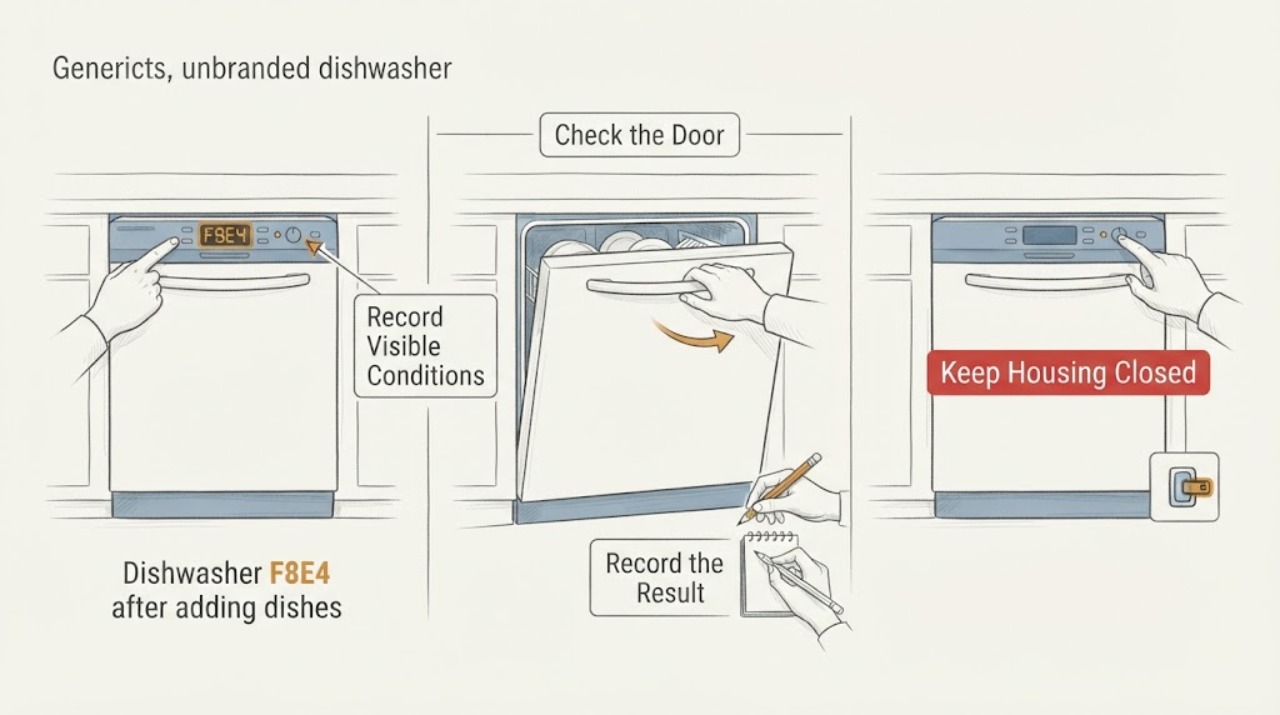
Work through in order
Diagnostic checks
Use only checks that match the exact appliance or system and its official guide.
-
Check 1
Before clearing anything, write down the complete displayed code, the cycle and approximate stage, whether the door was opened to add a dish, whether the detergent dispenser cover was open or closed, and whether the machine was in a hot or drying portion.
Expected result: The display is F8E4; only pause or Start/Resume lights are flashing; the dispenser cover was already open; or the event occurred during a hot portion.
Next step: Preserve the record and do not open the door or start a new cycle merely to reproduce the problem. If the code is F8E4 or water is visible, move to the water-safety check.
Stop if: Stop immediately for water, foam, smoke, burning odor, sparks, a damaged cord, or a repeatedly tripping breaker.
Why this matters
Why: F8E4 is a water-in-drip-tray indication in Maytag's code guidance. Maytag's add-item guidance makes the detergent-cover state and cycle timing relevant to whether opening the door was an allowed interruption, but neither timing nor the code alone identifies a failed part.
-
Check 2
Compare the door-opening event with Maytag's allowed add-item sequence without recreating it: spraying should have stopped before the door was opened, and the detergent cover should still have been closed. Note whether the door was opened during a high-temperature, sanitize, or drying portion.
Expected result: The dispenser cover was closed before the main wash, the door was opened briefly, and the cycle resumed; or the cover was open, the cycle was already hot, or the door was left open long enough to interrupt the cycle.
Next step: Do not add another item or run a test cycle. If F8E4 remains or returns, use the leak branch and arrange service; if only a pause indicator remains and there is no water or hazard, follow the exact owner's guide for this model once.
Stop if: Do not reach inside while spray action may continue, open the door during a hot portion to investigate, or repeatedly press Start/Resume.
Why this matters
Why: The first pattern is consistent with a permitted pause/resume event and does not by itself prove a leak. The second pattern means the interruption was outside the normal add-item window or exposed hot steam; it still does not prove that a component failed or that F8E4 was caused by the door opening.
-
Check 3
With the dishwasher idle, inspect only the accessible floor and the lower edge of the closed door for fresh water, foam, or a wet trail. Do not remove the toe panel, reach for a drip-tray float, pull the built-in unit out, or touch wet electrical parts.
Expected result: Water or foam is present; the floor is dry but F8E4 is still displayed; or the area is dry and the code has cleared.
Next step: For water or foam, stop the dishwasher, close its water supply, isolate power only from a safe dry location, and arrange service. For a dry area with a cleared code, do not run repeated cycles; retain the event record and consult the exact model guide before normal use.
Stop if: Do not tilt the unit, remove the drip tray or bottom panels, dry an inaccessible tray, or restart the dishwasher to see whether it leaks again.
Why this matters
Why: Water or foam supports the leak/overflow path that F8E4 is designed to detect. A dry floor does not rule out water in the drip tray, and a cleared code does not prove that the underlying condition is corrected.
-
Check 4
Record whether the code appeared immediately after the door was closed or only after the dishwasher attempted to fill, wash, or drain, and whether the machine stopped filling or began draining. Do not infer a valve, float, pump, or control failure from that timing.
Expected result: The code appears as soon as the event is interrupted; it appears only after water movement; the machine drains and will not resume; or no code returns after the original event.
Next step: If F8E4 recurs, the machine will not resume, or water is detected, leave it off and provide the timing record to Maytag or a qualified appliance technician. If the event was only a normal pause with no code or water, follow the exact model's resume instruction once.
Stop if: Do not repeatedly reset, bypass a door or float safety, enter service mode, or perform a live electrical test.
Why this matters
Why: A pause/resume problem and a water-detection response can look close in time but require different next steps. Maytag states that its leak system may stop filling and drain the tub, while F8E4 troubleshooting lists water connections and the drip tray; this is a service-routing clue, not a part diagnosis.
-
Check 5
Prepare the service record with MDB4949SKZ0, serial number, the exact F8E4 display or flash sequence, cycle and stage, door-opening timing, detergent-cover state, water/foam observations, and whether the code returned after the door was closed.
Expected result: The code and sequence are reproducible in the record, the model identity is confirmed, or the model/serial and display format are still uncertain.
Next step: Contact Maytag or qualified service for a recurring F8E4, any water condition, or a unit that will not resume. Do not order a part from the code alone.
Stop if: Keep the appliance off if F8E4 recurs or any water/electrical hazard is present.
Why this matters
Why: Maytag's troubleshooting material says exact codes can vary by model, and the model documentation identifies MDB4949SKZ0 as a distinct undercounter model. A complete handoff lets service distinguish a pause event from leak detection without unsafe user testing.
Use your observations
Decision map
Find the observation that best matches what you see, then follow the next safe action.
-
PATH 01Next step
What you see
F8E4 is displayed and water, foam, a wet trail, or a drip-tray alarm is present.
Do this next
Stop operation, close the dishwasher water supply, isolate power only from a safe dry location, protect the floor, and arrange service. Do not tilt the unit or open its bottom panels.
Why this path and its safety boundary
Why it matters: Treat this as a water-detection or leak/overflow condition, not as a normal result of opening the door to add a dish.
-
PATH 02Next step
What you see
The door was opened before the main wash, the detergent cover was closed, no water or foam is visible, and only a pause or Start/Resume indication remains.
Do this next
Use the exact MDB4949SKZ0 owner's guidance to resume once, without opening the door again. If F8E4 appears or the cycle will not resume, stop and arrange service.
Why this path and its safety boundary
Why it matters: This pattern is consistent with the documented add-item interruption and is not, by itself, evidence of a failed part or F8E4 leak detection.
-
PATH 03Next step
What you see
The detergent cover was already open, or the door was opened during a hot, sanitize, or drying portion, and F8E4 appeared afterward.
Do this next
Do not repeat the high-temperature or add-item event. Keep the dishwasher off if F8E4 remains or returns, and give service the code, stage, and water observations.
Why this path and its safety boundary
Why it matters: The interruption was outside Maytag's normal add-item window or exposed hot steam, but the timing still cannot identify the source of water in a drip tray.
-
PATH 04Next step
What you see
The floor is dry but F8E4 returns, the dishwasher stops filling, drains continuously, or will not resume.
Do this next
Leave the appliance off and arrange model-specific service; provide the exact code and sequence rather than repeatedly clearing it.
Why this path and its safety boundary
Why it matters: A dry exterior does not disprove water in the drip tray or another condition detected by the leak system. The public guidance does not justify naming a valve, float, pump, or control as the failed part.
Helpful context
Understand the symptom
Opening the door to add a dish can be a normal pause/resume event, but it does not explain away F8E4. Maytag's add-item guidance says to wait for spraying to stop, add an item only when the detergent cover is still closed, close the door firmly, and resume according to the model controls. Its F8E4 guidance separately treats water in the drip tray as a leak-detection condition. Keep those observations separate rather than naming a valve, float, or control as the cause.
The MDB4949SKZ0 is the stainless Maytag model identified in the manufacturer's undercounter dishwasher parts documentation. The public product information also says its leak-identification system can stop filling, drain the tub, and alert that service is needed, while noting that not every type of leak is detected. A dry-looking floor therefore does not prove that the code is harmless.
Do not tilt the dishwasher, remove the drip tray or bottom panels, enter a service mode, perform a live test, or keep restarting it. If there is standing water, a wet floor, foam, a burning smell, sparking, or a damaged cord, keep people away from the wet area and leave the appliance off while service is arranged.
When checks do not resolve it
Need a professional?
Call Maytag or qualified appliance service for any visible water, recurring F8E4, continuous draining, a dishwasher that will not resume, or uncertainty about whether the area is electrically safe.
Safety scope: F8E4 with water, foam, continuous draining, or a damaged electrical area is a stop-use condition. Do not tilt the dishwasher, remove the drip tray or bottom panels, bypass a door or float safety, enter service mode, perform live testing, or replace a part based on the code alone.
Have this ready
- Provide the exact model MDB4949SKZ0, serial number, F8E4 photo or flash count, cycle and stage, whether the door was opened to add a dish, detergent-cover state, water/foam location, and what happened after the door was closed.
Common questions
FAQ
Did opening the door to add a dish cause F8E4?
The timing alone cannot prove that. Maytag documents a controlled add-item pause before the main wash when the detergent cover is closed, while F8E4 separately indicates water detected in the drip tray. Treat any water or recurring code as a leak/service condition rather than blaming the door opening or ordering a part.
Can I run another cycle to see whether F8E4 returns?
No. Do not deliberately reproduce a water-detection code. If F8E4 remains or returns, or if water or foam is present, keep the appliance off, close the water supply, isolate power only from a safe dry location, and arrange service.
Read the exact guide
Official sources
- 8 Pause 4 Pause - pause, repeat - Error Code - DishwasherMaytag · Opened Maytag Product Help page for the F8E4 dishwasher code; it identifies water in the drip tray, discusses water connections and suds, and gives the stop/service path.
- Owner's ManualMaytag · Opened Maytag owner manual used only for the consumer-level pause/add-item sequence; it states that features vary by model and does not replace the exact MDB4949SKZ0 manual.
- Adding Items to Dishwasher During a Cycle - Product Help | MaytagMaytag · Opened Maytag consumer guidance for adding a dish during a cycle; exact buttons and displays remain model-dependent.
- Repair Parts List - W11460407 - Rev AMaytag (Whirlpool Corporation) · Opened manufacturer repair-parts PDF whose model list explicitly includes MDB4949SKZ0; used for identity locking, not for user repair steps.
- 24” Front Control Dishwasher with Dual Power Filtration and PowerBlast® Cycle - 50 dBA Fingerprint Resistant Stainless Steel MDB4949SKZ | MaytagMaytag · Opened Maytag product page for the MDB4949SKZ family; it confirms the product family and describes the leak-identification behavior, while the exact trailing model suffix is locked by the manufacturer parts list.
Community feedback
Share a repair observation
Share a plain-text repair observation. Accepted observations are published automatically; this page may take a moment to update.